
Sign up to save your podcasts
Or



My guest for episode #150 is Jeffrey M. Lobosky, MD, the author of the book It's Enough to Make You Sick: The Failure of American Health Care and a Prescription for the Cure.
Dr. Lobosky talks about what he thinks is lacking in current healthcare reform efforts driven by Washington D.C. We talk about how he defines the crisis in healthcare – “why are things going bad?” After we diagnose the problem, what are some treatments, cures, or solutions?
For a link to this episode, refer people to www.leanblog.org/150/.
Jeffrey M. Lobosky M.D. was awarded his Bachelor of Science degree in preprofessional studies from the University of Notre Dame and his Doctorate of Medicine from the University of California at Irvine. There, he received the J. Gordon Hatfield Award for Outstanding Student in the field of Surgery. As a surgical intern at UC Irvine Medical Center he was named Resident of the Year. He completed his neurosurgical residency at the University of Iowa where he was the recipient of the Department of Surgery's Outstanding Resident Research Award.
Dr. Lobosky currently serves as Associate Clinical Professor in the Department of Neurological Surgery at the University of California at San Francisco and is Co-Director of the Neurotrauma Intensive Care Unit at N.T. Enloe Memorial Hospital. He has served on the Board of Directors for the Joint Section on Trauma and Critical Care for the American Association of Neurological Surgeons and the Congress of Neurological Surgeons. Dr. Lobosky served as one of organized neurosurgery's six representatives to the American College of Surgeons Committee on Trauma which advises national policy makers on health care issues.
Dr. Lobosky has received national and international acclaim for his work on injury prevention, has been an invited lecturer throughout the U.S. and abroad and is listed in “Who's Who in American Medicine”. He has served as Chairman of the Board of the National Injury Prevention Foundation and has written a variety of research articles published in national journals as well as several book chapters and articles on the health care crisis in America's trauma system. He has received numerous awards for his contributions to the field of trauma and injury prevention and in 2007 was recognized for his distinguished teaching experience by the students and faculty of the University of California at San Francisco School of Medicine.
He and his wife, Diana, reside in Chico, California where he continues an active practice as a founding member of Northstate Neurosurgical Associates.
For earlier episodes, visit the main Podcast page, which includes information on how to subscribe via RSS or via Apple Podcasts.
My guest for episode #149 is Gregory Jacobson, MD, the co-founder and CEO at KaiNexus. We'll be talking about his early work with Kaizen in emergency medicine settings – how did he get introduced to Kaizen principles and how did train others, especially physicians, in getting started with this methodology?
In a future episode, we'll talk more about KaiNexus and use of software, but today's focus is on the application of core Kaizen principles (as discussed in my book Healthcare Kaizen).
For a link to this episode, refer people to www.leanblog.org/149.
Conflict of interest disclosure: I have been on the management team at KaiNexus since 2011 and I am a part owner of the company.
Episode #148 is a conversation with a returning guest, Naida Grunden (previous episode) and her co-author Charles Hagood (of Healthcare Performance Partners), talking about their new book Lean-Led Hospital Design: Creating the Efficient Hospital of the Future. It's an outstanding book and I was happy to endorse it, as did John Toussaint, MD and many others.
In the podcast, we talk about what lean-led hospital design entails, including getting staff involved, how to tie processes and space together, and how to collaborate with architects and construction companies to build space and processes that best serve the patients and healthcare professionals.
For a link to this episode, refer people to www.leanblog.org/148/.
For earlier episodes, visit the main Podcast page, which includes information on how to subscribe via RSS or via Apple Podcasts.
Episode #147 is a part two of a conversation with Scott Patten and Peter Armstrong from LeanPub.com (listen to part one in episode #140). They want to be THE website for publishing “in-progress books”. In this episode, we are talking about how they are applying the concepts of the Lean Startup methodology to their service and their business. We'll talk about some of my own experiences as an early adopter and later as an actual user — what have they learned along the way and how do they use lean methods to be innovative?
Conflict of interest disclosure: I have published two blog compilations via their service, a Best of Lean Blog 2011 book and a Best of 2012 book that is being published incrementally throughout the year. I'm a huge raving fan of their service…
For a link to this episode, refer people to www.leanblog.org/147.
For earlier episodes, visit the main Podcast page, which includes information on how to subscribe via RSS or via Apple Podcasts.
Episode #146 is a discussion with a returning guest (#54, #62, #72), John Toussaint, MD, the CEO of the ThedaCare Center for Healthcare Value. Today, we're talking about his latest book, recently released, called Potent Medicine: The Collaborative Cure for Healthcare.
John talks about the three aspects of his collaborative cure: patient-centered care redesign, transparency, and payment for outcomes. A lot of the discussion follows on my conversation with Dean Gruner, MD in Podcast #144, talking about the experiments with “Accountable Care Organizations” at ThedaCare and other organizations.
John will also be speaking at the upcoming Lean Healthcare Transformation Summit, this June in Minneapolis. We hope to see you there!
Links to organizations mentioned in the podcast:
For a link to this episode, refer people to www.leanblog.org/146.
For earlier episodes, visit the main Podcast page, which includes information on how to subscribe via RSS or via Apple Podcasts.
Episode #145 is a conversation with Natalie J. Sayer, co-author of the recently updated 2nd edition of the book Lean For Dummies.
I was able to meet Natalie at the recent ASQ Lean and Six Sigma Conference, where she was also a presenter.
While I was a bit resistant at first to the “for Dummies” being associated with Lean (given that “dummy” is a sort of disrespectful word), I came around when I read the first edition and found it to be a fun, solid overview of Lean concepts and a great first read for people who are new to Lean. In the podcast, Natalie shares what's new in the second edition and shares some of her history and experience with Lean, including some time learning at the famed NUMMI plant while working for GM.
For a link to this episode, refer people to www.leanblog.org/145.
ADVERTISEMENT: This podcast episode is brought to you by Creative Safety Supply, leaders in Visual Safety, floor marking, label printing and more visit their website at www.creativesafetysupply.com/leanpodcast for a discount.
For earlier episodes, visit the main Podcast page, which includes information on how to subscribe via RSS or via Apple Podcasts.
Episode #144 is a discussion with Dean Gruner, MD, the president & CEO of ThedaCare, talking about Accountable Care Organizations (ACOs) and how ThedaCare is using this approach, along with Lean methods, to improve the coordination of care for patients. Dean was previously a guest in episode 119, talking about the “strategy deployment” methodology.
Dean will be presenting at the upcoming Lean Healthcare Transformation Summit, June 6-7, 2012 in Minneapolis. I hope to see you there! I'll be attending and moderating the CEO panel again this year.
For a link to this episode, refer people to www.leanblog.org/144.
For earlier episodes, visit the main Podcast page, which includes information on how to subscribe via RSS or via Apple Podcasts.
Mark Graban: Hi, this is Mark Graban. Welcome to the podcast, episode 144 for April 16th, 2012. My guest today is Dr. Dean Gruner. He is the CEO of ThedaCare. He was previously a guest on episode 119 talking about “strategy deployment” as part of their management system at ThedaCare.
Today, we're going to be talking about ACOs or Accountable Care Organizations and how that fits in with a Lean perspective at ThedaCare, related to healthcare reform happening here in the United States. Dr. Gruner is going to be presenting at the “Lean Healthcare Transformation Summit,” June 6th and 7th in Minneapolis.
This is an event that's co-sponsored by the Lean Enterprise Institute and the ThedaCare Center for healthcare Improvement. I'll be there. I'll be attending. I'm going to be moderating the CEO panel again this year. I certainly hope to see you there. It's a great event, wonderful speakers from the healthcare value network organizations, just a lot of great attendees, networking, learning and sharing.
You can visit leanblog.org/healthcaresummit and that will forward you to the official conference website to learn more and to register. For other episodes, you can go to leanpodcast.org and for Dr. Gruner's previous episode, go to leanblog.org/119.
Thanks for listening.
[music]
Mark Graban: Dean, it's a pleasure to talk to you again. Thanks for joining us here on the podcast.
Dr. Dean Gruner: Thanks, Mark, for inviting me.
Mark: I think a lot of our listeners, especially those outside of healthcare and maybe even some within healthcare might not know a lot about ACOs or “Accountable Care Organizations.” Would you mind giving us a little bit of an intro about what an ACO is?
Dr. Gruner: I'll try. I think the short version is that, there are multiple definitions out there. Everybody has a little different description of what an ACO is. I think of it as a mechanism for a group of providers, whether it's a group of physicians, physicians at hospitals, hospitals or healthcare systems, to be accountable for both the quality and the cost of the care that they are providing to a group of patients.
An example today that people might be familiar with is Kaiser. Kaiser provides the premium in their case, but they only provide premium for their health insurance, but then they become accountable for providing all the services that that person would need under the Kaiser umbrella. All ACOs aren't just models like Kaiser, which is what we would call a staff model HMO.
There may be groups of physicians in hospitals and other care providers that come together, again, for the purpose of providing the services to patients and assuming some degree of accountability for both the quality of the care that's provided and the cost of the care that's provided.
Mark: Part of the idea, if we look at this from a Lean perspective, when you talk about improving quality and cost which, people familiar or experienced with Lean would realize it's possible to do both.
Where do these improvements come from? Is it a matter of better coordination between hospital care or primary care.? How do people in different organizations collaborate in an ACO? What are the types of benefits that we're expecting to see?
Like podcast #133, this episode is a Q&A that follows up a webinar I did for my good friends at Gemba Academy recently, on the topic “Using Statistical Process Control (SPC) to Make Better Management Decisions.”
You can view a recording of the webinar here or on the Gemba Academy website. You can get the slides here.
This might seem like an esoteric topic, but it's one I've found to be VERY practical and helpful in my career and with my clients. Some feedback I got included, “That wasn't nearly as boring as one might have expected.” :-)
Update: This topic is something I later explored in my 2018 book Measures of Success: React Less, Lead Better, Improve More.
For a link to this episode, refer people to www.leanblog.org/143.
For earlier episodes, visit the main Podcast page, which includes information on how to subscribe via RSS or via Apple Podcasts.
Episode page
Episode #142 brings us a returning guest (#115), Eric Ries, author of the best-selling book The Lean Startup: How Today's Entrepreneurs Use Continuous Innovation to Create Radically Successful Businesses.
In the book, Eric cites the work of Taiichi Ohno, including the “5 Whys” problem-solving approach. In this podcast, Eric shares his story about finding Ohno's work (including the Lean classic Toyota Production System: Beyond Large-Scale Production) and how it has influenced his work with startups.
For a link to this episode, refer people to www.leanblog.org/142.
For earlier episodes, visit the main Podcast page, which includes information on how to subscribe via RSS or via Apple Podcasts.
Eric: It's been incredibly influential. I think I would go so far as to say it has changed my life. It's actually just a coincidence. It's a funny thing how these things work. To set the stage a little bit, I had founded a company called IMVU in 2004.
I was really into a lot of the ideas that are called Agile software development, which have their origins in Lean, but a lot of the works I had read about them, Toyota was not specifically mentioned. Lean principles were not mentioned. I didn't know the theory of Lean or anything like that. I knew nothing about manufacturing.
I've actually, to be totally honest, never set foot in a manufacturing plant in my whole life. I have no idea any of that would be relevant to me. I had this intuition that we should be going a lot faster in a startup and doing practices that even in the Agile world were considered a little bit extreme.
We've had the chance to talk about them on other occasions, things like continuous deployment or putting software in customers' hands much faster than was previously considered possible. I had this problem which was I had no way to explain to anybody why that was going to work. People would look at me like I was completely crazy.
I could see that it was working, so I was very stubborn. I had this intuition. I said, “We're going to do it no matter what.” It was working, but we're always hiring new employees. The company's growing. We're bringing on investors.
We had investors that when they were doing their due diligence for the company, pulled out because they didn't like the answers I was giving them about how we built the technology.
They would bring their experts in, experts trained in more traditional software development methodologies, and they'd be like, “This kid is crazy. Doesn't know what he's talking about. This is not the way it's done.” This is a continuous point of stress for me and my co-founder. [laughs]
You got to remember, at the time, I was by far the youngest person on the team. I was often younger than the employees I was hiring and training them in this method. It's not like it was an easy situation to be in, but I really believed it was right.
I was reading everything I could get my hands on for ideas about, first of all, was I actually right or was it a fluke? If it was right, how could I possibly explain it? I read some cases about Toyota, the business school cases, so I was a little bit familiar with it. There was this thing called Toyota Production System. That's all I knew. I figured I should be educated about it.
From the publisher's feed
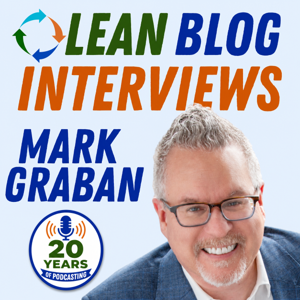
Lean Blog Interviews: Real-World Lean Leadership Conversations features thoughtful, in-depth discussions with leaders, authors, executives, and practitioners who are applying Lean thinking in the real world.
Hosted by Mark Graban—author of Lean Hospitals, Measures of Success, and The Mistakes That Make Us—the podcast explores Lean as a management system, a leadership philosophy, and a people-centered approach to continuous improvement.
Episodes span healthcare, manufacturing, startups, technology, and professional services. Guests share candid stories about what actually works—and what doesn’t—when organizations try to improve.
This is not a podcast about chasing tools, jargon, or “Lean theater.” Instead, you’ll hear honest conversations about leadership behaviors, culture, psychological safety, learning from mistakes, and building systems that help people do their best work.
If you believe improvement starts with respect for people—and that better systems beat blaming individuals—this podcast is for you.
Find show notes and all episodes at LeanCast.org.
Learn more about Mark Graban at MarkGraban.com.

32,056 Listeners
452 Listeners
1,462 Listeners

198 Listeners
15 Listeners

27 Listeners

8,554 Listeners
9,066 Listeners

20 Listeners
376 Listeners
2,432 Listeners

9 Listeners
2,204 Listeners

40 Listeners
19 Listeners
153 Listeners
1,619 Listeners
28 Listeners