
Sign up to save your podcasts
Or



Based on Podcast App listening data
According the Health Secretary Matt Hancock, the “vast majority” of people in Bolton who have been admitted to hospital after contracting the fast-spreading Indian variant of Covid-19 had been offered a vaccine but hadn’t taken it. Attempts to persuade vaccine uptake have focussed on public health, social freedom and economic recovery. What about the language of morality? Is it immoral to refuse the vaccine? We are social beings, and the definition of morality is behaving in a way that is good for others, not just ourselves. How are we to make moral judgments when there are many reasons for vaccine refusal and hesitancy: conspiracy theories, false information, health concerns, religious objections as well as cultural and language barriers. Some people justify their refusal precisely because they believe it to be moral. It could be argued that to be moral isn’t always about doing the right thing, it’s about seeking to do the right thing, and even if you have reached the wrong conclusions, this doesn’t make you bad person. Vaccine refusal often involves a group dimension above and beyond individual choice. A potential consequence of moral condemnation is the scapegoating of entire groups. While it is true that vaccine uptake is greater among white adults, it is also the case for the vast majority of adults across all social groups. Nevertheless, if there is a connection between vaccine hesitancy and certain religious or ethnic groups, how should we respond without risking further stigmatisation? To what extent does this issue raise wider questions about social integration and trust in British institutions? With Dr Rakib Ehsan, Dr Alberto Giubilini, David Halpern and Dr Travis Rieder.
Producer: Dan Tierney.
Easter 2021 comes at the end of an annus horribilis. We are meaning-seeking creatures, and the symbolism is everywhere if you want to find it. There’s the re-birth associated with the Spring equinox, the hope in the Christian account of the resurrection, the freedom marked by the Jewish Passover, and the reflection and restoration embodied in the Muslim observance of Ramadan. While many faith and spiritual groups instinctively see this is a powerful moment in the calendar, for many people, the Easter bank holiday weekend means very little other than gorging on chocolate eggs. What should Easter mean? In Christianity, it’s more important than Christmas, and no story has had a greater influence on Western civilisation. While we are no longer a ‘Christian’ society, should Easter be more of a moment of national unity, which transcends the cultural and faith traditions of Britain? We all instinctively know what is meant by the ‘Christmas spirit’, but should we be re-imagining an Easter equivalent, based on values like sacrifice and forgiveness? Or does the very fact of having designated time off work to spend how we chose provide meaning enough? Some people think we need to come together more than ever as a means of channelling our soul-searching following the existential insecurity of the last year. Others are more sceptical about the insistence that crises like pandemics naturally lead to deep moral or spiritual introspection, and question the value of collective gestures like clapping the NHS. As a nation and as a society should we invest more in the meaning of these moments as a basis for dialogue and togetherness? Or is any national endeavour of this kind bound to be seen as coercive and rendered meaningless? With Julian Baggini, Ronald Hutton, Rev Rachel Mann and David Mills.
Producer: Dan Tierney.
The mathematician John Allen Paulos once said, “uncertainty is the only certainty there is”. One year on from the beginning of the first lockdown, never has this felt more true. In light of this, how certain should we be in our judgments about the decisions that were taken by those in power over the last twelve months? One strongly-held view is that had the government and its advisors been more decisive, acting with greater moral clarity in the early stages of the pandemic, more lives would have been saved. While for others, hindsight is 20:20 and context is everything, and any decisions taken in the midst of extreme uncertainty must be judged accordingly. In the last year we have witnessed anything but moral clarity in our passionate debates about the balance of harms and the clashes of good versus good. Public health has been pitted against livelihoods, family life, culture and the right to protest. What lessons should we take from the pandemic about the moral value of certainty? Uncertainty, particularly if it is prolonged, is psychologically bad for us and something we instinctively want to avoid for the sake of our mental health. In leadership, we admire those who have a clarity of vision, who are not paralysed by indecision and who keep their doubts to themselves. Others, however, believe that the reason society is so polarised is because too many people are certain they are right, and that moral certitude often has the effect of pandering to one group of people while alienating another. Is it a moment to embrace complexity, humility and self-reflection? Or has the last year provided a moral clarity about all sorts of things, notably injustices, that must now push back hard against any lingering doubt? With Raghib Ali, Lord David Blunkett, Jonathan Calvert and Quassim Cassam.
Producer: Dan Tierney.
The abduction and murder of Sarah Everard has provoked widespread anger, fear, solidarity and soul-searching. While some may see elements of a moral panic, how are we to deal with the uncomfortable truth that, despite progress in so many areas of life, the overwhelming majority of domestic abuse, sexual assault and violent pornography is perpetrated by men against women? Is there something intrinsically wicked about men? That’s a very stark question, which invites deeper exploration. For some, the problem starts with the very idea of ‘masculinity’, which they regard as a social construct; a self-perpetuating myth; a set of harmful descriptors about how men should behave. Others believe that ‘masculine’ and ‘feminine’ are not arbitrary categories, that they usefully describe fundamental biological differences, and that to view the male propensity for violence solely as a ‘masculine’ problem wrongly demonises all men. Assuming there are ‘toxic’ aspects of masculinity, how should we deal with them? For some, it starts at birth with the compartmentalising of boys and girls into the clothes they should wear and the toys they should play with. The inherent misogyny behind this social-conditioning, they argue, pressurises many teenage boys into not displaying so-called ‘feminine’ traits. Is it time to re-define masculinity or scrap it altogether? Others warn against the dissolution of gender binaries and believe it is possible to celebrate male strength and competitiveness without encouraging pathological behaviour. While others argue that we need to address the relationship poverty that cuts through society: from the absence of paternal role models in the home to educating public school boys about consent. With Madeleine Kearns, Dr Lucy Nicholas, Tom Ross-Williams and Dr Andrew Smiler.
Producer: Dan Tierney.
The Covid vaccine has given us a ‘roadmap’ out of the lockdown but it also provides us with a whole new set of moral conundrums. The virus will likely be with us forever, so the question becomes: how will we live with it in the medium and long-term? We’ve all accepted conditions on our daily lives, with the view that they would be temporary, but should we have to get used to them? Downing Street says the idea of a "Covid passport" app is still under review. Should we make the ability to travel, socialise in public or even go to school and work conditional on having been vaccinated? Those in favour, say it’s a pragmatic route to normal life in a world of vaccine hesitancy. Others base their argument on the principles of safety and fairness: there is a good reason to treat people with immunity differently if they are not a risk to others. The 200,000+ people who signed a recent online petition urging the government not to introduce vaccine passports are worried about their impact on civil liberties and social cohesion. Sam Grant from the human rights organisation Liberty said they would, "create a two-tier society where some people can access support and freedoms, while others are shut out - with the most marginalised among us hardest hit." For many, conditionality is an issue of trust, fairness and proportionality; it is part of the give and take of the responsibilities and rights of citizens. In welfare, for example, they believe people should demonstrate their commitment to finding work in order to receive benefit payments. For others, conditionality undermines social cohesion, because it comes with an implicit sense of blaming victims. Rather than further stigmatising people by attaching conditions to their daily lives, they believe we need to understand better why they are not pursuing a particular course of action. What, if any, conditions should be applied to living in a post-vaccine world? With Silkie Carlo, Matthew Oakley, Prof Julian Savulescu and Dr Beth Watts.
Producer: Dan Tierney.
The government has announced a series of proposals to “strengthen free speech and academic freedom at universities in England”, with a “free speech champion” investigating potential infringements on campuses. The Education Secretary Gavin Williamson warned of a “chilling effect” where students and staff feel they cannot express themselves freely. Many believe these measures are a welcome legal intervention following claims of increasing numbers of individuals being silenced, no-platformed or sacked. Critics, however, say the threat to free speech on campuses is grossly exaggerated and the government is cynically stirring up a culture war to distract from its own failings in tackling Covid. Moreover, they claim these proposals actively undermine free speech because they are just another way of controlling what is 'acceptable' speech, the impact of which is to discipline those who are defending others from racism, sexism, homophobia and transphobia. Students have a right to physical safety and to expect not to be subjected to hatred, but some worry about a ‘concept creep’ in which the definition of hate speech has widened to include any opinions that go against the prevailing orthodoxy. Academics’ own experiences are mixed: some say they feel no pressure of censorship, others believe their colleagues are in denial about the regression of academic freedom. Universities have long been seen as places of intellectual danger, where people go to be shocked and changed. Is this idea in retreat? Or are universities still the vibrant and stimulating places they always were, with a generation of students who are merely less tolerant of intolerance? With Jonathan Haidt, Zamzam Ibrahim, Prof Eric Kaufmanm and Prof Dr Alison Scott-Baumann.
Producer: Dan Tierney
We’d probably all be able to give the government a score out of ten for its handling of the pandemic – but how many of us have even thought of subjecting ourselves to the same level of scrutiny? From illegal raves, house parties and large family weddings to the everyday decisions not to wear a mask or socially distance, how much should the public take a share of the responsibility for the spread of the virus? The author and commentator Matthew Syed claims that personal responsibility is “in retreat”. Citing a new drug to tackle obesity by hijacking the brain’s appetite-regulating system – while evidently good news – he cautions against the pernicious effects of easy fixes on human character and our sense of self. When a homeless person dies on the streets, many will view that tragedy as a “failure of the system”, and it would be unpopular to suggest the cause lies, even in small part, with the individual. Yet, individual autonomy is today’s sacred creed and it’s argued that with rights come responsibilities. Others believe there is a flaw in that logic because, as the pandemic has shown, we don’t all have the same resources or enjoy the freedom to pursue our lives as we would choose; that we are all products of our social background and no choice is made in a vacuum. What has our response to the pandemic revealed about the value we place in personal responsibility compared to other countries and cultures? Have we made too much or too little of the idea? And what does this tell us about how we should be tackling all kinds of social issues? Does an emphasis on free will, choice and responsibility help us to understand them better, or can it obscure what’s really going on? With Prof Sally Bloomfield, Dr Alexander Brown, Dr Deepti Gurdasani and Prof Sir Michael Marmot.
Producer: Dan Tierney.
“America is back”, said President Joe Biden, ushering in a new era of US foreign policy. There is a lot in his in-tray. Having announced an end to US support for the Saudi-led war in Yemen, he faces a coup in Myanmar, Russia’s election meddling and the “very credible case” of genocide against the Uighurs in China. There has been a sense for some time that liberal democracy is in retreat, politically, morally and perhaps also militarily. The result, according to some, is that we have become toothless in holding aggressive actors and rogue regimes to account. David Miliband, CEO of the International Rescue Committee, has described this as the ‘Age of Impunity’, where “war crimes go unpunished” and “militaries, militias, and mercenaries in conflicts around the world believe they can get away with anything”. Others might argue we have short memories, and the last century is full of tyrants we neglected to confront, atrocities we failed to prevent and conflicts we made worse through our morally-motivated interventions. If the US is resetting the global democratic order, recommitting to alliances and international agreements, what should be its guiding principles? Is there a place for morality in global affairs, or has it always been about realpolitik and enlightened self-interest? As a nation and as a group of nations, is it time to assert strong moral values on the global stage, whatever the consequences, or is it better to be pragmatic and honest about the problems we can and can’t solve? With David Miliband, Dr Joseph Nye, Prof Adrian Pabst and Prof Patrick Porter.
Producer: Dan Tierney.
The ethical calculation families across the UK have to make about seeing loved ones this Christmas could have far-reaching and potentially fatal consequences. The government has laid down the rules, but the moral choices lie between the gaps. Those who urge caution, even a postponement of Christmas, say it’s about taking personal responsibility to make everyone safe, and that it would be wrong to let our guard down now that the vaccine ‘cavalry’ is just over the other side of the hill. The other side of the argument is that, at the end of a terrible year, we deserve something to celebrate with family and friends, even if that means taking greater risks for a limited period of time. Do we have a right to Christmas? At what price? What is certain is that Christmas this year won’t be business as usual. So perhaps it is an opportunity to re-evaluate how and why we celebrate it? Some believe the pressure to conform to Christmas as we know it is psychologically bad for us. They are critical, sometimes for religious reasons, of what they see as months of build-up, driven by consumerism, all for a couple of days of rampant excess and dashed expectations, putting a strain on relationships. Is this a moment to reflect on the things that really matter; empathy for others over individualistic materialism? Others resist the call to simplify Christmas or to go back to its ‘original meaning’. Since time immemorial, Northern European cultures have celebrated a mid-winter festival, and before the Victorians re-invented Christmas, the season has always been somewhat raucous. Many think it should be a time of joyful celebration in the middle of dark nights and dark times; a gesture of companionship and welcome in modern, multi-cultural and multi-faith Britain. With Prof Linda Bauld, Ronald Hutton, Laura Perrins and Dr Steve Taylor.
Producer: Dan Tierney.
It’s hard to remember what normal life feels like, but for the first time since the start of the pandemic, there are reasons to be optimistic about when we might return to it. It looks increasingly likely that by the New Year at least one highly-effective Covid vaccine will be available. Despite this promising news, any new vaccines will be rationed, cost money and carry some degree of risk. This prompts a number of ethical and moral considerations. For some, this as a matter of global justice; they believe it would be immoral and counterproductive to distribute a vaccine on the basis of whichever countries have the biggest pockets. Others think it’s perfectly reasonable for any state to prioritise the health of its own citizens, particularly the vulnerable. There are those who have concerns about the speed of the vaccine trials, and believe that if we’re going to inoculate billions of people, many of whom are asymptomatic or unaffected, we’ve got to make sure we’re not cutting corners and causing harm. While, for others, normal rules shouldn’t apply during a crisis, and the faster you can get the vaccines out, the better. And what about those who refuse a Covid jab? There have been calls for emergency laws to stamp out anti-vaccine misinformation and conspiracy theories online. Last year, NHS chief Simon Stevens warned that large numbers of parents rejecting vaccines for their children was a "growing public health time bomb". Is there a moral case for compulsory vaccination? Or is it an unjustifiable infringement on civil liberties and parental rights? With Prof Helen Bedford, Matthew Lynn, Dr Julian Sheather and Prof Tom Solomon.
Producer: Dan Tierney.
From the publisher's feed
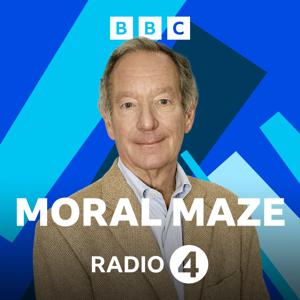
Combative, provocative and engaging live debate examining the moral issues behind one of the week's news stories. #moralmaze
Ranked by our users in the last 21 days

7,626 Listeners
874 Listeners

1,046 Listeners
157 Listeners

5,482 Listeners

1,798 Listeners
1,808 Listeners
1,031 Listeners
2,108 Listeners
1,904 Listeners
28 Listeners
35 Listeners

369 Listeners
161 Listeners
41 Listeners
59 Listeners
107 Listeners
693 Listeners

3,221 Listeners
725 Listeners
1,004 Listeners

3,021 Listeners

1,114 Listeners
773 Listeners
30 Listeners