
Sign up to save your podcasts
Or



Based on Podcast App listening data
Universities are counting the cost of COVID-19. They’ve lost revenue from international students, they’re struggling for investment and some of them are finding it hard to meet their pension commitments. As many as 13 of them may no longer be financially viable, according to the Institute for Fiscal Studies. The question of whether or not cash-strapped universities should be bailed out is moral as well as financial. It summons conflicting arguments about the social value of these institutions and the role they have in wider education. In the 1970s and 1980s between 8% and 19% of school-leavers went on to higher education; today it’s 50%. Should we be proud that at least half our young adults are engaged in self-directed learning? Some say yes, it’s a moral achievement and well worth holding on to. Others observe that whereas we may now have more graduates than ever, never before have their qualifications been worth so little. How we view universities has implications for schools, where hitting grade targets is the de facto measure of success. The pandemic has exposed the weakness of this approach, according to its critics, because it relies too heavily on testing as an end in itself. While some decry the lockdown as a disaster for a ‘lost generation’ of young people, others see it as a once-in-a generation opportunity to re-think not just how we’re educating our children but what education should be aiming to achieve. With Nick Hillman, Sir Anthony Seldon, Niamh Sweeney and Tim Worstall.
Producer: Dan Tierney.
Years of soft-touch regulation and the universal adoption of smartphones have created a “perfect storm of addictive 24/7 gambling”, making “the lives of two million people miserable” – according to a House of Lords Select Committee report looking into the betting industry. Its 66 recommendations include a ban on “loot boxes” in video games, which can often be bought for real money and offer a randomised reward; many see this as a dangerous gateway to gambling for children. It wants to ease the industry out of sports sponsorship; half the Premier League football clubs are currently supported by betting companies. It wants new taxes on gambling with the money used to fund addiction clinics. What, if any, is the moral equivalence between problem gambling and other forms of addiction to recreational activities like drinking and smoking? If it’s a public health issue rather than a matter of individual free choice, how heavily should gambling be restricted? Perhaps, because gambling addiction can often have a wider social impact, hurting families and friends as well as the addicts themselves, it should be compared to drug abuse. If that’s reasonable, why not just treat gambling like any class A drug and make it illegal? Gambling enthusiasts and libertarians see it as a leisure activity which offers harmless fun to the vast majority of punters. They believe there is nothing intrinsically immoral about the industry, although most admit that betting companies do have a duty of care to vulnerable clients. Are problem gamblers the hapless victims of a heartless racket or does that rob them of moral agency and free them of personal responsibility? Is problem gambling a disease, a moral failing or just the downside of freedom? With Dr Henrietta Bowden-Jones, Brigid Simmonds, Christopher Snowdon and Matt Zarb-Cousin.
Producer: Dan Tierney.
Major changes in the Civil Service are needed to tackle metropolitan ‘groupthink’ in government, according to Michael Gove. Sceptics are worried about the impact of all this on the political neutrality of our administrators. Beyond the walls of Whitehall, there are those in Britain who believe that ‘groupthink’ has become pestilential. The word was coined in the 1970s by social psychologist Irving Janis. It has come to refer to people who are passionate about a particular view of the world and who treat those who don’t share their values with contempt, or even hostility. Today, commentators talk also of ‘cancel culture’ – public denunciations of high-profile individuals whose beliefs are deemed to be incompatible with the prevailing moral orthodoxy. When ‘unacceptable’ private thoughts are made public, reputations can be trashed and jobs are sometimes lost. Those accused of this kind of ‘groupthink’ reject that criticism and believe that all public figures should be held accountable for their views. Once made public, they argue, those views can have a direct and adverse impact on people’s lives, so they become everybody’s business. Should a person’s legitimacy in public life be judged as much on what they think as how they behave? Is it possible to separate thoughts from deeds or are they intimately connected? Has social media robbed us of the ability to tolerate diversity of opinion, or is this talk of ‘the thought police’ hysterical? Is ‘groupthink’, as we have come to understand it, irrational, divisive and dangerous? Or does it merely describe an age-old phenomenon: a group of like-minded people uniting to campaign for a better world? With Dalia Gebrial, Paul Taylor, Rt Rev Dr David Walker and Toby Young.
Producer: Dan Tierney.
While the rest of the world is poleaxed by the pandemic, China is becoming increasingly assertive – if not downright aggressive. In the past few days it has annexed 60 square kilometres of the Himalayas, leaving 20 Indian soldiers dead. Meanwhile, Beijing is rushing through stringent security laws in Hong Kong, threatening Taiwan, sabre-rattling in the South China Sea and incarcerating 1.5 million Uyghur Muslims in concentration camps. China’s recent behaviour challenges the values that underpin liberal democracy, so what should the international community do about it? The problem is moral as well as geopolitical.
Some say the UK has been sleepwalking into economic dependency on China, with talk of a “golden era” of UK-Chinese relations. The time has come, they suggest, to disengage and denounce. For others, the priority must be our economic self-interest. They believe that imposing tough sanctions on Beijing or spurning Chinese investment in the UK (including Huawei’s role in our 5G networks) would inevitably hurt Britain in a post-Corona, post-Brexit world. Despite different traditions of governance, is it possible for China and the West to co-exist without trying to damage one another? History tells us that when powerful states become more oppressive at home and more aggressive abroad, military confrontation is never far away; under what circumstances might such action be needed? Or should we be concentrating instead on winning hearts and minds, worrying first about how our own nation could set a better moral example in the world? Within the long history of the rise and fall of global superpowers, how are we to deal with 21st Century China? With Dr Philip Cunliffe, Tom Fowdy and Isabel Hilton.
Producer: Dan Tierney.
The anti-racist protests of the last two weeks, and the far right backlash against them, have revealed something significant about British society. Over and above the rights and wrongs of toppling statues, scribbling out street signs and cancelling old comedies, is surely the deeper question of how we should understand what is happening? Racism exists and there is palpable anger at the injustices black and minority ethic people are experiencing. Yet, at the same time, there are concerns about how the serious fight for racial justice can become an over-simplified battle of competing and increasingly polarised identities, based solely on skin colour. How racist is modern Britain? How can we truly get to grips with the complexity of this question? Once we have a greater understanding of how we got here, what should we do to address the racial inequalities we see in health, education, housing, employment and the criminal justice system? Are some individuals and organisations more concerned with demonstrating their own virtue than doing the hard work required to bring about lasting change? What does the ‘hard work’ look like and who should be doing it? Does the cause of racial justice justify rage and a ‘zero sum’ approach? Or can meaningful social change be negotiated in a spirit of understanding and honesty on all sides? With Dr Dominic Abrams, Dr Jason Arday, Jude Blay Yawson and Inaya Folarin Iman.
Producer: Dan Tierney.
Some of the UK’s national parks saw visitor numbers soar to bank holiday levels over the weekend. The message about social distancing and self-isolation is taking time to sink in. "Life should not feel normal," said the Scottish First Minister, Nicola Sturgeon. If it does, she added, “You should ask if you are doing the right things." The public’s response to these unprecedented times has exemplified the best and the worst of humanity. What, then, does the coronavirus crisis tell us about the fundamental nature of our species? Your answer to that question will depend on whether you agree with the 17th century philosopher Thomas Hobbes that people are naturally disposed to ‘rapine and revenge’; or with the 18th century thinker Jean-Jacques Rousseau that humans are essentially good. The tussle between self-interest and altruism has been part of the human condition since we were decorating caves. Now an ever-tightening lockdown will make life-changing demands on all of us. We are social animals who evolved and adapted to survive in groups, so how well are we equipped to cope with extended periods of self-isolation? Some predict an epidemic of depression and suicides. Others argue that we are far more adept at developing our own inner life than were our ancestors in the ancient world, who saw exile as a fate worse than death. Are we right to be worried about the moral and psychological effects of a prolonged lack of human contact? Or are we more resilient than we think? With Hilda Burke, Andrew Colman, Julia Hartley-Brewer and Mark Vernon.
Producer: Dan Tierney.
The coronavirus pandemic has given the world a smack in the face. Sporting events have been cancelled, national borders have closed, jobs and livelihoods hang in the balance, the over-seventies will soon be asked to self-isolate and families are having difficult conversations about whether grandparents can be allowed to see their grandchildren. It’s life, but not as we know it. A cynical politician once said that you should never let a serious crisis go to waste, and pundits are already suggesting that we now have an opportunity to re-think society. After all, in Chinese, the word for crisis is often interpreted as signifying both "danger" and "opportunity". Is it time to make changes that would not have been feasible without an existential threat hanging over us? Could we, for example, strengthen global partnerships, accelerate the shift to sustainable energy, think about a universal basic income or forge a new sense of community? Such ‘politicisation’ of the problem is appalling to those who just want to get through this ordeal and return to normal; they say it’s much too soon to conclude that free market liberal democracy has failed the stress-test. They are sure that, if we do the right things to protect the most vulnerable, it will soon be business as usual. Yet history shows that a major crisis can be a catalyst for crucial changes. Talk of re-purposing hotels as make-shift hospitals and manufacturing plants to make ventilators, invites comparisons with the Second World War, which gave us the welfare state as we know it today. We won’t get through the corona crisis without ceding a lot of our individual autonomy to the state, but is that an opportunity for greater collectivism in the future - or a danger to liberty? With Rachel Cunliffe, Laura Perrins, Rabbi Lord Sacks and Dr Jamie Whyte.
Producer: Dan Tierney.
The anti-racism campaigner Trevor Phillips has been suspended from the Labour Party over allegations of Islamophobia. Some have described the move as “Orwellian”; others believe he has a case to answer. The issue turns on what we mean by ‘Islamophobia’ – although even to pose that question is to invite denunciation in some quarters; why split hairs when it’s obvious that anti-Muslim bigotry is rife? The Conservative party has been under attack for the allegedly Islamophobic utterances of some within its ranks, but it is waiting to agree on a definition of ‘Islamophobia’ before committing to an inquiry. It is 20 years since the term entered the political lexicon and almost a decade since Baroness Warsi declared that Islamophobia had passed the ‘dinner table test’ and become acceptable in polite society; yet, we still haven’t quite decided what it is and what it isn’t. Some people – including many Muslims – have a problem with the word itself because they think it reinforces the idea that Islam is something to be afraid of. Islam is a religion, not a race, but the definition used by the Labour Party calls Islamophobia ‘a type of racism’, because of the comparable experiences described by Muslims at the sharp end of group discrimination. Meanwhile, free speech advocates are concerned that any formal definition risks blurring the line between the unacceptable hatred of people (Muslims) and the legitimate criticism of ideas (Islam). Once we have our definition, whom should we appoint to decide whether particular words or deeds are Islamophobic? And if there’s a spectrum that runs from insensitivity and disrespect at one end to the most hideous kinds of hate crime at the other, where along that line should the law intervene? With Mohammed Amin, Myriam Francois, Ibrahim Mogra & Fiyaz Mughal.
Producer: Dan Tierney.
Late last year in the Chinese city of Wuhan, a tiny organism migrated from an animal to a human. Three months later, COVID-19 has gone global. So far, nearly 90,000 people are known to have caught coronavirus and more than 3,000 of them – mostly already ill or elderly – have died. Here in the UK, the government has acknowledged that its ‘containment’ strategy is likely to fail and is planning for delaying the spread of the virus and mitigating its effects. But nobody knows how the virus will behave in Britain, and planning for the unpredictable is far from straightforward. If we know we can’t win this fight, but we don’t want to lose it too badly, what are we prepared to sacrifice on the battlefield? How authoritarian do we want the government to be? Must we be ready to accept martial law, the isolation of towns and cities, closed schools, factories and offices, bans on public transport, concerts and sporting events? While some would see such measures as sensible, others warn against authorities who would stamp on our civil liberties out of a nervous need to be seen to be doing something. And what about those in the ‘gig’ economy who can’t afford not to work? The moral dimension goes beyond the arguments about precaution, panic, freedom and frailty. The coronavirus dilemma could be seen as a real-life example of that age-old ethical thought experiment, the ‘Trolley Problem’. Should we do everything we can to protect the most vulnerable in our society, even if the knock on effect to the global economy has the potential to cause suffering and death for many more people further down the line? With Dr. Tony Booth, Dr. Norman Lewis, Julian Sheather & Professor Dominic Wilkinson.
Producer: Dan Tierney
The boss of Ryanair has been criticised for saying that airport security checks should focus on Muslim men who are travelling alone, because they pose the biggest terror threat. The Muslim Council of Britain said Michael O'Leary's comments were "racist and discriminatory". Profiling is the practice of categorising people and predicting their behaviour on the basis of particular characteristics. We're profiled all the time by businesses and insurance companies with the help of computer algorithms. That same technology has been piloted by police and will now be used to identify low-level offenders who are deemed likely to go on to commit "high-harm" crimes, perhaps involving knives and guns. Is it right to target specific groups on the theory that they are statistically more likely to commit certain crimes? Civil liberty watchdogs argue that such ‘pre-crime’ profiling not only violates everyone’s civil rights, but fosters alienation and hostility in marginalised communities. Supporters of ‘data analytics’ believe that, on the contrary, it can eliminate all bias and human error from these judgments. There’s a wider debate about the balance between public safety and trust. Should we worry that these preventative measures are eroding our goodwill towards authority and each other? There are proposals to introduce airport-style security checks in ever more areas of our lives, from concert halls to places of worship. Security campaigners say it’s a necessary step towards making us all that little bit safer. Libertarians call it an over-reaction to a statistically-negligible threat. It is, they say, allowing the criminals to dictate how we live our lives. With Nick Aldworth, Tom Chivers, Dr Adam Elliott-Cooper and Tom McNeil.
Producer: Dan Tierney.
From the publisher's feed
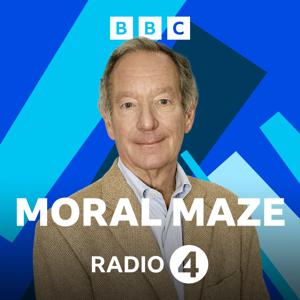
Combative, provocative and engaging live debate examining the moral issues behind one of the week's news stories. #moralmaze
Ranked by our users in the last 21 days

7,626 Listeners
874 Listeners

1,046 Listeners
157 Listeners

5,482 Listeners

1,798 Listeners
1,808 Listeners
1,031 Listeners
2,108 Listeners

1,904 Listeners
28 Listeners
35 Listeners

369 Listeners
161 Listeners
41 Listeners
59 Listeners
107 Listeners
693 Listeners

3,221 Listeners
725 Listeners
1,004 Listeners
3,021 Listeners

1,114 Listeners
773 Listeners
30 Listeners