
Sign up to save your podcasts
Or

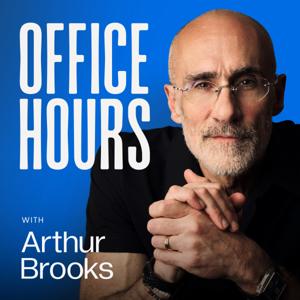

Does Christmas never live up to the version you remember from childhood? Or does it bring up painful memories that keep you stuck in the past? Or maybe you’re like I once was, feeling more like a curmudgeon than a bundle of holiday cheer.
In this episode of Office Hours, I explain why the holidays so often surface disappointment, sadness, and annoyance, and what research on memory reveals about why this happens. I share ways to reframe difficult memories, and my Christmas protocol, designed to help quiet the noise, focus on what truly matters, and move through the season with more gratitude and peace.
—
Where to find Arthur Brooks:
• Website: https://arthurbrooks.com/
• Newsletter: https://www.arthurbrooks.com/newsletter
• X: https://x.com/arthurbrooks
• Instagram: https://www.instagram.com/arthurcbrooks/
• Facebook: https://www.facebook.com/ArthurBrooks/
• YouTube: https://www.youtube.com/channel/UCGuyFRjJQFGCKzfHTBvWM6A
• LinkedIn: https://www.linkedin.com/in/arthur-c-brooks/
• Email: [email protected]
—
Timestamps:
(00:00) Intro
(03:13) Three common holiday mood problems
(04:10) Problem #1: Disappointment
(13:12) Problem #2: Sadness
(18:20) Problem #3: Annoyance
(21:36) Christmas protocol step #1: Start before dawn
(25:00) Christmas protocol step #2: Go for a walk
(26:00) Christmas protocol step #3: Write a gratitude letter
(26:39) Christmas protocol step #4: Give back
(28:32) Q&A: How a sleep schedule affects happiness
(30:21) Q&A: Dealing with burnout as a spiral career type
(31:55) Q&A: How to make close friends later in life
—
Referenced:
• The Happiness Scale: https://learn.arthurbrooks.com/the-happiness-scale
• How to Build a Life: https://www.theatlantic.com/projects/how-build-life/
• Remembering the past to imagine the future: the prospective brain: https://pubmed.ncbi.nlm.nih.gov/17700624/
• Is Nostalgia a Past or Future-Oriented Experience? Affective, Behavioral, Social Cognitive, and Neuroscientific Evidence: https://pmc.ncbi.nlm.nih.gov/articles/PMC7326063
• Perspectives on episodic-like and episodic memory: https://pubmed.ncbi.nlm.nih.gov/23616754
• Episodic memory: from mind to brain: https://pubmed.ncbi.nlm.nih.gov/11752477
• Not all emotions are created equal: The negativity bias in social-emotional development: https://pmc.ncbi.nlm.nih.gov/articles/PMC3652533
• Attributions, deception, and event-related potentials: an investigation of the self-serving bias: https://pubmed.ncbi.nlm.nih.gov/18282197
• ...References continued at: https://www.arthurbrooks.com/office-hours
—
Production and marketing by https://penname.co/.
 View all episodes
 By Arthur Brooks

4.9
286286 ratings
Does Christmas never live up to the version you remember from childhood? Or does it bring up painful memories that keep you stuck in the past? Or maybe you’re like I once was, feeling more like a curmudgeon than a bundle of holiday cheer.
In this episode of Office Hours, I explain why the holidays so often surface disappointment, sadness, and annoyance, and what research on memory reveals about why this happens. I share ways to reframe difficult memories, and my Christmas protocol, designed to help quiet the noise, focus on what truly matters, and move through the season with more gratitude and peace.
—
Where to find Arthur Brooks:
• Website: https://arthurbrooks.com/
• Newsletter: https://www.arthurbrooks.com/newsletter
• X: https://x.com/arthurbrooks
• Instagram: https://www.instagram.com/arthurcbrooks/
• Facebook: https://www.facebook.com/ArthurBrooks/
• YouTube: https://www.youtube.com/channel/UCGuyFRjJQFGCKzfHTBvWM6A
• LinkedIn: https://www.linkedin.com/in/arthur-c-brooks/
• Email: [email protected]
—
Timestamps:
(00:00) Intro
(03:13) Three common holiday mood problems
(04:10) Problem #1: Disappointment
(13:12) Problem #2: Sadness
(18:20) Problem #3: Annoyance
(21:36) Christmas protocol step #1: Start before dawn
(25:00) Christmas protocol step #2: Go for a walk
(26:00) Christmas protocol step #3: Write a gratitude letter
(26:39) Christmas protocol step #4: Give back
(28:32) Q&A: How a sleep schedule affects happiness
(30:21) Q&A: Dealing with burnout as a spiral career type
(31:55) Q&A: How to make close friends later in life
—
Referenced:
• The Happiness Scale: https://learn.arthurbrooks.com/the-happiness-scale
• How to Build a Life: https://www.theatlantic.com/projects/how-build-life/
• Remembering the past to imagine the future: the prospective brain: https://pubmed.ncbi.nlm.nih.gov/17700624/
• Is Nostalgia a Past or Future-Oriented Experience? Affective, Behavioral, Social Cognitive, and Neuroscientific Evidence: https://pmc.ncbi.nlm.nih.gov/articles/PMC7326063
• Perspectives on episodic-like and episodic memory: https://pubmed.ncbi.nlm.nih.gov/23616754
• Episodic memory: from mind to brain: https://pubmed.ncbi.nlm.nih.gov/11752477
• Not all emotions are created equal: The negativity bias in social-emotional development: https://pmc.ncbi.nlm.nih.gov/articles/PMC3652533
• Attributions, deception, and event-related potentials: an investigation of the self-serving bias: https://pubmed.ncbi.nlm.nih.gov/18282197
• ...References continued at: https://www.arthurbrooks.com/office-hours
—
Production and marketing by https://penname.co/.

16,174 Listeners

3,375 Listeners

11,904 Listeners

21,138 Listeners
12,730 Listeners
31,694 Listeners

9,194 Listeners
8,043 Listeners

4,942 Listeners
2,230 Listeners

29,272 Listeners

20,222 Listeners

1,246 Listeners

147 Listeners

2,038 Listeners