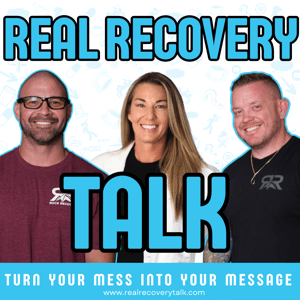
Real Recovery Talk

Real Recovery Talk

By Tom Conrad, Ben Bueno, Dr. Pamela TambiniHealth & FitnessMental HealthEducationSelf-Improvement
Download on the App Store

Real Recovery Talk episodes

  • 61 - Josh McBride - His Legitimate Need for Pain Management Led to His Addiction

    Josh McBride now works at Coastal Detox after his own experience with recovery. Josh's journey is different from many people's. He was diagnosed with Crohn's Disease at an early age, and eventually his pain management led him to addiction and moving to street drugs. Passing out in his car, led him to a 75-day stay in jail without any drugs or medication.

    Josh shares his journey with Tom and Ben. He talks about how he didn't have a lot of resources and had to turn to county and free resources. He also talks about the mind shift he had that convinced him to finally take recovery seriously. His story is unique and his perspective is inspirational. This is a wonderful conversation about how to think about recovery and how to find a way to accomplish it.

    Show Notes

    • [02:49] Josh is originally from Orlando.
    • [03:00] At a young age, Josh was diagnosed with crohn's disease. He began using pain meds to control the symptoms of his disease.
    • [03:44] Eventually, he became chemically dependent and struggled with addiction for at least 10 years.
    • [04:45] In his early twenties, he accepted that he wasn't going to live long and just wanted to stay comfortable with this medication.
    • [05:01] Unfortunately, the pain pills led to heroin and in 2011, a police officer found him hunched over in his car.
    • [06:17] He went to pill mills and got pills.
    • [08:53] He ended up selling his prescription drugs and buying street drugs. He overdosed, convinced the doctor in the hospital to give him oxy, and when he was released he shot up in his car.
    • [11:42] People who overdose are medically discharged within an hour. There are gaps. People need to get into treatment after overdosing.
    • [14:08] Josh's experience getting clean is different from the average person's.
    • [14:55] In 2011, when Josh was arrested, he was put in a county jail that had a lot of different rules. He began a cold turkey detox. He was there 75 days. His mom asked the jail to keep him for two more days until a Monday, so he could go straight into a Faith Farm work program.
    • [19:21] He was released on the Saturday, and he walked five miles to a county detox program. They kept him safe for two days, and then his mom took him to Faith Farm.
    • [21:17] He was at Faith Farm for almost two years.
    • [24:18] He had to put in a lot of work with his Christian based recovery. He took feedback even when he didn't believe in it.
    • [27:35] Josh works at Coastal Detox, and it's a great facility.
    • [28:02] People need to be under supervision when they are coming off of drugs. There is also a psychological factor. Coastal offers an interdisciplinary approach, plus all of the client's needs are taken care of.
    • [30:03] Couples need to be split up to be treated in a healthy way.
    • [30:23] There are resources out there for people who don't have good insurance coverage.
    • [33:58] There are many ways for people to get clean. There are different paths. Pay attention to what is available to you. You just need a little motivation and be willing to ask for help when you feel discouraged.

    Links and Resources:

    • Faith Farm
    • Coastal Detox
    39 min
  • 60 - Ira Levy from Sunrise Detox

    Ira Levy is the National Marketing Director of Sunrise Detox. Ira has 28 years in the sobriety industry and has been sober since 1980. Ira got into the industry by accident, but continued to learn, educate himself, and move up. He has worked in every aspect of the industry and is as passionate about helping clients as he is about educating their families.

    Tom, Ben, and Ira talk about the detox process and what patient and family members can expect. Ira shares some of his own personal experience about how important it is to decide not to use and then find other ways to cope with life events. We talk about the importance of family members learning about addiction, how to find a good treatment facility, and the importance of individualized treatment.

    Show Notes

    • [03:02] Ira stumbled into the recovery business by accident. 28 years ago he moved to Florida as a health tech and worked his way up.
    • [03:57] The owners of Sunrise Detox needed a marketer who understood the treatment industry. Ira has been with them for 15 years.
    • [04:54] Sunrise started with one facility and perfected their program, and now they have 8 facilities.
    • [05:04] Ira has really worked in every aspect of the industry.
    • [06:52] Ira has been sober since 1980.
    • [08:31] Ira went through
    • [09:18] Ira finally gave sobriety a real try. Mistakes happen in sobriety and life, but you really just need to try.
    • [10:18] A turning point for Ira was when his father passed away, and he wanted to get high. A friend of his said if that will bring your father back let's do it. This was a turning point in his life and he didn't get high.
    • [11:03] Ira tries to get patients at Sunrise to understand some of the right ways to success.
    • [11:55] When something bad happens, and you want to use, stop and think about where you will be in 72 hours.
    • [14:48] Ira is available 7 days a week to speak to families and explain what's going to happen. Sometimes people just want to know what happens in detox.
    • [15:15] Ira tries to educate the patient and let them know what detox going to be like and that it's going to be a positive experience.
    • [15:42] He wants to educate people, and he will help them find the proper place even if Sunrise isn't for them.
    • [17:27] Sunrise won't take people in if it's not a good fit.
    • [18:17] Ira recommends to trust your gut and your gut feeling. You want to feel warm, welcome, and nurtured.
    • [20:26] Education is so important in these centers. The client or patient needs to be detoxed, and the family needs to be educated.
    • [23:52] Sunrise does accept people on methadone. The detox process is longer. It can be done and Sunrise has success. It's usually a 14 to 21 day detox.
    • [26:45] They also mix clinical in with medical.
    • [28:49] MAT or medication-assisted treatment doesn't have a great success rate. It needs to be done right. Treatment needs to be individualized.
    • [32:05] It's a struggle to get insurance companies to cooperate.
    • [35:42] Ketamine is now having a resurgence.
    • [37:58] Contact people who have a passion for recovery and don't make a rash decision. Explore options.
    • [40:14] Research addiction to help your loved one. Go to Al-Anon and learn about the process.
    • [43:59] The average time to get medically stable and detox is 6 or 7 days and then the client can move to a sobriety program.
    • [45:51] After detox, some kind of therapy can be helpful. People need to commit to an aftercare program that fits their life.
    • [48:08] From a medical standpoint, alcohol and benzos are the most medically dangerous to stop cold turkey.

    Links and Resources:

    • Sunrise Detox
    • Al-Anon
    56 min
  • 59 - Alex Uslar - Hybrid Performance Method - From Druggie Punk Rocker to Strength Icon

    Alex Uslar is the manager of the Hybrid Gym and the Director of Operations for the online company Hybrid Performance Method. Alex is a powerlifting, weight lifting, and crossfit coach. The Hybrid Performance Method is a virtual gym that provides accessible, affordable, and effective online workout programs to athletes of all skill and experience levels.

    In this episode, we talk about Alex's journey and how he used nutrition and working out to stay sober. Like many addicts, Alex had a rough start and turned to alcohol and drugs. Unlike many, he discovered what he wanted to do at a young age. He was then able to harness that desire and use it as fuel for sobriety. We talk about his journey and how he was able to turn his experience into a positive.

    Show Notes

    • [02:47] Alex is 26 years old, and he just had his 7 years sobriety date.
    • [02:59] He was born in South Florida and moved to Pensacola when he was 4 years old.
    • [03:15] When he was 13, he moved to Miami.
    • [03:44] He had some emotional and psychological abuse when he was younger.
    • [04:13] He was expelled from private school, and he started public school in the middle of the year.
    • [04:47] It only took two or three days before kids tried to sell him drugs.
    • [05:06] He started smoking marijuana.
    • [05:31] There are people who drink super heavily in the punk rock scene. They're also the straight edge kids.
    • [05:49] Things escalated after 8th grade for him.
    • [06:51] His parents are from Venezuela.
    • [07:18] His family left Venezuela when things got really bad, but his dad stayed over there.
    • [08:01] Ben and Tom see a lot of clients who have had instability in their lives when they were young.
    • [09:12] From 13 to 19, Alex's entire life revolved around music and partying.
    • [10:51] Alex wouldn't change or trade anything that he went through, because without that he wouldn't be where he is now.
    • [12:49] He dropped out of school and in the process, he got arrested. The counseling he had to go through helped him a lot.
    • [17:09] He still went down a super destructive path. When he was 19, he wanted to get his act together.
    • [20:29] The catalyst for him was getting a DM from an older punk rocker who owned a gym. They had similar stories and signing up for the gym was his first day sober.
    • [21:23] He even realized that he wanted to work at a gym.
    • [21:53] Staying sober and staying mentally strong and going to the gym was one of the hardest things he did. He had to relearn how to live.
    • [25:34] He was given an opportunity to do an unpaid internship at the gym. The owner was his mentor in sobriety and coaching. He eventually became one of the head coaches.
    • [32:06] Follow your passion if you work hard, you have the opportunity to rewrite the script.
    • [32:46] Taking steps forward can be uncomfortable.
    • [33:56] Alex became an extrovert as he learned how to sell gym memberships. There weren't any promises that he would get hired. He still worked hard and kept getting more and more work.
    • [35:44] He ended up with the most personal training clients and made more money than anybody at the gym.
    • [36:32] He showed so much ambition and desire that he kept growing and growing until h maximized his abilities and income.
    • [38:52] Alex left his mentor's gym in 2017 to go work for Hybrid.
    • [40:18] They talked three or four days ago.
    • [45:18] People come and go in life sometimes.
    • [47:16] Utilizing fitness and nutrition in sobriety. Alex feels people need something to rely on.
    • [49:39] He believes that you control your thoughts and your actions.
    • [52:06] At the end of the day, we are all trying to get to a better place.
    • [53:58] If you don't want to look for a higher power, find a higher purpose.
    • [55:46] Alex got sober by working out.
    • [57:44] He loved seeing his clients transform. Now his social media following has grown.

    Links and Resources:

    • Hybrid Performance Method
    • Alex Uslar on Instagram
    • The OK Podcast by Tom Boyden & Jujimufu Stefi Cohen & Alex Uslar
    1 hr 6 min
  • 58 - Blake Cohen Author of "I Love You More"

    Tom's friend Blake Cohen is here to today to talk about his work, his recovery, and his upcoming book, "I Love You More" which is coming out in June. Tom and Blake have gotten to know each other while being part of a program where they go to schools and talk to students about addiction including everything from vaping to heroin. Blake is the National Outreach Manager at Recovery Unplugged which is a recovery program that includes music as part of the program.

    Blake and Tom have a lot in common and in this episode, they discuss addiction, recovery, and Blake's story. Blake also talks about why he wrote his book and what the purpose and format is. They both discuss their passion for helping addicts find a way to recovery in a positive life changing way that only gets better over time.

    Show Notes

    • [03:03] Blake had a great childhood. Sometimes he thinks he's an example of a person who could never develop an addiction.
    • [03:41] He grew up in Boca Raton, Florida. His brother did struggle with addiction.
    • [04:39] When opiates were introduced in Blake's life, he immediately got hooked. He had surgery on his wrist and got a prescription for pain pills when he was 15.
    • [05:30] He loved the way he felt and took the whole bottle in one night.
    • [06:01] He told his mom that he was in a lot of pain and got more pills.
    • [06:44] When he was older he snorted oxycodone. It turned out his neighbor was a dealer.
    • [07:42] Things evolved and Blake got arrested and went to some treatment centers.
    • [08:13] His family held an intervention and sent him to treatment, and he got sober.
    • [09:02] He majored in Psychology at UCF. He then switched to FAU.
    • [10:06] Geographical change doesn't make everything okay.
    • [11:38] Blake's Mom had back pain, and there were pills around.
    • [13:30] Blake got sober at 25.
    • [16:46] When his family found out everything that Blake was doing, he knew it was time to get sober.
    • [18:15] Blake has always enjoyed writing. He believes in visualization and writing a book was one of the schools.
    • [19:06] Blake's book is for the families of the addicts and for people to learn what it is like to go through addiction. There are three short stories that go into recovery, continued use, and overdose and death.
    • [20:01] The book is called, "I Love You More" and it jumps from the different perspectives of people involved.
    • [20:45] It's an easy to read book that brings perspective and has questions at the end that can be tied into a treatment center.
    • [21:08] In his book, the stories are fictional but the emotions are very real. He interviewed people who have been through these situations.
    • [21:22] This book is a powerful tool that can be used by treatment centers.
    • [23:30] Blake currently works for Recovery Unplugged. It's a really special program that has music infused throughout the program.
    • [23:58] He is the National Outreach Manager and he connects Recovery Unplugged with the community.
    • [25:02] Prior to this he worked as a director of admissions at another recovery program.
    • [25:36] The fear of giving tough love is what stops family members from giving their loved ones the push that they need.
    • [27:16] People in active addiction respond to tough love. That's what they need.
    • [30:43] In the beginning of treatment, people need to be prepared to work and take suggestions.
    • [32:48] Once Blake gave AA a real shot it worked out for him. Work the 12-steps. Find a meeting that works for you.
    • [35:16] The more we talk about it and educate people the more comfortable people will feel about asking for help.

    Links and Resources:

    • Recovery Unplugged
    • Alcoholics Anonymous
    38 min
  • 57 - The Importance or Exercise When Getting Clean and Sober

    Getting clean and sober can be stressful. We try to do everything possible to help people going through recovery deal with stress. It's scientifically proven that exercise will help reduce stress levels. This is why we can't emphasize the importance of exercise enough in the process of getting clean and sober.

    Today's episode is about exercise and why it is important to incorporate into your journey. Tom and Ben will be discussing this important topic along with the benefits of exercising throughout the recovery process and how exercise can affect your overall physical and mental well being. It can even have an effect on heart health and inflammatory issues.

    Show Notes

    • [02:23] Stress reduction. Exercise is a natural stress reducer. It naturally correlates with the chemicals in your brain. It also gives you an opportunity to take your mind off of whatever you've been thinking about for the day.
    • [03:42] Getting clean and sober can be stressful. There are a lot of things that you aren't used to doing that you now have to do while you're sober.
    • [04:20] There is even research out there that shows stress can cause heart and inflammatory issues.
    • [04:50] Exercise also incorporates into time management. Going to the gym right after work gives you an opportunity to step away from the stressors of the day.
    • [05:46] If you exercise, you get better sleep. Most people in recovery are prescribed some type of sleep aid. It's hard to fall asleep when you first begin recovery.
    • [06:52] It's extremely beneficial to wean off of the sleep meds, and exercise can help you do this.
    • [09:57] Seroquel is an antipsychotic used for sleep. It makes you tired and makes you sleep. Tom became dependent on it.
    • [11:29] Tom has to do something exercise-related during the day even if it's just going for some walks. It definitely helps him sleep.
    • [12:15] In Ben's opinion, sleep medication helps maintain the addicts behavior and mentality.
    • [13:11] While we're sleeping our bodies rejuvenate and repair themselves.
    • [13:51] Improves mood. Exercising actually improves your mood. Exercise helps with the depression and anxiety that people in recovery frequently have.
    • [15:45] We just built a gym and run our clients through a workout routine. We ask them to pay attention to their mood before and after the exercise. We frequently see people walk out of the exercise session with a smile on their face.
    • [17:32] Opiates release endorphins. A runner's high is similar to the endorphins from opiates. It's the same chemicals on the brain.
    • [19:48] Most people who get regular exercise aren't depressed.
    • [20:10] CrossFit or something with a community workout gives people a sense of accomplishment.
    • [21:15] We find exercises that we can modify for all of our clients.
    • [22:06] Increase of energy. Energy capital. Even though exercising expends energy, by exercising you end up with more energy throughout the day.
    • [24:05] Coffee and energy drinks are not the only way to energize.
    • [25:26] If you work out you sleep better, if you sleep better you have more energy. It all comes full circle.
    • [26:01] Exercise gives you a stronger immune system. It's important to have a strong immune system during recovery, because you don't want to get sick.
    • [27:20] Exercise can help push out the last of the detox process.
    • [28:49] Pot is fat soluble and can store in your fat cells.
    • [30:07] Exercising as a whole will help with relapse prevention.
    • [30:24] It's a challenge, it gives you purpose, it's something you enjoy, you sleep better and feel better.
    • [30:59] Also add good nutrition and have a sense of community or a 12-step program, and you will be setting yourself up for success.
    • [31:44] Tom just competed in a US powerlifting competition.
    • [32:29] A big part of recovery is fellowship.
    • [35:12] We have seen exercise work time and time again. It helps with mood and everything else.
    • [35:47] This is why we incorporate exercise into our programs. We give people the tools they need and coach them through the workouts.

    Links and Resources:

    • Ep. 27 โ€“ Is Steroid Use in Recovery Considered a Relapse?
    39 min
  • 56 - Cotton Fever - What Are the Symptoms and How Do I Know If I Have It?

    Cotton Fever is the name of a condition that is caused by bacteria getting into the blood and creating extreme flu like symptoms and uncontrollable shaking. Unfortunately, addicts will use cotton to filter heroin before injecting it. If the cotton contains bacteria, it can get into the syringe and then the addict's blood stream and create this condition.

    In this episode, Tom and Adam discuss the symptoms and Ben shares some personal experiences that happened, before he was in recovery. The whole purpose of this episode is to make people aware of this condition, the symptoms, and what to do if they experience these symptoms. We also talk about the deeper issue of finding help for addiction and eliminating these dangerous behaviors.

    Show Notes

    • [02:05] Cotton fever is caused by germs left in cotton that is used to filter drugs before being put in a syringe. The bacteria gets injected into the bloodstream.
    • [04:24] Ben and his girlfriend both got cotton fever. He shot the heroin, and then got a severe headache, involuntary muscle shaking, and severe flu like symptoms.
    • [05:38] His roommates could hear him moaning and got him some Tylenol and NyQuil.
    • [06:20] Cotton fever doesn't seem to be fatal, but the symptoms are severe. Ben was scared when he saw his fiance go through it.
    • [07:54] She was really frightened and even called her mother. They wanted to go to the hospital but were afraid of getting arrested.
    • [08:15] They waited it out through the night. They felt a little better in the morning.
    • [08:56] There isn't a lot of medical research on cotton fever. It is similar to flu like symptoms. Fever, nausea, anxiety, shaking, it can mimic withdrawal.
    • [10:32] The symptoms are a bit different than withdrawal.
    • [11:38] If it doesn't subside in a few hours or days, an antibiotic is necessary to kill the bacteria in the bloodstream.
    • [12:24] It's probably not safe to assume that your severe symptoms are cotton fever. Seek help if something is wrong.
    • [13:32] Ben also had a girlfriend who got a staph infection in her arm.
    • [14:46] Ben was in detox and a woman who was there shot heroin with well water that wasn't sterilized and got an infection in her brain through her blood.
    • [16:14] Opiates take a lot of the part of the brain that gives you the ability to have logical thought.
    • [18:50] Addiction is scary and can cause people to make very bad decisions when it comes to how they get high.
    • [20:44] If you think you have cotton fever don't freak out too much. Treat it with some Tylenol, take a warm bath and get some sleep. Drink water not alcohol.
    • [21:24] The main thing that Adam wants to talk about is you shouldn't shoot heroin in the first place.
    • [21:39] There are so many dangers involved. It's like Russian Roulette. Especially with all the dangerous fentanyl floating around.
    • [23:19] If you're making a phone call about cotton fever or you're concerned about cotton fever, there is something wrong.
    • [24:12] If you're having symptoms, and you feel you need to see a doctor, please go see a doctor.

    Links and Resources:

    27 min
  • 55 - What Is Proper Structure in Sober Living With Crazy Keith

    Tom and Benjamin B. are joined by Keith. Keith is a rockstar when he plays the guitar. He is also here to talk about why it's so important to have structure within sober living. There are some places that don't have any structure, but a guy like Keith could whip them into shape really fast.

    Keith is a behavioral health tech. He has also been a house manager, and he is a recovering addict. He tells it like it is, but is able to do it in a way where he doesn't offend people and is able to gain the respect of the clients. This episode is a great insight into how structure can help someone move forward with their life.

    Show Notes

    • [03:00] Ben and Keith have known each other for at least three years now. Keith is also in recovery, and he is a behavioral health tech.
    • [03:12] Keith is known for some methods that are tied into the structure and regimen that we are going to be talking about today.
    • [03:30] Keith is an addict. He came to Florida in 2013 from a homeless shelter. This is where he first learned to start having a regimen.
    • [04:16] He didn't want to be drunk, high, and irresponsible anymore.
    • [05:12] Get up in the morning, make your bed, do your dishes, take a shower, and take care of yourself.
    • [05:42] A lot of clients that we deal with tend to be a little bit spoiled. Keith had limited resources, but took what was available and applied what he needed to.
    • [07:06] Keith was grateful to have a roof over his head at the homeless shelter when it was snowing outside.
    • [08:04] Keith lost everything and anything that came to him after that he considers a gift.
    • [10:27] Tom and Ben both started this text as well.
    • [10:47] Keith demands respect, and he is very straightforward with his clients.
    • [12:53] Clients spend 90% of the day with the techs, and it might just be the most important position here.
    • [13:53] You have to think about what the client is going through.
    • [15:18] People aren't perfect. Who runs treatment centers? People.
    • [17:03] The work actually starts after you get sober.
    • [17:34] A house manager is someone with a certain amount of sobriety time. This is one of the hardest positions to find.
    • [19:13] It's really a job on top of a job.
    • [20:28] Being a house manager was an opportunity that Keith took while he was also working another full-time job.
    • [20:42] This was his opportunity to make things different and fix things that were wrong when he was a client.
    • [22:02] Keith has flipped mattresses, and even set up a guy's entire room in a gazebo.
    • [24:04] Keith is always involved in exciting stuff, and his life looks like a blast. The clients seem to pick up on that.
    • [25:00] He'll go diving and jump out of a plane all in one day. He has also broken every bone in his body.
    • [26:34] Say what you mean, but don't say it mean.
    • [29:05] Experience is what Keith had to bring to the table.
    • [31:25] There is meant to be confrontation in treatment. The job is to give people the opportunity to utilize coping skills.
    • [33:15] It's a client's responsibility to contribute to the safety of the treatment program.
    • [34:07] There are people from all walks of life with every defect in the house.
    • [36:22] Keith has opinions that bring truth and help the treatment plan have balance.
    • [41:41] Keith is from the Bronx. He presents himself for who he is.

    Links and Resources:

    • AA
    46 min
  • 54 - A Broken Home May Have Fueled His Addiction from Myles

    Adam and Tom are joined by Myles today. Myles is 23 years old, and this is his first serious time in treatment. When he was 19, his parents forced him to go into treatment, but his heart wasn't into it. He left after 20 days. He shares his journey and how alcohol contributed to a serious health issue.

    Myles is now committed to treatment. In this episode, we talk about what has changed for him and what has shifted in his head to convince him to take treatment more seriously. He also shares how he went from a lonely place to feeling connected and being part of the community.

    Show Notes

    • [03:57] Myles started drinking at the bar, and then just started drinking about a fifth of whiskey each night.
    • [05:43] His parents got divorced when he was six.
    • [06:44] His dad got remarried when he was seven, and he had a new stepmom and two step sisters.
    • [07:23] Myles was by himself when he was six during those formative years. Drugs and alcohol became an escape for a period of time.
    • [08:14] He loved pot the first time he tried it.
    • [08:41] When he was a senior in high school his pot smoking really took off.
    • [09:23] He played division 3 NCAA football. He was an offensive line left guard. He was around 300 pounds.
    • [10:21] He lost around 70 lbs in his first year of football. He then packed all the weight back on, because he was drinking. Then he was diagnosed with congestive heart failure and ended up in the hospital and lost all the weight.
    • [11:00] The doctors think the congestive heart failure was related to the drinking.
    • [13:19] Drinking and smoking weed temporarily made Myles problems go away.
    • [15:47] Myles went to live with his grandparents in Savannah, Georgia. The isolation became worse, and he started drinking again.
    • [18:25] Father Martin says if we don't handle our emotions they will always handle us.
    • [19:07] If you hold emotions in, they are going to come out in negative ways.
    • [20:23] Myles loved it when he first came to Florida. He needed help, because he couldn't put the bottle down by himself.
    • [22:07] He is harnessing his past as a positive.
    • [23:58] Myles wants to feel like he belongs and being part of the recovery community is helping him get there.
    • [24:38] He found that he can contribute to the community and that life is worth living.
    • [26:25] Myles was reluctant to feel vulnerable, because it made him feel like he was searching for pity or that he didn't deserve sympathy.
    • [27:35] He finally saw that he had to be vulnerable to heal. He is getting over a lifetime of holding things in. This made him feel lighter.
    • [30:04] Not letting people in can feel safe, but it's also very damaging.
    • [31:17] Myles was actually thinking about continuing to smoke weed, but he realized that it wasn't a good idea for him.
    • [33:35] Reach out don't make excuses to be alone in life.

    Links and Resources:

    • Father Martin's Chalk Talk on Alcohol

    36 min
  • 53 - Matthew the Musician

    Our Guest today is Matthew the musician. He has never been to treatment before and is 1 day clean. he is going to share his story and what his expectations are. Since he has never been to treatment before this is going to be a learning experience for him.

    In this show, he gets the opportunity to ask us questions and we get the opportunity to ask him questions. This show is a good Insight on the perspective of someone who has never done this before and is 1 day clean. Rene and Benjamin join Tom today in this special show with Matt.

    Show Notes

    • [03:11] Matt has a twin brother and life has been pretty great. He moved from Connecticut to Westchester, New York when he was about 10.
    • [03:26] He started using pot when he was 11, and then moved on to psychedelics, heroin, and benzos.
    • [04:26] He used substances for about 22 years.
    • [04:47] When he was 11, he took a cigarette out of the ashtray that turned out to be pot. Age 15 and 16 were formative years for his drug use.
    • [06:36] When he was around 12, he started playing guitar and got into music.
    • [08:00] Matt wants to get sober and take his music career further.
    • [09:06] Matt hasn't seen his child in five years, and he believes it's due to his lifestyle choices.
    • [12:15] Matt is interested in finding out why he took such comfort in changing his state of mind when he was younger.
    • [13:39] His motivating factor in seeking treatment is that he's just really tired.
    • [17:27] Matt knows he needs help and can't do it alone. That is why he is here.
    • [19:23] He hopes that life is different in a more positive productive way when he is done with treatment.
    • [20:48] Matt tried AA last year.
    • [22:27] The recovery culture and 12-step meetings in South Florida are amazing.
    • [24:02] AA and NA give us an opportunity to devote time to our recovery.
    • [24:24] Matt is going to be here in treatment for the next 30 days.
    • [25:01] Being open to suggestion is the best place someone can be when they choose to go to treatment.
    • [25:47] Matt doesn't know how he'll feel at the end of the 30 days, he's not sure if he'll be completely cured.
    • [26:22] The most important thing for Matt is getting better.
    • [27:08] After 30 days of treatment, people rarely go back to life like nothing has happened.
    • [29:48] Doing it alone is impossible.
    • [29:52] It's a daunting task to cure people in 30 days. It takes about three weeks just to get a feel of how a person is.
    • [32:04] People like Matt need people like Ben and Rene and Tom who devote their time to helping people.
    • [33:34] It's refreshing to see someone with Matt's attitude.

    Links and Resources:

    • AA
    • Narcotics Anonymous
    37 min
  • 52 - Mark Jennison: I Am A Comeback

    Mark Jennison the founder and CEO of I Am A Comeback is here today. I Am A Comeback is a program created by Mark to help men who are high-level earners and executives get their addiction under control. He has an online component, and he holds his clients accountable by texting them everyday.

    Mark helps many men get back on track. One of the interesting things about him is that he takes a very different approach than I do. His unique approach is different than AA. It doesn't even focus on complete abstinence. Although, that is the goal. It is about the Comeback 7. Find out about Mark and his wild story and his unique program that is helping men to regain control of their lives.

    Show Notes

    • [02:03] The whole purpose of recovery is to make sure that you get better. Addiction doesn't discriminate.
    • [02:49] Mark is 38 years old. He had been drinking and using drugs since he was 14 years old. He has been clean and sober for four years.
    • [03:19] Things got rocky when he was 19 or 20 years old.
    • [03:45] He was dating a woman who became a stripper, and it broke his heart. This was the catalyst for finding ways to take away the hurt.
    • [04:26] He moved to Southern California and drugs and drinking were prevalent. Being able to drink other people under the table to find who he was.
    • [05:00] He drank in Southern California from 2000 to 2007.
    • [05:39] He then began doing crystal meth. It seemed like it made him better, until it made him worse.
    • [06:25] He then went back to Wisconsin and slept on his brother's couch.
    • [06:51] His uncle owned a trucking company. Mark helped grow the company into a different company.
    • [07:37] He was still involved with drugs and alcohol, but he now had the ability to make money.
    • [08:02] He built the company into a multimillion-dollar company. He also got married and had a child.
    • [08:17] He still drank, did drugs, and went to strip clubs.
    • [08:52] He went from being a millionaire to his life unraveling. He went on a trip to Jamaica and when he came home his business was in shambles.
    • [09:25] He wasn't able to make payroll, and his company failed.
    • [09:55] He lost the business in 2013. He hit rock bottom and was suicidal.
    • [11:35] He met a girl who was using heroin and next thing you know he started doing heroin. A friend of his joined them and then OD'd on heroin.
    • [12:42] Mark lost everything.
    • [13:29] He then got sober for a brief time and built another business.
    • [14:17] He then started network marketing an sold Isagenix protein shakes.
    • [15:36] He then started selling cars. Once he had cash, he started drinking again.
    • [16:17] It seemed like he would always relapse between May and July after getting sober.
    • [16:32] He went to a treatment center in Rockford, Illinois. He got out after 28 days.
    • [18:09] He did just one shot which led to many more shots and another relapse and more heroin.
    • [18:29] It took six hours for him to leave rehab and relapse.
    • [21:05] After relapsing over and over, Mark decided to finally get his life back.
    • [23:21] AA didn't work for him, so he went to a church.
    • [24:33] He started putting pieces in place like faith, family, fitness, and making money.
    • [25:31] His moral inventory wasn't about who he hurt, it was more about why he hurt.
    • [30:02] There are parallels between Mark and Tom's life, because they were both in the car business.
    • [30:36] Tom got baptized when he was 23 years old. The 12 Steps also played a big part in his life.
    • [32:06] It doesn't make sense to mark that there is only one way to get sober.
    • [32:58] People who have the resources go to South Florida to get sober.
    • [33:29] People value what they put their money into.
    • [34:57] Mark's clientele are high-level sales executives and people like himself. Making money is an important part of his program.
    • [35:41] Mark has 81 guys in his program, and he texts each of them individually every day. He helps to pivot their mindset.
    • [36:57] He doesn't promote complete abstinence.
    • [37:16] At some point, the amount of people is going to outgrow his methods for accountability. He already has a plan in place to solve that issue.
    • [37:29] His plan works because his clients are connected to him 24/7.
    • [38:23] They have online group discussions on Tuesdays and Thursdays.
    • [38:57] He wants to be a rival for AA.
    • [40:23] Mark's plan is specifically for men. They go through his funnel and have to make 12 micro commitments before joining.
    • [41:26] He is located in Wisconsin.
    • [42:28] One of his approaches is that alcohol isn't the problem, it's the solution. The problem is really what is fueling the addiction.
    • [43:31] According to Mark, drinking alcohol is a choice that you make.
    • [44:51] Alcohol makes it easy not to think about stuff.
    • [45:17] Mark works with his clients for 45 days. There is a six-week course. The first thing is mindset. Then they assess where they are. The third thing they work on his confidence. The fourth thing is balancing your life with new ideas.
    • [46:19] Mark doesn't believe in balance. he believes in abundance.
    • [46:29] In week 5, they go through all of the obstacles that they are facing. Week 6 is all about discipline.
    • [46:52] If you've successfully completed the 45 days, then you just stay in the chat group. If you need more help, you become part of the 6-month comeback alliance.
    • [47:17] This consists of coaches with meditation, spirituality, and fitness, etc.
    • [48:29] Then he implements the Comeback seven which is faith, finances, family, fitness, future, freedom, and foundation.
    • [55:07] The great thing about I Am A Comeback is that it's designed for men who are at a certain place in their life where they need to be surrounded by similar people.
    • [01:01:02] When people come to the Rock Treatment Center they know they're coming to a family environment where people really do want to help them.

    Links and Resources:

    • I AM A Comeback
    • The Comeback Podcast
    • Mark Jennison on Facebook
    • I Am A Comeback on YouTube
    • Dave Ramsey
    1 hr 8 min

About Real Recovery Talk

From the publisher's feed

We are a podcast dedicated to sobriety and recovery from alcohol and drugs. (And whatever other addiction that is out there) It doesn't matter what you have been through in the past. We have all doneโ€ฆ

More shows like Real Recovery Talk

The Recovery Show ยป Finding serenity through 12 step recovery in Al-Anon โ€“ a podcast by The Recovery Show

The Recovery Show ยป Finding serenity through 12 step recovery in Al-Anon โ€“ a podcast

1,604 Listeners

20/20 by ABC News

20/20

11,906 Listeners

Sober Cast: An (unofficial) Alcoholics Anonymous Podcast AA by AA Podcast

Sober Cast: An (unofficial) Alcoholics Anonymous Podcast AA

2,216 Listeners

The Addicted Mind Podcast by Duane Osterlind, LMFT

The Addicted Mind Podcast

622 Listeners

This Naked Mind Podcast by Annie Grace

This Naked Mind Podcast

2,548 Listeners

Dateline NBC by NBC News

Dateline NBC

46,851 Listeners

Court TV Podcast by Court TV

Court TV Podcast

1,061 Listeners

Porn, Betrayal, Sex and the Experts โ€” PBSE by Steve Moore & Mark Kastleman

Porn, Betrayal, Sex and the Experts โ€” PBSE

193 Listeners

The Dr. John Delony Show by Ramsey Network

The Dr. John Delony Show

7,541 Listeners

The Dr. Tyna Show by Dr. Tyna Moore

The Dr. Tyna Show

1,671 Listeners

All There Is with Anderson Cooper by CNN Podcasts

All There Is with Anderson Cooper

10,562 Listeners

The Mel Robbins Podcast by Mel Robbins

The Mel Robbins Podcast

18,895 Listeners

Till The Wheels Fall Off by TWFO Couple - Matt & Paige Robinson

Till The Wheels Fall Off

261 Listeners

Rise Above with Kevin Lanning by Kevin Lanning

Rise Above with Kevin Lanning

252 Listeners

Real Recovery Talk by Tom Conrad, Ben Bueno, Dr. Pamela Tambini

Real Recovery Talk

0 Listeners