
Sign up to save your podcasts
Or



Based on Podcast App listening data
“I’m done, what’s next?” In every classroom, a handful of students will finish the work at warp speed. While the rest of the class is still mid-task, teachers must quickly pivot to keep the fast finishers busy, without missing an instructional beat.
Former K-12 teacher Todd Finley argues this challenge presents a golden opportunity. “Instead of asking the question: ‘How do I keep fast finishers busy?’ the question should be: ‘Am I providing them with activities that are really meaningful?’” he says.
In this episode of School of Practice, Finley, a professor of English education at East Carolina University, shares flexible, low-prep strategies for keeping speed racers engaged in meaningful work that’s immersive and challenging. Plus: Logistical tips for busy classrooms, and pointers for aligning tasks to classroom objectives.
Related resources:
The idea that you’re not a writer unless you stare down a blank page and produce text—that’s about to change, says high school teacher Jen Roberts.
In her classroom, AI is not the enemy. It’s a tool she uses to help students become better writers. And yes, she sets guardrails. “You can be a real writer who started with an AI-generated outline,” she says. “You can have an AI thought partner who helps you plot out your story.” Yet for this to work in classrooms, “we need to readjust our expectations about student writing—and what we’re going to allow them to do and not do.”
In this episode of School of Practice, we dive into this radical pedagogical shift with Roberts, and examine the strategies she’s developed to weave AI into the writing process to deliver thoughtful, authentic student writing.
Related resources:
Did you know that drawing can be a learning superpower—even for students who claim they’re not good at it?
When kids attentively sketch something they’re learning about, they tap into the visual, kinesthetic, and linguistic parts of the brain, research shows. This generates abundant connections across the brain’s neural network and encodes learning even more deeply than more passive learning tasks, like reading or listening to a lecture.
In this episode of School of Practice, high school biology and chemistry teacher Selim Tlili delves into how drawing to learn works across grade levels and subjects, as well as how he sets up and grades the practice in his classroom. Plus, he’s got special tips for engaging even the most reluctant sketch artists.
Related resources:
Humans are social creatures, hardwired to take cues from others. If students don’t see classmates asking for help, they assume they should avoid it too. But when help-seeking becomes visible in the classroom, it starts to feel natural.
In this episode of School of Practice, high school teacher Cathleen Beachboard explains how she rewrote the script with her students to make asking for help not just acceptable but expected. Bonus: Once this shift happens, students won’t just ask more questions, they’ll start answering them, too.
Related resources:
After trying numerous seating arrangements—including rows, blocks, and U shapes—educator Jay Schauer stumbled on a desk layout that outperformed them all. Edutopia’s community took notice.
In this episode of School of Practice, Schauer walks listeners through the many benefits of arranging desks in L-shaped groups, including better communication, greater flexibility, and improved learning outcomes for students. Plus, we ask him how to adapt the setup for testing, tiny rooms, and a range of other real classroom challenges.
Related resources:
It’s a powerful, non-verbal classroom management tool designed to curb off-task behavior without breaking the flow of learning. Here’s how to use it across grade levels.
Crystal Frommert has been using “the look” in her classroom for 20 years. She says the tactic—a skeptical glance and an arched eyebrow directed at a chronic whisperer, for example—is almost universal among teachers, despite recent debates about whether the practice has run its course.
Frommert, who has taught math at the middle and high school levels, explains why she thinks “the look” still works; how it fits in with other classroom management tools; and what she does to adapt it for students who may not pick up on non-verbal cues. Plus, we ask what’s on everyone’s mind: Can it actually work on teenagers?
Related resources:
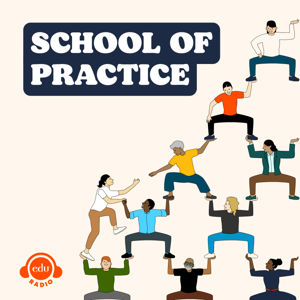
School of Practice, the first podcast from the team at Edutopia, brings you ready-to-use strategies to improve your teaching today. Join us for 15-minute episodes filled with smart, pedagogy-shifting advice—backed by research and test-driven by teachers just like you.
From the publisher's feed
Ranked by our users in the last 21 days
12,893 Listeners

2,417 Listeners
1,257 Listeners

12,719 Listeners

1,421 Listeners

14,337 Listeners

642 Listeners

208 Listeners

388 Listeners

572 Listeners
206 Listeners

10,806 Listeners
176 Listeners

8,469 Listeners

2,213 Listeners