
Sign up to save your podcasts
Or



Today I am talking to a “unicorn”. Ashley Whitaker is one of the 505 (at the time of this recording) dually certified SLP/BCBAs! Ashley has been in the field for 10 years and shares her path to certification.
Ashley started her undergrad with the idea to become a teacher after a lifelong passion for helping kids learn. When her roommate suggested a course in speech, the rest was history. Shortly after her career began, she was exposed to ABA and began her journey to BCBA certification.
As prep for the exam, Ashley recorded herself reading The Cooper Book summaries and relistened to them during her commute, as well as taking mock exams and using the ABA Wizard App. If you're listening and interested in becoming a BCBA, remember that the requirements are always changing, so be sure to download the BCBA handbook for the latest information.
I actually met Ashley through ABA Speech, and she is a part of the new ABA Speech Connection CEU Membership. Her experience has shown it is a like minded group of professionals and a collaborative community. With the membership, Ashley has found a place to ask questions and learn in a non judgmental space.
As always, I want you to leave this episode with actionable tips to use in your therapy room. Listen to the end to see how Ashley uses Essentials for Living as a framework in her practice.
#autism #speechtherapy
What’s Inside:
Mentioned In This Episode:
Learn more about the ABA SPEECH Connection CEU Membership and Joint Attention on September 12th at 8-9pm eastern and September 13th at 8-9pm eastern.
My guest today, Lorri Unumb needs no introduction. Lorri is a mother of three, an autism mom, a lawyer, an autism advocate, and an absolute dynamo in the field. Be sure to check out her long list of achievements in the guest bio for this episode!
We are talking about something so important and impactful for families everywhere who have an autism diagnosis: insurance. In 2003 when Lorri’s youngest, Ryan, was diagnosed ABA was not a covered treatment even though it was evidence based and crucial to his opportunity to reach his highest potential. Full time ABA therapy for Ryan’s needs would run $70,000+ annually. And they weren't the only family dealing with this.
While Lorri’s family could make it work, paying full price for therapy was not ideal and for some families this would simply not be possible. So in 2005 she got to work writing a bill that would require insurance coverage for all evidence based autism treatments to include ABA. And after a 2 year journey what became known as “Ryan’s Law” was passed in 2007. Autism Speaks reached out to employ Lorri and she then spent the next decade replicating this law across the country, finally passing in the 50th state in 2019.
Lorri also shares about her role in the Council for Autism Service Providers, a collaborative organization of providers working and learning together from across the country. And as an autism mom herself she has some great advice for parents facing new diagnosis: “It gets better”.
#autism #speechtherapy
What’s Inside:
Mentioned In This Episode:
Council of Autism Service Providers
The Autism Law Summit
Learn more about the ABA SPEECH Connection CEU Membership and Joint Attention on September 12th at 8-9pm eastern (https://us02web.zoom.us/j/835049703570) and September 13th at 8-9pm eastern. (https://us02web.zoom.us/j/86200908099)
Have you ever had a client exhibit behaviors that you just don’t know how to approach? Dr. Jonathan Fernand has had experiences in the field across many settings that aid in his understanding on intervening with restrictive and repetitive behaviors.
Restrictive and repetitive behaviors can mean a variety of behaviors, from high order (compulsive and ritualistic) to low order (self injurious and vocal/motor stereotypy). But when do these behaviors warrant intervention?
Dr. Fernand reminds us that while every decision is contextual and depends solely on the individual, there are factors that contribute to deciding on the intervention process. Consider safety, health and wellness, community, and other lifespan barriers as indicators for intervention. Prioritize the need for intervention and differing methods with changes in skills and interests. It’s also important to note that not all restrictive and repetitive behaviors need to be at zero levels if they can be enjoyed appropriately.
This conversation is great for SLPs, who are often in situations where they feel like they are calling in the BCBA when things have gone too far wrong and can maybe do more to intervene preventatively. Dr. Fernand, like me, is an advocate for lifelong learning. He urges professionals to access a network of resources and lean on colleagues and mentors to learn and grow.
#autism #speectherapy
What’s Inside:
Mentioned In This Episode:
Dr. Jonathan Fernand on LinkedIn
Jonathan K. Fernand Florida Institute of Technology · School of Behavior Analysis
Learn more about the ABA SPEECH Connection CEU Membership and Joint Attention on September 12th at 8-9pm eastern and September 13th at 8-9pm eastern.
Get ready for an inspiring episode. I chatted with Dr. Shahla Alai-Rosales and Peggy Heinkel-Wolfe, who co-authored the book Responsible and Responsive Parenting in Autism: Between Now and Dreams.
This comes from Dr. Alai-Rosales’ extensive professional career and over 4 years of experience in the field, as well as Peggy’s personal experience as an Autism mom. The book binds together responsive parenting into three parts: Learning, Loving, and Connecting.
We discuss a philosophy prominent in the book, ABA, as a science of love and change. Dr. Alai-Rosales explains the deep care and concern required to work with an individual when trying to change behavior. Being a provider, you must harmonize the process of change with your deep regard for human rights and the individual you’re responsible for.
For professionals, these two share some insight into how to cultivate genuine kindness and positivity that will impact your clients and their families. Remembering your why and purpose in the field and staying present in the moment can help ground you.
This is a great reminder that although this is work, our time is a precious gift to our clients and their families, and every conversation makes a difference.
#autism #speectherapy
What’s Inside:
Mentioned In This Episode:
Responsible and Responsive Parenting in Autism: Between Now and Dreams
Learn more about the ABA SPEECH Connection CEU Membership and Joint Attention on September 12th at 8-9pm eastern and September 13th at 8-9pm eastern.
Having an autistic adult on the podcast is always an opportunity to learn how we, as practitioners, can do our best for our clients. Joining me today is Larissa Minner, a passionate and experienced disability rights advocate, speaker, and consultant.
Burnout is commonly talked about, and I've even done an episode where we talked about professional burnout in the field. Larissa talks about Autistic Burnout and Neurodivergent Burnout and what that looks like for many individuals. Signs and symptoms of Autistic (or Nuerodivergent) Burnout can include feeling drain in all aspects of life, an increase in executive functional challenges, a lowered coping skill level, regression and loss of skills, brain fog, physical fatigue, mimicking and causing depression/anxiety, and even being a factor involved in suicidal ideation. This causes a lot of problems for autistic individuals, like finding a job or making their way through university.
So what can we do? As professionals, we can provide Neuro Affirming Environments. A Neuro Affirming Environment applies to social, emotional, and physical aspects, and Larissa explains some ways to do that without putting the burden on the autistic person. Firstly, use the person's preferred language, whether they prefer Autistic Person or Person with Autism. Also developing language that is not based on a person’s deficit; for example, Larissa uses the term Strategic Explorer to verbalize her preference for routine. Additionally, consider sensory friendly rooms with adjustable lighting and noise accommodations, validations in different listening and communicating skills, and always giving ample warning when it comes to events and changes.
Larissa is active in making changes across the field for both autistic children and autistic adults when it comes to healthcare, education, and career opportunities. This is a great conversation that shares some less talked about advocacy for autistic people and encourages professionals to check themselves when it comes to providing compassionate care.
#autism #speechtherapy
What’s Inside:
Mentioned In This Episode:
You can participate in her ongoing research study at Shape in Healthcare Survey (Healthcare Equality)
You can find out more about Larissa and her work at: https://linktr.ee/larissaminner
My guest today Dr. Cody Morris is an asset to the field, his goals include improving the practice of BCBAs, by Improving assessment and treatment methodologies regarding problem behavior and addressing organization challenges in delivering services.
Today we discuss Assent, its importance, and how to gain Assent even when a client is not yet speaking. Dr. Morris makes a very important comparison in definitions between Consent and Assent.
Consent: the affirmation that an individual who is legally authorized gives permission for themselves or another person to participate.
Assent: the affirmation that an individual who is not legally authorized to provide their own consent, affirms their willingness to participate.
Both of these are incredibly important, Consent has many legalities that affirm participation. Assent on the other hand, can be difficult to confirm when a child has limited or no communication skills. There are multiple ways to gain assent. 1, through Verbal statements or 2, through Behavior Allocation.
Assent can be obtained when a student's behavior allocated the confirmation to engage through choice. Choice does not mean the student decides all goals and treatment, but as Dr. Morris and I discuss small choices that affirm engagement and build to grander decision making skills.
In our conversation today, Dr. Cody Morris and I discuss some important fundamentals of behavior analysis that heavily involve Assent as a best practice. You can find out more about Dr. Morris’s work and research in the provided links.
#autism #speectherapy
What’s Inside:
Mentioned In This Episode:
Dr. Cody Morris on LinkedIn
Cody MORRIS | Assistant Professor | Ph.D. | Salve Regina University, Rhode Island | Department of Psychology | Research profile
Welcome to the fourth and final part of my Autism Case Study Series. I am going back over my last 20 years of experience in public education, non-public programs, and teletherapy working with autistic learners.
The last learner I want to talk about is a 3 year old boy that I saw in-home with my private practice, ABA Speech. When I first began services, the child had received an autism diagnosis, was not yet speaking, and was attending ABA services. After two years of working with this child, he had begun to speak in sentences and enjoy group activities.
I saw this child weekly for 35 minutes of instruction and 10 minutes of parent coaching. In my very first session with this learner, I focused on Joint attention using my 3 pronged approach: Music, Books, and Play. We sang Wheels on the Bus with motions, we read Pete the Cat, and we played with bubbles! These are some of my go-to resources. The child at first was not engaged or interested at all, but I continued to observe and take data, and engagement increased over time.
We even saw this child’s first spontaneous word during a play section of therapy. Playing with mini objects in a bag, the child reached in and pulled out a miniature shoe and said the word “shoe”! After that, engagement continued to increase. We played with miniature objects in many different ways, shaking them up in bags and hiding them in the learning space.
This series has been designed to help you resonate and feel inspired to help your clients or children develop a way to communicate with the world. What do you think of solo shows? Send me a DM on Instagram, an email, or please take time to leave a review.
Stay tuned for the launch of my community membership coming in Fall 2023; send me an email if you want to get in early.
#autism #speectherapy
What’s Inside:
Mentioned In This Episode:
Start Communicating Today- Toddler and Preschool Course
Welcome to Part 3 of 4 of my Autism Case Study Series. I am going back over my last 20 years of experience in public education, non-public programs, and teletherapy working with autistic learners.
Today I am sharing about an elementary learner from a non-public program. He came to me with no communication and unsafe behaviors that were a barrier to his learning, community, and school environment. This student actually brought with him a beautifully set up AAC on his iPad but had zero tools for utilization.
As we worked with this student in this non-public program, we collaborated with his parents, his home district (a rural area 1 hour away), and he was in a private classroom with 2 male assistants to keep everyone safe. I worked with this child for 1 hour a week in his classroom. We began work on building receptive language, requesting, understanding basic vocabulary: nouns and actions, joint attention, social engagement, and utilizing his iPad.
Several things helped me be successful with this learner. I was able to meet the learner where he was and engage in a way that was respectful of his preferences. I helped him with modified leisure skills like modified memory, where we used video modeling. During my work with this student, my idea for Action Build Cards also came to life.
Things took a big turn when this student realized his AAC was his voice. He began to use his iPad with pride. We even took community based outings to lunch places where the learner was able to use his AAC with a cashier to order his lunch. If you’ve taken my course, Help Me Find My Voice, you may have even seen this learner in some of my videos.
Stay tuned for Part 4 of this case study series next week, where I will share about a 2 year old learner!
#autism #speectherapy
What’s Inside:
Mentioned In This Episode:
Social skills for students with autism- Modified Memory
School-Age Course
Action Builder Cards
Welcome to Part 2 of 4 of my Autism Case Study Series. I am going back over my last 20 years of experience in public education, non-public programs, and teletherapy working with autistic learners.
Today I am sharing about an 8-year-old nonverbal learner I worked with in a non-public program. This learner came to me with no way to communicate with the world and various behaviors that were barriers to safety and learning. He really struggled with the learning environment, and I had to be creative.
Building rapport and getting to know your learner is so important. My usual iPad videos and sensory toys were not interesting to this learner, so I had to think outside the box. Listening to country music, special light up sensory toys, small objects to carry, and even mirrors ended up being some of the learners biggest interests and reinforcers.
I saw this learner in two 30-minute sessions across their school day, individually in my office. We started communication with AAC using an app on a device, which we really had to adapt this learner to. We also used visual prompts in an AAC binder with laminated pictures of familiar and favorite things.
These solo sessions were built around these three goals and activities:
As time progressed over several years, we worked on labeling, verbal imitation, and vocational skills. Eventually we segued into ½ individual and ½ group sessions where this learner became a shining star in more modified leisure games like Musical Chairs, Simon Says, and the Grocery Store game.
Stay tuned for part 3 of this Autism Case Studies series!
#autism #speectherapy
What’s Inside:
Mentioned In This Episode:
Connect Four Modified - YouTube
Social skills game for mixed groups - ABA Speech
Save $100 on our autism courses!
Toddler & Preschool Course - ABA Speech
School-Age Course - ABA Speech
The Advanced Language Learner - ABA Speech
Welcome to Part 1 of 4 of my Autism Case Study Series. I am going back over my last 20 years of experience in public education, non-public programs, and teletherapy working with autistic learners.
In this case study, I discuss a middle school learner in public education. He had recently come to the country and was completely nonverbal. I first began with AAC to give him a voice and start communication. He did have to shape up his point with OT to make this accessible, but from there we began to build rapport. I also started using sign language and the resource LifePrint for his teaching area.
For assessment, I did the VB-Mapp and collaborated on this with his teacher, paraprofessional, and BCBA. The collaborative piece was so important, and we were all working really hard to help this learner find his voice. The VB-Mapp is a great gauge of expressive, receptive, and social language skills.
I structured our therapy around functional goals for this learner involved in leisure skills, requesting, and sharing activities. I worked with this learner in solo sessions in his classroom setting twice a week, and once with group activities.
I used a variety of resources that were tailored to the likes and interests of the learner to gain verbal imitation, and from there I inventoried his sounds and began to build more words and phrases.
The focus of these case studies is to help and inform therapists on how to work with our hard learners. We can make this fun and functional, give these learners their voice, and change their lives. Stay tuned for part 2.
#autism #speectherapy
What’s Inside:
Mentioned In This Episode:
LifePrint
Save $100 on our autism courses!
Toddler & Preschool Course - ABA Speech
School-Age Course - ABA Speech
The Advanced Language Learner - ABA Speech
From the publisher's feed
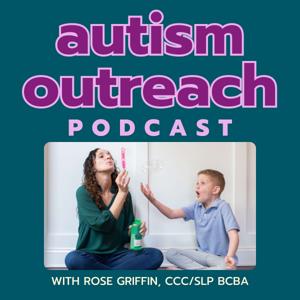
Join Rose Griffin, a dedicated Speech Therapist and BCBA from ABA SPEECH, as she shares her compassionate approach to supporting the communication needs of autistic individuals. With 20 years of…
This podcast is a resource for professionals and parents alike, offering practical strategies that honor each person's unique communication style. Rose covers a wide range of topics, including how to recognize and support autistic communication from an early age, the distinctions between autism and speech differences, and effective, respectful approaches to fostering communication, whether a child is non-speaking, minimally speaking, or verbal.
Through a mix of interviews and solo episodes, Rose explores how to enhance meaningful connections, address challenges with empathy, and celebrate the strengths of autistic individuals. Whether you're a parent, therapist, or educator, you'll find valuable insights and actionable advice to create supportive environments that empower communication and honor neurodiversity.
Hit subscribe and learn more at www.abaspeech.org.

7,683 Listeners
11,950 Listeners
626 Listeners
9,093 Listeners

25,787 Listeners
4,759 Listeners

46,879 Listeners
1,346 Listeners
625 Listeners
422 Listeners

15,404 Listeners

29,200 Listeners
59 Listeners

19,209 Listeners

10,193 Listeners