
Sign up to save your podcasts
Or



MTHFR is one of the most talked-about—and misunderstood—genes in the functional medicine world. But what does it actually mean to have an MTHFR mutation? How does methylation influence fertility, thyroid health, homocysteine levels, detox pathways, and chronic illness? And when is genetic testing truly helpful versus fear-driven?
In this episode, I’m joined by functional medicine expert Dr. Sam Shay to break down the science of methylation in a practical, clinically grounded way. We discuss how MTHFR variants impact folate metabolism, vitamin B12 utilization, homocysteine regulation, and oxidative stress—and why these pathways matter deeply for women navigating infertility, recurrent pregnancy loss, Hashimoto’s, PCOS, autoimmunity, and complex inflammatory conditions.
We also unpack common myths about MTHFR, including when high-dose methylated supplements may backfire.
If you’ve ever been told you have an MTHFR mutation and felt confused about what to do next—or if you’re struggling with unexplained fertility challenges, thyroid antibodies, chronic fatigue, or inflammatory symptoms despite “normal labs”—this episode will help you understand the bigger biochemical picture and how to approach methylation support in a personalized, root-cause way.
This conversation is especially important for active women who are trying to conceive, managing autoimmune thyroid disease, or navigating chronic illness through a functional medicine lens.
A few things we chat about in this episode 👇👇👇
Important show links 👇👇👇
In this AMA episode, I answer some of your frequently asked questions you submitted over on Instagram. We discuss the causes of low luteal phase basal body temperatures (BBT), progesterone dysfunction, mold-related inflammation, thyroid antibodies, and thyroid swelling.
A few things we chat about in this episode 👇👇👇
Important show links 👇👇👇
Trying to conceive after 35 requires more than just “taking a prenatal.” In this episode, we break down how to choose the right prenatal supplement for both women and men, and why fertility optimization starts months before conception.
We discuss why the number of capsules per serving actually matters, how iron and calcium should be dosed and timed, and how modern food systems contribute to widespread nutrient depletion. You’ll learn why sperm health plays a critical role in fertility and pregnancy outcomes, how lifestyle toxins and oxidative stress damage egg and sperm quality, and why mitochondrial health becomes increasingly important with age.
We also cover the key nutrients that support mitochondrial function, hormone balance, and reproductive health—and explain why the three months before conception are a critical window for both egg and sperm development.
A few things we chat about in this episode 👇👇👇
Important show links 👇👇👇
Overtraining Syndrome isn’t just about doing too much—it’s what happens when your body stops adapting to exercise and shifts into a protective, survival state. In this episode, we break down what overtraining syndrome actually is, why it affects both recreational exercisers and competitive athletes, and how it’s often driven by inadequate recovery and fueling rather than training volume alone. We explore early warning signs that the body is no longer responding positively to exercise, the role of oxidative stress and mitochondrial dysfunction, and how chronic training stress disrupts thyroid function, cortisol, androgens, progesterone, metabolism, and ovulation. You’ll also learn how to strategically reduce training load, restore energy availability, and reintroduce exercise in a way that supports hormone balance, metabolic health, and long-term performance.
A few things we chat about in this episode 👇👇👇
Important show links 👇👇👇
In this episode, we explore how to support androgens in women by understanding both low and high testosterone and DHEA-S, and what these patterns reveal about thyroid function, insulin signaling, adrenal health, inflammation, and stress. Androgens are essential for female energy, mood, muscle tone, libido, and fertility, and when they are either too low or too high, they signal deeper metabolic and immune imbalances rather than isolated hormone problems.
A few things we chat about in this episode 👇👇👇
Important show links 👇👇👇
In this episode of Strength in Hormones, we explore how Chinese Medicine approaches children’s health differently than Western medicine and why understanding these differences can transform the way you support your child’s digestion, sleep, emotions, and immune system. Chinese Medicine views children as physiologically and energetically developing, with immature digestive systems, sensitive nervous systems, and rapidly evolving emotional regulation, which means symptoms are often signals of deeper imbalances rather than isolated problems.
We discuss common pediatric concerns such as asthma, ADHD, sleep disturbances, digestive issues, and behavioral challenges, and how patterns like night waking, nightmares, bedwetting, irritability, and frequent illness can reflect underlying imbalances in the gut, nervous system, and immune function. You’ll learn why digestive health is often the foundation for emotional regulation, focus, sleep quality, and overall development in children.
A few things we chat about in this episode 👇👇👇
• How Chinese medicine views children differently than Western medicine
• Why kids’ digestion, nervous systems, and emotions are still developing
• Common patterns behind issues like asthma, ADHD, sleep problems, and digestive concerns
• What symptoms like night waking, nightmares, bedwetting, and irritability can signal
• Why digestive health is often the foundation for behavior and development
• How food temperature, simplicity, and meal timing matter for kids
• When and how herbs may be used safely in children
• How parents can support nervous system regulation and emotional resilience
• Why addressing root imbalances early can prevent long-term issues
Important show links 👇👇👇
Low T3 is one of the most misunderstood thyroid patterns, and it’s rarely a problem that starts in the thyroid itself. In this episode, we explore how the immune system, inflammation, and metabolic stress drive changes in T3 and reverse T3, often long before the thyroid gland becomes the primary issue.
You’ll learn what T3 actually controls in the body, why normal TSH and T4 levels do not guarantee healthy thyroid function, and how mitochondrial health determines whether thyroid hormone can truly do its job. We break down the difference between low T3 and elevated reverse T3, explain why the body shifts into energy conservation mode under chronic stress, and cover the critical role of deiodinase enzymes (D1, D2, and D3) in thyroid hormone conversion.
A few things we chat about in this episode 👇👇👇
Important show links 👇👇👇
In this episode, I sit down with Ayla Barmer, registered dietitian and founder of FullWell Fertility, to break down what the research actually says about micronutrients, probiotics, and prenatals for fertility, pregnancy, and postpartum health.
Despite the growing prenatal market, many supplements still miss the mark when it comes to evidence-based dosing, bioavailable nutrient forms, and individualized needs. We cover the most misunderstood and controversial topics in prenatal nutrition, including folate vs. folic acid, the role of methylated forms, and why blanket fear around vitamin A may be contributing to widespread deficiency and downstream thyroid, immune, and fertility issues. We also dive into why iron and omega-3s are often excluded from prenatals, how iron needs change across each trimester, and how to determine whether supplementation is necessary based on labs—not assumptions.
A few things we chat about in this episode 👇👇👇
Why many prenatals don’t align with the evidence on nutrient forms or dosing
Modern drivers of nutrient depletion—even with a “healthy” diet
Folate vs. methylfolate vs. folic acid: what matters most in pregnancy
The truth about vitamin A in pregnancy and why avoidance may backfire
Why iron and omega-3s are often intentionally excluded from prenatals
How iron needs shift across pregnancy and how to assess the right dose
What really matters for DHA and EPA for mom and baby
How to evaluate probiotics and support the microbiome intelligently
Important show links 👇👇👇
If your TSH looks “normal” but you still feel exhausted, with irregular cycles and slowed metabolism, this episode will help you understand what standard testing often misses.
In this episode, we break down energy availability—the balance between the energy you take in and the energy your body expends—and why it is one of the most overlooked drivers of thyroid dysfunction, particularly low T3, the active thyroid hormone that actually controls metabolism, energy, and the menstrual cycle.
A few things we chat about in this episode 👇👇👇
What T3 (active thyroid hormone) actually controls in the body
How you can have normal TSH and T4 but still feel exhausted
The connection between low energy availability and suppressed T3
Key variables that push the body into metabolic conservation mode
Why adequate nutrition is essential for T4 → T3 conversion
Hormones that inhibit thyroid function under stress or low fuel states
Common signs and symptoms of low T3
Why thyroid medication alone often falls short
How fueling, timing, and safety signals support thyroid and hormone restoration
If you are an active woman, athlete, or high-performing individual struggling with fatigue, stubborn symptoms, or “normal” TSH levels that don’t match how you feel, this episode will give you a new framework for understanding—and supporting—your thyroid from the inside out.
Important show links 👇👇👇
Low progesterone is one of the most common hormone concerns I see—but it’s also one of the most misunderstood. In this episode, we unpack why low progesterone is rarely a true progesterone deficiency and is far more often a downstream signal of poor ovulation quality driven by low T3, metabolic stress, or thyroid autoimmunity.
You’ll learn why progesterone is best understood as a marker of ovulation strength—not something the body simply “fails to make”—and how thyroid hormone, mitochondrial energy, inflammation, blood sugar, and nervous system safety all determine whether ovulation (and the corpus luteum) can function properly.
We also dive into why luteal phase defect is frequently misdiagnosed as PCOS, how Hashimoto’s can quietly disrupt ovulation even with normal cycles, and why progesterone supplementation alone often fails to fix the problem.
A few things we chat about in this episode 👇👇👇
Why progesterone reflects ovulation quality—not ovarian failure
The thyroid–progesterone axis and how low T3 weakens ovulation and the corpus luteum
How stress, cortisol, and reverse T3 put metabolic “brakes” on progesterone production
The overlooked role of thyroid autoimmunity in low progesterone, short luteal phases, and miscarriage risk
Luteal phase defect vs. PCOS: how to tell the difference
What labs actually matter for identifying thyroid-driven low progesterone (and how to time them correctly)
Why progesterone supplementation is sometimes helpful—but rarely a root-cause solution
Treatment priorities that restore ovulation by fixing thyroid conversion, metabolism, and immune stress
Important show links 👇👇👇
From the publisher's feed
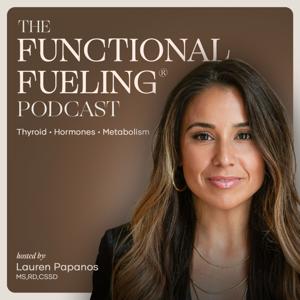
The Functional Fueling® Podcast is hosted by expert Functional Registered Dietitian and hormone specialist, Lauren Papanos. Join us every Wednesday for a brand new LOdown with Lo solo episode or…
3,922 Listeners
1,353 Listeners
782 Listeners

4,870 Listeners
9,148 Listeners

129 Listeners

4,087 Listeners

619 Listeners

1,403 Listeners

1,546 Listeners

1,477 Listeners

2,701 Listeners

399 Listeners

592 Listeners

141 Listeners