
Sign up to save your podcasts
Or

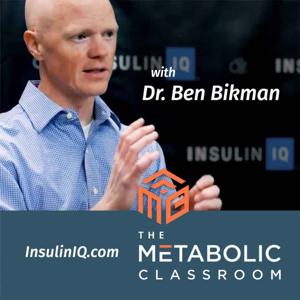


Based on Podcast App listening data
One of the most persistent oppositions to a low carb diet is the idea that it can damage the kidneys. Let's dive into what the data really shows.
Here is the resource that Ben references during the episode:
Source #1 - https://pubmed.ncbi.nlm.nih.gov/30383278/
Source #2 - https://pubmed.ncbi.nlm.nih.gov/27346534/
Learn more at Insulin IQ
Hosted on Acast. See acast.com/privacy for more information.
Many people claim that eating low-carb can actually make you insulin resistant. How can this be? The answer lies in the key difference between two types of insulin resistance; pathological versus physiological. Let's discuss what's really happening.
Here is the resource that Ben references during the episode:
Source #1 - https://academic.oup.com/jes/article/5/5/bvab049/6199842?login=true
Learn more at Insulin IQ
Hosted on Acast. See acast.com/privacy for more information.
It’s estimated that up to 12% of women in the US are affected by fertility problems directly caused by insulin resistance. Join Dr. Ben Bikman, the Insulin IQ team, and special guest Dr. Steven Cowles, OBGYN, for a conversation on how insulin control is giving women hope to have the family they want.
Here is the resource that Ben references during the episode:
Source #1 - https://pubmed.ncbi.nlm.nih.gov/26225266/
Learn more at Insulin IQ
Hosted on Acast. See acast.com/privacy for more information.
Here are the resources that Ben references during the episode:
Study #1 - https://care.diabetesjournals.org/content/25/2/364.short
Learn more at Insulin IQ
Hosted on Acast. See acast.com/privacy for more information.
For our entire lives we’ve always heard that “healthy whole grains are an essential part of a balanced diet.” In light of what we now know about nutrition and insulin, does that statement hold up? Join Dr. Bikman and the Insulin IQ team for a conversation about the evidence.
Here are the resources that Ben references during the episode:
Study #1 - https://www.sciencedirect.com/science/article/abs/pii/0002934387900581?via%3Dihub
Study #2 - https://onlinelibrary.wiley.com/doi/abs/10.1111/j.1651-2227.1987.tb10498.x
Study #3 - https://www.ncbi.nlm.nih.gov/pmc/articles/PMC4325021/
Study #4 - https://cdnsciencepub.com/doi/full/10.4141/cjas2012-017
Study #5 - https://academic.oup.com/ajcn/article/103/2/341/4564756?login=true
BYU Address - https://speeches.byu.edu/talks/benjamin-bikman/the-plagues-of-prosperity/
Learn more at Insulin IQ
Hosted on Acast. See acast.com/privacy for more information.
Some of the most common diabetes drugs work in interesting ways. Let’s talk about some of the most common: SGLT inhibitors and GLP-1 receptor agonists.
Here are the resources that Ben references during the episode:
Study #1 - https://pubmed.ncbi.nlm.nih.gov/24917578/
Study #2 - https://pubmed.ncbi.nlm.nih.gov/30240793/
Study #3 - https://pubmed.ncbi.nlm.nih.gov/32827151/
Learn more at Insulin IQ
Hosted on Acast. See acast.com/privacy for more information.
“Good” cholesterol? “Bad” cholesterol? Decades of unclear and misinterpreted science have led to widespread misunderstanding of this vital component of every cell in our bodies. Join Dr. Ben Bikman, special guest Dr. Bret Scher, and the Insulin IQ team as we distill down what you need to know about cholesterol.
Learn more at Insulin IQ
Hosted on Acast. See acast.com/privacy for more information.
Despite sharing a name, type 1 and type 2 diabetes have surprisingly little in common. Let’s explore what they have in common and their many differences.
Here are the resources that Ben references during the episode:
Study #1 - https://www.endocrinology.org/endocrinologist/129-autumn18/features/endogenous-insulin-its-role-in-the-initiation-progression-and-management-of-diabetes
Learn more at Insulin IQ
Hosted on Acast. See acast.com/privacy for more information.
Metformin is the most widely used drug to fight diabetes. Let’s talk about how it works and when it doesn’t work well.
Here are the resources that Ben references during the episode:
Study #1 - https://www.sciencedirect.com/science/article/abs/pii/S0891584910003874?casa_token=z96rcmkuc7YAAAAA:pxbbTkuPhL7Nop4oUECKmCq81Ev4Dc7z4XYvbaNMXLorp-F9p4nrHLo9bkUiIL0Trjv9EhNNGds
Study #2 - https://www.jci.org/articles/view/13505?content_type=full
Study #3 - https://europepmc.org/article/med/3817257
Study #4 - https://onlinelibrary.wiley.com/doi/full/10.1111/acel.13039
Study #5 - https://onlinelibrary.wiley.com/doi/full/10.1111/acel.12880
Learn more at Insulin IQ
Hosted on Acast. See acast.com/privacy for more information.
A spike in glucose levels each morning can be startling, but it doesn’t need to be scary. To understand the dawn phenomenon, you need to understand hormones.
Here are the resources that Ben references during the episode:
Study #1 - https://www.nejm.org/doi/full/10.1056/nejm198811103191901
Study #2 - https://pubmed.ncbi.nlm.nih.gov/6389230/
Study #3 - https://pubmed.ncbi.nlm.nih.gov/2859524/
Study #4 - https://diabetes.diabetesjournals.org/content/45/8/1044
Learn more at Insulin IQ
Hosted on Acast. See acast.com/privacy for more information.
From the publisher's feed
Hosted on Acast. See acast.com/privacy for more information.
Ranked by our users in the last 21 days

1,527 Listeners

775 Listeners

3,422 Listeners

9,165 Listeners
1,115 Listeners

133 Listeners
2,571 Listeners
1,089 Listeners

466 Listeners

845 Listeners
583 Listeners
443 Listeners
160 Listeners

1,190 Listeners

217 Listeners