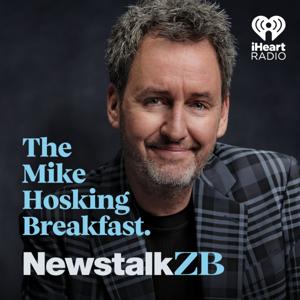
The Mike Hosking Breakfast

The Mike Hosking Breakfast

By Newstalk ZBNews
Download on the App Store
  • Favorites

    295

    Followers

  • Typical duration

    4 min

    per episode

  • If it hooks

    63%

    finish an episode

Based on Podcast App listening data

The Mike Hosking Breakfast episodes

  • Rod Liddle: UK cuts overseas aid after worst recession in over 300 years
    The British government faced fury Wednesday after ditching its long-standing target for overseas aid in the wake of what it described as the deepest recession in over three centuries.
    In a statement to lawmakers, Treasury chief Rishi Sunak said the target to allocate 0.7% of national income to overseas aid will be cut to 0.5%. The move is expected to free up 4 billion pounds ($5.3 billion) for the Conservative government to use elsewhere, money that critics say could be used to save tens of thousands of lives in the poorest parts of the world.
    While expressing “great respect to those who have argued passionately to retain this target,” Sunak said “sticking rigidly” to it “is difficult to justify" to people at a time when the economy has been so battered by the coronavirus pandemic.
    “At a time of unprecedented crisis, government must make tough choices,” he said.
    Without giving a timetable, he said that the government aims to return to the target first laid out by the Labour government of Tony Blair in 2004. And he said that even with the new target, the U.K. will still be the second biggest aid spender among the Group of Seven leading industrial nations.
    The decision goes against the government's promise last year to maintain the aid target and drew sharp criticism from across the political spectrum, including within Prime Minister Boris Johnson’s own Conservative Party.
    Liz Sugg, a junior minister at the Foreign Office, quit in the wake of the decision, arguing that it “will diminish our power to influence other nations to do what is right.” She said it undermines Johnson's efforts to promote a “Global Britain” in the wake of the country's departure from the European Union earlier this year.
    The U.K. is considered one of the world's leaders in development issues so the cut was met with dismay from anti-poverty campaigners.
    “Cutting the U.K.’s lifeline to the world’s poorest communities in the midst of a global pandemic will lead to tens of thousands of otherwise preventable deaths," said Oxfam Chief Executive Danny Sriskandarajah.
    Save the Children Chief Executive Kevin Watkins said the decision had “broken Britain's reputation for leadership on the world stage” ahead of its hosting of the 2021 United Nations Climate Change Conference.
    The Archbishop of Canterbury Justin Welby joined the chorus of disapproval, describing the cut as "shameful and wrong” and urging lawmakers “to reject it for the good of the poorest, and the U.K.’s own reputation and interest.”
    In a sobering assessment that provided the backdrop to the cut, Sunak sought to balance ongoing support for the economy with a longer-term commitment to heal public finances after a stark deterioration.
    “Our health emergency is not yet over and our economic emergency has only just begun,” he said.
    Sunak said the government's independent economic forecasters are predicting that the British economy will shrink 11.3% this year, the “largest fall in output for more than 300 years.”
    The Office for Budget Responsibility expects the economy to grow again next year as coronavirus restrictions are eased and hoped-for vaccines come on stream, though it warned that a failure to agree a post-Brexit trade deal with the EU would wipe 2 percentage points off growth next year.
    Assuming a trade deal is secured by the year-end deadline, the agency is predicting growth of 5.5% in 2021 and 6.6% the following year. As a result the output lost during the pandemic won't have been recouped until the final quarter of 2022.
    Sunak warned that the pandemic's cost will create long-term “scarring,” with the economy 3% smaller in 2025 than predicted in March, before the spring lockdown.
    The massive fall in output this year has led to a huge increase in public borrowing as the government sought to cushion the blow and tax revenues fell. Sunak said the government has pumped 280 billion pounds into the economy to get...
    6 min
  • Jill Brinsdon: Black Caps consider kneeling prior to first T20 with West Indies
    The Black Caps are set to have discussions with the West Indies as to whether they will take a knee prior to their opening international Twenty20 at Eden Park.
    The New Zealand international cricket summer gets underway with the Caps' first match in over eight months on Friday.
    The huge gap in between matches has been dominated by the Covid-19 pandemic, which halted virtually all sport worldwide. As well as that, the Black Lives Matter movement captivated the world and injected itself into sport, with several players, teams and leagues promoting the cause.
    Black Lives Matter has largely dominated American sport, with the NBA and Major League Baseball in particular taking part in pre-game kneeling and making changes to apparel.
    Black Caps coach Gary Stead says they will seek out the thoughts and feelings of the West Indies before the match.
    "We're actually meeting with the West Indies team around that [Black Lives Matter]," he confirmed.
    "It's part of our education and understanding of their thoughts.
    "But we also have been with the New Zealand Human Rights Commission as well with 'Give Nothing to Racism', so we're pairing up with them in terms of our own message and making sure that we have our own stance on those things. What happens in terms of taking a knee will be discussed with West Indies.
    "We're meeting with them to make sure that we understand how they feel about it and understand their point of view."
    It wasn't that long ago the movement found its way into rugby circles here, when Wallabies outside back Dane Haylett-Petty said it would be a "great show of support" to kneel prior to their second Bledisloe Cup test with the All Blacks.
    Dave Rennie confirmed a day later they wouldn't be.
    Meanwhile, the Black Caps have confirmed today they will be without allrounder Colin de Grandhomme and spinner Ajaz Patel for their opening test against the West Indies in Hamilton, which will follow on from the three match T20I series.
    De Grandhomme has bone bruising at the top of his right foot which will keep him out of both tests, while Patel is still recovering from a left calf tear.
    Patel could still suit-up for the second test, which will be in Wellington.
    Daryl Mitchell and Mitchell Santner come into the squad as replacements.
    3 min
  • Oliver Hartwich: New Zealand Initiative executive director on his open letter to Mike Hosking over housing
    The finger's being pointed firmly at politicians of the past for the country's housing crisis.
    Finance Minister Grant Robertson has called on an important ally in the Government's attempts to tame New Zealand's wild housing market.
    Robertson has publicly lobbied Reserve Bank Governor Adrian Orr to do more to cool New Zealand's red-hot housing market.
    It comes at a time when house prices have grown 20 per cent in the space of a year, while the rest of the economy grapples with a recession.
    New Zealand Initiative executive director Oliver Hartwich, who wrote an open letter to Mike Hosking about the housing market,  you can keep house prices stable,  if you have the right policies in place.
    "Over decades, politicians have wrecked the housing market. It's time we stop making apologies for that."
    LISTEN ABOVE
     
    7 min
  • Six60 band members on their new documentary and Helen Clark's stance on Eden Park
    Six60 have called for former Prime Minister and Arts Minister Helen Clark to support their bid to play Eden Park.
    The band, who made history as the first local band to sell out Western Springs are eyeing being able to play a show at Eden Park, but are subject to staunch opposition from local residents - including Clark.
    Clark has been vocal about not being in favour of concerts at the stadium, and told a planning hearing for the gigs in November that concerts would "represent a home invasion of noise".
    "She has done so much for the arts, and in my opinion, if I could say this to her - if she's listening - is that you're the reason we're here and as a New Zealand band even able to play Eden Park. So it makes no sense that now you'd go against everything you stood up for," Matiu Walters told Newstalk ZB breakfast host Mike Hosking.
    The band's bassist Chris Mac added: "I've got a lot of respect for Helen Clark, I think we all do. But I do wonder if she's proud of the success in the New Zealand music industry that she helped create. I wonder if she's proud of us and our success, and why she would want to get in the way of helping us succeed more."
    Newstalk ZB has approached Clark for comment.
    Walters confirmed to the Herald in an October interview that after playing to two sold-out audiences at Western Springs, they had then hoped to play at Eden Park, but have been held back by red tape they would have to get through to be able to perform at the venue.
    No concert has been hosted at the ground in its 120-year history.
    Under Auckland Council's Unitary Plan, Eden Park is allowed to host six music events a year, contingent on the venue and respective promoters gaining resource consent.
    The process is so costly that to date Eden Park hasn't lodged an application; any bids are set to be hotly contested by the Eden Park Neighbours' Association (EPNA). The group opposes additional night time and noisy events at the ground dubbed New Zealand's "National Stadium".
    12 min
  • David Seymour: Act leader frustrated with government's capital gains tax approach
    Frustration from David Seymour, with talk of extending the bright line test.
    Finance Minister Grant Robertson has asked Treasury for advice on extending the test.
    It means people need to pay income tax if they sell a second property, that's owned for less than five years.
    The test was introduced by National in 2015, and in 2018, Labour extended the test from two years to five.
    Seymour told Mike Hosking when you introduce a new tax, they are like acorns - and they grow.
    "The National Party planted this one, saying it would only be two years, now the test is at five years, and  it's likely to become ten."
    LISTEN ABOVE
    5 min
  • Mike's Minute: Government must crack on with Covid vaccine delivery
    It seems, to me anyway, a remarkable thing the government doesn’t have more heat on it than it does over our lack of Covid vaccine.
    You could conclude it's part of the malaise that’s swept the country this year. You could conclude that the media, or at least too much of it, has either fallen asleep along with the rest of the population, or as is more likely the case, it doesn’t suit their agenda to hold the government to any sort of account.
    But if you're at all interested in what going on in the world, much of it has dates and times and expectations for a vaccine, and we astonishingly don’t.
    The University of Texas is preparing as we speak to receive doses, as if the order was arriving this week. The FDA meets December 10 and it could ship the next day. By this Saturday week, needles could be in American arms. Same story in Britain, they know what they’ve bought, when it's being rolled out, who is top of the priority list, and how those initial jabs will be well and truly in British arms by Christmas.
    Even Australia, who have bought more vaccines than us, are manufacturing at least one of them themselves, and have a march date to start their programme.
    Our plan is still, according to Jacinda Ardern and Chris Hipkins being worked through. Why? We don't have a date for arrival. Why? We don't therefore have a start date. Why? We have no idea what sort of level of herd immunity we should expect before borders are opened. Why?
    Just what is it they have been doing by way of planning?
    Did we, or did we not, know that a vaccine, given our strategy of elimination was the sole answer to re-joining the world? And given it was, what the hell have we been doing for the past nine months?
    Vaccine wise, to this point, we've bought some of Pfizer's. That turns out to be some of the most expensive, not to mention hard to store. We don’t have the hardware to store it, that’s on order.
    It's almost as though we don’t care, that there is no hurry here, the border is not a big deal, and at some point, after the Christmas break, we may have a look and see if anything has arrived in the mail.
    Meantime at the W.H.O, we have hooked in with their Covax plan. We will stand dutifully in line while they roll out their highly political, poor countries first programme.
    For those desperate to get this nation off its knees and back to work, the likes of the pilots, the hoteliers, the moteliers, the exporters, and businesses that need the world up and running, am I the only one looking at Ardern and Hipkins aghast at their lack of planning urgency, and dare I suggest, delivery?

    3 min
  • Edna Brady: Football legend Diego Maradona dies aged 60
    Diego Maradona, the Argentine football great who was among the best players ever and who led his country to the 1986 World Cup title, has died. He was 60.
    The office of Argentina's president will decree three days of national mourning because of Maradona's death today, and the Argentine football association expressed its sorrow on Twitter.
    Maradona died two weeks after being released from a Buenos Aires hospital following brain surgery.
    Famed for the "Hand of God" goal in which he punched the ball into England's net during the 1986 World Cup quarterfinals, Maradona captivated fans over a two-decade career with a bewitching style of play that was all his own.
    Although his reputation was tarnished by his addictions and an ill-fated spell in charge of the national team, he remained idolised in football-mad Argentina as the "Pibe de Oro" or "Golden Boy."
    The No. 10 he wore on his jersey became synonymous with him, as it also had with Pele, the Brazilian great with whom Maradona was regularly paired as the best of all time.
    Bold, fast and utterly unpredictable, Maradona was a master of attack, juggling the ball easily from one foot to the other as he raced upfield. Dodging and weaving with his low center of gravity, he shrugged off countless rivals and often scored with a devastating left foot, his most powerful weapon.
    "Everything he was thinking in his head, he made it happen with his feet," said Salvatore Bagni, who played with Maradona at Italian club Napoli.
    Cocaine habit haunted him
    A ballooning waistline slowed Maradona's explosive speed later in his career and by 1991 he was snared in his first doping scandal when he admitted to a cocaine habit that haunted him until he retired in 1997, at 37.
    Hospitalized near death in 2000 and again in '04 for heart problems blamed on cocaine, he later said he overcame the drug problem. Cocaine, he once said famously, had proven to be his "toughest rival."
    But more health problems followed, despite a 2005 gastric bypass that greatly trimmed his weight. Maradona was hospitalised in early 2007 for acute hepatitis that his doctor blamed on excessive drinking and eating.
    He made an unlikely return to the national team in 2008 when he was appointed Argentina coach, but after a quarterfinal exit at the 2010 World Cup in South Africa, he was ousted — ultimately picking up another coaching job with the United Arab Emirates club Al Wasl.
    His career was brilliantly captured by Oscar Award winning documentarian Asif Kapadia in the 2019 film 'Diego Maradona'.
    From the slums to the best ever
    Maradona was the fifth of eight children who grew up in a poor, gritty barrio on the Buenos Aires outskirts where he played a kind of dirt-patch football that launched many Argentines to international stardom.
    None of them approached Maradona's fame. In 2001, FIFA named Maradona one of the two greatest in the sport's history, alongside Pele.
    "Maradona inspires us," said then-Argentina striker Carlos Tevez, explaining his country's everyman fascination with Maradona at the 2006 World Cup in Germany. "He's our idol, and an idol for the people."

    Maradona reaped titles at home and abroad, playing in the early 1980s for Argentinos Juniors and Boca Juniors before moving on to Spanish and Italian clubs. His crowning achievement came at the 1986 World Cup, captaining Argentina in its 3-2 win over West Germany in the final and decisive in a 2-1 victory against England in a feisty quarterfinal match.
    Over the protests of England goalkeeper Peter Shilton, the referee let stand a goal by Maradona in which, as he admitted years later, he intentionally hit the ball with his hand in "a bit of mischief."
    But Maradona's impact wouldn't be confined to cheating. Four minutes later, he spectacularly weaved past four opponents from midfield to beat Shilton for what FIFA later declared the greatest goal in World Cup history.
    3 min
  • Mike Hosking: Push for Maori wards on councils is racist and undemocratic
    Here is the great advantage Nanaia Mahuta has over most of the rest of us: we don’t care.
    What she is doing in trying to change the law and prevent a democratic action in terms of Māori wards and the ability to have any sort of public say is racist.
    She, along with the rest of the apologists on various councils around the country who favour separatist Māori wards, is that the bulk of the constituency don’t want them.
    We know this because when we get the chance to directly vote on them, the no’s win and win by large margins.
    Under current law, if a ward is voted for by council, that is the council going beyond their mandate because they know full well it’s not supported by the majority of people who elected them.
    So by way of a safe guard, they can choose to put those sorts of decisions to a vote: when they have, they lose.
    So now, they not only vote for separate race based wards, they then also vote not to have a vote.
    Fortunately, the law allows the public, i.e. the people the council are supposed to be serving, to drum up a petition involving five percent of the local constituency at which point a referendum is forced.
    This is where Mahuta comes in. She’s changing that law. She is taking away a democratic right, in order to propel a racist agenda.
    They know that what they are doing is not publicly supported, so they’re taking the public out of the equation.
    We should of course be outraged, but this is where they have the aforementioned advantage.
    We don’t care.
    We can barely turn up each three years for local body elections, so pathetic has it become it ranges from a third to a half of turnout.
    It’s a chicken and egg situation. Has the representation become so tragic; i.e. Invercargill, Tauranga, Northland, Wellington, Canterbury, Auckland, pick your recent headline and shambles, so we’ve given up?
    Or did because we gave up, it becomes the mess it has, i.e. any doofus can get elected and know they’re good for life because no one is going to do anything about it, hence the disintegration. 
    Either way, here are some simple facts; if Māori are underrepresented, then stand. Nothing stopping you.
    If you want more Māori on council, vote for them. Nothing’s stopping you, the mechanisms are all there.
    In a democracy, everyone gets a free shot. What Mahuta and her lot are looking to do is not democracy, its artificial, its racist, its stacking the deck, its making up the rules to suit your agenda.
    They are shameless, overt and dangerous, so what now? That ball is in the court of those who currently by in large can’t be bothered, so guess who’s got the upper hand?
    3 min
  • Brad Olsen: Economist explains data showing Kiwis are moving out to the regions
    It's official, Kiwis have seen another way of living during Covid, and we're leaving the cities in droves.
    Infometrics has looked at the number of people re-locating to regions,  and say they show people have realised there's life outside the office bubble.
    While New Zealander's look for a change in lifestyle, there's some positive news for New Zealand's economy, which is in the red but not as badly as it could be.
    Treasury's released the Crown accounts, these are the same numbers already released in the Pre-election Economic and Fiscal Update that have now been audited.
    They show Treasury’s operating a balance deficit of $23.1 billion dollars, about $5 billion better than forecast in the Budget.
    Net core Crown debt is at more than 83 billion dollars, and its tax revenue is about $85 billion.
    Infometrics senior economist Brad Olsen says it reflects people are getting out and about, and spending local.
    "On the whole, it's a better economic picture than originally forecast - but certainly not where we would have been in a pre-Covid world."
    LISTEN ABOVE
    5 min

About The Mike Hosking Breakfast

From the publisher's feed

Open your mind to the world with New Zealand’s number one breakfast radio show.

Without question, as New Zealand’s number one talk host, Mike Hosking sets the day’s agenda.

The sharpest…

Best of The Mike Hosking Breakfast

Ranked by our users in the last 21 days

More shows like The Mike Hosking Breakfast

Test Match Special by BBC Radio 5 Live

Test Match Special

210 Listeners

Sky Sports Cricket Podcast by Sky Sports

Sky Sports Cricket Podcast

118 Listeners

Gone By Lunchtime by The Spinoff

Gone By Lunchtime

29 Listeners

Australian True Crime by Bravecasting

Australian True Crime

1,223 Listeners

Saturday Morning with Jack Tame by Newstalk ZB

Saturday Morning with Jack Tame

2 Listeners

Heather du Plessis-Allan Drive by Newstalk ZB

Heather du Plessis-Allan Drive

10 Listeners

Early Edition with Ryan Bridge by Newstalk ZB

Early Edition with Ryan Bridge

2 Listeners

Weekend Sport with Jason Pine by Newstalk ZB

Weekend Sport with Jason Pine

4 Listeners

The Weekend Collective by Newstalk ZB

The Weekend Collective

2 Listeners

The Re-Wrap by Newstalk ZB

The Re-Wrap

2 Listeners

The Leighton Smith Podcast by Newstalk ZB

The Leighton Smith Podcast

82 Listeners

Smart Money by Newstalk ZB

Smart Money

2 Listeners

Matt Heath & Tyler Adams Afternoons by Newstalk ZB

Matt Heath & Tyler Adams Afternoons

0 Listeners

The OneRoof Radio Show by Newstalk ZB

The OneRoof Radio Show

5 Listeners

Kerre Woodham Mornings Podcast by Newstalk ZB

Kerre Woodham Mornings Podcast

1 Listeners

A Captain's Cup by Radio Sport

A Captain's Cup

1 Listeners

Between Two Beers Podcast by Steven Holloway & Seamus Marten

Between Two Beers Podcast

149 Listeners

The High Performance Podcast by High Performance

The High Performance Podcast

581 Listeners

I Catch Killers with Gary Jubelin by News.com.au

I Catch Killers with Gary Jubelin

537 Listeners

Newstalk ZB ANZAC Centenary Tribute by Newstalk ZB

Newstalk ZB ANZAC Centenary Tribute

0 Listeners

Election 2026: The Front Bench by Newstalk ZB

Election 2026: The Front Bench

0 Listeners

On The Front Foot by Newstalk ZB

On The Front Foot

4 Listeners

Holiday Breakfast by Newstalk ZB

Holiday Breakfast

0 Listeners

The Superior Sailor Series by Newstalk ZB

The Superior Sailor Series

0 Listeners

Rugby Direct by Newstalk ZB

Rugby Direct

6 Listeners

The Dom Harvey Podcast by Dom Harvey

The Dom Harvey Podcast

80 Listeners

Secrets We Keep by LiSTNR

Secrets We Keep

78 Listeners

Motive & Method by Tapt Media

Motive & Method

87 Listeners

The Big League Podcast by Newstalk ZB

The Big League Podcast

2 Listeners

All Sport Breakfast Canterbury by NewstalkZB

All Sport Breakfast Canterbury

0 Listeners

News Fix by Newstalk ZB

News Fix

0 Listeners

Football Fever by Newstalk ZB

Football Fever

0 Listeners

Sports Fix by Newstalk ZB

Sports Fix

2 Listeners

Great Chats with Francesca Rudkin by Newstalk ZB

Great Chats with Francesca Rudkin

0 Listeners

In My Day by Newstalk ZB

In My Day

0 Listeners