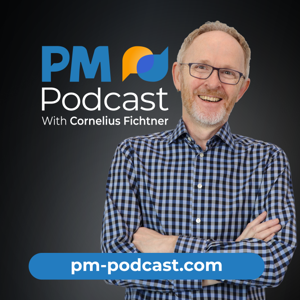
The Project Management Podcast

The Project Management Podcast

By Cornelius Fichtner, PMPBusinessCareers
Download on the App Store
  • Ranking

    2nd

    on Management & Marketing

  • Favorites

    512

    Followers

  • Typical duration

    35 min

    per episode

Based on Podcast App listening data

The Project Management Podcast episodes

  • Episode 411: The Future of Project Management (Free)
    Play Now: Download Project Management Professional (PMP)® exam prep to your pocket: Stephen Maye, Projectified host The Project Mangement Institute (PMI)® launched their new podcast "Projectified with PMI®" at their thought-provoking Global Conference 2017 in Chicago, Illinois. And during the conference I had the opportunity to sit down with Stephen W. Maye (LinkedIn Profile) who is the Projectified host. We begin by looking at PMI's new podcast itself, but then quickly move on to a number of "futuristic" topics. Stephen has had the opportunity to interview some of the brightest project management thinkers from around the world. Anand Swaminathan, Dr. Michael Chui, and Jacqueline Van Pelt to name just a few. Stephen summarizes their thoughts and ideas for us. We also discuss what Stephen sees as the number one trend in project management, what this trend means for us project managers, and how digitalization, artificial intelligence and the internet of things will influence the way we manage projects going forward. You can find Projectified with PMI by visiting http://www.pmi.org/podcast. Episode Transcript Below are the first few pages of the transcript. The complete transcript is available to Premium subscribers only. Podcast Introduction Stephen Maye: In this episode of The Project Management Podcast™, we look into a crystal ball to see how project management is changing and how modern tools and emerging technologies impact the way you will manage your projects in the future. Cornelius Fichtner: Hello and welcome to The Project Management Podcast™ at www.pm-podcast.com. I am Cornelius Fichtner. We are coming to you live from the thought-provoking 2018 PMI Global Conference in Chicago. Podcast Interview Cornelius Fichtner: And I have moved on to Room 474-B and I am sitting here opposite Stephen Maye from the Projectified with PMI podcast. Hello Stephen! Stephen Maye: Hello, Cornelius! Thanks for having me! Cornelius Fichtner: Yeah, welcome to the program. Thank you so much for being here! Absolutely great! So you are the Host of Projectified with PMI, a new podcast that PMI is launching here at the Congress. Why has PMI finally, only after 12 years of me doing it, decided to start their own podcast? Stephen Maye: Well, it was important to make sure you had a large bank of material that we could rip off and republish. No, you know I think it was just time. When you look at what PMI’s mission is in the world and kind of where it fits and PMI paying in particular attention to responding to where the market is going, where people get their information, not only the current community of not just people who call themselves project managers. But people who get up every day and go to work and do something that’s significant in a project or multiple projects. Not just once a day but those coming up. And I think it became clear, and again I of course wasn’t in those conversations initially but I think it became clear that this was an important way to make information available to people on the go, on their schedule where they happen to be. Personally, I like to consume podcast when I run. So that’s the kind of thing that doesn’t work for a lot of formats but works well with this. I think it was about meeting people where they are. Cornelius Fichtner: What’s the focus of your podcast? Stephen Maye: It’s really around what’s next. It’s really focused on being forward looking on those subjects, those concepts, those ideas, those insights that are relevant to people doing important project work. So if you can imagine this kind of core space of what we think of as project management knowledge and skill and technique. And even if you were to take for example, the PMBOK® Guide, and the Agile Practice Guide, and if you were to say, well that’s a pretty good way of describing what’s in that core specs. Well around that, there are all these other disciplines and all these other ways of thinking and skills and techniques that make the person pra
    26 min
  • Episode 410: How NASA Manages its Annual Plan and Portfolio (Free)
    Play Now: Download Project Management Professional (PMP)® training to your pocket: Darryl Hahn and Cornelius Fichtner NASA's Jet Propulsion Laboratory has worked with PMOs around the United States to define a "best practice" for creating and delivering an annual plan. This interview with Darryl Hahn (LinkedIn Profile) was recorded at the stimulating Project Management Institute (PMI)® Global Conference 2017 in Chicago, Illinois. Our interview presents both strategic and tactical approaches for uncovering your organizations' goals and objectives and for creating the prioritized list of achievable projects. We also examine ways of categorizing and classifying types of work, identifying and weighting priorities and adjusting the completed plan for when it collides with real life. Episode Transcript Below are the first few pages of the transcript. The complete transcript is available to Premium subscribers only. Podcast Introduction Male Voice:   In this episode of the Project Management Podcast™, we discuss how NASA’s Jet Propulsion Laboratory and other top federally-funded research and development centers prioritize and monitor annual plan and portfolios. Podcast Interview Cornelius Fichtner:   Hello and welcome to the Project Management Podcast™ at www.pm-podcast.com. I am Cornelius Fichtner. We are coming to you live from the stimulating 2017 PMI® Global Conference in Chicago where I am currently sitting in a completely empty presentation room—it’s Room W180 and the presenter who will be speaking here in about nineteen minutes is Darryl Hahn, sitting with me here. Hello Darryl. Darryl Hahn:   To a completely empty room.    Cornelius Fichtner:   We don’t know that. Oh, somebody just walked in the door so we have at least one person who will be listening to you, Darryl. How are you enjoying the conference so far? Darryl Hahn:   Oh, pretty well. We didn’t get a chance to see a whole lot of presentations yet. We flew in from California last night. We’re actually flying out tonight right after this one. It’s Halloween weekend so I got to get back to the kids so we can go trick or treating. Cornelius Fichtner:   Yeah, that’s also important. Is this your first conference? Darryl Hahn:   No, no. I’ve been to a couple of these. Went to the Gartner ones. I’ve been to a bunch of the other different conferences as well. We went to the PMI® one last year. Cornelius Fichtner:   And when you compare the PMI® to the others—this is specifically for project managers. Do you feel more at home here as a project manager, program manager than you feel at the others? Darryl Hahn:   I think that’s –that maybe a safe bet to say. It’s certainly more specialized to specifically project management stuff that people are interested in in that expertise so there’s usually a bit more specifics to do here than there are in some of the other ones maybe. Cornelius Fichtner:   Yeah, What prompted you to talk about and to speak about the topic of the methods and madness to strategic planning—it doesn’t sound like the sexiest of topics. Darryl Hahn:   No. One of the things that we do at JPL is we chair the Project Management working groups session of all the FFRDCs. FFRDCs are federally-funded research and development facility. We are a full NASA center. There are a bunch of other NASA centers—Ames, Kennedy, a bunch of other ones but we sit down with those folks on a continuing basis and for lack of a better phrase, we share our pain. “Hey what are the other issues that you guys are having today? How do you guys figure out how to attract resources better than anybody else? What are you guys doing when your annual planning blows up and what are the sort of methods that you guys employ to get back on track”—those types of things. We found a lot of value in collaborating with some of the other FFRDCs  and we decided that each of the FFRDCs do
    32 min
  • Episode 409: CCRS and PDUs (Free)
    Play Now: Get PDUs on your phone: John Kleine, Global Manager, Product Strategy & Delivery The Project Management Institute (PMI)® has made a number of changes to the Continuing Certification Requirements (CCR) in the past 18 months. These requirements define the policies and guidelines that certified project managers must follow in order to earn PDUs and renew their certification. In this interview we speak with John Kleine (LinkedIn Profile) who is the Global Manager, Product Strategy & Delivery, at Project Management Institute. One of John's responsibilities is overseeing the CCR and any changes made to it. We begin by discussing the recertification requirements for a certified Project Management Professional (PMP)® and walk you through many of the updated rules. Of course, the interview is also full with good ideas and suggestions on how to earn PDUs. For example, what would you expect are the most frequently used, and the most under-used PDUs earning activities? Episode Transcript Below are the first few pages of the transcript. The complete transcript is available to Premium subscribers only. Podcast Introduction Male Voice:   In this episode of the Project Management Podcast™, we talk about what’s new and coming regarding PDUs for all those who hold a PMI® certification. Podcast Interview Cornelius Fichtner:   Hello and welcome to the Project Management Podcast™ at www.pm-podcast.com. I am Cornelius Fichtner. We are coming to you live from the thrilling 2017 PMI Global Conference in Chicago. With me right now, sitting on the other side of the table is John Kleine who is the Global Managers Certifications at PMI. Good afternoon, John. John Kleine:   Good afternoon, Cornelius.   Cornelius:   We’ve had you on before and every time we talk about the same thing—PDUs, CCRS [laughs] John:   Oh, well it’s a very important topic. Cornelius:   I was just going to say it’s an important topic and a lot of people need to know about it and want to know about it. Yeah. So, the CCR, the Continuing Certification Requirements Program has seen some major changes over the past 18 months. They have been widely publicized and every PMP should know about them by now yet I’m still being asked to explain the new guidelines again and again. So, to get us started, would you please give us a quick overview of what the requirements are for someone who has just passed their PMP exam maybe yesterday. What do they need to know in regards to PDUs? John:   Right. I can tell you somewhere in the world yesterday, someone did pass the PMP. Well, the first thing I would tell you if we were in a hotel lobby or something and we’re limited on time, would be go to www.pmi.org, click on “Certifications” and then click on “Maintenance of Certifications” and that’ll have a much deeper dive than what I’m currently going to give you but I would tell that individual that within a three-year cycle to maintain this PMP certification that they’ve worked so hard for and had earned that over three years, they’re going have to earn 60 PDUs—60 Professional Development Units and those are broken out into two categories. We have Education and we have Giving Back to the Profession. Now within Education, PMI in the new changes stated that you have to have a minimum of 35 PDUs but you could have up to 60—which means in Giving Back to the Profession, you don’t have to have any but you can’t have more than 25 because the whole program’s emphasis is on professional development. And then within the Education, based on research and feedback from organizations, what we’ve done is we’ve now directed the learning into three areas—technical skills, the leadership skills and the business and strategic skills. So, skills and knowledge in all those areas are what we’ve learned from employers that they really want to see development within the project managers and their organizations. And so, from that, that’

    18 min
  • Episode 408: How to Write Excellent User Stories (Free)
    Play Now: Get PMI Agile Cerfified Practitioner (PMI-ACP)® Training on your phone: Betsy Stockdale and Cornelius Fichtner In agile, technically anyone can write user stories. Sounds easy, right? However, many people really do not have a good understanding of how to write high-quality stories or effectively manage the product backlog. In this interview you will learn about the full life cycle of agile requirements, including how to use visual models at each step of the iterative process. This interview with Betsy Stockdale (LinkedIn Profile) was recorded at the inspiring Project Management Institute (PMI)® Global Conference 2017 in Chicago, Illinois. We explain the life cycle of agile requirements and how to use visual models to identify epics and user stories, and how to write testable acceptance criteria using a variety of techniques. Those currently working on their PMI-ACP training will find this interview valuable for their general understanding of Agile approaches. Episode Transcript Below are the first few pages of the transcript. The complete transcript is available to Premium subscribers only. Podcast Introduction Female Voice:   In this episode of the Project Management Podcast™, we will look at the life cycle of Agile requirements and how to use visual models to identify epics and user stories. Podcast Interview Cornelius Fichtner:   Hello and welcome to the Project Management Podcast™ at www.pm-podcast.com. I am Cornelius Fichtner. We are coming to you live from the inspiring 2017 PMI Global Conference in Chicago. And with me right now is Betsy Stockdale. Good afternoon. Betsy Stockdale:   Good afternoon.   Cornelius:   How has your conference been so far? You look very chipper. Betsy:   Oh well. Of course. Because it’s really great to be here and it’s really fun to listen to a number of these different sessions and just get inspired on things that I might be able to take back to the office with me. Cornelius:   Wow and I used the word “inspire” just a moment ago. Betsy:   Yes, you did and that was not planned [laughs] Cornelius:   Completely not. So, what have you seen so far?      Betsy:   Oh well, the keynote was awesome, obviously and then there was a couple of others especially around Agile and I’m definitely working in an Agile world these days. So, just you know, attending some of the sessions with regards to Agile and really trying to pick up some tips and tricks that I can take back to my organization and my team. Cornelius:   The energy is really fantastic this year. I’m really excited to be here, yeah. Let’s move on to your presentation. Have you already presented? Betsy:   No, I’ll actually present tomorrow afternoon. Cornelius:   OK. Your presentation is about “Not Your Mama’s Acceptance Criteria: A Guide to Writing Excellent User Stories”. Now at this point, we have to make one thing clear—you’re not a project manager. You’re a business analyst?   Betsy:   I am.   Cornelius:   Yes, you are our backbone. You’re the person we can’t live without. Betsy:   I like to think so.    Cornelius:   Yes, absolutely. [laughs]  Betsy:   [laughs].    Cornelius: “Not your Mama’s Acceptance Criteria—two words—acceptance criteria: A Guide to Writing Excellent User Stories”—how do these four words—acceptance criteria and user stories—how do they match together? Betsy:   Well, it’s –in this Agile world, we really are looking at writing our requirements in a different format so instead of the system shell statements, over and over and a thousand times over, we’re really using much more of a natural language to write our requirements and that’s the user story part. So that’s very helpful in terms of understanding what it is that –who our user is and what are they trying to accomplish but
    31 min
  • Episode 407: The Agile Practice Guide (Free)
    Play Now: Get PMI Agile Cerfified Practitioner (PMI-ACP)® Training on your phone: Jesse Fewell, Mike Griffiths and Cornelius Fichtner Work is changing from industrial, routine work to knowledge-oriented work that requires more of an ongoing collaborative endeavor to manage change, complexity, and uncertainty. Learn how project management has evolved to reflect these changes with the publication of the new “Agile Practice Guide,” developed in collaboration with the Agile Alliance. This interview with Mike Griffiths (LinkedIn Profile) and Jesse Fewell (LinkedIn Profile) was recorded at the splendid Project Management Institute (PMI)® Global Conference 2017 in Chicago, Illinois. We not only discuss the implications that The Agile Practice guide has on the PMI-ACP exam and your PMI-ACP exam prep, we also examine the core chapters of the new guide and discuss application and adaptation implications. We explore many elements of the guide and learn more about its content and use in a variety of domains. Episode Transcript Below are the first few pages of the transcript. The complete transcript is available to Premium subscribers only. Podcast Introduction Cornelius Fichtner: In this episode of The Project Management Podcast™, we talk about the Agile Practice Guide that was released earlier this year. Hello and welcome to The Project Management Podcast™ at www.pm-podcast.com. I am Cornelius Fichtner. We are coming to you live from the splendid 2017 PMI Global Conference in Chicago. Podcast Interview Cornelius Fichtner: And sitting with me here at the PMI Bookstore are Jesse Fewell and Mike Griffiths. Hello Mike! Mike Griffiths: Hi, hi everyone! Cornelius Fichtner: And Jesse! Jesse Fewell: Hey, good to be here! Cornelius Fichtner: And listeners of the Podcast, you already noticed this sounds a bit different than normal interviews do. Yes, we are using the handheld mic today because there are three of us. And since I started out with mic, let’s continue with Mike. Mike, question for you. The people, listeners, they have been introduced to PMI before. However, the Agile Alliance was part of the development of The Agile Practice Guide. Who is the Agile Alliance? Mike Griffiths: Sure! So the Agile Alliance is a not-for-profit group that exists to promote and educate people about Agile methods. So Agile is a broad umbrella of methods. People are very familiar with Scrum but it includes other approaches such as XP and Feature-Driven Development and another type there. The Agile Alliance is like I say is not-for-profit group that creates their own conferences and promotes Agile and Agile practices in organizations. So there are resource center. You can go there to learn more about Agile and techniques. Cornelius Fichtner: What was the vision for developing the Agile Practice Guide? Mike Griffiths: So it was really to provide guidance for project practitioners that are frequently in the space of having Agile teams or being asked to spin up Agile teams quite often in less than Agile environments. So we described the hybrid environment being where we have some Agile elements in play but parts of the organization are still traditionally predictive or plan-driver.\ And so the Agile Practice Guide was really the basic steps for project practitioners who are in that space, who would like to become more Agile and perhaps not sure how to do that or what steps to follow. And we wanted to provide a methodology agnostic independent way of providing that guidance. Cornelius Fichtner: And Jesse, even though it’s methodology agnostic, what methodology or framework did you actually follow as you prepared and developed the guide? What is more a plan-driven or was it more an Agile approach? Jesse Fewell: Well Mike would say was a hybrid approach. We had a very firm fixed deadline for the perspective publication. I mean this is a publication project and so there is a fixed deadline that had to synchronize with the publication of PMBOK® Guide Sixth Edition. Bec
    30 min
  • Episode 406: Leading Projects Without Authority (Free)
    Play Now: Download Project Management Professional (PMP)® training to your pocket: Jeff Kissinger and Cornelius Fichtner You've been there, right? You've managed a project where nobody on the team reported to you. But what can a project manager do to succeed other than beg borrow or steal in this situation? This interview with Jeff Kissinger (LinkedIn Profile) was recorded at the superb Project Management Institute (PMI)® Global Conference 2017 in Chicago, Illinois. It is based on his presentation "Leading Without Authority: The Project Manager's Dilemma" and looks at what project managers can do to successfully deliver their projects even in situations where they have little or no authority at all over the people on their project. Here is what Jeff wrote about his presentation: Leading project teams without direct authority is a dilemma that many project leaders face. Doing this well is an art. And, like art, it’s often practiced using a mixture of skills, techniques, and tools. Attendees will learn how to identify and resolve authority issues quickly that adversely affect their projects and learn how to lead their project teams successfully without direct authority. You can find the Unified Vision Framework discussed in the interview by visiting http://www.pmobrothers.com/. Episode Transcript Below are the first few pages of the transcript. The complete transcript is available to Premium subscribers only. Podcast Introduction Male Voice:   In this episode of the Project Management Podcast™, we discover how to lead project teams successfully without direct authority. Podcast Interview Cornelius Fichtner:   Hello and welcome to the Project Management Podcast™ at www.pm-podcast.com. I am Cornelius Fichtner. We are coming to you live from the superb 2017 PMI Global Conference in Chicago. And with me right now is Jeff Kissinger. Good afternoon, I think it is. Hello Jeff! Jeff Kissinger:   Good afternoon. Just turned afternoon. How are you today? Cornelius:   I am doing very well. How is everything going for you, so far? I understand this is what—your eighth day in Chicago? Jeff:   Yes, it is. I’ve been here since Monday. I was here for the PMI Master Class and I graduated with 34 wonderful people that I can see again soon. Cornelius:   Congratulations! Jeff:   They’re all over the world. I hope to see them again, if not next year, sooner. Cornelius:   Yeah. The Master’s Class is a PMI-sponsored program. I think it takes four years in total, right?      Jeff:   Well, it’s one year—they take you, they start you at the LIM. Others at class 2018 started at this LIM that we had—that Leadership Institute Meeting and they had their classes before the LIM and then they have group projects they do and they meet again next year, March or April and then they’ll meet at the next one in Los Angeles for the final classes but they work throughout the year. They’re constantly doing work challenging each other, connecting with each other, learning –it’s intensive. And I really feel grateful I got to go through it. I put my information against all these other people who applied for it and I feel fortunate to have been chosen and I can’t stress enough to anybody who’s a PMI chapter leader just volunteering for the first time if they have an opportunity to apply for the Master Class to go for it. Cornelius:   How are you enjoying the conference? Jeff:   I’m enjoying it. I met a lot of people here that are just very kind, interesting, willing to talk about what they do. That’s amazing when you put a bunch of people who have a lot in common together how much—whether it be commiserating together about things about projects or sharing ideas that I’ve never heard of before but doing this for a while but I can always learn something. It’s wonderful to meet these people and talk about it whether it be at the conference or the L
    34 min
  • Episode 405.2: The PMI-ACP Exam is Changing in 2018 (Free)
    Play Now: PMI Agile Cerfified Practitioner (PMI-ACP)® Training on your mobile device: Alicia Burke, Global Product Manager PMI-ACP The Agile Practice Guide was released together with A Guide to the Project Management Body of Knowledge (PMBOK® Guide) – Sixth Edition in September 2017. As a result the Project Management Institute (PMI)® wil implement a "lexicon update" to the PMI Agile Certified Practitioner (PMI-ACP)® exam om 26 March 2018. This is to ensure that exam lexicon is consistent with the new guide. This interview with Alicia Burke (LinkedIn Profile) was not recorded at the grand PMI Global Conference 2017 in Chicago, Illinois because we had scheduling conflicts. So we recorded it via Skype after the Conference. We discuss the how, what, why and when of the changes that are coming to the PMI-ACP exam. Although the PMI-ACP is not a test of the Agile Practice Guide, it will become one of the references for the exam. This means that students preparing to take the exam after the change can expect to see lexicon changes and terminology used within the exam to be consistent with the guide. Students planning to take the exam after the change are advised to use PMI-ACP exam prep materials that are updated to the new guide. Episode Transcript Below are the first few pages of the transcript. The complete transcript is available to Premium subscribers only. Podcast Introduction Female Voice: In this episode of the Project Management Podcast, you will learn when, how and why the PMI-ACP® Exam is changing in 2018. Cornelius Fichtner: Hello and welcome to The Project Management Podcast™ at www.pm-podcast.com. I am Cornelius Fichtner. And I wish that I could say that we are coming to you live from the Grand 2017 PMI Global Conference in Chicago but schedules change and we could not do it there so Alicia and I are doing this interview over Skype. Podcast Interview Cornelius Fichtner: So with me on the line right now is Alicia Burke from PMI! Hello and welcome! Alicia Burke: Hello! Thank you so much for having me. Cornelius Fichtner: Yes, we are very glad to have you. We want to talk about the changing PMI-ACP® Exam but let’s first of all turn to you. What is your role within PMI? Alicia Burke: Okay! Well I’m a Global Product Manager for our certification team. I work of with three of our certifications so I work with PMI-ACP of course. Also with the Program Management Professional (PgMP)® for Program Managers and PMI Professional in Business Analysis (PMI-PBA)® which is for business analysis. I’m really overseeing the strategy of those products making sure that we continue to meet the needs of the practitioners, making sure that we are evolving overtime as the profession evolves and I work closely with our exam development team on the actual, you could say manufacturing of the products as we create the examination. Cornelius Fichtner: So the actual question development and the way it will look in the exam room to the people taking the exam? Alicia Burke: Yeah, a little bit of all of that. So it’s a really interesting opportunity. I love having so many different aspects of the process and the products that I get to work with. Cornelius Fichtner: Alright! Well then, let’s jump into the PMI-ACP® Exam. On what date is the PMI-ACP® Exam changing? Alicia Burke: It will be the 26th of March, 2018. Cornelius Fichtner: Okay. Alicia Burke: So coming up with the end of the first quarter next year. Cornelius Fichtner: Yeah and before we go any further, I think it’s good to take a step back to understand PMI processes and publications and how they affect the changing PMI-ACP® Exam. First of all, we have to talk about the PMI-ACP Role Delineation Study. Alicia Burke: Yeah, this is something that all of our certification products go through every few years. So for PMI-ACP, we did a Role Delineation Study when the certification leading up into 2011 and we also did another study 2014 and to 2015 where we worked with a task force of Agile experts fro
    23 min
  • Episode 405.1: The PMP Exam is Changing in 2018 (Free)
    Play Now: Project Management Professional (PMP)® Training on your mobile device: Simona Fallavollita and Cornelius Fichtner The exam for the Project Management Professional (PMP)® certification is driven by current practices in the profession. Because project management is evolving, so is the PMP exam. As a result of the release of the A Guide to the Project Management Body of Knowledge (PMBOK® Guide) – Sixth Edition in September 2017, the PMP exam will change on 26 March 2018. This is to ensure that exam content is consistent with the guide. This interview with Simona Fallavollita (LinkedIn Profile) was recorded at the magnificient Project Management Institute (PMI)® Global Conference 2017 in Chicago, Illinois. We discuss the how, what, why and when of the changes that are coming to the PMP exam. Although the PMP is not a test of the PMBOK® Guide, it is one of the primary references for the exam. This means that students preparing to take the exam after the change can expect to see lexicon changes and terminology used within the exam as well as harmonization of process groups, tools, and techniques. Students planning to take the exam after the change are advised to use PMP Training materials that are updated to the new guide. Episode Transcript Below are the first few pages of the transcript. The complete transcript is available to Premium subscribers only. Coming soon... Above are the first few pages of the transcript. The complete transcript is available to Premium subscribers only. Please subscribe to our Premium Podcast to receive a PDF transcript.
    21 min
  • Episode 404: Building Trust Using Virtual Communication (Free)
    Play Now: Project Management Professional (PMP)® Training on your mobile device: Sara Gallagher and Cornelius Fichtner A large number of projects these days rely on virtual teams. This means that we project managers must master how we communicate in a virtual setting in order to properly lead our teams. But how do you build trust as a leader if nobody can actually see you? This interview with Sara Gallagher (LinkedIn Profile) was recorded at the awe-inspiring Project Management Institute (PMI)® Global Conference 2017 in Chicago, Illinois. It is based on her presentation "You Can Trust Me: Communicating When Nobody Can See Your Face" and explores tools and techniques project leaders can apply to improve communication and convey trust even in digital and virtual settings. Here is what Sara wrote about her presentation: Trust is essential to effective communication across your team and your stakeholders - but how can you communicate trust when no one can see your face? This engaging session will examine how the four cores of trust are impacted in a digital, global communication environment. Participants will be given the opportunity to immediately apply what they've learned to improve communication across their teams. Episode Transcript Below are the first few pages of the transcript. The complete transcript is available to Premium subscribers only. Podcast Introduction Female Voice: In this episode of the Project Management Podcast, we learned to apply specific tools and techniques to improve communication and convey trust even in digital and virtual settings. Cornelius Fichtner: Hello and welcome to The Project Management Podcast™ at www.pm-podcast.com. I am Cornelius Fichtner. We are coming to you live from the inspiring 2017 PMI Global Conference in Chicago. Podcast Interview Cornelius Fichtner: And with me right now is Sara Gallagher. Good morning! Sara Gallagher: Hello, good morning! Cornelius Fichtner: How are you today? Sara Gallagher: I’m doing great! This has been a fantastic conference! Cornelius Fichtner: You are smiling from ear to ear. You have already presented and they invited you back! Sara Gallagher: They do! Cornelius Fichtner: You’re going to have to give an encore presentation. Sara Gallagher: Yes, I’ll be speaking again at 1 o’clock today. Cornelius Fichtner: Yeah! So you must be ecstatic. Sara Gallagher: Well sort of. It’s funny right after you present, you’re like: "Ah, finally I can relax.” And then you get the call that you are doing it again. And it all starts again and all the prep work and everything. But it’ll be fun. I’m really excited. Cornelius Fichtner: How do you like the energy at this conference? Sara Gallagher: Energy has been amazing! So I’ll tell you, this has been a different conference for me in that I came alone and I don’t always do that. But I haven’t felt alone. Everywhere I’ve walked, everywhere I’ve gone, people have smiled, introduced themselves, taken me to dinner. So I found friends everywhere and in every industry, every state and many different countries. It’s been amazing. Cornelius Fichtner: So to the people at home who are kind of on the edge: “Should I go to a conference? Should I not go to a conference?” What is your recommendation? Sara Gallagher: Oh absolutely do it. Absolutely do it. My first conference was 2015 and I went in both feet in. I came and I also spoke at two presentations. So it’s a first-time conference experience and a first time speaking-at-a-conference experience, and it was fabulous! I get so many great little nuggets of inspiration and ideas I can take back with me, and a great network I come back with. So definitely do it. Cornelius Fichtner: Your presentation is titled: “You can trust me. Communication when no one can see your face.” Which is something that we are doing right now! Sara Gallagher: It is true! It’s true! Cornelius Fichtner: Nobody can see our faces. Sara Gallagher: Yes. Cornelius Fichtner: What’s the story behind this particular prese
    34 min
  • Episode 403: Advanced Product Quality Planning (APQP) (Free)
    Play Now: For your Project Management Professional (PMP)® exam get PMP Training on your phone from The PM PrepCast: Marygracesoleil Ericson Advanced product quality planning (or APQP) is a framework of procedures and techniques used to develop products in industry, particularly the automotive industry. This interview about APQP with Marygracesoleil Ericson (LinkedIn Profile) was recorded one day before the excellent Project Management Institute (PMI)® Global Conference 2017 in Chicago, Illinois. Marygracesoleil was an attendee of the congress (not a speaker) who contacted me and suggested that we do an interview on a topic relevant to her industry. She is the PMO manager of a car audio equipment manufacturer, leading a team of program managers who build designs and coponents for the audio divisions in the automotive industry. If you have a premium sound system in your car then you might be using their speakers. For more information about APQP please visit the APQP Wikipedia Page. Episode Transcript Below are the first few pages of the transcript. The complete transcript is available to Premium subscribers only. Introduction Cornelius Fichtner:   In this episode of the Project Management Podcast™ we look at APQP which stands for Advanced Product Quality Planning. A framework of procedures and techniques used to develop product particularly in the automotive industry. Hello and welcome to the Project Management Podcast™ at www.pm-podcast.com . We are coming to you live and one day before the excellent 2017 PMI Global Conference in Chicago. I am Cornelius Fichtner and with me right now is Marygracesoleil Ericson. Hello, Marygrace. Marygracesoleil Ericson:   Hi, how are you? Cornelius:   I’m doing very well, thank you. And thank you so much for stopping by a day before the conference. Marygracesoleil:   That’s right. Cornelius:   And doing this interview. Marygracesoleil:   I’m very excited. Cornelius:   So, you are the director of Program Management for a car audio manufacturing. Marygracesoleil:   That’s right. Cornelius:   That’s as much as we can say. Marygracesoleil:   Yeah. I lead a team of program managers that builds designs and builds component on the audio division for the automotive industry. Cornelius:   So, anybody listening to this podcast right now, driving somewhere on the freeway, listening it through their car speakers, there is a chance that it comes from your company. Marygracesoleil:   That’s right. Only the good speakers. Cornelius: [laughs] Right. We wanted to talk today about APQP—the Advanced Product Quality Planning. Ooh, that’s a mouthful. What is it? Marygracesoleil:   APQP is basically the disciplined approach to develop PM launching new products. So, it’s the process that we follow from cradle to grave. How do we build components from when we receive the scope from the customer, how we design it, what deliverables we have up until we launch it into mass production. So that’s what we follow. Cornelius:   And when you say the process that we follow, who is “we”? Marygracesoleil:   All automotive industries follow this. All components that deliver to the automotive OEMs need to follow the APQP process. Cornelius:   OK. So, we’re talking Ford, Chrysler, Toyota—whatever car you’re driving. Marygracesoleil:   Yeah. Cornelius:   If you are somebody who delivers components for those cars, that’s the process you follow. Marygracesoleil:   Right. And in some of the Fareast customers—they might not call it the APQP but the deliverables are the same. Cornelius:   OK. And my understanding is that APQP came into being because there are so many suppliers who not only supply to one car manufacturer but to multiple car manufacturers and they did not want to have to follow through your four different set of processes and
    32 min

About The Project Management Podcast

From the publisher's feed

Become the project manager everyone wants on their team. Tune in to The Project Management Podcast™ and join Cornelius Fichtner, PMP, CSM, as he interviews global PM experts to uncover what drives…

Best of The Project Management Podcast

Ranked by our users in the last 21 days

More shows like The Project Management Podcast

TED Radio Hour by NPR

TED Radio Hour

21,775 Listeners

The Tim Ferriss Show by Tim Ferriss: Bestselling Author, Human Guinea Pig

The Tim Ferriss Show

16,036 Listeners

Coaching for Leaders by Dave Stachowiak

Coaching for Leaders

1,455 Listeners

HBR IdeaCast by Harvard Business Review

HBR IdeaCast

138 Listeners

Something You Should Know by Mike Carruthers | OmniCast Media

Something You Should Know

4,237 Listeners

The Diary Of A CEO with Steven Bartlett by DOAC

The Diary Of A CEO with Steven Bartlett

8,334 Listeners

Projectified by Project Management Institute

Projectified

231 Listeners

Learning English from the News by BBC Radio

Learning English from the News

237 Listeners

Life Kit by NPR

Life Kit

4,747 Listeners

The Happiness Lab with Dr. Laurie Santos by Pushkin Industries

The Happiness Lab with Dr. Laurie Santos

14,298 Listeners

Think Fast Talk Smart: Communication Techniques by Matt Abrahams, Think Fast Talk Smart

Think Fast Talk Smart: Communication Techniques

803 Listeners

Huberman Lab by Scicomm Media

Huberman Lab

28,981 Listeners

The Everyday PM: Project Management Principles for Your Everyday Life by Ann Campea

The Everyday PM: Project Management Principles for Your Everyday Life

37 Listeners

The Mel Robbins Podcast by Mel Robbins

The Mel Robbins Podcast

18,838 Listeners

HBR On Leadership by Harvard Business Review

HBR On Leadership

159 Listeners