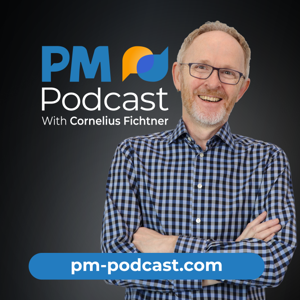
The Project Management Podcast

The Project Management Podcast

By Cornelius Fichtner, PMPBusinessCareers
Download on the App Store
  • Ranking

    2nd

    on Management & Marketing

  • Favorites

    512

    Followers

  • Typical duration

    35 min

    per episode

Based on Podcast App listening data

The Project Management Podcast episodes

  • Episode 344: Self-Assessment Questionnaire
    Click here to download the Self-Assessment Questionnaire PDF Document... This PDF Document is a the second of two handouts that Neal gave to the attendees of his session "Achieving the Elusive Work-Life Balance" at the PMI Global Congress 2015 in Orlando FL. The document is also part of a Neal Whitten eLearning course called "Achieving the Elusive Work-Life Balance" and was developed by Neal Whitten in partnership with Velociteach.
    0 min
  • Episode 343: Managing Virtual Teams (Free)
    Play Now: This episode is sponsored by The Agile PrepCast. Earn 37 PDUs:: Cornelius Fichtner and Jesse Fewell This interview with Jesse Fewell was recorded at the 2015 PMI Global Congress in Orlando, Florida. We discuss his paper and presentation "Can You Hear Me Now? Working with Global, Distributed, Virtual Teams". Here is the paper's abstract: Today's work world has changed radically. Whether video chatting with China or taking a call at from home, more and more professional work is no longer in person. It can be frustrating, but a deeper look reveals some surprises: Everyone is doing it, and not just for costs; many organizations are thriving with it. Most pain points have simple work-arounds. This paper will walk you through tips and benefits for working with people outside your office. With the rise of the Internet, emerging economies, and the trend of working from home, today’s professionals are dealing with a workplace that is very different from anything the world has ever seen. Never before in the history of mankind have we been able to conduct so much work, so quickly, with so many people outside our own location. Of course, it’s not all rainbows and unicorns. We struggle with time zone issues, language barriers, limited visibility, poor infrastructure, and so on and so on. Sometimes we choose remote teams intentionally for their benefits. But often, this kind of organizational structure is handed to managers and team members without choice. This paper is about how to deal with all those issues and strengthen your teams. Episode Transcript Below are the first few pages of the transcript. The complete transcript is available to Premium subscribers only. Coming very soon to a podcast near you... :-) Above are the first few pages of the transcript. The complete transcript is available to Premium subscribers only. Please subscribe to our Premium Podcast to receive a PDF transcript.

    23 min
  • Episode 342: Organizational Innovation is Driven by Business Analysis (Free)
    Play Now: This episode is sponsored by The Agile PrepCast. Earn 37 PDUs:: Cornelius Fichtner and Elizabeth Larson This interview with Elizabeth Larson was recorded at the 2015 PMI Global Congress in Orlando, Florida. We discuss her paper and presentation "I Don’t Have Time to Innovate: I’m Too Busy Doing Business Analysis" (Co-written with Richard Larson). Here is the paper's abstract: Everyone seems to be talking about the importance of organizational innovation, as well as what it means for practitioners of business analysis. Are business analysis and innovation even compatible? This paper answers this question affirmatively: yes, they are. But what is innovation and how can business analysis practitioners help organizations innovate? Innovation may include process improvement as some have suggested. It also may include doing root cause analysis to identify problems and then finding solutions to those problems as others have claimed. And it can certainly include doing projects agilely, changing the features of the product being built as needs become known. However, although each of these is an important factor in developing creative solutions, each by itself is probably not enough. Innovation requires us not only to spot all manner of opportunities, but also to use our influencing skills to convince the organization to seize them. Episode Transcript Below are the first few pages of the transcript. The complete transcript is available to Premium subscribers only. Podcast Introduction Cornelius Fichtner: Welcome back to Orlando, Florida. You are listening to the Project Management Podcast at www.pm-podcast.com. And we're coming to you live from the 2015 PMI Global Congress. I'm sitting in the Exhibit Hall and next to me is Elizabeth Larson. Hello, Elizabeth. Elizabeth Larson:   Hi, Cornelius. Cornelius Fichtner:   Good morning. How's everything? Elizabeth Larson:   Everything is great. I really am delighted to be here. Cornelius Fichtner:   Wonderful. Elizabeth Larson:   Happy to be talking to you. Cornelius Fichtner:   So our key note this morning is all about innovation. You and I, we're going to talk about innovation. This is a wonderful mind-meld here today. But my first question for you, what is the 2016 trend that you see coming our way? Elizabeth Larson:   As far as project management is concerned, I see the fact that project management skills will always be needed. Whether we're working on Agile projects, whether we're working on traditional projects, we need the project management skills. But the trend that I see is more towards a distribution of the role. I see the titles are going to be less important so maybe the title of project manager will be less important in some organizations than it's been in the past. But the skills will still be needed. So that's the trend that I see. I see other people may be picking up parts of what we now might say as a project manager role. And I see that the project manager may be asked to pick up and do some other things, but the skills are still going to be needed. Cornelius Fichtner:   Excellent. I Don't Have Time To Innovate, I'm Too Busy Doing Business Analysis is the topic of your paper & presentation. Why this topic? What got you interested in it? Elizabeth Larson:   I'm very interested in business analysis. And when I say business analysis, I do distinguish between business analysis and a business analyst by the way. So I'm talking about anyone that practices business analysis. I'm also very interested in innovation and its effect on organizations of all sizes. And I thought, this would be kind of a fun topic that, boy, some people think it's an either/or thing. That either we're doing business analysis, I’m so busy, I don't have time to do anything else or I'm busy innovating. And my central theme really is, i
    16 min
  • Episode 341: The Business Analysis Practitioner as Entrepreneur (Free)

    Play Now:

    This episode is sponsored by The Agile PrepCast. Earn 37 PDUs::

    Cornelius Fichtner and Richard Larson

    This interview with Richard Larson was recorded at the 2015 PMI Global Congress in Orlando, Florida. We discuss his paper and presentation "Entrepreneurial Business Analysis Practitioner" (Co-written with Elizabeth Larson). Here is the paper's introduction:

    Given both authors are entrepreneurs and have done extensive business analysis work, it seems logical for us to write about this topic. But, why bother? What possibly could be relevant about entrepreneurialism for a business analyst or project manager? For starters, entrepreneurship is an increasingly attractive career option within an organization and as a start-up, and is more and more viable with each passing year. Even if we are not interested in forming a start-up, the principles of entrepreneurship are becoming increasingly important for organizations to innovate and stay competitive.

    In this paper, we will explore several aspects of entrepreneurs and intrapreneurs and what it means for business analysis. Our firm belief is that by adopting a more entrepreneurial way of working, practitioners will be more effective and organizations will benefit.

    Episode Transcript
    Below are the first few pages of the transcript. The complete transcript is available to Premium subscribers only.

    Podcast Introduction

    Cornelius Fichtner: Hello everyone and welcome back to the Project Management Podcast at www.pm-podcast.com. We are coming to you live from the Exhibit Hall here at the 2015 PMI Global Congress in Orlando, Florida at Disneyworld. And sitting next to me is Richard Larson from Watermark Learning. Hello, Richard.

    Richard Larson:   Hello Cornelius, glad to be here.

    Cornelius Fichtner:   Good morning. Good morning.

    Richard Larson:   Good morning.

    Cornelius Fichtner:   My first question to everybody at the congress is, what's coming our way next year? What do you see as a project management trend for 2016? What do our listeners have to be aware of?

    Richard Larson:   Well, I think the trend has been brewing for awhile in terms of project managers being more business leaders rather than project implementers per se. And that you can see that happening with the new CCR changes from PMI in terms of real big emphasis on leadership. And so that, the presentation that I'm doing, we'll get into this question a bit later, I understand, but applies to project managers as much as business analysts in terms of being more entrepreneurial. And that's just one manifestation that the leadership trend. There are many others. There's speakers like my wife Elizabeth who’s going to be talking about innovation that’s certainly key and that's hot and how can we help the business succeed. Over and above, we're just doing our job as project implementers.

    Cornelius Fichtner:   All right. Your talk is about Entrepreneurial Business Analysis Practitioners. Why did you choose this topic? What's your interest in this?

    Richard Larson:   Well, it came together when I was asked to do a key note at a business analysis conference last fall in New Zealand. And we're talking about different topics like innovation, and they said, no, no, we're already been there, done that, which proves kind of interesting. They needed something beyond that, and they thought that an entrepreneurial element to it, knowing that I was an entrepreneur, having been running a company for 23 years, would know something about the topic, which is true. But then how can a business analyst or how can people practicing business analysis be more entrepreneurial in what they do? And so the talk kind of grew from that and I really got interested in it. And I have been writing a series of articles in BA Times and Project Times over the last year on this topic. And I hope to have an e-book with my wife Elizabeth being published at some point around the first of the year or so. And it does really grown a lot in my mind in terms of more than just being entrepreneurial after you leave your job as a BA or a PM. But applying it to entrepreneurs on the job, which I really taken it to a new level in terms of focusing on entrepreneurship where people who are project professionals let’s say, it doesn't matter if you're highly a business analyst or project manager. But if you do any kind of project related work which this congress is probably focused on, of course, can be entrepreneurs within your organization as intrapreneur.

    Cornelius Fichtner:   So the presentation you're doing and our discussion here is also interesting for project managers because after all, we are the Project Management Podcast and not the Business Analysis Podcast

    Richard Larson:   Right, yeah. And to some extent, the name Business Analysis in the title, I hope it doesn't dissuade project managers from attending. And we picture it that way in part because we've been working with Dave Big whose in-charge of the business analysis portfolio here at PMI. And wanted to help him with the business analysis track but it really is applicable in anybody in a project role.

    Cornelius Fichtner:  All right. Let's get in to your presentation. What do business analysis and entrepreneurship have in common?  

    Richard Larson:   Well, the basic course, that both are involved in product development. And whether it's from product inception to the requirements to product testing and product performance, there's a lot in common. Plus, entrepreneurs have a number of traits and skills and techniques that map very closely to business analysis. I published a book along with my wife Elizabeth done on her website, there are 15 or 16 very similar traits. And as I was studying the topic and getting ready for that key note in New Zealand, the list kept growing and growing and I was just astounded by how much in common. And not only business analysis but project management as well, there are many parallel traits. And so in the presentation here at congress, I boil it down to six core ones.

    Cornelius Fichtner:   All right. That's perfect segue because that's my next question. What are those traits?  

    Richard Larson:   Well, a number of things, one is they both help foster innovation. Now the paper has, you know, a bigger list. But again, innovation is an important one where people who work on product development in companies help understand problems. come up with solutions, recommend them for, you know, project proposals, I say, or business cases and so forth. Observation and experience, they're very important for entrepreneurs to be able to look around, take our experience and use it to a new situation. But people in organizations have that experience as well and so I think it's an important trait in both realms.

    Cornelius Fichtner:   And even if I think of myself as a project manager in this environment, these are the things that I have to do - observation and innovation. I have to think about these things. as I'm running my projects.

    Richard Larson:   I'm sure. And in benchmarking, I would throw in to that as well.

    Cornelius Fichtner:   And so often, we project managers, we were both has, we're project managers and business analyst at the same time.

    Richard Larson:   Right. And so, now you're making me regret the title. Because it's really broader than just business analyst. You know, there's a whole lot of planning and research and as I mentioned earlier, product testing is similar. Influencing skills, you have to be able to influence your stakeholders on projects whether you're a project manager or a business analyst and certainly, as an entrepreneur. And lastly, communication skills, I think, in some of the research I've done, that's listed as the number one trait amongst entrepreneurs. And I think, that's essential for BAs and PMs. Somebody once said that 90% of the project manager’s job is communication. And of the communication skills, one book cited listening skills is the most important skill for entrepreneur which I have to say it's true. And certainly for project professionals, well, there's a tremendous overlap between entrepreneurship and project work especially business analysis and project management.

    Cornelius Fichtner:   What I like about the skills that you have in the paper is you divided them up into three categories: ability to analyze and conceptualize, business skills and then also, interpersonal skills. Did that just grow naturally out of the ones you found or...?  

    Above are the first few pages of the transcript. The complete transcript is available to Premium subscribers only. Please subscribe to our Premium Podcast to receive a PDF transcript.
    18 min

About The Project Management Podcast

From the publisher's feed

Become the project manager everyone wants on their team. Tune in to The Project Management Podcast™ and join Cornelius Fichtner, PMP, CSM, as he interviews global PM experts to uncover what drives…

Best of The Project Management Podcast

Ranked by our users in the last 21 days

More shows like The Project Management Podcast

TED Radio Hour by NPR

TED Radio Hour

21,775 Listeners

The Tim Ferriss Show by Tim Ferriss: Bestselling Author, Human Guinea Pig

The Tim Ferriss Show

16,036 Listeners

Coaching for Leaders by Dave Stachowiak

Coaching for Leaders

1,455 Listeners

HBR IdeaCast by Harvard Business Review

HBR IdeaCast

138 Listeners

Something You Should Know by Mike Carruthers | OmniCast Media

Something You Should Know

4,237 Listeners

The Diary Of A CEO with Steven Bartlett by DOAC

The Diary Of A CEO with Steven Bartlett

8,334 Listeners

Projectified by Project Management Institute

Projectified

231 Listeners

Learning English from the News by BBC Radio

Learning English from the News

237 Listeners

Life Kit by NPR

Life Kit

4,747 Listeners

The Happiness Lab with Dr. Laurie Santos by Pushkin Industries

The Happiness Lab with Dr. Laurie Santos

14,298 Listeners

Think Fast Talk Smart: Communication Techniques by Matt Abrahams, Think Fast Talk Smart

Think Fast Talk Smart: Communication Techniques

803 Listeners

Huberman Lab by Scicomm Media

Huberman Lab

28,981 Listeners

The Everyday PM: Project Management Principles for Your Everyday Life by Ann Campea

The Everyday PM: Project Management Principles for Your Everyday Life

37 Listeners

The Mel Robbins Podcast by Mel Robbins

The Mel Robbins Podcast

18,838 Listeners

HBR On Leadership by Harvard Business Review

HBR On Leadership

159 Listeners