
Sign up to save your podcasts
Or

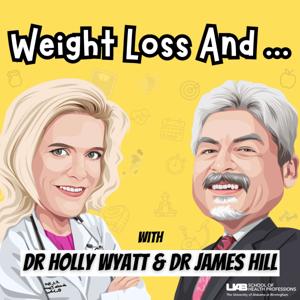


If losing weight made movement easier, wouldn’t you naturally start moving more? It’s the kind of assumption that feels almost too obvious to question: shed 40 or 50 pounds, and your knees stop aching, the stairs get easier, and you’re out there living more. Holly and Jim certainly believed it. But in the age of GLP-1 medications, where rapid, substantial weight loss is now common, does this assumption still hold up?
In this episode, Holly and Jim put that belief to the test with real data. Diving into three separate studies (including brand-new, cutting-edge research), they explore what happens to physical activity levels once people start losing weight on GLP-1s. The results might surprise you, and as Jim warns early on, they might leave you feeling a little deflated too. But stick around, because Holly and Jim don’t just deliver the bad news; they explain why it matters and what you can actually do about it.
Discussed on the episode
Everyone knows GLP-1 medications help people eat less. But does eating less actually mean eating better? It’s a question the weight loss field never really had to ask before, and the answer might surprise you.
Join Holly and Jim as they dig into three GLP-1 studies looking at what people are actually eating. You’ll hear the real numbers behind diet quality, protein intake, and nutrient gaps on these medications, plus what it means for anyone currently taking (or considering) a GLP-1. Holly and Jim also share five practical tips to help ensure your diet works as hard as your medication is.
Discussed on the episode
Think you know what it takes to keep weight off? Most people can tell you how to lose weight, but ask them what actually predicts keeping it off, and the answers get shaky fast. That’s a problem, because losing weight and maintaining weight loss are two completely different biological and behavioral games, and confusing the two is one of the biggest reasons people yo-yo.
In this episode, Holly and Jim put their listeners to the test literally. They’ve built a 20-question pop quiz covering everything from the hidden biology of metabolic adaptation to the real findings from the National Weight Control Registry, the groundbreaking study Jim co-founded three decades ago. And because so much has changed recently, they’re also tackling the question everyone’s asking: does any of this still apply in the age of GLP-1 medications?
Grab a pen (or play along in your head) and see how many you get right. Some answers might surprise you, and a few might change how you think about your own weight loss journey for good.
Discussed on the episode:
What did humans actually evolve to eat? With paleo, keto, vegan, Mediterranean, and a thousand other diets all claiming to be "the one," it's no wonder people feel whiplashed every time they walk into a grocery store. But what if the answer isn't found in the latest diet book, but in millions of years of human evolution?
Join Holly and Jim as they welcome back Harvard evolutionary biologist Dan Lieberman for a second appearance on the show. This time, Dan isn't talking exercise. He's talking food. Drawing on his new book, "Fed Up: What Evolution Reveals About Food, Diet, Health, and Eating Well," Dan explains why there's no single "evolutionary diet," why our supermarkets are a completely unprecedented environment for the human brain, and why willpower alone was never going to be enough. And because Dan doesn't just study diets, he lives them. He shares the surprisingly rough personal experiments he and his wife put themselves through in the name of research.
By the end of this episode, you'll understand exactly why eating well feels so hard in the modern world, and why that struggle has nothing to do with a lack of discipline.
Discussed on the episode:
Resources mentioned:
Most people trying to lose weight obsess over the what: what diet, what medication, what workout plan. But according to Holly and Jim, the real key to long-term success isn't found in any of those choices. It's found in a set of decisions most people never even realize they're making.
In this episode, Holly and Jim count down the 10 decisions that determine whether a weight loss journey actually sticks. Some are questions you'd expect. Others might catch you completely off guard, including the one they say most listeners will never predict is number one.
Whether you're just starting, deep into a GLP-1 medication, working to maintain weight you've already lost, or wondering if you're on the right plan at all, this countdown is built for you. So before you make your next move, find out if you've quietly been making these decisions by default or on purpose.
Discussed on the episode:
For years, the ceiling on medical weight loss was 15%, maybe 20% if you were lucky. Now a new triple-target medication is posting average results that flirt with 30% body weight loss in clinical trials, numbers once reserved for the operating room. Holly and Jim sat down to unpack what's driving these results, and found themselves asking a question neither expected to ask in their careers: how much weight loss is actually too much?
Retatrutide, the drug at the center of this episode, adds a third receptor target to the GLP-1 and GIP combination already familiar to listeners. Holly and Jim break down what this third piece brings to the table, walk through the newest published and presented trial data, and get refreshingly honest about the parts of this "medical miracle" that keep them up at night.
More weight loss isn't automatically better weight loss. As these medications get more powerful, Holly and Jim argue the field needs to catch up fast on nutrition, dosing, and what "success" even means going forward. If you've been following the GLP-1 story, this episode is the plot twist you didn't see coming.
Discussed on the episode:
Can simply paying attention to your first bite of food change how much you eat? It sounds too simple to matter, but Holly and Jim are digging into a topic that might seem completely outside their lane: mindfulness and meditation.
For years, mindfulness has been filed under "stress management," not "weight management." But a growing body of research is asking a bigger question: can training the mind actually change the way we eat, not by altering our biology, but by changing how we respond to it? Holly and Jim break down a recent meta-analysis of dozens of studies to find out what's real, what's hype, and where this surprisingly powerful tool might fit into your own weight loss journey, especially the part everyone struggles with most: keeping the weight off.
Tune in as Holly and Jim separate the science from the sales pitch, tackle listener questions, and even reveal a personal update that might surprise you.
Discussed on the episode
A few clicks online. No exam, no phone call, no video visit. Minutes later, a GLP-1 prescription is headed to your door. It sounds like the future of healthcare: fast, easy, convenient. But is convenience the same thing as care?
A Yale research team wanted to find out, so they built a fake patient, sent her to 49 different online GLP-1 providers, and tracked exactly what happened. What they found may change the way you think about getting these medications online and raise questions you didn't know to ask.
Join Holly and Jim as they unpack this eye-opening "secret shopper" study and use it to explore a much bigger question: when does convenience actually improve obesity care, and when does it quietly replace it? Whether you're currently taking a GLP-1, considering one, or just curious about where obesity treatment is headed, this episode will change how you evaluate any provider online or in person.
Discussed on the episode:
For years, patients kept telling Holly the same strange thing: it wasn't the number on the scale that changed their life, it was something quieter, something they'd never had words for. They just didn't think about food anymore.
Now that experience has a name, and for the first time, a way to measure it. Food noise has gone from an offhand comment on social media to one of the most talked-about concepts in obesity science, and Holly and Jim are back to unpack how far the research has come since they last covered it.
Join Holly and Jim as they revisit food noise with fresh eyes. You'll hear how a handful of scattered patient stories turned into a full-blown scientific movement, what the newest validated tools can actually tell us, and why this "invisible" part of obesity might reshape how we think about treatment for years to come. Along the way, Holly and Jim get personal, sharing their own honest (and sometimes surprising) answers to whether they experience food noise themselves.
Discussed on the episode:
GLP-1 medications are the single most requested topic on the show, no contest. But with so much noise on social media, in doctors' offices, and everywhere in between, sorting fact from fiction has never been trickier. Some of what's out there is spot-on. Some of it is dangerously wrong.
So this week, Holly and Jim are flipping the format. Instead of another lecture, they're putting GLP-1 knowledge to the test with a 20-question quiz covering everything from the basic biology of these medications to the questions doctors themselves don't always get right. Grab a pen, keep score, and see how you stack up.
By the end of this episode, you'll have a clearer, science-backed answer to the questions you've been too afraid to ask or too confused by conflicting headlines to trust.
Discussed on the episode:
From the publisher's feed
Ranked by our users in the last 21 days

11,785 Listeners
862 Listeners

1,070 Listeners

2,199 Listeners

12,714 Listeners
1,193 Listeners

775 Listeners

2,602 Listeners
9,148 Listeners

8,001 Listeners

129 Listeners
545 Listeners
413 Listeners

1,192 Listeners
170 Listeners