
Sign up to save your podcasts
Or

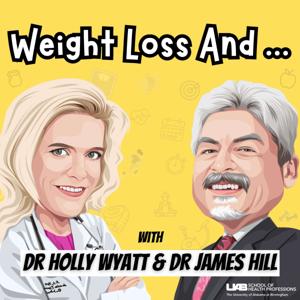


Can simply paying attention to your first bite of food change how much you eat? It sounds too simple to matter, but Holly and Jim are digging into a topic that might seem completely outside their lane: mindfulness and meditation.
For years, mindfulness has been filed under "stress management," not "weight management." But a growing body of research is asking a bigger question: can training the mind actually change the way we eat, not by altering our biology, but by changing how we respond to it? Holly and Jim break down a recent meta-analysis of dozens of studies to find out what's real, what's hype, and where this surprisingly powerful tool might fit into your own weight loss journey, especially the part everyone struggles with most: keeping the weight off.
Tune in as Holly and Jim separate the science from the sales pitch, tackle listener questions, and even reveal a personal update that might surprise you.
Discussed on the episode
A few clicks online. No exam, no phone call, no video visit. Minutes later, a GLP-1 prescription is headed to your door. It sounds like the future of healthcare: fast, easy, convenient. But is convenience the same thing as care?
A Yale research team wanted to find out, so they built a fake patient, sent her to 49 different online GLP-1 providers, and tracked exactly what happened. What they found may change the way you think about getting these medications online and raise questions you didn't know to ask.
Join Holly and Jim as they unpack this eye-opening "secret shopper" study and use it to explore a much bigger question: when does convenience actually improve obesity care, and when does it quietly replace it? Whether you're currently taking a GLP-1, considering one, or just curious about where obesity treatment is headed, this episode will change how you evaluate any provider online or in person.
Discussed on the episode:
For years, patients kept telling Holly the same strange thing: it wasn't the number on the scale that changed their life, it was something quieter, something they'd never had words for. They just didn't think about food anymore.
Now that experience has a name, and for the first time, a way to measure it. Food noise has gone from an offhand comment on social media to one of the most talked-about concepts in obesity science, and Holly and Jim are back to unpack how far the research has come since they last covered it.
Join Holly and Jim as they revisit food noise with fresh eyes. You'll hear how a handful of scattered patient stories turned into a full-blown scientific movement, what the newest validated tools can actually tell us, and why this "invisible" part of obesity might reshape how we think about treatment for years to come. Along the way, Holly and Jim get personal, sharing their own honest (and sometimes surprising) answers to whether they experience food noise themselves.
Discussed on the episode:
GLP-1 medications are the single most requested topic on the show, no contest. But with so much noise on social media, in doctors' offices, and everywhere in between, sorting fact from fiction has never been trickier. Some of what's out there is spot-on. Some of it is dangerously wrong.
So this week, Holly and Jim are flipping the format. Instead of another lecture, they're putting GLP-1 knowledge to the test with a 20-question quiz covering everything from the basic biology of these medications to the questions doctors themselves don't always get right. Grab a pen, keep score, and see how you stack up.
By the end of this episode, you'll have a clearer, science-backed answer to the questions you've been too afraid to ask or too confused by conflicting headlines to trust.
Discussed on the episode:
We've all felt it: you decide to eat healthier, open social media, and within minutes, you're drowning in contradictory advice. Eggs are back. Butter's healthy. Seed oils are toxic. Never eat after 7pm. Wait, only eat between noon and 6pm? By the end, you're left wondering if anyone can just tell you what to eat.
Join Holly and Jim as they sit down with award-winning food journalist and registered dietitian Carolyn O'Neil to unpack why nutrition advice feels so exhausting and contradictory. With decades spent translating nutrition science for CNN and beyond, Carolyn has made a career out of turning "pie in the sky" science into "pie on the plate" advice people can actually use. In this conversation, she shares how to separate real science from clickbait, why food doesn't have to be the enemy, and how her philosophy of "the more you know, the more you can eat" can transform your relationship with food.
Whether you're confused by conflicting headlines, navigating a GLP-1 journey, or just trying to enjoy a family celebration without guilt, this episode is packed with practical, joyful wisdom from one of the most trusted voices in nutrition communication.
Discussed in the episode
Cancer is the disease most people fear. But heart disease is the one that actually kills the most Americans, and most people never connect it to their weight. For decades, obesity was treated as a bystander to heart disease, a risk factor at best. That thinking has changed dramatically, and the data behind that shift is stunning: we now have a medication proven to cut major cardiovascular events by 20% in people with obesity.
Join Holly and Jim as they sit down with an old friend and true legend in the field, Dr. Robert Eckel, Professor Emeritus at the University of Colorado Anschutz Medical Campus. Bob is the only person to have ever served as president of the American Heart Association, the American Diabetes Association, and the Obesity Society, a hat trick that connects heart, metabolism, and weight in a way no one else in medicine can claim. He's been in the room for four decades of major turning points in this field, from the earliest meetings on obesity science to the current GLP-1 era.
In this episode, Bob walks Holly and Jim through the science, the skepticism, and the surprises behind the biggest shift in obesity treatment of their careers and answers real listener questions about medications, guidelines, and what patients should actually be asking their doctors.
Discussed in the episode:
For decades, one number has ruled the world of fitness: 10,000 steps. It's on your watch, your phone, maybe even tattooed into your daily to-do list. But what if that number was never based on science at all?
Join Holly and Jim as they sit down with Dr. Amanda Paluch, Associate Professor of Kinesiology at the University of Massachusetts Amherst and leader of the Steps for Health Collaborative, an international research consortium pooling data from over 125,000 adults to answer one deceptively simple question: how many steps do you actually need? Amanda pulls back the curtain on where the 10,000-step goal really came from, what the data shows instead, and why the "right" number might depend on how old you are. Whether you're chasing a step count, recovering from mobility limitations, or navigating GLP-1 medications, this conversation will change the way you think about your daily walk.
Discussed in the episode:
For 40 years, every time nutrition has found a new villain, the food industry has handed us a new label to go with it: non-fat, no GMOs, gluten-free, no seed oils, and now, non-ultra-processed. We have more experts, more studies, and more food rules than ever before, so why does standing in the grocery aisle still feel like such a guessing game?
Join Holly and Jim as they sit down with Tamar Haspel, the James Beard Award-winning Washington Post columnist behind Unearthed and author of To Boldly Grow, to pull apart the ultra-processed food debate and ask whether today's labels are actually helping us eat better or just making us easier to market to. Tamar doesn't just write about food from behind a desk: she gardens, fishes, raises chickens, and runs an oyster farm on Cape Cod, and she brings three decades of reporting, real skepticism, and zero patience for diet cranks to the conversation.
You'll hear why the food world keeps repeating the same mistake, what a cage full of B.F. Skinner's pigeons can teach us about our relationship with food, and what's really driving overeating once you strip away the marketing.
Discussed on the episode:
Losing weight on a GLP-1 medication can feel like magic until the scale stops moving. For almost everyone on these drugs, there comes a moment when the rapid progress slows, then stalls completely. Is the medication failing? Has your metabolism adapted? Did you do something wrong? For most people, that moment feels like a problem. It isn't.
Join Holly and Jim as they unpack one of the most misunderstood parts of the GLP-1 journey: the shift from losing weight to keeping it off. You'll discover why a stalled scale is actually a sign the medication is doing exactly what it's supposed to do, and why "maintenance" is a completely different physiological state than "weight loss." One that comes with its own rules. Along the way, you'll pick up science-backed (and some still-unanswered) guidance on nutrition, muscle, bone health, and motivation for the long haul, plus a clear answer to a question Holly says she gets all the time: Are they against staying on these medications long-term?
Discussed on the episode:
Have a question or a success story? Send it in. Holly and Jim read every one, and they're especially looking for listener stories about navigating weight loss maintenance.
What if the biggest obstacle to your health isn't your willpower, it's your zip code? Most of us have been raised to believe that weight and health come down to personal choices: what you eat, how much you move, how disciplined you are. But what if the deck has been stacked against millions of Americans before they ever make a single decision?
This week, Holly and Jim sit down with Dr. Christina Economos, Dean of the Friedman School of Nutrition Sciences and Policy at Tufts University, to explore one of the most important and most overlooked dimensions of the obesity epidemic: the environments we live in. With decades of groundbreaking research behind her, including the landmark Shape Up Somerville study, Dr. Economos makes a compelling case that lasting health change can't happen one person at a time.
And with GLP-1 medications reshaping what's possible for individual weight loss, the conversation has never been more urgent. Does community still matter when we have powerful new treatments? Dr. Economos has a clear answer, and it just might change how you see your own role in the bigger picture.
Discussed on the episode:
From the publisher's feed
Ranked by our users in the last 21 days

11,739 Listeners
872 Listeners

1,075 Listeners
2,194 Listeners

12,682 Listeners
1,196 Listeners
776 Listeners
2,614 Listeners

9,140 Listeners

7,922 Listeners

130 Listeners
544 Listeners
414 Listeners

1,218 Listeners
173 Listeners