
Sign up to save your podcasts
Or

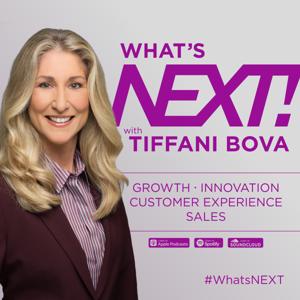


Welcome to the What's Next! Podcast with Tiffani Bova. I'm thrilled to welcome you back to a series I did with my dear friend, Roger Martin. He's the author of the amazing book, Playing to Win. In this episode, we discuss how your current actions impact your strategy.
THIS EPISODE IS PERFECT FOR…leaders, executives, entrepreneurs, and teams trying to improve results without getting stuck chasing the "perfect" strategy.
TODAY'S MAIN MESSAGE…whether you claim it or not, you already have a strategy. It's reflected in the choices you're making every day. In this episode, Roger and Tiffani unpack one of the biggest misconceptions in business: the belief that strategy is something you create from scratch during a planning session. Roger explains that every company already has a strategy because every organization is making choices about investments, hiring, marketing, products, customers, and priorities. The real question is whether those choices are producing the results you want.
KEY TAKEAWAYS…
WHAT I LOVE MOST…Roger's emphasis on "betterment" over perfection. Instead of trying to engineer one flawless strategy that solves everything forever, he encourages leaders to continuously improve the choices creating the biggest pain points.
Running Time: 27:38
Subscribe on iTunes
Find Tiffani Online:
X
Find Roger Online:
Website
Show Summary on Substack
Welcome to the What's Next! Podcast with Tiffani Bova.
I'm thrilled to welcome Cheryl Strauss Einhorn, author, decision strategist, and creator of The Area Method. Her new book, The Human Edge, really challenges a core assumption we're all making right now that more technology automatically leads to better outcomes. What I love about her work is that it's not anti-AI, it's pro-human. She gives us a framework to think more clearly, challenge what we're seeing, and ultimately make decisions with more confidence and intention. Because at the end of the day, the question isn't whether we'll use AI, it is whether we will lead it or it will lead us.
THIS EPISODE IS PERFECT FOR…anyone using AI in their work and wondering how to make better decisions without losing their human edge.
TODAY'S MAIN MESSAGE…AI can make you faster but it doesn't automatically make you better. Cheryl breaks down why decision-making, not technology, is the true competitive advantage. While AI can accelerate research, generate ideas, and even mirror your voice, it lacks context, judgment, and an understanding of what truly matters to you. Cheryl introduces the concept of "strategic stops" which are intentional moments to reflect, question assumptions, and ensure you're solving the right problem in the first place.
KEY TAKEAWAYS…
AI is only as good as the context you give it. Without that critical piece, you risk getting answers that sound right but aren't useful.
Strategic pauses ("friction") improve decisions by helping you question assumptions and refine your thinking.
AI can reinforce bias or limit perspective if you don't actively challenge its outputs.
The most important decisions still require human judgment especially when stakes are high and outcomes are uncertain.
The future belongs to strong decision-makers, not just companies with the best AI tools.
WHAT I LOVE MOST…Cheryl's perspective that AI isn't replacing thinking but is actually demanding better thinking. The idea that we're all "chief deciders" in our own lives is a powerful reminder: no matter how advanced the technology gets, the responsibility to think critically is still ours.
Running Time: 25:56
Subscribe on iTunes
Find Tiffani Online:
X
Find Cheryl Online:
Website
Cheryl's Book: The Human Edge: Smarter Decisions in the Age of AI
Welcome to the What's Next! Podcast with Tiffani Bova. I'm thrilled to welcome you back to a series I did with my dear friend, Roger Martin. He's the author of the amazing book, Playing to Win. In this episode, we discuss the concept of what would have to be true for something to be a good idea.
THIS EPISODE IS PERFECT FOR…anyone frustrated by endless debates who wants a smarter way to make strategic decisions.
TODAY'S MAIN MESSAGE…most teams get stuck arguing about what's true when the better question is what would have to be true. In this conversation, Roger reframes one of the most common breakdowns in strategy: teams debating data, context, and "facts" without ever moving forward. Instead of trying to prove what's true today, he introduces a more powerful approach, working backward from a future outcome and asking what conditions must exist for it to succeed.
KEY TAKEAWAYS…
"What would have to be true" shifts teams from arguing about data to aligning on logic.
Strong strategies often make something true that isn't true yet.
Breaking goals into assumptions exposes whether a plan is realistic or wishful thinking.
WHAT I LOVE MOST…the idea that strategy isn't about proving you're right, it's about testing whether your thinking holds up. When you shift from "this is true" to "what would have to be true," the conversation changes completely. It removes ego, surfaces assumptions, and forces clarity.
Running Time: 27:35
Subscribe on iTunes
Find Tiffani Online:
X
Find Roger Online:
Website
Show Summary on Substack
Welcome to the What's Next! Podcast with Tiffani Bova. I'm thrilled to welcome you back to a series I did with my dear friend, Roger Martin. He's the author of the amazing book, Playing to Win. In this episode, we discuss how being too busy sabotages your strategy.
THIS EPISODE IS PERFECT FOR…leaders and high-performers who feel constantly busy (or burned out) and want a more strategic way to manage their time and energy.
TODAY'S MAIN MESSAGE…being busy isn't a badge of honor. It's often a signal that your personal strategy isn't working. In this episode, Roger reframes busyness as a strategic failure, not a productivity win. If you're constantly overwhelmed, it likely means you haven't clearly defined where to focus your time, how to create the most value, and what to stop doing.
KEY TAKEAWAYS…
Constant busyness is often a sign of a weak or unclear personal strategy.
You have fixed capacity so where you spend your time matters more than how much you work.
Strategy is as much about what you don't do as what you do.
Subtracting low-value work is the fastest way to create more impact.
Investing time upfront (in people, systems, and planning) pays off long-term.
WHAT I LOVE MOST…the emphasis on subtraction over addition.So many people think the path to more impact is doing more but Roger shows that the real leverage comes from removing what doesn't matter and doubling down on what does.
Running Time: 25:36
Subscribe on iTunes
Find Tiffani Online:
X
Find Roger Online:
Website
Show Summary on Substack
Welcome to the What's Next! Podcast with Tiffani Bova.
I'm thrilled to welcome Dr. Vivienne Ming to the show. She's a theoretical neuroscientist, AI expert, and what she calls a "professional mad scientist for the public good." She's also fabulous in person and one of my go-tos whenever I have a question about these topics because her work challenges the idea that we should compete with machines and instead pushes us to become more human, not less.
THIS EPISODE IS PERFECT FOR…anyone trying to understand how to stay relevant in an AI-driven world and how to use technology to become more human, not less.
TODAY'S MAIN MESSAGE…we've spent the last decade building AI that can operate without us, but that may be the wrong goal entirely. Vivienne challenges the dominant narrative around artificial intelligence, arguing that the real opportunity isn't automation or efficiency, it's hybrid intelligence. The most powerful outcomes happen when humans and machines work together, not when one replaces the other.
KEY TAKEAWAYS…
The real differentiator in an AI world is your ability to explore unknown, messy, "ill-posed" problems.
Using AI to challenge your thinking—not replace it—leads to better outcomes and deeper insights.
WHAT I LOVE MOST…the idea that AI shouldn't make life easier, it should make your thinking better. The people who win in this new world aren't the ones who automate everything… they're the ones who stay deeply engaged, ask better questions, and use AI as a thought partner.
Running Time: 37:22
Subscribe on iTunes
Find Tiffani Online:
X
Find Vivienne Online:
Website
Vivienne's Book: Robot-Proof: When Machines Have all the Answers, Build Better People
Welcome to the What's Next! Podcast with Tiffani Bova. I'm thrilled to welcome you back to a series I did with my dear friend, Roger Martin. He's the author of the amazing book, Playing to Win. In this episode, we discuss whether OKRs, or Objectives and Key Results, actually help you win or whether they're masquerading as strategy.
THIS EPISODE IS PERFECT FOR…leaders and operators who are frustrated with OKRs, unclear metrics, or goals that feel disconnected from reality and want a smarter way to connect strategy to execution.
TODAY'S MAIN MESSAGE…we often treat OKRs like a magic solution, but according to Roger, they're only as good as the strategy behind them. Too many organizations jump straight from setting big goals (the "O") to measuring results (the "KR") without doing the hard work in between. That missing middle—where to play, how to win, and what capabilities are required—is what actually makes goals achievable.
KEY TAKEAWAYS…
OKRs fail when there's no strategy connecting the objective to the results.
Measurement helps but not everything that matters can be measured.
The "middle three boxes" (where to play, how to win, capabilities) determine success.
Many OKRs are unrealistic because they're based on assumptions, not strategy.
When goals aren't achievable, adjust the strategy or reset the goal.
WHAT I LOVE MOST…Roger's reminder that metrics don't create outcomes but strategy does. This is such an important shift, especially for teams stuck chasing numbers that were never grounded in reality.
Running Time: 25:36
Subscribe on iTunes
Find Tiffani Online:
X
Find Roger Online:
Website
Show Summary on Substack
Welcome to the What's Next! Podcast with Tiffani Bova.
I'm thrilled for this show for so many reasons. Today's guest has spent his career challenging how we think about people at work, what drives performance, what builds great teams and what actually helps people thrive. Marcus Buckingham is a New York Times bestselling author and a friend and one of the original pioneers of the strength movement. And now in his new book, Design Love In, he takes that thinking even further, arguing that love, when designed intentionally into how we lead and operate, is one of the most powerful forces in business.
THIS EPISODE IS PERFECT FOR…leaders, managers, and individuals who want to better understand what drives high performance and how to build roles and teams around what people naturally do best.
TODAY'S MAIN MESSAGE…We've been taught to focus on improving our weaknesses but that approach is fundamentally flawed. In this conversation, Marcus explains why excellence comes from doubling down on strengths, not fixing what's broken. He shares how organizations can unlock performance by designing roles around what people love to do, why engagement surveys often miss the mark, and how leaders can create environments where individuals thrive by doing more of what energizes them.
KEY TAKEAWAYS:
People grow most when they invest in what they naturally do best.
High performance comes from aligning work with what energizes individuals.
Traditional feedback and engagement systems often overlook individual strengths.
Great leaders focus on outcomes while allowing flexibility in how work gets done.
WHAT I LOVE MOST…Marcus' reminder that excellence isn't built by fixing weaknesses but by understanding and using your strengths every day. It's a simple shift, but it completely changes how we think about performance.
Running Time: 40:16
Subscribe on iTunes
Find Tiffani Online:
X
Find Marcus Online:
Buckingham Institute
Marcus' Book: Design Love In: How to Unleash the Most Powerful Force in Business
Welcome to the What's Next! Podcast with Tiffani Bova.
This week's guest is someone whose work has shaped how millions of people think about their work, their strengths, and their lives. Tom Rath is a #1 New York Times bestselling author whose books, including Strengths Finder 2.0, have sold more than 10 million copies worldwide and transformed how organizations develop talent. For more than two decades, Tom has studied what helps people thrive at work and in life from strengths and wellbeing to leadership and meaning. His latest book, What's the Point? explores one of the most important questions we can ask: how do we turn purpose into something we actually live every day?
THIS EPISODE IS PERFECT FOR…anyone who wants to do more meaningful work, lead with intention, and better align their strengths with how they show up every day.
TODAY'S MAIN MESSAGE…80% of us go through our lives not doing what we're best at and that disconnect has a massive impact on our energy, engagement, and overall well-being. In this conversation, Tom challenges the idea that success comes from fixing weaknesses and instead makes the case for investing in what you naturally do best. He breaks down how leaders can create environments where people thrive, why well-being and performance are more connected than most organizations realize, and how small, intentional shifts can help you get more out of your work and your life.
KEY TAKEAWAYS:
Your greatest opportunity for growth comes from investing in your natural strengths, not fixing every weakness.
Well-being is directly tied to performance, decision-making, and long-term success.
People do their best work when they feel energized, not just productive.
Leaders play a critical role in helping others discover and use what they do best.
WHAT I LOVE MOST…Tom's reminder that doing your best work isn't about pushing harder, it's about aligning what you do every day with what naturally gives you energy and purpose.
Running Time: 28:55
Subscribe on iTunes
Find Tiffani Online:
X
Find Tom Online:
Website
Tom's Book: What's the Point? Turning Purpose Into Your Daily Superpower
Welcome to the What's Next! Podcast with Tiffani Bova.
This week, I'm super excited to have Jon McNeill on the show. Jon's resume reads like a playbook. He was appointed by Elon Musk as president of Tesla after an introduction from Meta's Sheryl Sandberg. During his tenure, he helped scale revenue from $2 billion to $20 billion in 30 months. He later served as CEO of Lyft doubling revenue and leading the company's IPO. Today he co-founds and scales companies at DVx Ventures where he has launched 12 ventures and delivered 6x return to investors. His leadership experience spans every stage of growth, founder, CEO, board member at GM, Lululemon, and CrossFit. He also collaborated with historian Walter Isaacson to write The Algorithm, the first book written by any of Elon's direct reports.
THIS EPISODE IS PERFECT FOR…leaders, executives, and founders who want to scale innovation and speed without burning out their teams. If you've ever wondered how Tesla moved faster than traditional companies or how to build high-performing teams under extreme pressure, this episode will change how you think about leadership at scale.
TODAY'S MAIN MESSAGE…hypergrowth doesn't happen by chance. Jon shares the leadership principles and operating systems that allowed Tesla to scale quickly and consistently. In this conversation, he explains why innovation isn't just about smart ideas but about simplifying processes, removing friction, and giving teams the clarity and focus to execute at high intensity. He also shares why great leaders know where to get involved and where to step back, and how to build cultures where people feel empowered to solve big problems.
KEY TAKEAWAYS:
Hypergrowth succeeds when leaders simplify processes and remove unnecessary friction.
High-performing teams operate like "special forces," focused on the right problems during core hours.
Leaders scale by knowing which decisions require their involvement and which they can delegate.
Speed and performance don't come from working more hours, they come from working smarter.
WHAT I LOVE MOST…Jon's reminder that breakthrough results come from designing the system, not burning out people. His story shows that you can move fast, scale big, and innovate without sacrificing clarity, focus, or humanity.
Running Time: 38:59
Subscribe on iTunes
Find Tiffani Online:
X
Find Jon Online:
Jon's Book: The Algorithm: The Hypergrowth Formula That Transformed Tesla, Lululemon, General Motors, and SpaceX
Welcome to the What's Next! Podcast with Tiffani Bova. I'm thrilled to welcome you back to a series I did with my dear friend, Roger Martin. He's the author of the amazing book, Playing to Win. In this episode, we discuss what makes a great strategist.
THIS EPISODE IS PERFECT FOR…leaders, strategists, and executives who want to strengthen their strategic thinking and better understand what separates great strategists from good planners.
TODAY'S MAIN MESSAGE…great strategy doesn't come from intellectual brilliance alone. Roger says the best strategists develop a mindset rooted in humility, curiosity, and practice. In this episode, Roger makes the case that great strategy starts with a deep understanding of customers and evolves through experimentation in complex systems.
KEY TAKEAWAYS
Strategy should begin with a deep understanding of customers and their needs.
Overreliance on data analytics can limit creativity and strategic thinking.
Data should inform judgment, not replace it.
Great strategists invent the future rather than simply extrapolating from the past.
WHAT I LOVE MOST…Roger's reminder that strategy is a skill anybody can learn. Even leaders like A. G. Lafley became great strategists through years of experimentation and learning. It's a powerful reminder that anyone can get better at strategy with practice.
Running Time: 25:51
Subscribe on iTunes
Find Tiffani Online:
X
Find Roger Online:
Website
Show Summary on Substack
From the publisher's feed
21,750 Listeners

43,324 Listeners
39,040 Listeners

16,687 Listeners
3,155 Listeners

4,375 Listeners
1,165 Listeners
1,459 Listeners
1,341 Listeners
1,935 Listeners

111,874 Listeners

56,435 Listeners
4,457 Listeners
9,066 Listeners

824 Listeners