
Sign up to save your podcasts
Or



A simple, flexible story structure framework that works for every kind of story.
Great stories are built on great story structure.
And while there are a lot of story structure systems out there . . .
. . . I do have a favorite. It’s one that I use every single day in my editing. I apply it to every story I edit. And it works every time.
In this episode, I’m breaking it all down for you.
You’ll learn:
When I learned this framework, it transformed my entire approach to editing. That’s not a hyperbole—learning this made all the difference for me.
I practice it every time I pick up a story. And I’m always discovering new insights it offers into what makes story work.
And who knows? Maybe this will become your favorite approach to story structure, too!
Links mentioned in the episode:
Send me a Text Message!
Support the show
Rate, Review, & Follow on Apple Podcasts
"I love Alice and Your Next Draft." If that sounds like you, please consider rating and reviewing my show! This helps me support more writers through the mess—and joy—of the editing process. Click here, scroll to the bottom, tap the stars to rate, and select “Write a Review.” Then be sure to let me know what you loved most about the episode!
Loving the show? Show your support with a monthly contribution »
Story theory doesn’t sap creativity—it helps us reflect truths about the human experience in our art.
When you edit a novel, much of your job is to use story theory to evaluate what’s working and what’s not.
But often, I find that this makes writers uncomfortable. They’re afraid that applying story theory will suck the life, creativity, and originality out of storytelling.
Have you ever felt that way? Ever wondered whether the storytelling principles you use (even the ones I share here on this podcast!) might make your story too predictable, formulaic, and—gasp—boring?
If so, then you’ll love today’s episode of Your Next Draft.
In it, you’ll learn:
Full confession: this episode was inspired by a moment when I was confronted with story theory in my own life. In fact, my therapist told me something I’ve said to you many times here on this podcast!
So this episode is a little more personal than I typically get here on the podcast. But that moment was such a perfect illustration of why story theory works that I just have to share it with you.
Enjoy this glimpse into how my editor brain works. And see if you can spot story theory around you in your own life!
Links mentioned in the episode:
Send me a Text Message!
Support the show
Rate, Review, & Follow on Apple Podcasts
"I love Alice and Your Next Draft." If that sounds like you, please consider rating and reviewing my show! This helps me support more writers through the mess—and joy—of the editing process. Click here, scroll to the bottom, tap the stars to rate, and select “Write a Review.” Then be sure to let me know what you loved most about the episode!
Loving the show? Show your support with a monthly contribution »
Build a reading habit that helps you edit amazing novels.
“If you don’t have time to read, you don’t have the time (or the tools) to write. Simple as that.”
This quote from Stephen King gets shared a lot in writer circles.
But I have a confession: when I became an editor, I fell into a reading slump. Worse, I stayed in the slump for several years. (After all, Stephen King was talking about writers, not editors, right?)
Last year, I read 58 books, nearly three times the books I read the year before. And this year, I’m on track to surpass that again.
So in this episode, I’m sharing all about how to read in a way that benefits your writing and editing.
How did I get out of the reading slump? And how has reading more impacted my editing? It’s all in the episode.
You’ll learn:
Plus, a few years ago, I created a robust reading tracker spreadsheet so I can quickly reference books when I’m editing. Want to steal my reading tracker? Download my "Read Like an Editor" Reading Tracker here.
Let’s be honest: you and I are in the book industry because we love stories.
I hope this episode gives you strategies to leverage your reading in your editing process.
But more than that, I hope it inspires you and helps you reinvigorate your own reading habit.
Happy reading!
Links mentioned in the episode:
Send me a Text Message!
Support the show
Rate, Review, & Follow on Apple Podcasts
"I love Alice and Your Next Draft." If that sounds like you, please consider rating and reviewing my show! This helps me support more writers through the mess—and joy—of the editing process. Click here, scroll to the bottom, tap the stars to rate, and select “Write a Review.” Then be sure to let me know what you loved most about the episode!
Loving the show? Show your support with a monthly contribution »
Does your story’s climax solve a problem that’s different from the one you have?
The last thing you want is for the ending of your novel to disappoint your readers.
Yet as an editor, I’ve seen my fair share of disappointing endings.
And in this episode, I’m sharing one of the most common problems I see with endings that just don’t work.
You’ll learn:
When I’m working with writers, I often say something like this:
“It feels like this story is solving a problem that’s different from the one we have.”
In this episode, I’m breaking down exactly what that means—and how you can spot this issue and fix it in your story.
Links mentioned in the episode:
Send me a Text Message!
Support the show
Rate, Review, & Follow on Apple Podcasts
"I love Alice and Your Next Draft." If that sounds like you, please consider rating and reviewing my show! This helps me support more writers through the mess—and joy—of the editing process. Click here, scroll to the bottom, tap the stars to rate, and select “Write a Review.” Then be sure to let me know what you loved most about the episode!
Loving the show? Show your support with a monthly contribution »
Your characters MUST take action in every scene. Look out for scenes where they don’t.
I’ve edited hundreds of scenes. (In fact, editing scenes is one of my favorite things to do!)
In all that editing, I’ve picked up on some patterns. Things that work really well in scene after scene—and common pitfalls that many scenes fall into.
And in this episode, I’m sharing one common scene mistake I often see.
If your scenes get this wrong, they’ll be . . . boring. And no one wants to read a boring scene!
But not to worry—in today’s episode, I’ll show you how to spot this common error and fix it.
You’ll learn:
Plus, in the episode, I’ll tell you how you can download my most popular editing resource, the Scene Analysis Worksheet.
It includes all the questions I ask when I’m editing a scene so you can polish your scenes like a pro.
Listen to the episode, grab the worksheet, and go master editing scenes!
Links mentioned in the episode:
Send me a Text Message!
Support the show
Rate, Review, & Follow on Apple Podcasts
"I love Alice and Your Next Draft." If that sounds like you, please consider rating and reviewing my show! This helps me support more writers through the mess—and joy—of the editing process. Click here, scroll to the bottom, tap the stars to rate, and select “Write a Review.” Then be sure to let me know what you loved most about the episode!
Loving the show? Show your support with a monthly contribution »
Gotten feedback from an editor? Use this process to turn developmental feedback into actionable edits.
One of the most exciting moments in your book writing journey is the day that you get feedback from an editor.
But just getting feedback isn’t enough. Once you get it, you have to apply it.
And the challenge of applying your editor’s feedback can feel . . . intimidating. Scary. Overwhelming.
How do you do it? How do you cut through the overwhelm and apply your feedback with confidence?
That’s what this episode is all about.
In it, I’m sharing the three-step process I recommend to my one-on-one clients. You’ll learn:
If you’ve ever received developmental feedback on your novel, this is how I recommend you put it to use.
I hope that this takes a little bit of the overwhelm out of the process and helps you create an editing plan that works for you.
Links mentioned in the episode:
The scene list series:
The scene editing series:
Send me a Text Message!
Support the show
Rate, Review, & Follow on Apple Podcasts
"I love Alice and Your Next Draft." If that sounds like you, please consider rating and reviewing my show! This helps me support more writers through the mess—and joy—of the editing process. Click here, scroll to the bottom, tap the stars to rate, and select “Write a Review.” Then be sure to let me know what you loved most about the episode!
Loving the show? Show your support with a monthly contribution »
Your story has the power to shape the way your readers think.
So what is it communicating?
That’s the topic of this episode. In it, I’m sharing why storytelling is absolutely essential for humanity, plus the responsibility—and honor—that gives you as an author.
You’ll learn:
Your writing is powerful. It carries great meaning. And it will have an impact on your readers.
It’s up to you to shape what that meaning will be.
Send me a Text Message!
Support the show
Rate, Review, & Follow on Apple Podcasts
"I love Alice and Your Next Draft." If that sounds like you, please consider rating and reviewing my show! This helps me support more writers through the mess—and joy—of the editing process. Click here, scroll to the bottom, tap the stars to rate, and select “Write a Review.” Then be sure to let me know what you loved most about the episode!
Loving the show? Show your support with a monthly contribution »
A prolific author shares her editing process and strategies for designing the process that works for you.
There are as many ways to edit novels as there are writers.
Which editing process is best? The one that works for you. The process you customize, refine, and repeat, novel after novel after novel.
And in this episode, we’re talking about how to create your very own editing process.
I’ve invited my client JD Edwin, author of the Headspace trilogy, to share the process she’s developed and her best tips for finding what works for you.
You’ll hear:
JD is honestly one of the most productive authors I know—so productive that it’s almost a little intimidating.
Take a listen to our conversation and get tips and inspiration to try in your own editing process!
Links mentioned in the episode:
Find full show notes, including timestamps of key topics, here
Read JD Edwin’s books and find her online:
Read the Write Great Fiction series and learn how to develop your own editing process:
Listen to Your Next Draft:
Send me a Text Message!
Support the show
Rate, Review, & Follow on Apple Podcasts
"I love Alice and Your Next Draft." If that sounds like you, please consider rating and reviewing my show! This helps me support more writers through the mess—and joy—of the editing process. Click here, scroll to the bottom, tap the stars to rate, and select “Write a Review.” Then be sure to let me know what you loved most about the episode!
Loving the show? Show your support with a monthly contribution »
Two editors break down how Spider-Man creates a transcendent moment of triumph that feels like story magic.
Last month, I asked a big question:
How do you make your readers feel?
See, the writers I work with are telling fantastic stories. But often, those stories are missing some essential piece, some spark of magic that captures my emotions and makes me laugh, cry, swoon, grieve, worry, or—well—feel anything at all.
So I turned to a scene that does make me feel. It’s a brilliant moment from Spider-Man: Into the Spider-Verse.
First, I broke down exactly how that scene creates a sense of triumph so strong, it’s almost palpable.
Then, I laid out the three-step formula I’m using with my clients right now to help them do the same thing in their stories.
And when I finished recording those episodes . . . well, I still had more to say.
So I turned to my editor colleague Kim Kessler, who loves this movie as much as I do. And I invited her to grab a mic and join me for an intensely detailed breakdown of how exactly this scene creates story magic.
Kim and I cover:
Consider this the uncut (or at least, much, much less cut) behind-the-scenes version of those previous two episodes.
In it, you’ll hear tons of editing concepts I’ve talked about on the podcast, all put into action and applied to a brilliant scene.
Kim and I had a blast breaking down every nuance of this scene, and I hope you enjoy it as much as we did. More importantly, I hope it helps you craft stories your readers love just as much.
Links mentioned in the episode:
Go deeper in this episode:
Catch up on the previous episodes in this Spider-Man series:
Follow editor Kim Kes
Send me a Text Message!
Support the show
Rate, Review, & Follow on Apple Podcasts
"I love Alice and Your Next Draft." If that sounds like you, please consider rating and reviewing my show! This helps me support more writers through the mess—and joy—of the editing process. Click here, scroll to the bottom, tap the stars to rate, and select “Write a Review.” Then be sure to let me know what you loved most about the episode!
Loving the show? Show your support with a monthly contribution »
The best stories capture our emotions and make us feel so deeply, it seems like magic.
The good news is, it’s not magic.
Want to make your readers feel? There’s a simple three-step process to do just that. And in this, I’m sharing that process with you.
You’ll learn:
Want to make your readers laugh? Cry? Swoon? Shake with fear? The whole range of human emotion is at your fingertips. Find out how to create any emotion you like in the episode.
Links mentioned in the episode:
Send me a Text Message!
Support the show
Rate, Review, & Follow on Apple Podcasts
"I love Alice and Your Next Draft." If that sounds like you, please consider rating and reviewing my show! This helps me support more writers through the mess—and joy—of the editing process. Click here, scroll to the bottom, tap the stars to rate, and select “Write a Review.” Then be sure to let me know what you loved most about the episode!
Loving the show? Show your support with a monthly contribution »
From the publisher's feed
Supporting fiction writers doing the hard work of revising unputdownable novels. The novel editing process is the creative crucible where you discover the story you truly want to tell—and it can…
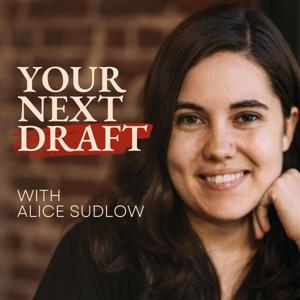
Developmental editor and book coach Alice Sudlow will be your companion through the mess and magic of revision. You’ll get inspired by interviews with authors, editors, and coaches sharing their revision processes; gain practical tips from Alice’s editing practice; and hear what real revision truly requires as Alice workshops scenes-in-progress with writers.
It’s all a quest to discover: How do you figure out what your story is truly about? How do you determine what form that story should take? And once you do, how do you shape the hundreds of thousands of words you've written into the story’s most refined and powerful form?
If you’ve written a draft—or three—but are still searching for your story’s untapped potential, this is the podcast for you. Together, let’s dig into the difficult and delightful work of editing your next draft.

38,654 Listeners
1,296 Listeners
1,007 Listeners
627 Listeners
251 Listeners
1,479 Listeners
114 Listeners
782 Listeners
430 Listeners

40 Listeners
32 Listeners

17 Listeners
21 Listeners

12,521 Listeners
15 Listeners