
Sign up to save your podcasts
Or



Answer these questions now to clarify your goals for your novel. Plus, they’ll prepare you to work with an editor when you’re ready for expert advice.
When you reach out to an editor (like me!), they’ll have a lot of questions about your novel.
After all, your editor is stepping into the middle of a writing, editing, and publication process that started long before they get to read your manuscript.
The more information you can give your editor about your story, your process, and what success means to you, the better.
In this episode, you’ll learn eight questions I ask writers when they reach out to me.
You can even download them in a worksheet to fill out your answers as you listen. Grab the worksheet here.
Treat that worksheet as a living document. It’s your guide to your novel and your goals.
And when you’re ready to work with an editor, it will help you answer any questions they ask so you can find the editor who’s the best fit for you and your novel.
Links mentioned in the episode:
Send me a Text Message!
Support the show
Rate, Review, & Follow on Apple Podcasts
"I love Alice and Your Next Draft." If that sounds like you, please consider rating and reviewing my show! This helps me support more writers through the mess—and joy—of the editing process. Click here, scroll to the bottom, tap the stars to rate, and select “Write a Review.” Then be sure to let me know what you loved most about the episode!
Loving the show? Show your support with a monthly contribution »
Two simple questions to ensure your character development drives your plot.
Every time I edit a novel, I ask two questions about the protagonist. They’re deceptively simple questions, but they reveal so much about the character.
More than that, they reveal how the story should end.
In other words, these two questions are the keys to:
. . . your character development,
. . . your climax,
. . . and your resolution.
In this episode, I’ll walk you through these essential questions:
What does your character want?
And what does your character need?
You’ll learn:
Plus, I’ll show you an example of character wants and needs at play in a fantastic novel: The Last Graduate by Naomi Novik. It’s a perfect illustration of how these questions impact character development and plot.
How about your story? What does your protagonist want? And what do they need
Links mentioned in this episode:
Send me a Text Message!
Support the show
Rate, Review, & Follow on Apple Podcasts
"I love Alice and Your Next Draft." If that sounds like you, please consider rating and reviewing my show! This helps me support more writers through the mess—and joy—of the editing process. Click here, scroll to the bottom, tap the stars to rate, and select “Write a Review.” Then be sure to let me know what you loved most about the episode!
Loving the show? Show your support with a monthly contribution »
Ever wondered what it looks like to get feedback from an editor?
Recently, my friend Kim Kessler, herself a developmental editor and author, sent me a scene of the novel she’s working on. I read it and prepared some notes for her.
Then, we hopped on a call to talk through my feedback.
And we recorded the whole conversation!
In this episode, you’ll hear exactly how developmental editing works. I walk Kim through the same process I use for all my editing clients.
You’ll hear the questions I ask her, the specific recommendations I give, and my favorite part: the moment of epiphany, when we “solve” what she needs to do next with her scene.
And if you ever feel nervous about working with an editor . . . well, we get it. Kim and I share why we felt nervous about this episode, too—and why this editing session was worth all the nerves and risk!
Fair warning: this episode is long.
It’s worth listening to the whole thing, especially if you want to hear exactly what a real developmental editing session looks like.
But if you’d like to jump straight to some key moments, check out these time stamps:
[5:42] Why Kim and I don’t offer sample edits of developmental editing
[10:06] Kim introduces her novel and shares the context of her scene
[18:35] The most important editing question: WHY Kim is writing this novel and what she wants it to achieve
[25:40] What I love about Kim’s scene and what she’s doing well
[29:47] The start of our scene analysis—if you’ve listened to the episode “5 Essential Questions to Fix Boring Scenes,” these questions will be familiar to you
[36:22] What changes in this scene? What’s the value shift?
[54:31] What is this scene really about?
[1:02:45] The specific recommendation I have for Kim’s scene
[1:04:57] Kim and I brainstorm ways to apply that feedback
And if you’d like this kind of feedback on your scenes . . .
. . . keep your eye out for a way to sign up for a scene critique of your own, coming soon!
Links mentioned in the episode:
Send me a Text Message!
Support the show
Rate, Review, & Follow on Apple Podcasts
"I love Alice and Your Next Draft." If that sounds like you, please consider rating and reviewing my show! This helps me support more writers through the mess—and joy—of the editing process. Click here, scroll to the bottom, tap the stars to rate, and select “Write a Review.” Then be sure to let me know what you loved most about the episode!
Loving the show? Show your support with a monthly contribution »
Have you ever wanted to quit your book?
Here’s the good news, and the bad news: that’s a normal part of the book writing process.
Every writer I know has struggled to make it through the middle of their novel. They’ve all been tempted to quit the book they’re currently working on and start over with a better story idea.
So if you’re feeling ready to ditch this book idea and start writing something better . . .
. . . you’re not alone.
Before you quit, though, I want to share a few truths with you.
Don’t believe me? Hit play and find out what I told a writer recently who emailed me to ask whether she should quit her book.
Then, get back to writing!
You’ve got this. And I’m cheering you on the whole way through!
Links mentioned in the episode:
Send me a Text Message!
Support the show
Rate, Review, & Follow on Apple Podcasts
"I love Alice and Your Next Draft." If that sounds like you, please consider rating and reviewing my show! This helps me support more writers through the mess—and joy—of the editing process. Click here, scroll to the bottom, tap the stars to rate, and select “Write a Review.” Then be sure to let me know what you loved most about the episode!
Loving the show? Show your support with a monthly contribution »
If you want readers to fall in love with your protagonist . . .
. . . to remember them long after they finish your book . . .
. . . then you need to craft a compelling character arc.
To do that, you need to know: who is your protagonist?
What makes them unique? How do they grow and change? Why is their story worth telling?
And you can figure all that out by answering just two essential questions.
These questions are deceptively simple. But when you dig in and explore them, you’ll learn so much about what challenges your character faces and all the ways they’ll grow.
I ask these questions every time I work with a writer. And over and over, they lead us to breakthroughs about the writer’s protagonist—and the arc of their entire story.
Ready for the questions? Listen in! You’ll learn:
Plus, I’ll show you how I would answer these two questions for the character arc in a novel I love: LITTLE THIEVES by Margaret Owen.
And I’ve created a worksheet to help you answer these questions for your character, too. Get the worksheet at alicesudlow.com/characterworksheet.
Links mentioned in the episode:
Send me a Text Message!
Support the show
Rate, Review, & Follow on Apple Podcasts
"I love Alice and Your Next Draft." If that sounds like you, please consider rating and reviewing my show! This helps me support more writers through the mess—and joy—of the editing process. Click here, scroll to the bottom, tap the stars to rate, and select “Write a Review.” Then be sure to let me know what you loved most about the episode!
Loving the show? Show your support with a monthly contribution »
You can tell your story from any point of view you want. In fact, you can tell it from multiple points of view.
So how many points of view should you use? What will most effectively communicate your story to your readers? And how many points of view is too many?
That’s what this episode is all about. I’m breaking down the strengths and pitfalls of using multiple points of view.
You’ll learn:
Plus, I’ll share examples of some multiple point of view novels I love—and what makes them work so well.
Are you working on a multiple point of view novel? Use the questions in this episode to make sure every single point of view is serving your story well.
And be sure to download the worksheet to get all those questions in one place. Grab the worksheet at alicesudlow.com/multipov.
Links mentioned in the episode:
Send me a Text Message!
Support the show
Rate, Review, & Follow on Apple Podcasts
"I love Alice and Your Next Draft." If that sounds like you, please consider rating and reviewing my show! This helps me support more writers through the mess—and joy—of the editing process. Click here, scroll to the bottom, tap the stars to rate, and select “Write a Review.” Then be sure to let me know what you loved most about the episode!
Loving the show? Show your support with a monthly contribution »
The point of view you choose for your novel shapes the information that you give your readers. And it shapes how your readers receive and interpret that information.
Which means your point of view actually shapes the story itself. And that’s a really big deal!
The challenge is, point of view can be tricky to master. There are nearly unlimited ways you can craft your point of view. And there are just as many point of view mistakes you can make.
In this episode, I’m sharing the most important mistake I see writers make in their point of view. Here it is:
Being inconsistent.
Ever find yourself accidentally switching between first person and third person point of view? Or between past and present? Or between multiple characters’ perspectives?
Those are inconsistencies. And they’ll distract, confuse, and frustrate your readers.
Not to worry, though! In this episode, you’ll learn:
Plus, I’ve put together a worksheet for you to reference and practice. In it, I’ll show you what a consistent point of view looks like, and how to spot an inconsistent point of view shift.
Then, challenge yourself to spot all the point of view inconsistencies I’ve hidden in the practice exercise.
Get the worksheet at alicesudlow.com/povworksheet and practice your point of view skills.
Then, pull out a scene of your novel and clean up any point of view inconsistencies you find!
Links mentioned in the episode:
Send me a Text Message!
Support the show
Rate, Review, & Follow on Apple Podcasts
"I love Alice and Your Next Draft." If that sounds like you, please consider rating and reviewing my show! This helps me support more writers through the mess—and joy—of the editing process. Click here, scroll to the bottom, tap the stars to rate, and select “Write a Review.” Then be sure to let me know what you loved most about the episode!
Loving the show? Show your support with a monthly contribution »
The most important moment in your story is the moment when your protagonist is faced with a decision.
Do this or do that? Stay or go? Speak or remain silent? Flee or fight?
In fact, your protagonist will face dozens of decisions throughout your novel. They’ll face at least one in every scene: moments where they experience a crisis, when whatever happens next hinges on the decision they make.
But how long should this moment take? Does your protagonist need to waffle between two options for several pages in every scene? Do they even need to know the full weight of what they’re deciding?
In this episode, I’m sharing the art and science of the perfect crisis. You’ll learn:
Plus, I’ll break down the opening scenes of two novels with very different crises.
You’ll see how Natalie C. Parker writes a five-page-long crisis in Seafire—and why it works.
And you’ll see how Naomi Novik writes a crisis so short you could blink and you’d miss it in Spinning Silver. Yet the choice the protagonist makes sparks the conflict of the whole book.
A well-written crisis can be the absolute best moment in a scene. Find out how to master the crisis in this episode!
This episode was inspired by a listener question from David. Thanks, David!
Have an editing question you’d like answered? Send me an email at [email protected] with the subject line “Podcast Question,” and I’ll keep it in mind for future podcast episodes!
Links mentioned in the episode:
Send me a Text Message!
Support the show
Rate, Review, & Follow on Apple Podcasts
"I love Alice and Your Next Draft." If that sounds like you, please consider rating and reviewing my show! This helps me support more writers through the mess—and joy—of the editing process. Click here, scroll to the bottom, tap the stars to rate, and select “Write a Review.” Then be sure to let me know what you loved most about the episode!
Loving the show? Show your support with a monthly contribution »
Scenes and chapters are not the same.
Scenes are the units of story writers use to craft amazing stories. They include one story event that moves the plot forward.
Chapters are the units of story that readers see. Writers divide their books into chapters in a variety of ways in order to shape the way their readers experience the book.
How do these work together? How can you craft chapters that are the best fit for your book?
In this episode, I’ll show you three ways that authors divide their books into chapters. Plus, I’ll show you examples from novels ranging from Jane Austen’s Pride and Prejudice to Hank Green’s An Absolutely Remarkable Thing.
You’ll learn:
This isn’t a comprehensive list of every possible way to organize your chapters. Study your favorite novels, and you’ll find so many creative ways that authors arrange the chapters in their books.
But the principles I’m sharing in this episode will be helpful to you no matter how you decide to organize your chapters.
This episode was inspired by a listener question from Kathi. Thanks, Kathi!
Have an editing question you’d like answered? Send me an email at [email protected] with the subject line “Podcast Question,” and I’ll keep it in mind for future podcast episodes!
Links mentioned in the episode:
Send me a Text Message!
Support the show
Rate, Review, & Follow on Apple Podcasts
"I love Alice and Your Next Draft." If that sounds like you, please consider rating and reviewing my show! This helps me support more writers through the mess—and joy—of the editing process. Click here, scroll to the bottom, tap the stars to rate, and select “Write a Review.” Then be sure to let me know what you loved most about the episode!
Loving the show? Show your support with a monthly contribution »
Scene structure is a powerful tool for editing your scenes. But what about the writing process? How can you use structure to plan your scenes before you write—and make it that much easier to edit those scenes later?
In the last few episodes, we’ve talked a lot about scenes: what they are, how they work, and how to edit them. And I’ve received tons of insightful questions about all this scene theory.
So in this episode, I’m answering your questions about scenes.
From Evan and Samrobb: What can you plan before you write in order to make writing (and editing!) easier?
From Bill: Can you have a value shift that applies to the whole story, not just a single scene?
Here’s a sneak peek at what you’ll hear in the episode:
Have more scene writing questions? Send me an email at [email protected] with the subject line “Podcast Question,” and I’ll save your question for a future podcast episode!
Links mentioned in the episode:
Send me a Text Message!
Support the show
Rate, Review, & Follow on Apple Podcasts
"I love Alice and Your Next Draft." If that sounds like you, please consider rating and reviewing my show! This helps me support more writers through the mess—and joy—of the editing process. Click here, scroll to the bottom, tap the stars to rate, and select “Write a Review.” Then be sure to let me know what you loved most about the episode!
Loving the show? Show your support with a monthly contribution »
From the publisher's feed
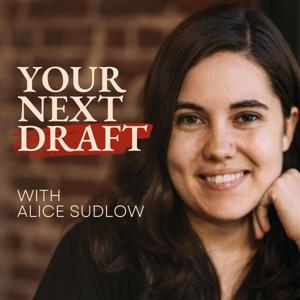
Supporting fiction writers doing the hard work of revising unputdownable novels. The novel editing process is the creative crucible where you discover the story you truly want to tell—and it can…
Developmental editor and book coach Alice Sudlow will be your companion through the mess and magic of revision. You’ll get inspired by interviews with authors, editors, and coaches sharing their revision processes; gain practical tips from Alice’s editing practice; and hear what real revision truly requires as Alice workshops scenes-in-progress with writers.
It’s all a quest to discover: How do you figure out what your story is truly about? How do you determine what form that story should take? And once you do, how do you shape the hundreds of thousands of words you've written into the story’s most refined and powerful form?
If you’ve written a draft—or three—but are still searching for your story’s untapped potential, this is the podcast for you. Together, let’s dig into the difficult and delightful work of editing your next draft.

38,654 Listeners
1,296 Listeners
1,007 Listeners
627 Listeners
251 Listeners
1,479 Listeners
114 Listeners
782 Listeners
430 Listeners

40 Listeners
32 Listeners

17 Listeners
21 Listeners

12,521 Listeners
15 Listeners