
Sign up to save your podcasts
Or



The magic of storytelling is in making your readers feel. Here’s how great stories capture emotion.
One of my favorite questions to ask writers is, “What does success mean to you?”
And usually, I hear some version of the following:
You want to make readers feel. You want them to fall in love with your book. You want to make them laugh, to make them cry, to make them feel fear and excitement and relief and catharsis.
Sound like you? You’ll love this episode.
In it, I’m taking a close look at one of my favorite movie moments. It’s a scene that captures emotion so powerfully that even a tiny clip out of context can give you chills.
You’ll learn:
Don’t worry—this episode contains no spoilers for the newest Spider-Man movie. Listen to it completely spoiler-free.
(Then, go watch Spider-Man: Across the Spider-Verse for another masterclass in creating emotion!)
Links mentioned in the episode:
Send me a Text Message!
Support the show
Rate, Review, & Follow on Apple Podcasts
"I love Alice and Your Next Draft." If that sounds like you, please consider rating and reviewing my show! This helps me support more writers through the mess—and joy—of the editing process. Click here, scroll to the bottom, tap the stars to rate, and select “Write a Review.” Then be sure to let me know what you loved most about the episode!
Loving the show? Show your support with a monthly contribution »
A flexible method to create a scene list with exactly the information you need—no more, no less.
For the last few weeks, I’ve been touting the magic of scene lists.
Because I do think they’re magic, or pretty darn close to it. The simple scene list is one of my absolute favorite editing tools. I wouldn’t know how to edit a book without one!
So far, I’ve covered why it’s worth making one, plus two ways to format it.
And it’s all been leading up to this: how to actually make your scene list.
That’s what I’m sharing in this episode.
You’ll learn:
This is a meaty episode, which isn’t really a surprise—I have a lot to say about scene lists!
And by the end of the episode, you’ll be ready to sit down, pull up your manuscript and your favorite scene list template (yes, I’ll give you two templates in the episode), and make a scene list of your very own.
Links mentioned in the episode:
Send me a Text Message!
Support the show
Rate, Review, & Follow on Apple Podcasts
"I love Alice and Your Next Draft." If that sounds like you, please consider rating and reviewing my show! This helps me support more writers through the mess—and joy—of the editing process. Click here, scroll to the bottom, tap the stars to rate, and select “Write a Review.” Then be sure to let me know what you loved most about the episode!
Loving the show? Show your support with a monthly contribution »
Plus, two scene list templates for you to download and customize.
Your scene list is infinitely customizable. It can be as simple or as complex as you like. And you have a lot of choices when it comes to how you’ll create it and what information you’ll include.
Your first choice? What format you’ll use.
My first-ever scene lists were created with paper and pen. But I recommend you use something a little more robust.
In this episode, I’ll share my two favorite scene list formats: the document and the spreadsheet.
You’ll learn:
Plus, I’ve created not one, but two scene list templates: a document template and a spreadsheet template.
Get the templates and start creating your own scene list here: alicesudlow.com/list
Links mentioned in the episode:
Send me a Text Message!
Support the show
Rate, Review, & Follow on Apple Podcasts
"I love Alice and Your Next Draft." If that sounds like you, please consider rating and reviewing my show! This helps me support more writers through the mess—and joy—of the editing process. Click here, scroll to the bottom, tap the stars to rate, and select “Write a Review.” Then be sure to let me know what you loved most about the episode!
Loving the show? Show your support with a monthly contribution »
Your scene list is your map to all your revisions. Here’s how to make the most of it.
If you’re doing a developmental edit on your manuscript, you need a scene list. Seriously—I can’t think of a single book I’ve edited without one.
Why? What makes a scene list so essential?
That’s what I’m covering in this episode of Your Next Draft.
You’ll learn:
Plus, I’m sharing the story of my first-ever professional editing gig—and what happened when I didn’t make a scene list. (This lesson has stuck with me ever since!)
I know it’s tricky to condense an entire novel into just a few words. But a scene list is worth the effort it takes to create. Take a listen, and I’ll show you why.
Links mentioned in the episode:
Send me a Text Message!
Support the show
Rate, Review, & Follow on Apple Podcasts
"I love Alice and Your Next Draft." If that sounds like you, please consider rating and reviewing my show! This helps me support more writers through the mess—and joy—of the editing process. Click here, scroll to the bottom, tap the stars to rate, and select “Write a Review.” Then be sure to let me know what you loved most about the episode!
Loving the show? Show your support with a monthly contribution »
Is your novel ready to publish? Here’s how to tell when you’re finally done editing.
One of the hardest parts of writing a book is knowing when to let go.
After all, you don’t want to write just any book. You want to write something amazing!
But at the same time, you could tinker with your manuscript forever, always finding something new to change. And if you’re always editing . . . well, you’ll never publish.
So how do you know when you’re done?
This question is really personal, and it differs from writer to writer and editor to editor. Your answer might be different from mine, and that’s okay!
In this episode, I’m going to share the strategies I use to help my clients know when their books are done.
You’ll learn:
Be sure to grab the checklist I created to help you determine when your book is ready to publish. Get the checklist here »
I also mention several other episodes of Your Next Draft that will help you further explore the nine questions I ask in this episode. Listen to those episodes at the links below.
Also, I'd love to know how YOU know when you're done! Head over to this post on Instagram or this post on Facebook and leave a comment to share.
Links mentioned in the episode:
Send me a Text Message!
Support the show
Rate, Review, & Follow on Apple Podcasts
"I love Alice and Your Next Draft." If that sounds like you, please consider rating and reviewing my show! This helps me support more writers through the mess—and joy—of the editing process. Click here, scroll to the bottom, tap the stars to rate, and select “Write a Review.” Then be sure to let me know what you loved most about the episode!
Loving the show? Show your support with a monthly contribution »
Stories are about change. Here’s how to craft compelling change in every scene, act, and novel.
In fact, change is one of the fundamental things—maybe the fundamental thing—that makes stories useful, interesting, and fun.
How do you make sure something changes in your story? And not just any change, but the right change?
Let me introduce you to one of my favorite editing concepts: the value shift.
Master value shifts, and you’ll find that crafting the perfect change in every story you write becomes . . . well, almost easy.
And in this episode, I’ll show you how. You’ll learn:
Plus, I’ve created a free resource to make finding changes in your story even easier. It’s called the Value Shift Word Bank.
In it, you’ll find all the value shifts that happen in the novels I’ve been editing lately. Use it to help you spot your own value shifts—or find the perfect value shift to add to your story!
Get the Value Shift Word Bank here »
This episode is one of my favorites. Value shifts are the foundation of everything I do as an editor. I’m always, always asking: what changes in this story?
I can’t wait to share this essential approach to crafting change in stories with you!
Links mentioned in the episode:
Send me a Text Message!
Support the show
Rate, Review, & Follow on Apple Podcasts
"I love Alice and Your Next Draft." If that sounds like you, please consider rating and reviewing my show! This helps me support more writers through the mess—and joy—of the editing process. Click here, scroll to the bottom, tap the stars to rate, and select “Write a Review.” Then be sure to let me know what you loved most about the episode!
Loving the show? Show your support with a monthly contribution »
Overwhelmed by your novel? Try these five strategies to edit with confidence.
Sometimes, editing your novel feels really scary.
Yep, I said it. Sometimes, you get overwhelmed. You feel stuck. You wonder, do you even have what it takes to edit a book?
I’m a professional editor, and even I feel that way sometimes. Right now, I’m working on a new novel from a fantastic author. And halfway through, I started wondering . . . is this book too good for me to edit it? Is it beyond me?
In fact, I got so nervous about it that I actually paused in the middle of the book to write this episode!
If you’ve ever doubted yourself while editing your novel, this episode is for you.
In it, you’ll learn:
You have what it takes to edit your book. You have the perseverance, the love of great stories, and the passion it will take.
Don’t believe me? Listen to the episode and find out how to defeat the overwhelm.
Oh, and that book I’m editing?
After I created this episode, I went back to the book. I applied all five strategies you’ll hear in the episode.
And they worked!
I shared tons of feedback with the writer, and she loved it. It just took me a quick break and a few intentional strategies to break through the overwhelm and find the best feedback for her.
Because I have what it takes to edit a novel . . .
. . . and so do you.
Links mentioned in the episode:
Send me a Text Message!
Support the show
Rate, Review, & Follow on Apple Podcasts
"I love Alice and Your Next Draft." If that sounds like you, please consider rating and reviewing my show! This helps me support more writers through the mess—and joy—of the editing process. Click here, scroll to the bottom, tap the stars to rate, and select “Write a Review.” Then be sure to let me know what you loved most about the episode!
Loving the show? Show your support with a monthly contribution »
Three acts aren’t enough. If you’re stuck in the middle of your story, try this four-act structure instead.
Recently, a writer told me she was stuck in the middle of her story.
She’d written the complete first draft. She’d gotten an editor’s feedback. She was editing her second draft, and she’d made it just past the fifty percent mark.
And then . . . she got stuck.
After all that, she had no idea what should come next. No idea how to make everything from the midpoint to the climax interesting.
So I gave her a solution: Split your story into four acts.
Three-act structure is our default approach to storytelling. But it’s not enough.
So I use four-act structure instead. And in this episode, I’ll tell you why.
You’ll learn:
If you’re feeling lost in the middle of your story, I invite you to listen in and discover a simple path to “The End.”
And even if you’re not feeling lost right now, give it a listen and get fresh inspiration for every part of your story.
By the way, that writer who was feeling stuck? She loved this four-act approach to stories . . . and so did everyone else in her writing group. Every single person told me some version of, “Oh! This makes so much sense. And I’m feeling so inspired now!”
What will you discover about your story with this four-act story structure?
Send me a Text Message!
Support the show
Rate, Review, & Follow on Apple Podcasts
"I love Alice and Your Next Draft." If that sounds like you, please consider rating and reviewing my show! This helps me support more writers through the mess—and joy—of the editing process. Click here, scroll to the bottom, tap the stars to rate, and select “Write a Review.” Then be sure to let me know what you loved most about the episode!
Loving the show? Show your support with a monthly contribution »
You can get fantastic feedback on your writing for free. But first, you need to know whom to seek out, when to ask for feedback, and what kind of feedback to ask for.
Ask the wrong people, and you’ll get uncritical praise, unhelpful critique, or even rejection.
But ask the right people . . .
Ask the right people, and you’ll get feedback that:
You can even get the kind of feedback that professional editors can’t give you!
In this episode, I’ll show you where to find the right people to ask for free feedback. You’ll learn:
Even if you plan to hire an editor, you can apply free feedback in strategic ways to craft your best book. Listen to the episode and I’ll show you how.
Send me a Text Message!
Support the show
Rate, Review, & Follow on Apple Podcasts
"I love Alice and Your Next Draft." If that sounds like you, please consider rating and reviewing my show! This helps me support more writers through the mess—and joy—of the editing process. Click here, scroll to the bottom, tap the stars to rate, and select “Write a Review.” Then be sure to let me know what you loved most about the episode!
Loving the show? Show your support with a monthly contribution »
Most writers miss this simple editing principle. But when you understand it, when you truly master it, you have the power to craft your best story.
Here it is:
When you’re doing a developmental edit on a story, you can change absolutely anything.
It sounds obvious, yet it’s so hard to do. In this episode, I’ll show you why—and share a simple three-step process that will give you editing superpowers.
You’ll learn:
Plus, I’ll show you exactly how this editing process works with a real example.
I’ve chosen the best highlights from my editing session with Kim Kessler. Listen to us apply this process step-by-step to edit Kim’s scene.
Want to hear the full editing session? Listen to Kim’s edit here!
By the end of this episode, you’ll have a clear process to use to edit your own scenes—or even your entire novel. This is one you’ll want to save to revisit again and again!
Links mentioned in the episode:
Send me a Text Message!
Support the show
Rate, Review, & Follow on Apple Podcasts
"I love Alice and Your Next Draft." If that sounds like you, please consider rating and reviewing my show! This helps me support more writers through the mess—and joy—of the editing process. Click here, scroll to the bottom, tap the stars to rate, and select “Write a Review.” Then be sure to let me know what you loved most about the episode!
Loving the show? Show your support with a monthly contribution »
From the publisher's feed
Supporting fiction writers doing the hard work of revising unputdownable novels. The novel editing process is the creative crucible where you discover the story you truly want to tell—and it can…
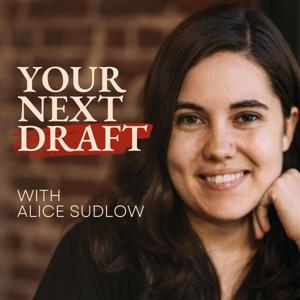
Developmental editor and book coach Alice Sudlow will be your companion through the mess and magic of revision. You’ll get inspired by interviews with authors, editors, and coaches sharing their revision processes; gain practical tips from Alice’s editing practice; and hear what real revision truly requires as Alice workshops scenes-in-progress with writers.
It’s all a quest to discover: How do you figure out what your story is truly about? How do you determine what form that story should take? And once you do, how do you shape the hundreds of thousands of words you've written into the story’s most refined and powerful form?
If you’ve written a draft—or three—but are still searching for your story’s untapped potential, this is the podcast for you. Together, let’s dig into the difficult and delightful work of editing your next draft.

38,654 Listeners
1,296 Listeners
1,007 Listeners
627 Listeners
251 Listeners
1,479 Listeners
114 Listeners
782 Listeners
430 Listeners

40 Listeners
32 Listeners

17 Listeners
21 Listeners

12,521 Listeners

15 Listeners