
Sign up to save your podcasts
Or

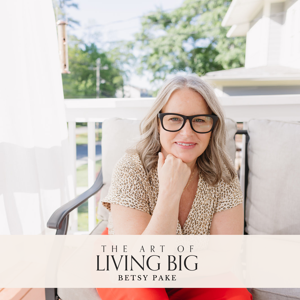

This episode aims to inspire listeners to live authentically and joyfully, just like we did before the world shaped our identities. Betsy shares insight on honoring the impulses we feel, like we did when we were kids, but this time with the intention of discovering ourselves again. So grab a wooden spoon and sing… after you listen:)
Transcript
Welcome to The Art of Living Big, where we explore how to live intentionally and with more joy. I’m Betsy Pake, your host, master, coach, and creator of the Navigate Method. Here to help you listen in to your true desires, elevate your standards, and live life to the fullest. Now, let’s go live big.
Hello everyone. Hi. Welcome to The Art of Living Big. This week, hopefully I will be in Florida meeting with my coach and the mastermind team that I’m part of. I with the airline flights, I’m getting a little concerned. I’m getting a little concerned, but I’m really hopeful. So I’m recording this podcast early so that you still get one, even though I’m gone and we’re just gonna keep our fingers crossed that I actually am gone.
Although I think my kitty will be happy if it doesn’t work out. My kid will be happy. . My adult daughter will be happy if I’m. Still around, but I’m really hoping that I’ll be able to go. So I wanted to record this and , this episode is something that has been on my mind, like sort of in the back of my mind as the years gone by.
And then, , the other day we did. The fireside chat, which was just an open invitation for people to come and get together in community and just talk about some of the challenges and commonalities that happen in midlife. Right. And I think more and more I’m recognizing how important my village is, and as I have started to create my own village over the past year, really focusing on that.
I can see how helpful it is. So I wanted to create that for people that maybe don’t have it, and then also for people who just wanted more of it. So we’ve been doing these, what I say we’ve been doing, we did ’em once. We’re gonna keep doing these fireside chats. And so, , in that, one of the things that kept coming up was that this idea that in midlife what’s really happening is an uncovering.
What’s really happening is you’re getting back to who you were before, , before the world told you had to be a certain way. And gosh, this is something I feel like has been, like I said in the back of my mind and something I have been thinking about of what really makes me happy. And I did a whole episode on that, on joy and the things that I’m finding that bring me joy.
But what really makes me happy and. What are the things that make me uniquely me? And I think there’s a component of this that can be really hard to dissect because so much of who we are is what we were told we were right when we’re young or when we formed relationships that we have now that are significant and whatever role that we’re playing in that begins to define how we are.
It may not be what we would choose if we could wipe the slate clean and say, this is who I am, this is how I wanna show up. And the thing is, once you’ve started down a path of showing up a certain way, it’s really hard to change course. Not only because. It feels unsafe internally. Our nervous systems, they don’t do that.
But also because other people around us start to react differently to that. And that’s, , one of the challenges and positive things that can happen. And one of the things we talk about inside the Navigate Method, when you show up different, your partners going to have to show up different. Right.
Or you’ll just recognize you’re just. You’re not interested anymore. Right? So there, there is this shift that happens organically, I think, when we hit midlife, but also when we really wanna start looking at this and discovering this. So what I wanna talk about today is really who you were before the whole world told you who you needed to be.
And I think this is something that. Impacts all of us in different ways at different times of our lives, right? And it is a question that shows up, , in, midlife when you have a breakdown or when something really big happens in your life or it just in those moments. I know there are times where I’ve got my coffee and I’m just thinking, , on the thinking couch in my thinking chair.
And I think , what is. The version of me who is really, really joyful. There’s this, idea that I have that, and maybe you have this too, that our soul, right? So I’m thinking like my soul is inside me, but it’s, that is the essence of me. I think that I’ve had this soul for a lot of different lifetimes, and so the.
Packaging shows up this time as Betsy and Betsy’s choosing to live her life in the way that she is. And in another life I was somebody else and in a different life I was somebody else. Like I, the outside could change, the packaging could change, the circumstances might change to give me an opportunity to experience lots of different things.
But there is this soul. Peace of me and I really feel like I can, I get to her and I say her, but I don’t even feel like it’s a gender. I know this sounds kinda strange. I can feel this soul part of me. And sometimes when things are really bad, I check in with my soul and my soul loves it. I know. Is that so weird?
When things are bad and I check in? My soul is really happy because my soul came here to have experiences. It didn’t come here to just have positive experiences, and I don’t know if that’s my delusional way of dealing with hard things, but it really does help me deal with hard things. But I think there’s, I believe there, it feels like truth, even when I say that it feels like truth.
And so. When I think about who I was before the world told me who I needed to be, there is this soul piece of me that has been a lot of different things and a lot of different versions. And so who I was perhaps is a piece of this, of something that I get to choose and if I haven’t chosen, which so often we haven’t, and in most ways I haven’t.
Then maybe there’s something to look at, right? And so I think we start to look at this when we have a big transition. We get married, we get divorced, we have kids, even we start a new job, right? All of those things, we have a breakdown. Or when we’re just sitting thinking like, what happened to me? You know, there’s that Oprah book.
, And I read it years ago, but I think it’s called What, Happened to You? And it’s the idea that. Everyone is acting or reacting out of a place of what they know and what has been handed to them in many cases. And that instead of saying like, why are you so frustrating or whatever, it’s like, what happened to you to make you that way?
Right? And I think about that in terms of myself, like what happened that made me. The way that I am, that made, that gave this packaging right, this shell, this exterior, when I can touch my soul and I know that my soul is just skipping along, real oblivious to the danger, but. It also gives me a lot of, a peace, you know, and I think that there have been a lot of roles and expectations.
I think about, gosh, I think about some things that I’ve done. , Even when I was dating my, , former boyfriends or my former husband, , and. Like the things that I did, were in an effort to be a good girlfriend, right? In an effort to be a good friend in an effort. And that’s not necessarily bad, but does it align with who I really am or is it some rule that we were following to just make you more lovable or valuable?
And who were you before all of that rules came into place? And so here’s what I think. I think that most of our lives were built around who we think we’re supposed to be, but not who we actually are. So I go all the way back to when I’m little, when I think about this, and , when we’re little, we’re wide open, we laugh at everything.
We cry when we need to. I mean, I saw a kid on the floor of the grocery store the other day, like having a tantrum. And I’m like, , that’s how I feel too when my ice cream is out. Like it, we. We, go with the flow of whatever is the experience and emotion, and we’re curious, right? We follow curiosity.
We ask a lot of questions, and then we learn and we learn at some point that being loud gets you in trouble. That making a mistake gets you a big red check mark on your page. You know that you crying or being emotional can make people really uncomfortable. I remember crying when my mom died and everybody comes to your house, you know, after somebody dies, like everybody just comes.
So, I mean, this was within hours and there was an adult , that I love. I loved then, and I still love now, but an adult man who said, don’t cry, stop crying. I was like, I remember even at the time being like, if any time seems appropriate, it’s this , but it makes people uncomfortable, right?
He, loved me and so he was uncomfortable with me being in pain. It takes a lot to be okay with witnessing someone’s pain, , and we become the achiever and the peacemaker, right? We hold back our pain just to make people feel better. Then we become caretakers and, little by little, I think we start to trade our, truth for belonging, for being chosen, right?
Not because we’re weak, but because we are really smart. And because fitting in and being chosen meant survival. But the problem is, especially now, it’s 2025, , we wake up and we have a life that might look good on paper, but it feels like somebody else’s story. And we start to wonder, look what happened.
Like, who am I? Where did I go? What do I even like? I can’t even tell you how many times people are like, I don’t even know what I like. That I think is the moment. It’s the moment where we begin to remember, , I think that there is a cost to becoming who you were told that you needed to be.
Right. There’s a cost to all that adapting, and I think it’s, I think it’s really subtle and it’s quiet. I think it looks sometime like. Resentment. I think it can feel like being invisible. It’s the, thing, and I hear people say this all the time, and I’ve said it too, like I should be grateful, but, and so you might notice that you have become really, really good at seeing what everybody else wants.
Caring for everybody else, but not yourself. I went out to dinner with a friend of mine. Last year, last March, we were in California and I said something and I, wasn’t even like venting or I just said something and I’ll never forget because she looked at me and she said, do you always sweep things like that under the rug that way?
And I remember being like, well, I’m not sweeping it under the rug. Like it’s just how it is. , And I remember the look on her face. She didn’t even have to say anything else, but I remember I felt, I felt so, I’m gonna use this word, but it’s not be, not, I felt ashamed, but not because she was making me feel ashamed and not because I was ashamed in front of her.
I was ashamed ’cause I knew it was right. I was ashamed. ’cause I knew I had totally abandoned myself. And laughed when things weren’t funny and pretended everything was okay. And just a million different ways. A million different ways. And so, you may notice that you have become really excellent at making sure everybody else is comfortable, but not yourself, you know?
You know what your kids need for school. You know what everybody needs at work. You know what everybody wants for dinner, but if somebody asks you what you want, your mind goes totally blank. And the blank isn’t a flaw. It’s just evidence, right? It’s just evidence of, slow self abandonment and you know that forgetting it, it’s not failure, it’s a survival strategy.
And when you start to remember yourself, that becomes a spiritual one. So let’s talk about this then. How do you start to find yourself again? , I don’t think this is like some aha moment or some bolt of lightning comes down or aliens come down and say, this is what you do. , I think this is a much more.
Um, , gentle. I’m gonna say gentle excavation. You have to get really curious. You have to start to ask yourself what actually feels like me? And, , maybe it’s, I just find music so powerful, but maybe it’s simply like the music that you used to love before. Everything became like productivity or reading books.
I know I started reading books this year and I always read books that would be like productive where I would be learning something and then I found I would buy all these books and I wouldn’t wanna read ’em, but it’s ’cause I was just done reading stuff that was like meant to make me better or different.
Maybe it’s painting. , I mentioned that I started watercolor painting, which if you are interested in painting, watercolor’s really good. ’cause you kind of can’t screw it up. It looks sort of pretty no matter what you do, , but maybe it’s going for walks or it’s just sitting, , maybe you have a thinking couch and you just sit quietly with a cup of tea.
It might be saying no to things and just noticing how good that feels. So. Start paying attention to small impulses. And I always say to people, even if you do the other thing, like I said, yes, but I really didn’t want to. Don’t beat yourself up. It’s great. ’cause then you notice I didn’t want to and think through it.
How, what would it have felt like to say no? Sometimes that can feel dangerous, right? And not because you’re in danger, but because your nervous system thinks saying yes is what keeps you safe. But noticing and saying, I wish I had said no. How could I have said that? That would’ve felt really good to me, that’s still honoring yourself because you’re moving in the direction that you wanna go.
So start noticing these little things. There, there might be a little voice, under the, under all the noise. And you’ll start to excavate her. You’ll start to know, I, think of this as like the original. You, the one who loved everything and was curious and loud and fun and giggly and magic, and didn’t have to apologize for any of it.
And I think when you start doing this work. You’ll start getting her in flashes. , It’ll be moments where you laugh. I know when I moved into this apartment and my daughter came over and there was a song on, I need to Look ’cause she sent me the recording, like the video I was singing. Oh, I know. It was,, ,, we Are The World and I was doing all the voices with a.
With a soup spoon, ? And it, that was the version of me that it just felt right. I mean, it was so silly and it was such the young version of me. So you’ll notice right when you laugh so hard that you snore, you know, you say something and you can immediately feel your body exhale because it was the truth,?
That’s how you remember. That’s how you remember. It’s not one big thing. It’s little pieces piece by piece by piece. And then you know, the hard part is when you start remembering things around, you are gonna shift. And sometimes that’s great and sometimes that’s really messy. And you know you’re not gonna fit in the same old spaces anymore.
You are not gonna be. Quiet perhaps in relationships that used to really demand your silence. You’re not gonna keep pretending that you’re fine in a job that actually drains you. You’re not gonna put up with someone putting you down. You’re not gonna keep apologizing for wanting more in your life. And that’s where courage comes in.
I always say the women inside the Navigate Method are brave. That courage leans into bravery, right to let go of what was built around this false version of you. Because what’s real can only come when everything else is safe enough to fall away, and that looks, it might look like loss. Sometimes people are like, oh my God, your life, when they look at me like things changed, or anybody that’s gone through a big transition, a divorce, moving to a new place, they’re like, oh my gosh.
And I’m like, it’s not loss. What you’re witnessing is liberation. I got all these messages a year or so ago about, oh my God, you look glowy. I got messages from people that I didn’t even , , that were. Friends of people and like that, that I heard, , that I had met before, but they were like, oh my God, you look so glowy.
And I’m like, it’s, liberation. It’s, it’s being able to take a big, deep breath. It’s being me again. You know? And so maybe, maybe this invitation is actually really simple. It’s just to ask yourself, who was I? Before the world told me who to be, what did she love, what did she dream about, and what part of her wants to show up again.
So you don’t have to force anything or make something happen. Just ask. But give the space to get curious, give the space to answer, to be, , journaling. Be still, go for walks, make choices, because what I know. What I know is that the world doesn’t need a version of you who’s acquiescing to make everything okay.
It doesn’t need this like hyper polished version of you. It mean it needs the remembered version of you. I think about my soul came here to have this experience inside me as it came. Not to have it as everyone told me to have it. It knows the way, and there’s a version of you that’s no longer performing belonging, but actually being it.
So you were meant to live big, not just in what you do, but in who you are. So when you do that. I think that is how you live a big life. All right. Thank you so much for listening this week. I love you guys so much. I hope that you enjoyed this episode, and if you did, please share it with a friend and I’ll see you next week.
Thanks for joining me on The Art of Living Big. I hope today’s episode sparked something within you, maybe pushed you to dream a little bit bigger and live a little larger. Don’t forget to subscribe. Leave us a review and share this podcast with someone you know who might need a little inspiration today.
You can find me over on Instagram at betsy pake and on my YouTube channel. Remember, the world is vast. Your potential is endless. And your life. It’s yours to shape. Until next time, keep reaching, keep exploring, and keep living big.
 View all episodes
 By Betsy Pake

4.9
162162 ratings
This episode aims to inspire listeners to live authentically and joyfully, just like we did before the world shaped our identities. Betsy shares insight on honoring the impulses we feel, like we did when we were kids, but this time with the intention of discovering ourselves again. So grab a wooden spoon and sing… after you listen:)
Transcript
Welcome to The Art of Living Big, where we explore how to live intentionally and with more joy. I’m Betsy Pake, your host, master, coach, and creator of the Navigate Method. Here to help you listen in to your true desires, elevate your standards, and live life to the fullest. Now, let’s go live big.
Hello everyone. Hi. Welcome to The Art of Living Big. This week, hopefully I will be in Florida meeting with my coach and the mastermind team that I’m part of. I with the airline flights, I’m getting a little concerned. I’m getting a little concerned, but I’m really hopeful. So I’m recording this podcast early so that you still get one, even though I’m gone and we’re just gonna keep our fingers crossed that I actually am gone.
Although I think my kitty will be happy if it doesn’t work out. My kid will be happy. . My adult daughter will be happy if I’m. Still around, but I’m really hoping that I’ll be able to go. So I wanted to record this and , this episode is something that has been on my mind, like sort of in the back of my mind as the years gone by.
And then, , the other day we did. The fireside chat, which was just an open invitation for people to come and get together in community and just talk about some of the challenges and commonalities that happen in midlife. Right. And I think more and more I’m recognizing how important my village is, and as I have started to create my own village over the past year, really focusing on that.
I can see how helpful it is. So I wanted to create that for people that maybe don’t have it, and then also for people who just wanted more of it. So we’ve been doing these, what I say we’ve been doing, we did ’em once. We’re gonna keep doing these fireside chats. And so, , in that, one of the things that kept coming up was that this idea that in midlife what’s really happening is an uncovering.
What’s really happening is you’re getting back to who you were before, , before the world told you had to be a certain way. And gosh, this is something I feel like has been, like I said in the back of my mind and something I have been thinking about of what really makes me happy. And I did a whole episode on that, on joy and the things that I’m finding that bring me joy.
But what really makes me happy and. What are the things that make me uniquely me? And I think there’s a component of this that can be really hard to dissect because so much of who we are is what we were told we were right when we’re young or when we formed relationships that we have now that are significant and whatever role that we’re playing in that begins to define how we are.
It may not be what we would choose if we could wipe the slate clean and say, this is who I am, this is how I wanna show up. And the thing is, once you’ve started down a path of showing up a certain way, it’s really hard to change course. Not only because. It feels unsafe internally. Our nervous systems, they don’t do that.
But also because other people around us start to react differently to that. And that’s, , one of the challenges and positive things that can happen. And one of the things we talk about inside the Navigate Method, when you show up different, your partners going to have to show up different. Right.
Or you’ll just recognize you’re just. You’re not interested anymore. Right? So there, there is this shift that happens organically, I think, when we hit midlife, but also when we really wanna start looking at this and discovering this. So what I wanna talk about today is really who you were before the whole world told you who you needed to be.
And I think this is something that. Impacts all of us in different ways at different times of our lives, right? And it is a question that shows up, , in, midlife when you have a breakdown or when something really big happens in your life or it just in those moments. I know there are times where I’ve got my coffee and I’m just thinking, , on the thinking couch in my thinking chair.
And I think , what is. The version of me who is really, really joyful. There’s this, idea that I have that, and maybe you have this too, that our soul, right? So I’m thinking like my soul is inside me, but it’s, that is the essence of me. I think that I’ve had this soul for a lot of different lifetimes, and so the.
Packaging shows up this time as Betsy and Betsy’s choosing to live her life in the way that she is. And in another life I was somebody else and in a different life I was somebody else. Like I, the outside could change, the packaging could change, the circumstances might change to give me an opportunity to experience lots of different things.
But there is this soul. Peace of me and I really feel like I can, I get to her and I say her, but I don’t even feel like it’s a gender. I know this sounds kinda strange. I can feel this soul part of me. And sometimes when things are really bad, I check in with my soul and my soul loves it. I know. Is that so weird?
When things are bad and I check in? My soul is really happy because my soul came here to have experiences. It didn’t come here to just have positive experiences, and I don’t know if that’s my delusional way of dealing with hard things, but it really does help me deal with hard things. But I think there’s, I believe there, it feels like truth, even when I say that it feels like truth.
And so. When I think about who I was before the world told me who I needed to be, there is this soul piece of me that has been a lot of different things and a lot of different versions. And so who I was perhaps is a piece of this, of something that I get to choose and if I haven’t chosen, which so often we haven’t, and in most ways I haven’t.
Then maybe there’s something to look at, right? And so I think we start to look at this when we have a big transition. We get married, we get divorced, we have kids, even we start a new job, right? All of those things, we have a breakdown. Or when we’re just sitting thinking like, what happened to me? You know, there’s that Oprah book.
, And I read it years ago, but I think it’s called What, Happened to You? And it’s the idea that. Everyone is acting or reacting out of a place of what they know and what has been handed to them in many cases. And that instead of saying like, why are you so frustrating or whatever, it’s like, what happened to you to make you that way?
Right? And I think about that in terms of myself, like what happened that made me. The way that I am, that made, that gave this packaging right, this shell, this exterior, when I can touch my soul and I know that my soul is just skipping along, real oblivious to the danger, but. It also gives me a lot of, a peace, you know, and I think that there have been a lot of roles and expectations.
I think about, gosh, I think about some things that I’ve done. , Even when I was dating my, , former boyfriends or my former husband, , and. Like the things that I did, were in an effort to be a good girlfriend, right? In an effort to be a good friend in an effort. And that’s not necessarily bad, but does it align with who I really am or is it some rule that we were following to just make you more lovable or valuable?
And who were you before all of that rules came into place? And so here’s what I think. I think that most of our lives were built around who we think we’re supposed to be, but not who we actually are. So I go all the way back to when I’m little, when I think about this, and , when we’re little, we’re wide open, we laugh at everything.
We cry when we need to. I mean, I saw a kid on the floor of the grocery store the other day, like having a tantrum. And I’m like, , that’s how I feel too when my ice cream is out. Like it, we. We, go with the flow of whatever is the experience and emotion, and we’re curious, right? We follow curiosity.
We ask a lot of questions, and then we learn and we learn at some point that being loud gets you in trouble. That making a mistake gets you a big red check mark on your page. You know that you crying or being emotional can make people really uncomfortable. I remember crying when my mom died and everybody comes to your house, you know, after somebody dies, like everybody just comes.
So, I mean, this was within hours and there was an adult , that I love. I loved then, and I still love now, but an adult man who said, don’t cry, stop crying. I was like, I remember even at the time being like, if any time seems appropriate, it’s this , but it makes people uncomfortable, right?
He, loved me and so he was uncomfortable with me being in pain. It takes a lot to be okay with witnessing someone’s pain, , and we become the achiever and the peacemaker, right? We hold back our pain just to make people feel better. Then we become caretakers and, little by little, I think we start to trade our, truth for belonging, for being chosen, right?
Not because we’re weak, but because we are really smart. And because fitting in and being chosen meant survival. But the problem is, especially now, it’s 2025, , we wake up and we have a life that might look good on paper, but it feels like somebody else’s story. And we start to wonder, look what happened.
Like, who am I? Where did I go? What do I even like? I can’t even tell you how many times people are like, I don’t even know what I like. That I think is the moment. It’s the moment where we begin to remember, , I think that there is a cost to becoming who you were told that you needed to be.
Right. There’s a cost to all that adapting, and I think it’s, I think it’s really subtle and it’s quiet. I think it looks sometime like. Resentment. I think it can feel like being invisible. It’s the, thing, and I hear people say this all the time, and I’ve said it too, like I should be grateful, but, and so you might notice that you have become really, really good at seeing what everybody else wants.
Caring for everybody else, but not yourself. I went out to dinner with a friend of mine. Last year, last March, we were in California and I said something and I, wasn’t even like venting or I just said something and I’ll never forget because she looked at me and she said, do you always sweep things like that under the rug that way?
And I remember being like, well, I’m not sweeping it under the rug. Like it’s just how it is. , And I remember the look on her face. She didn’t even have to say anything else, but I remember I felt, I felt so, I’m gonna use this word, but it’s not be, not, I felt ashamed, but not because she was making me feel ashamed and not because I was ashamed in front of her.
I was ashamed ’cause I knew it was right. I was ashamed. ’cause I knew I had totally abandoned myself. And laughed when things weren’t funny and pretended everything was okay. And just a million different ways. A million different ways. And so, you may notice that you have become really excellent at making sure everybody else is comfortable, but not yourself, you know?
You know what your kids need for school. You know what everybody needs at work. You know what everybody wants for dinner, but if somebody asks you what you want, your mind goes totally blank. And the blank isn’t a flaw. It’s just evidence, right? It’s just evidence of, slow self abandonment and you know that forgetting it, it’s not failure, it’s a survival strategy.
And when you start to remember yourself, that becomes a spiritual one. So let’s talk about this then. How do you start to find yourself again? , I don’t think this is like some aha moment or some bolt of lightning comes down or aliens come down and say, this is what you do. , I think this is a much more.
Um, , gentle. I’m gonna say gentle excavation. You have to get really curious. You have to start to ask yourself what actually feels like me? And, , maybe it’s, I just find music so powerful, but maybe it’s simply like the music that you used to love before. Everything became like productivity or reading books.
I know I started reading books this year and I always read books that would be like productive where I would be learning something and then I found I would buy all these books and I wouldn’t wanna read ’em, but it’s ’cause I was just done reading stuff that was like meant to make me better or different.
Maybe it’s painting. , I mentioned that I started watercolor painting, which if you are interested in painting, watercolor’s really good. ’cause you kind of can’t screw it up. It looks sort of pretty no matter what you do, , but maybe it’s going for walks or it’s just sitting, , maybe you have a thinking couch and you just sit quietly with a cup of tea.
It might be saying no to things and just noticing how good that feels. So. Start paying attention to small impulses. And I always say to people, even if you do the other thing, like I said, yes, but I really didn’t want to. Don’t beat yourself up. It’s great. ’cause then you notice I didn’t want to and think through it.
How, what would it have felt like to say no? Sometimes that can feel dangerous, right? And not because you’re in danger, but because your nervous system thinks saying yes is what keeps you safe. But noticing and saying, I wish I had said no. How could I have said that? That would’ve felt really good to me, that’s still honoring yourself because you’re moving in the direction that you wanna go.
So start noticing these little things. There, there might be a little voice, under the, under all the noise. And you’ll start to excavate her. You’ll start to know, I, think of this as like the original. You, the one who loved everything and was curious and loud and fun and giggly and magic, and didn’t have to apologize for any of it.
And I think when you start doing this work. You’ll start getting her in flashes. , It’ll be moments where you laugh. I know when I moved into this apartment and my daughter came over and there was a song on, I need to Look ’cause she sent me the recording, like the video I was singing. Oh, I know. It was,, ,, we Are The World and I was doing all the voices with a.
With a soup spoon, ? And it, that was the version of me that it just felt right. I mean, it was so silly and it was such the young version of me. So you’ll notice right when you laugh so hard that you snore, you know, you say something and you can immediately feel your body exhale because it was the truth,?
That’s how you remember. That’s how you remember. It’s not one big thing. It’s little pieces piece by piece by piece. And then you know, the hard part is when you start remembering things around, you are gonna shift. And sometimes that’s great and sometimes that’s really messy. And you know you’re not gonna fit in the same old spaces anymore.
You are not gonna be. Quiet perhaps in relationships that used to really demand your silence. You’re not gonna keep pretending that you’re fine in a job that actually drains you. You’re not gonna put up with someone putting you down. You’re not gonna keep apologizing for wanting more in your life. And that’s where courage comes in.
I always say the women inside the Navigate Method are brave. That courage leans into bravery, right to let go of what was built around this false version of you. Because what’s real can only come when everything else is safe enough to fall away, and that looks, it might look like loss. Sometimes people are like, oh my God, your life, when they look at me like things changed, or anybody that’s gone through a big transition, a divorce, moving to a new place, they’re like, oh my gosh.
And I’m like, it’s not loss. What you’re witnessing is liberation. I got all these messages a year or so ago about, oh my God, you look glowy. I got messages from people that I didn’t even , , that were. Friends of people and like that, that I heard, , that I had met before, but they were like, oh my God, you look so glowy.
And I’m like, it’s, liberation. It’s, it’s being able to take a big, deep breath. It’s being me again. You know? And so maybe, maybe this invitation is actually really simple. It’s just to ask yourself, who was I? Before the world told me who to be, what did she love, what did she dream about, and what part of her wants to show up again.
So you don’t have to force anything or make something happen. Just ask. But give the space to get curious, give the space to answer, to be, , journaling. Be still, go for walks, make choices, because what I know. What I know is that the world doesn’t need a version of you who’s acquiescing to make everything okay.
It doesn’t need this like hyper polished version of you. It mean it needs the remembered version of you. I think about my soul came here to have this experience inside me as it came. Not to have it as everyone told me to have it. It knows the way, and there’s a version of you that’s no longer performing belonging, but actually being it.
So you were meant to live big, not just in what you do, but in who you are. So when you do that. I think that is how you live a big life. All right. Thank you so much for listening this week. I love you guys so much. I hope that you enjoyed this episode, and if you did, please share it with a friend and I’ll see you next week.
Thanks for joining me on The Art of Living Big. I hope today’s episode sparked something within you, maybe pushed you to dream a little bit bigger and live a little larger. Don’t forget to subscribe. Leave us a review and share this podcast with someone you know who might need a little inspiration today.
You can find me over on Instagram at betsy pake and on my YouTube channel. Remember, the world is vast. Your potential is endless. And your life. It’s yours to shape. Until next time, keep reaching, keep exploring, and keep living big.
3,290 Listeners
1,395 Listeners
2,501 Listeners

6,431 Listeners

4,723 Listeners

3,307 Listeners
27,396 Listeners
567 Listeners

230 Listeners
41,539 Listeners

1,050 Listeners

1,406 Listeners

19,671 Listeners
174 Listeners
1,860 Listeners