
Sign up to save your podcasts
Or



Based on Podcast App listening data
Your skin has a biological age and for most people, it's not the same as their chronological one. Mayo Clinic published the SkinSpan framework this year specifically to quantify it, and the 12 Hallmarks of Aging now have a direct application to dermal tissue.
This raises an uncomfortable question: if you're already optimizing everything below the neck with NAD IVs, peptides, and red light, why is the skincare on your face still operating on a paradigm from 1987?
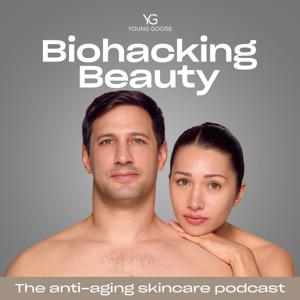
In this new episode of the Biohacking Beauty Podcast, we give you a preview of the keynote we're delivering at Dave Asprey's Beyond Conference and walk you through the 3-pillar framework that replaces traditional anti-aging skincare with longevity science in mind.
Because the results you can feel today and results you can measure in ten years are not the same thing. And we think you deserve both.
Let's dive in.
What's Discussed:
(2:29) The gap no one in longevity talks about.
(3:06) Why your moisturizer is 38 years behind your supplements.
(6:21) The 12 Hallmarks of Aging, decoded.
(9:42) Pillar 1: The master pathway of skin aging.
(12:18) Why NAD in a jar doesn't work (and what does).
(14:22) The cellular housekeeping system that quietly shuts down with age.
(15:17) The peptide that affects 32% of your skin's genome.
(16:55) Pillar 2: The software updates your cells stop sending.
(20:09) The PRP lineage that changed regenerative aesthetics.
(22:54) Pillar 3: The pillar our community doesn't want to hear about.
(29:09) The protocol, tiered by where you're starting.
(37:55) How Young Goose fits into what you're already doing.
(40:32) The two tests we're building to measure skin longevity.
Find more from Young Goose:
The melanocytes giving pigment to your skin right now might be older than your car. They have been sitting in your dermis for decades, and unlike the cells on your skin's surface, they do not get replaced. They have to keep themselves clean which happens through autophagy.
In Part 2 of our autophagy deep dive, we get specific about how skin handles autophagy differently from other parts of the body. We unpack why long-lived cells like fibroblasts and melanocytes depend on this cleanup process, what happens when it fails, and how it ties directly to gray hair, hyperpigmentation, sagging skin, and that brownish dullness no serum seems to fix.
We also introduce one of the most overlooked players in this entire conversation, and explain why we believe it is the next NAD. If you want to understand what is actually happening underneath your skin as it ages, and what tools we have to intervene at the cellular level, this episode is for you.
What's Discussed:
Resources Mentioned:
Biohacking Beauty Podcast with Dr. Scott Sherr: Stress & Light on Your Skin Are Aging Your Entire Body Podcast/dr-scott-sherr-stress-light-on-your-skin-are-aging/
2024 Study on endogenous spermidine as essential for rapamycin-induced autophagy and longevity: pubmed.ncbi.nlm.nih.gov/39212197/
Young Goose Companion Booklet: younggoose.com/pages/autophagy-skin-activate-your-bodys-anti-aging-system
Find more from Young Goose:
What if your skin could literally rebuild itself from the inside out? In this episode, we break down one of the most powerful and misunderstood biological processes in the human body: autophagy.
From its Nobel Prize-winning discovery to the molecular machinery that drives it, we walk you through exactly what autophagy is, how it works at the cellular level, and why it matters far more than most people realize for skin aging.
We explore the two master switches that control autophagy, mTOR and AMPK, and how the constant tug of war between them determines whether your cells are in build mode or cleanup mode. We also explain why most people in the modern world are stuck in permanent mTOR activation, and what that means for how their skin ages over time.
This is Part 1 of our deep dive. In Part 2, we go skin-specific and break down exactly how autophagy renews your skin at the tissue level.
What's Discussed:
(0:19) The "phoenix process": the cellular mechanism rebuilding your skin from the inside out
(3:14) What autophagy actually means, and why the science world ignored it for 30 years
(4:47) How baker's yeast cracked the code that won the 2016 Nobel Prize
(7:14) Inside a single skin cell: the step-by-step breakdown of how autophagy actually works
(10:22) Why autophagy is not destruction, and what this means for your collagen supplements
(16:44) The two master switches controlling whether your cells build or clean
(20:10) The everyday habit silencing your body's most powerful anti-aging system
(26:17) Why aging skin isn't broken, it has just never been told to clean
Resources Mentioned:
Biohacking Beauty Podcast: Ben Azadi: Why 93% of Americans Are Aging Too Fast + What to Do About It: podcasts.apple.com/us/podcast/ben-azadi
Find more from Young Goose:
Use code PODCAST10 to get 10% OFF your first purchase, and if you’re a returning customer use the code PODCAST5 to get 5% OFF at younggoose.com
Instagram: @young_goose_skincare
Most of what the supplement and skincare industry sells for aging targets one pathway at a time. But your biology does not age that way. It declines across 12 interconnected processes simultaneously, and by the time one of them shows up on your skin, the others have already been running for years.
We at Young Goose believe that skin longevity is not a topical problem. It is a whole biology problem, and the ingredients you choose, how they interact, and whether anyone has actually tested them together matters more than any single molecule ever could.
In this episode, we are joined for the second time around by Chris Mirabile, founder of NOVOS which is the first biotech company to target all 12 biological causes of aging. Chris collaborates with leading researchers at Harvard and MIT and has built his work around one premise: that real interventions require real testing on real humans, not just promising ingredients.
Let's dive in.
What's Discussed:
Find more from Young Goose:
Find more from Chris Mirabile & Slow My Age:
Instagram: @slowmyage
YouTube: @slowmyage
TikTok:@slowmyage
X: @slowmyage
Personal Blog: slowmyage.com
Find more from NOVOS:
Website: NOVOSlabs.com
Instagram: @NOVOSlabs
Facebook: NOVOS
Youtube: @NOVOSlabs
TikTok: @NOVOSlabs_
X: @NOVOSLabs
Most of what goes viral on SkinTok is missing one thing. The part where someone actually checks if it works.
In this bonus episode, Amitay and Anastasia break down three of the most viral skincare trends circulating today, red light therapy wands, at-home dermarolling, and tretinoin, and run each one through a biohacker's lens. Not to dismiss them outright. But to ask the questions the original videos never do.
What is actually happening at the cellular level? What are the real risks? And where does the marketing stop and the science start?
What’s Discussed:
Check out our Mother’s Day Special:
Explore the Mother’s Day gift sets at younggoose.com/pages/mothers-day
Find more from Young Goose:
Mothers sacrifice so much of themselves to carry another human being in their body for nine months. Even after childbirth, there's a phase called the fourth trimester because babies are still heavily dependent on moms for their survival.
Motherhood looks different for every woman. For Anastasia, who is a first-time mom, motherhood looked particularly different since her family is overseas and she's also running Young Goose with Amitay. Yet, there's something unique when a biohacker becomes a mom that new moms can learn from.
In this Young Goose Mother's Day Special, we celebrate every mother who gives selflessly to their family. We also take a peek into Anastasia's life as a new mom, what changed in her body and mindset, and how she maintained her self-care while taking care of the family and the business.
This episode will make you realize that it takes a village to raise a kid, but it takes a great mom to raise a kid and still come back to herself. Because the only way she can show up fully for others is when she can show up for herself first.
What's Discussed:
Check out our Mother’s Day Special:
Explore the Mother’s Day gift sets at https://www.younggoose.com/pages/mothers-day
Find more from Young Goose:
Most of the NAD+ skincare on shelves right now is built on a misunderstanding. And if you've been trusting niacinamide to do the heavy lifting, this episode is going to change how you read a label.
This episode is Part 2 of our NAD+ deep dive. Here, we get into what actually works to raise NAD+ in the skin, the real precursors, the delivery technology that gets them where they need to go, and the mitochondrial support system most brands leave out. We also walk through the lifestyle levers that move the needle, and why one of them becomes non-negotiable for women after a certain age.
If Part 1 explains what steals your NAD+, this episode is where the science gets practical and eye-opening.
What's Discussed:
Check out resources mentioned:
Part 1 of our NAD+ deep dive: The NAD+ Thief Your Skin Can't Escape: CD38, Zombie Cells, and the Decline
Check out our NAD+ Guide: NAD+ & SKIN AGING - The Cellular Energy Connection
Sleep is Skincare episode: How Timing Unlocks Your Body’s Best Skincare Repair
Find more from Young Goose:
A lot of us treat hair loss the way skincare treats wrinkles, as a cosmetic problem to cover up. But almost every case of thinning, recession, or shedding has something deeper driving it, and by the time it shows up in the mirror, a significant amount of density is already gone.
We at Young Goose believe that beauty is whole body care, and hair is one of the most metabolically active tissues in the body. It is also one of the first places systemic stress, hormone shifts, nutrient deficiencies, and inflammation show up.
In this episode, Dr. Alan Bauman joins us to break down the biology of hair aging and the protocols that actually move the needle. Dr. Bauman is the founder of Bauman Medical in Boca Raton and one of the pioneers of modern hair restoration, with nearly three decades of clinical practice and more than 35,000 patients treated.
His core message is simple and urgent: time equals follicles. Every week of delay is density you do not get back. And most people have no idea it is happening until the loss is already visible.
We go deeper into this in the latest episode of Biohacking Beauty: The Anti-Aging Skincare Podcast. We also cover the hidden hair loss risks of GLP-1s and testosterone optimization, the precision diagnostics replacing guesswork, and the red light therapy details almost no one talks about.
Let's dive in!
What's Discussed:
Find more from Young Goose:
Find more from Dr. Alan Bauman:
Instagram: @dralanbauman
Youtube: @AlanBaumanMD
X: @DrAlanBauman
Facebook: Bauman Medical Group
Shop: https://dralanbauman.com/
Website: https://www.baumanmedical.com/
Most people know NAD+ as a supplement trend. But very few understand what's actually happening inside their skin cells when it runs out or what's stealing it in the first place.
By the time you're 45, you've lost half of the molecule that powers virtually every function keeping your skin young. Sadly, it only gets worse from there.
The enzyme your skin uses for DNA repair can wipe out up to 90% of what's left after a single afternoon in the sun. This isn't a slow, graceful decline. It's a collapse happening beneath the surface long before the wrinkles appear.
In this episode, we will nerd out and break down exactly why NAD+ disappears, who the thieves are, and what the science actually says about getting it back. From the sirtuin-PARP-CD38 trifecta to the zombie cell feedback loop that accelerates the drain with age, this is the most complete picture of NAD+ and skin aging we've put together to date.
We also cover the real differences between NMN, NR, and niacin, why the precursor you choose actually matters, and what to stack with it to protect your methylation pathways.
Ready to nerd out in this with us?
Let's dive in!
What's Discussed:
Learn more about NAD from our previous podcasts and videos:
Previous NAD YouTube Videos:
Previous NAD Podcasts:
Research Studies Mentioned:
Find more from Young Goose:
Most people treat their skin like a surface problem. But almost every persistent skin issue, from rosacea to eczema to accelerated aging, has something deeper driving it.
That deeper driver is almost always the gut, the liver, or a backed-up detox pathway. We at Young Goose, always believe that skincare is whole body care and we want our community to identify the deeper causes of skin issues that products alone can’t fix.
In this episode, functional nutrition practitioner Dani Conway joins us to break down why the skin is not the origin of the problem but the exit sign. When the body cannot eliminate toxins efficiently, they take the path of least resistance. For a lot of women, that path is the skin on their faces.
Dani brings nearly 20 years of clinical practice to this conversation, along with a sharp, evidence-grounded perspective on why fixing hormones first is often the wrong starting point and what to address instead.
We go deeper into this in the latest episode of Biohacking Beauty: The Anti-Aging Skincare Podcast. We also cover how to deal with food sensitivities, common misconceptions around hormones and blood sugar testing, and the use of GLP-1 and peptide use.
Let’s dive in!
What's Discussed:
(0:57) How poor detoxification shows up on the skin.
(2:09) The foundational actions to support detox.
(5:44) The lymphatic system explained.
(6:33) Why Dani stopped addressing hormones first.
(8:01) Microplastics, endocrine disruptors, and chemicals women apply to their skin.
(11:40) The gut-skin axis: How gut symptoms always end up on your face.
(13:55) NAD, CD38, and why a bacterial infection in your gut affects cell energy.
(16:59) Why peptides and NAD supplements don't work if the foundation isn't dialed in first.
(21:26) Can you actually fix hormones or just manage them?
(25:12) Real-world food sensitivity examples and how to figure out your personal triggers. (29:41) How to run an elimination diet correctly.
(34:39) The big picture nobody talks about: it's not the food, it's the immune system.
(36:06) The new science on acne: The bacteria and immune system response.
(38:06) Hot take: Why immune optimization is the next mitochondria.
(39:49) CGMs and skin aging: Why Dani actually pulls clients back from data obsession.
(42:09) Fasting insulin ranges: Why the lab's "normal" range is dangerously wide.
(43:35) The role of GLP-1s and how to use them as a therapy instead of a crutch.
(45:12) Dani's hot take on berberine and leptin resistance.
Find more from Young Goose:
Find more from Dani Conway:
From the publisher's feed
Ranked by our users in the last 21 days
371 Listeners
7,183 Listeners

4,973 Listeners
1,138 Listeners

920 Listeners
775 Listeners

9,160 Listeners

333 Listeners
137 Listeners

4,090 Listeners
617 Listeners
116 Listeners
292 Listeners
1,478 Listeners
1,207 Listeners