
Sign up to save your podcasts
Or



Send me a text message about this podcast
Summary
In this episode of Decluttering Untangled, Heather Tingle addresses the common struggle of managing paperwork. She shares her personal experience with paperwork clutter and provides actionable strategies for listeners to reduce incoming paperwork, gather and categorise existing documents, and create effective systems for managing paperwork. The episode emphasises the importance of separating sorting from decision-making to streamline the decluttering process and encourages listeners to take the first steps towards a more organised life.
Chapters
00:00 Introduction to Paperwork Challenges
02:51 Strategies for Reducing Incoming Paperwork
06:08 Gathering and Categorizing Paperwork
08:55 Sorting and Decision-Making Process
11:48 Creating Actionable Systems for Paperwork
15:06 Conclusion and Next Steps
Resources
Mail Preference Service (UK)
Royal Mail Opt Out
Support the show
If you'd like to say 'Thank you', by buying me a virtual coffee (it'll actually buy me a cup of tea!), you can do so HERE. It will mean I can afford to continue to give help for free and continue with this podcast.
Get started with my Zoning and Getting Started Workshop, everything you need to know on how to get started and have the best success when decluttering.
Join my free Declutter Community for real support, tips and advice from Heather and other Untanglers that are just like you!
Follow me on Facebook
Buy my Declutter Your Home Planner from Amazon to start to declutter your home yourself! (affiliate link)
Grab my current freebies to support a cleaner, tidier home.
Follow me on instagram
Feel free to email me: [email protected]
Please note, I may not be able to reply, but do read all emails to me and appreciate them massively.
Send me a text message about this podcast
Summary
Can’t get through the door of your room of doom, never mind start decluttering it? This episode answers one of the questions from DeclutterCon that we didn’t get time for on the day: what do you do when you can’t even get into the room, and where on earth do you start?
You might be surprised by where the first step actually is (and it isn’t decluttering). I share the one thing you should never do when you’re faced with piles you can’t get past, the simple trick that makes hundreds of little things feel far less overwhelming, and why you might be about to trap yourself in the room without realising it. We also get into the big furniture question that comes up in so many spare rooms, and why one of the best moves you can make might not feel good straight away.
Chapters
00:00 Introduction and the importance of starting small
02:24 Handling items safely and avoiding hazards
04:42 Transforming clutter into manageable categories
06:08 Managing rubbish and quick wins outside the room
07:23 Deciding the room’s purpose and furniture considerations
09:13 Removing bulky furniture for space and clarity
10:38 The importance of proper, long-lasting decluttering
12:00 Defining the room’s identity and long-term use
13:26 The step-by-step decluttering process
14:21 Upcoming events and feedback request
More information
If you want to work through the whole process step by step, my book Reclaim Your Room of Doom is available now on all Amazon sites, taking you from getting through the door all the way to having a room you can actually use.
DeclutterCon 2027 tickets are on sale now, with one ticket covering everything whether you join us in the room or virtually from anywhere in the world, and you can swap between the two if your plans change. If you’d like to spread the cost, you’ve only got until the end of October to grab a ticket on the payment plan.
I’d also love your help with something new I’m working on for the Untangled Life membership. What are the stress points in your kitchen? Is it the sink that’s never empty, the worktops covered in stuff, or the cupboards that greet you with a Tupperware avalanche every time you open them? Send me a message, an email or a DM, and if you’re brave enough, a photo (the worse the better, honestly, I get genuinely excited by them).
If this episode helped, please leave a rating or review so more people can find the podcast. Thank you! xx
Support the show
If you'd like to say 'Thank you', by buying me a virtual coffee (it'll actually buy me a cup of tea!), you can do so HERE. It will mean I can afford to continue to give help for free and continue with this podcast.
Get started with my Zoning and Getting Started Workshop, everything you need to know on how to get started and have the best success when decluttering.
Join my free Declutter Community for real support, tips and advice from Heather and other Untanglers that are just like you!
Follow me on Facebook
Buy my Declutter Your Home Planner from Amazon to start to declutter your home yourself! (affiliate link)
Grab my current freebies to support a cleaner, tidier home.
Follow me on instagram
Feel free to email me: [email protected]
Please note, I may not be able to reply, but do read all emails to me and appreciate them massively.
Send me a text message about this podcast
Summary
In this episode, Heather Tingle answers common questions about organising zones in the home, focusing on whether doubling up on zones like bedding and tech causes problems or offers benefits. She provides practical advice on system consistency and how to decide the best approach for your space.
Key topics
Chapters
00:00
Introduction to doubling zones and common questions
02:24
Pros and cons of having bedding in each room versus one central location
03:21
The pitfalls of mixed zones and scattered storage
04:16
Organising tech: splitting into work and home zones
05:31
The importance of keeping zones distinct to avoid confusion
06:29
Why separating towels and bedding can cause issues
07:23
Benefits of keeping guest bedding and towels in one place
08:14
How a well-organized system saves time and reduces stress
09:11
Summary: how to effectively double up zones without chaos
09:39
Upcoming DeclutterCon 2027 and new resources from Heather Tingle
My New Mini Book: Reclaim your Room of Doom:
USA Amazon Store Affiliate Link HERE
UK Amazon Store Affiliate Link HERE
Buy your DeclutterCon 2027 Tickets HERE
Find out more/join the Untangled Life Membership for Unlimited* 1:1 Whatsapp Support, strategy sessions and group body doubling zooms. Link HERE. (*within reason)
Support the show
If you'd like to say 'Thank you', by buying me a virtual coffee (it'll actually buy me a cup of tea!), you can do so HERE. It will mean I can afford to continue to give help for free and continue with this podcast.
Get started with my Zoning and Getting Started Workshop, everything you need to know on how to get started and have the best success when decluttering.
Join my free Declutter Community for real support, tips and advice from Heather and other Untanglers that are just like you!
Follow me on Facebook
Buy my Declutter Your Home Planner from Amazon to start to declutter your home yourself! (affiliate link)
Grab my current freebies to support a cleaner, tidier home.
Follow me on instagram
Feel free to email me: [email protected]
Please note, I may not be able to reply, but do read all emails to me and appreciate them massively.
Send me a text message about this podcast
Summary
In this episode, Heather Tingle shares practical tips and personal insights on how to make packing and unpacking less stressful, especially for neurodivergent travellers. She discusses strategies to simplify the process, reduce decision fatigue, and create routines that make travel easier.
Key topics
Chapters
00:00 The Evolution of Packing and Unpacking
03:50 The Challenges of Unpacking
07:36 Strategies for Easier Packing and Unpacking
Support the show
If you'd like to say 'Thank you', by buying me a virtual coffee (it'll actually buy me a cup of tea!), you can do so HERE. It will mean I can afford to continue to give help for free and continue with this podcast.
Get started with my Zoning and Getting Started Workshop, everything you need to know on how to get started and have the best success when decluttering.
Join my free Declutter Community for real support, tips and advice from Heather and other Untanglers that are just like you!
Follow me on Facebook
Buy my Declutter Your Home Planner from Amazon to start to declutter your home yourself! (affiliate link)
Grab my current freebies to support a cleaner, tidier home.
Follow me on instagram
Feel free to email me: [email protected]
Please note, I may not be able to reply, but do read all emails to me and appreciate them massively.
Send me a text message about this podcast
Summary
In this episode of Decluttering Untangled, Heather talks about the clothes that don't fit right now, and why packing them away in a separate box often isn't the answer. Whether it's the bag under the bed marked "one day" or the vacuum pack in the loft, out of sight can quickly become out of mind, especially for neurodivergent brains, and that box can end up holding a lot of quiet guilt along with the clothes.
Heather shares a different approach: keep the favourites, the pieces you genuinely love, in with your current clothes, so they're there and ready when they fit again. Bodies change for all sorts of reasons, and a loved dress doesn't need to go just because it doesn't fit this month. She also looks at children's clothes, both the ones they're growing into and the ones they've outgrown, and how keeping the next size where you can see it means it actually gets worn.
For the clothes that will never fit again but you adore, Heather talks through ways to keep them close, from repurposing them into cushions, quilts or memory bears, to a memory box, to simply giving them a spot in your wardrobe where they make you smile every day. The simple test is how a piece makes you feel when you see it. If it makes you happy, keep it and enjoy it. If it makes you sad, it might be time to let someone else love it.
Plus, a DeclutterCon update: tickets close this Sunday (4th October 26) at 10pm and only a handful are left. Join us on Saturday 10th October 2026 at the Radisson Blu Sheffield, with tickets at decluttercon.co.uk.
Timestamps
00:00 Introduction to Decluttering Clothes That Don't Fit
02:46 The Emotional Weight of Clothing and Body Changes
05:34 Keeping Favorites and Letting Go of the Rest
08:38 Creative Ways to Repurpose Cherished Clothing
Support the show
If you'd like to say 'Thank you', by buying me a virtual coffee (it'll actually buy me a cup of tea!), you can do so HERE. It will mean I can afford to continue to give help for free and continue with this podcast.
Get started with my Zoning and Getting Started Workshop, everything you need to know on how to get started and have the best success when decluttering.
Join my free Declutter Community for real support, tips and advice from Heather and other Untanglers that are just like you!
Follow me on Facebook
Buy my Declutter Your Home Planner from Amazon to start to declutter your home yourself! (affiliate link)
Grab my current freebies to support a cleaner, tidier home.
Follow me on instagram
Feel free to email me: [email protected]
Please note, I may not be able to reply, but do read all emails to me and appreciate them massively.
Send me a text message about this podcast
Summary
Have you ever been told, or told yourself, that if you really wanted a tidier home you'd have done it by now? In this episode Heather gets into why that message is so untrue, and why wanting it badly is rarely the missing piece. Money, health, energy, the people you live with, inherited stuff and sheer volume all play their part, and so do systems that were built for someone else's brain. Sometimes, though, what keeps you stuck is more psychological than that.
Heather talks about how every blitz that slid back and every borrowed system that never stuck quietly gets filed away as evidence that you can't do this. If you're neurodivergent and have spent years braced for criticism, it's no wonder your brain eventually asks why you're even bothering.
She shares three stories she sees over and over with clients. The first is the quiet belief that you don't deserve a nice home, or that you'd never keep it nice anyway. The second is the feeling that there's no point until you move or the extension gets built. The third is the idea that nice homes just aren't who you are. That last one is personal. Heather opens up about growing up in doer uppers, envying friends with freshly plastered new builds, nearly writing to DIY SOS, and realising it was never the walls that made her home feel wrong.
There's a lot here about perfectionism, and why you're allowed one lovely corner, one comfy nook or one finished drawer even when the rest of the room still needs work. Heather explains avoidance as self preservation: your brain protecting you from disappointment. What breaks the cycle is trusting yourself (or trusting her, if that feels like too much right now), with mindset and action working together. There's also an HSIO moment giving you permission to want and keep a nice home, whatever your family's homes looked like.
This is the penultimate episode before DeclutterCon on 10th October at the Radisson Blu, Sheffield, UK. Tickets are on sale until Sunday 4th October, now with live stream tickets available if you can't be there in person. You'll find them at www.decluttercon.co.uk
Timestamps
00:00 - Why decluttering failures are usually psychological, not proof of laziness
00:57 - Why “you don't want it enough” is a damaging myth
03:21 - Why self-help advice often misses the real problem
05:15 - Wanting it badly can become part of the overwhelm
06:14 - When the issue is systems, not mindset
06:43 - Why blitz decluttering works briefly and then falls apart
09:07 - The hidden belief that you do not deserve a nice home
10:31 - “It is temporary” and why waiting can last for years
13:49 - Perfectionism and the belief that a home must be fully finished to be worth loving
15:40 - Self-preservation, avoidance, and the cycle that keeps people stuck
19:07 - Why mindset and action both have to change together
19:37 - Heather Says It Is Okay: permission to want and keep a nice home
20:36 - Choosing one tiny change instead of copying someone else's system
21:59 - Final encouragement and reminder to be kind to yourself
Support the show
If you'd like to say 'Thank you', by buying me a virtual coffee (it'll actually buy me a cup of tea!), you can do so HERE. It will mean I can afford to continue to give help for free and continue with this podcast.
Get started with my Zoning and Getting Started Workshop, everything you need to know on how to get started and have the best success when decluttering.
Join my free Declutter Community for real support, tips and advice from Heather and other Untanglers that are just like you!
Follow me on Facebook
Buy my Declutter Your Home Planner from Amazon to start to declutter your home yourself! (affiliate link)
Grab my current freebies to support a cleaner, tidier home.
Follow me on instagram
Feel free to email me: [email protected]
Please note, I may not be able to reply, but do read all emails to me and appreciate them massively.
Send me a text message about this podcast
Summary
Heather Tingle shares a personal reflection on why decluttering sometimes means releasing more than objects. In this episode, she unpacks how a box of old business supplies surfaced an abandoned subscription box idea and what that revealed about identity, sunk cost, and the difference between a dream and the stuff attached to it. Letting go of stored items can also mean letting go of guilt, without giving up the possibility of a future version of the dream.
Timestamps
00:00 — Why this episode is about letting go of a dream
00:29 — The maintenance declutter that surfaced an old box
00:58 — Why Heather had not decluttered her home in 10 years
02:53 — Discovering autism and ADHD during lockdown
05:44 — Why the abandoned idea felt sad, not silly
07:41 — Sunk cost, identity, and staying in limbo
08:35 — Letting go of the stuff without killing the dream
10:32 — Other examples of unfinished dreams and projects
11:30 — How hope turns into guilt and obligation
12:00 — Why the dream was never in the objects
12:22 — Releasing the nagging feeling of unfinished potential
12:51 — Dreams can rest and return in a different form
13:20 — A “Heather says it’s okay” moment about choosing the present
13:49 — Reality over fantasy and prioritising peace of mind
14:46 — Letting go now does not prevent revisiting the idea later
Support the show
If you'd like to say 'Thank you', by buying me a virtual coffee (it'll actually buy me a cup of tea!), you can do so HERE. It will mean I can afford to continue to give help for free and continue with this podcast.
Get started with my Zoning and Getting Started Workshop, everything you need to know on how to get started and have the best success when decluttering.
Join my free Declutter Community for real support, tips and advice from Heather and other Untanglers that are just like you!
Follow me on Facebook
Buy my Declutter Your Home Planner from Amazon to start to declutter your home yourself! (affiliate link)
Grab my current freebies to support a cleaner, tidier home.
Follow me on instagram
Feel free to email me: [email protected]
Please note, I may not be able to reply, but do read all emails to me and appreciate them massively.
Send me a text message about this podcast
Summary
This episode started with a comment from an Untangled Life member: "but that's the missing piece, isn't it, no accountability." Heather takes that and runs with a live confession: she set herself a DeclutterCon bonus challenge to find and sell £60 worth of stuff from her own home to pay for a course she's doing. She's found £90 to £100 worth. She's sold none of it, because she hasn't listed a single item. Heather unpacks why announcing something publicly isn't the same as being accountable for finishing it, why the classic "pretend someone's coming over" trick doesn't work for her brain, and shares two real examples from her own life (a disastrous A level project and a course she completed in her 40's) that show the actual difference between a deadline that works and one that doesn't. She ends with specific, small, immediate accountability tactics, and a public commitment you can hold her accountable to!
What you'll walk away with
Chapters
00:00
Introduction: The importance of accountability in decluttering
02:11
Heather's personal decluttering challenge and honesty about progress
04:21
Why accountability often fails when only self-imposed
06:28
The significance of fixed deadlines from Heather's academic experience
08:36
Using short-term checkpoints to stay on track
09:54
The problem with vague goals and how to make them specific
12:30
Practical strategies: body doubling, public declarations, and micro deadlines
13:49
Encouragement to start small and find accountability partners
Support the show
If you'd like to say 'Thank you', by buying me a virtual coffee (it'll actually buy me a cup of tea!), you can do so HERE. It will mean I can afford to continue to give help for free and continue with this podcast.
Get started with my Zoning and Getting Started Workshop, everything you need to know on how to get started and have the best success when decluttering.
Join my free Declutter Community for real support, tips and advice from Heather and other Untanglers that are just like you!
Follow me on Facebook
Buy my Declutter Your Home Planner from Amazon to start to declutter your home yourself! (affiliate link)
Grab my current freebies to support a cleaner, tidier home.
Follow me on instagram
Feel free to email me: [email protected]
Please note, I may not be able to reply, but do read all emails to me and appreciate them massively.
Send me a text message about this podcast
Summary
Is Your Tidying Actually Making Your Home Worse?
We've all done it, shoved something into whatever drawer had space, told ourselves "away" counted as "organised," and called it a day. In this episode Heather digs into a pattern she sees in almost every client's home: drawers and cupboards with no real system, no zoning, just wherever things happened to end up. She walks through exactly how this spirals, the hunting, the giving up, the leaving things out "so I'll remember where it is," the piles that build on piles, the doom drawers and doom bags, and how it all ends with owning ten of the same item because you can never trust you'll find the original. She unpacks why this is so exhausting on a deeper level too. Your working memory was never built to hold onto "which of six random drawers has the batteries in it today," and it's not laziness when things get left out, it's a system asking your brain to do a job it can't do. The fix is zoning before organising: deciding where something actually lives based on how you use it, then trusting that home enough to put things back there every time. Heather also shares one of her favourite parts of a declutter session: the moment a client finds something they'd forgotten they even owned, tucked away in a drawer that never had a proper place before.
Chapters
00:00 Introduction: Why tidiness isn't enough
02:13 The problem with random drawers and cupboards
04:47 The cycle of clutter and why it happens
06:28 The broken windows theory of clutter
09:53 Why your brain can't remember everything
11:58 The importance of zoning and categorisation
12:51 How trusting your system creates lasting order
13:17 The joy of rediscovering forgotten items
Support the show
If you'd like to say 'Thank you', by buying me a virtual coffee (it'll actually buy me a cup of tea!), you can do so HERE. It will mean I can afford to continue to give help for free and continue with this podcast.
Get started with my Zoning and Getting Started Workshop, everything you need to know on how to get started and have the best success when decluttering.
Join my free Declutter Community for real support, tips and advice from Heather and other Untanglers that are just like you!
Follow me on Facebook
Buy my Declutter Your Home Planner from Amazon to start to declutter your home yourself! (affiliate link)
Grab my current freebies to support a cleaner, tidier home.
Follow me on instagram
Feel free to email me: [email protected]
Please note, I may not be able to reply, but do read all emails to me and appreciate them massively.
Send me a text message about this podcast
Summary
Ever hit the point in decluttering where it feels like nothing's changing, no matter how much work you've put in? In this episode Heather talks about the invisible wall so many people hit partway through their decluttering journey. The point where progress feels invisible and it's easy to think "what's the point, nothing's ever going to change."
Heather breaks down why this happens: shrinking dopamine rewards as you get used to letting go of more, the shift away from delayed gratification, working by area instead of by category (which makes progress harder to see), fatigue from treating decluttering as a marathon rather than a sprint, and still putting things down rather than putting them away.
She also shares the broken windows theory and how it applies both to relapsing into clutter and to the moment things finally click, plus her own snowball-up-the-hill metaphor for where you might be in the process right now.
If you're feeling demoralised and like you'll never get there: this one's for you.
Chapters
00:00 Introduction to the decluttering wall and emotional challenges
02:20 How initial decluttering efforts feel more rewarding
05:03 The 'click point' and reaching decluttering milestones
06:22 Decluttering as a slow marathon, not a sprint
07:16 The challenge of putting things away consistently
08:10 The benefits of proper organization and how mess becomes easier to manage
09:36 Dealing with frustration when things are out of place
10:33 Taking breaks and managing capacity during decluttering
11:28 Encouragement to keep pushing and recognising progress
11:55 Final motivation: you're making progress and not alone
Support the show
If you'd like to say 'Thank you', by buying me a virtual coffee (it'll actually buy me a cup of tea!), you can do so HERE. It will mean I can afford to continue to give help for free and continue with this podcast.
Get started with my Zoning and Getting Started Workshop, everything you need to know on how to get started and have the best success when decluttering.
Join my free Declutter Community for real support, tips and advice from Heather and other Untanglers that are just like you!
Follow me on Facebook
Buy my Declutter Your Home Planner from Amazon to start to declutter your home yourself! (affiliate link)
Grab my current freebies to support a cleaner, tidier home.
Follow me on instagram
Feel free to email me: [email protected]
Please note, I may not be able to reply, but do read all emails to me and appreciate them massively.
From the publisher's feed
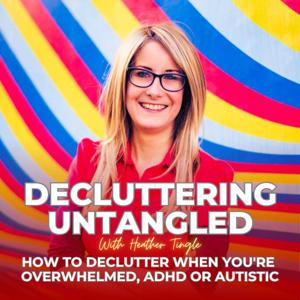
In this podcast, Heather will teach you what really works, and what doesn't, to successfully declutter your home - as when you're overwhelmed, ADHD or Autistic, it isn't just a case of hiring a…
Heather is an expert in working with families that live in chaos, and all the challenges that brings. She is Autistic and has ADHD so knows all about how neurodiversity links to clutter. As a naturally messy person herself, she can show you how to live in a clean, clutter free and organised home regardless of the issues you face. She thrives on creating strategies and systems that work for real families. Transforming your cluttered homes to calm, safe spaces can also improve your mental, physical and financial health, learn all about it in this podcast.
Heather Tingle has been a member of The Association of Professional Declutterers and Organisers since 2016. She and her family have had hoarding tendencies, living in messy homes, stuck in that never ending, exhausting cycle of chores and tidying. She decluttered her home and found a new, calmer and more content way to live. She now supports clients in person and online to achieve the same outcome in their own homes - and now you can learn how she does it through this podcast too!
Ranked by our users in the last 21 days

403 Listeners

2,481 Listeners
2,081 Listeners
274 Listeners

319 Listeners
203 Listeners

844 Listeners
931 Listeners
390 Listeners

675 Listeners

352 Listeners
124 Listeners
166 Listeners
296 Listeners
54 Listeners