
Sign up to save your podcasts
Or

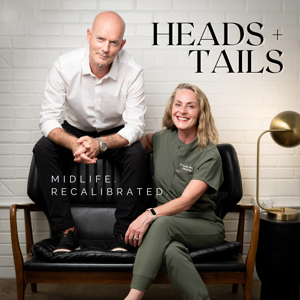


In this special Ask Us Anything episode of Heads & Tails, Dr. Kate White and Jay White tackle some of the most common—and most important—questions they receive from listeners navigating midlife. From relationship challenges and people-pleasing to GLP-1 medications, menopause metabolism, hormone therapy after 60, and why we care so much what others think of us, this episode is packed with practical insights from both the biological and psychological sides of midlife.
In This Episode: ✔ Why you're often nicer to strangers than your spouse or family ✔ The hidden danger of "keeping score" in relationships ✔ Why caring what people think is normal—and when it becomes unhealthy ✔ The psychology behind the "spotlight effect" ✔ Are GLP-1 medications cheating? ✔ How menopause changes metabolism and increases insulin resistance ✔ Why GLP-1s may be especially beneficial for women in midlife ✔ Can you start hormone therapy after age 60? ✔ The truth about vaginal estrogen and urinary tract infections ✔ What hormone therapy can—and cannot—help after menopause
Key Takeaways • Unconditional love isn't unlimited. Healthy relationships require deposits, not just withdrawals. • Most people think about you far less than you think they do. • GLP-1 medications are not "diet drugs"—they may help correct metabolic changes associated with menopause. • It's rarely too late to have a conversation about hormone therapy with a menopause-trained clinician. • Midlife isn't a crisis—it's an opportunity for recalibration.
Connect With Us Website: HeadsAndTailsPodcast.com Questions for future episodes: [email protected] Dr. Kate White's practice: RecalibrateHealthMD.com
If you enjoyed this episode, please subscribe, leave a review, and share it with a friend navigating midlife. Because taking care of yourself means taking care of your head and your tail.
Does it feel like anxiety has become your constant companion in midlife?
You're not imagining it.
In this episode of Heads & Tails, Dr. Kate White and Jay White explore why anxiety often increases during midlife—especially during the menopause transition—and how it affects our relationships, health, sleep, and overall quality of life.
They discuss the biological changes that make anxiety more common, the life-stage pressures that amplify stress, and the practical, non-medication strategies that can help you regain control.
You'll learn:
• Why anxiety affects women and men differently
• How hormone changes can increase anxiety during perimenopause
• The surprising connection between anxiety, weight gain, blood pressure, and heart health
• Why chronic stress and anxiety aren't always the same thing
• The "Ladder of Anxiety" framework for slowing down catastrophic thinking
• How sleep, exercise, alcohol, blood sugar regulation, and social connection influence anxiety
• Why avoidance makes anxiety worse
• The role of therapy, community, and self-compassion in recovery
Key Takeaways
✅ Anxiety isn't always about the problem itself—it's often about the speed of the conclusion.
✅ Midlife anxiety grows in isolation and shrinks through connection.
✅ Small daily habits like sleep, movement, protein intake, and meaningful relationships can significantly reduce anxiety.
Memorable Quote
"Anxiety isn't the problem itself—it's the speed your brain gets to the conclusion."
Resources Mentioned
• Cognitive Behavioral Therapy for Insomnia (CBT-I)
• Headspace meditation app
• Recalibrate Health
• Sleep education resources from Dr. Andrea Matsumura
Connect With Us
Follow Heads and Tails for practical conversations where biology meets psychology to help you recalibrate midlife.
Why do couples fight about money so much in midlife? In this episode of Heads & Tails Podcast, gynecologist and menopause specialist Dr. Kate White and marriage therapist Jay White break down the emotional psychology behind financial conflict in long-term relationships.
This episode covers:
✔️ Money anxiety in midlife
✔️ Financial resentment in marriage
✔️ Spender vs saver relationships
✔️ Emotional labor & unpaid work
✔️ How menopause affects stress tolerance
✔️ Financial secrecy and intimacy
✔️ Retirement fears & aging parents
✔️ Healthy communication around money If you've ever argued about spending, saving, retirement, vacations, or financial priorities with your partner—this conversation is for you.
👍 Like, Subscribe & Share 💬 Comment: Are you the spender or the saver in your relationship?
What if the, low desire, or changes in your sex life you've been told are "normal" actually aren't?
In this episode of Heads & Tails, Dr. Kate White and Jay White sit down with Dr. Sameena Rahman — widely known online as "GynoGirl" — for a candid, empowering conversation about women's sexual health, trauma-informed gynecology care, pelvic pain, libido, menopause, and why so many women are dismissed when they ask for help.
Together, they unpack:
• Why pain with sex is never something women should simply "push through"
• How women are conditioned to normalize suffering
• The connection between pelvic floor dysfunction, hormones, anxiety, and sexual pain
• What pelvic floor physical therapy actually is — and why it can be life-changing
• The difference between spontaneous desire and responsive desire in long-term relationships
• Why libido often disappears when sex becomes painful
• How trauma, culture, shame, and "medical gaslighting" affect women's willingness to seek care
• How perimenopause and menopause impact arousal, vaginal tissue, and intimacy
• New treatments for female arousal, including topical sildenafil ("topical Viagra")
• Why women need clinicians who actually have time and training to address sexual health concerns
Dr. Rahman also shares insights from her upcoming book, Brown Girl's Disease: A Guide to Sexual Health and Empowerment Through a South Asian Lens, and discusses how women can better advocate for themselves in a healthcare system that often overlooks sexual wellness.
If you've ever wondered:
• "Is this normal?"
• "Why does sex hurt?"
• "Why don't I feel desire anymore?"
• "Why do I feel dismissed by doctors?"
• "Could hormones, stress, trauma, and relationship dynamics all be connected?"
…this episode is for you.
Because midlife isn't just about surviving changes — it's about recalibrating your body, mind, and relationships from your head to your tail.
In this episode, Dr. Kate White (OB/GYN & menopause specialist) and Jay White (therapist) break down how to separate hormone-driven changes from the mental and emotional load of midlife—and why the answer is often both.
You'll learn:
What perimenopause actually is (and why it's so hard to define)
Why your brain notices hormonal shifts before your cycle changes
The real reason anxiety, irritability, and brain fog spike in midlife
How to tell if your symptoms are cyclical vs situational
Why there's no "simple test"—and what to do instead
The role of hormone therapy (and why fear may be outdated)
Practical tools to manage emotional reactivity and overwhelm
Why midlife care must address both biology AND psychology
This episode reframes midlife from confusion and frustration into something far more powerful: recalibration.
📍 Learn more about Dr Kate White's Menopause focused practice opening August 2026 in Charleston, SC Recalibrate Health: recalibratehealthmd.com
📍 April 30 book launch event in Charleston, SC : Dr Kate White talks "The New Perimenopause" with author Dr. Mary Claire Haver
When your kids become adults, your role changes—but no one gives you the playbook.
In this episode of Heads & Tails, Dr. Kate White and Jay White break down one of the most challenging transitions in midlife parenting: shifting from manager to consultant. When should you give advice… and when should you stay quiet?
They explore how love, fear, identity, and even hormones shape the advice we give—and why sometimes "helping" can actually harm the relationship.
You'll learn how to decide when to speak up, how to be heard when it matters, and how to maintain connection without control.
In this episode:
Why advice is often more about you than your child
The shift from parenting → consulting
How midlife brain changes affect your filter and delivery
The 5 key areas where parents struggle most to hold back:
Career
Relationships
Money
Parenting (yes—grandparent dynamics)
Health & lifestyle
A powerful communication tool: "Do you want me to listen or give advice?"
"Direct by yielding" — how to guide without pushing
How too much advice makes your voice easier to ignore
Key takeaway:
You're not caring less—you're protecting the relationship so they'll come to you when it really matters.
You're in the same house, the same marriage, the same life — so why do you still feel lonely?
In this episode, Kate and Jay unpack one of the most painful and common midlife relationship struggles: feeling emotionally alone while living a very full life. They explore how distraction, stress, hormonal changes, sleep disruption, and the mental load of midlife can quietly erode connection — and what couples can do to reconnect before resentment takes over.
We cover:
• Why loneliness can happen inside a good relationship
• How missed bids for attention create disconnection
• The role of midlife biology in emotional regulation
• Why "I didn't mean anything by it" doesn't erase impact
• Practical tools to rebuild presence and intimacy
You'll learn:
• How to ask for attention more clearly
• How to ground yourself before hard conversations
• How a 10-minute daily check-in can change the tone of a relationship
• When therapy may help break the pattern
This episode is especially for midlife women, but it will resonate with anyone who has ever felt alone while sitting right next to the person they love.
Desire mismatch in midlife is common — and it does not mean your relationship is broken. In this episode, Dr. Kate White and Jay White sit down with sexual medicine expert Dr. Kelly Casperson of the You Are Not Broken podcast to talk about why differing levels of desire show up so often in long-term relationships, especially in midlife.
What you'll take away from this conversation
You'll come away with a more compassionate and realistic understanding of sex in long-term relationships: that good sex is not automatic, that intimacy often requires intention, and that midlife is not the end of desire — it's often the beginning of a different, more informed, more connected version of it.
Questions answered in this episode:
• Why don't I want sex the way I used to?
• Is responsive desire normal?
• What helps couples when desire doesn't match?
• Why does sex sometimes feel harder in midlife?
• What kinds of stimulation work better for women in perimenopause and menopause?
Mentioned in this episode:
• Dr. Kelly Casperson's podcast: You Are Not Broken
• Books: You Are Not Broken and The Menopause Moment
• The Explorer Vibrator from Elixir Play
• Discount code: NOTBROKEN20
• Tell Me What You Want: The Science of Sexual Desire and How It Can Help You Improve Your Sex Life — Justin J. Lehmiller
• Magnificent Sex: Lessons from Extraordinary Lovers — Peggy J. Kleinplatz and A. Ménard
• Dr Laurie Mintz — Becoming Cliterate and A Tired Woman's Guide to Passionate Sex
Subscribe, like, and share with someone who needs this conversation.
Midlife can turn minor conflict into major disconnection—especially when hormones, mental load, and stress push your brain into "flooded" mode. Dr. Kate White and Jay White break down what fighting fair actually looks like in midlife: how to regulate first, stay on one issue, name the pattern underneath repeat fights, and prioritize respect and repair so you can stay a team—even in conflict.
In this episode, we cover:
Why "fighting fair rules" are easy to know and hard to use
The "book of hurts" (and why dragging it into every fight derails repair)
Start and end on the right note: repair > perfection
Midlife brain changes: prefrontal cortex vs. amygdala ("smoke detector")
Dopamine/attention/executive function shifts and why fights go off the rails
Anger as a secondary emotion: what happened right before the blow-up?
The "3 folders" tool: your last 20 fights usually boil down to a few themes
Circular arguments and how to break the loop with a concrete next step
Mental load + unequal load: the frog-in-the-soup problem
Loneliness and loss in midlife—and how they show up as anger
Safety note: when conflict escalates beyond safe
Try this this week:
Use the reset script: "I'm flooded. I need a minute. I want to come back and do this well."
Do the 3-folder exercise: categorize your last 10–20 fights into themes.
End with a next step: "What do we need from each other this week?"
Resources / CTA
Want our 4-week Recalibration + Intimacy Reset? Email: [email protected]
Educational content only; not medical or mental health advice.
To my fellow clinicians: listen to the You Are Not Broken podcast on Pinnacle's network to earn FREE CME credit.
https://learnatpinnacle.com/education
What happens when "be strong" turns into "be silent"? In this episode of Heads & Tails, we sit down with Traver Boehm, founder of the UNcivilized Men's Movement, to unpack the cultural myth that men must always be tough, unbothered, and emotionally bulletproof—and how that training can quietly sabotage intimacy, conflict repair, and long-term connection.
Traver and Jay get real about what often replaces emotional vocabulary: shutdown, defensiveness, or burying pain with what Jay calls "Pot, Porn, or Pabst Blue Ribbon." Traver shares practical tools that help men build the capacity to stay present—like meditation, nervous-system regulation, and (crucially) community—so the relationship isn't the only place their unprocessed pain leaks out.
If you love a good man but feel like you're talking to a wall during conflict, this episode is for you—and for the men you care about.
💡 Name: Traver Boehm
💡Company: Man UnCivilized
💡Noteworthy: founder of the UNcivilized Men's Movement and has built programs and communities focused on helping men develop emotional strength, accountability, and connection.
💡 Where to find them:
Man UnCivilized Podcast https://www.manuncivilized.com/meet-traver-boehm
Find an in person men's group: https://www.manuncivilized.com/mensgroup
The Book: 28 Days In Darkness (https://www.manuncivilized.com/books#section-1751992894384) for men ready to reclaim authentic masculinity (and for the people who love them)
To my fellow clinicians: listen to the You Are Not Broken podcast on Pinnacle's network to earn FREE CME credit.
https://learnatpinnacle.com/education
From the publisher's feed
12,832 Listeners

246 Listeners

12,666 Listeners

6,675 Listeners

6,446 Listeners

9,131 Listeners

7,911 Listeners

1,124 Listeners

3,338 Listeners

28,980 Listeners

41,313 Listeners

18,797 Listeners

10,742 Listeners

8,452 Listeners
430 Listeners