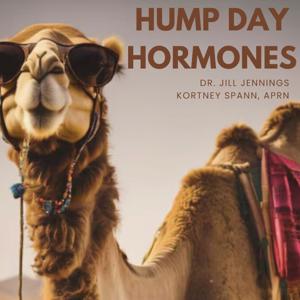
Hump Day Hormones

Hump Day Hormones

By Dr. Jill Jennings & Kortney Spann, APRNMedicineHealth & FitnessEducation
Download on the App Store

Hump Day Hormones episodes

  • Ep: 57: Joint Pain and Sarcopenia in Perimenopause and Menopause – Why Everything Hurts and What Helps
    If your joints ache when you get out of bed…
    If your hands hurt opening jars that never used to be a problem…
    If your muscles feel weaker, softer, or harder to maintain — even though you’re trying…
    You’re not imagining it.
    You’re not broken.
    And no — this is not “just aging.”
    Today on Hump Day Hormones, we’re talking about joint pain and sarcopenia — two of the most common (and dismissed) complaints in perimenopause and menopause.
    This episode is part of our Head-to-Toe Menopause Series, and it tackles what’s now being recognized as the musculoskeletal syndrome of menopause.
    We break down:
    🔥 Why up to 70% of midlife women experience new or worsening joint and muscle pain
    🔥 Why perimenopause is a uniquely vulnerable time for musculoskeletal symptoms
    🔥 How fluctuating and declining estrogen affects bones, joints, cartilage, tendons, and muscle
    🔥 Why inflammation increases — and recovery slows
    🔥 Why muscle loss accelerates in menopause (and why that matters for metabolism and insulin resistance)
    🔥 Why symptoms often worsen with poor sleep, stress, or under-fueling
    🔥 How to tell hormone-related pain from red flags that need further workup
    If your knees, hips, hands, shoulders, or feet suddenly hurt — this is a real, recognizable pattern.
    And then we get practical about what actually helps.
    We talk about:
    ✔ Why resistance training is non-negotiable in menopause
    ✔ How much protein women actually need to preserve muscle
    ✔ Why even distribution of protein matters more than total grams
    ✔ Creatine and collagen — what the evidence actually shows
    ✔ How estrogen therapy can reduce joint pain for some women
    ✔ The role of testosterone in preserving lean mass (and why it’s not magic on its own)
    ✔ Why thyroid, vitamin D, iron, and inflammation labs matter
    ✔ When pain is not hormonal — and should not be ignored
    Joint pain and muscle loss in menopause are not:
    A personal failure
    A lack of motivation
    Something you should “just get used to”
    They are:
    A physiologic transition
    Influenced by hormones, inflammation, sleep, nutrition, and stress
    Highly responsive to the right, layered strategy
    If you’ve been told, “This is just aging,” that’s outdated medicine.
    Your body isn’t betraying you.
    It’s asking for a different approach.
    And the good news?
    This is a season where small, consistent changes make a big difference — in strength, function, and how you feel in your body.

    1 hr
  • Ep: 56: GSM — The Menopause Symptom Nobody Warned You About
    This episode is part of our Head-to-Toe Menopause Series, and it tackles one of the most underdiagnosed and undertreated menopause conditions out there — GSM. This is a menopause symptom that’s incredibly common, highly treatable, and somehow still whispered about like it’s a secret.
    If you’ve ever thought:
    “Why does sex suddenly feel like sandpaper?”
    “Why am I peeing all the time?”
    “Why do I feel irritated down there for no reason?”
    You’re not broken.
    You’re not “just getting older.”
    You may have Genitourinary Syndrome of Menopause (GSM) — and today, we’re talking all about it.
    We break down:
    • What GSM actually is (and why it replaced the outdated term “vaginal atrophy”)
    • Why symptoms often persist and worsen without treatment
    • How low estrogen changes vaginal, vulvar, and urinary tissue at a structural level
    • Why this is about collagen, blood flow, pH, and microbiome — not “just dryness”
    • Why GSM can affect sex, bladder control, UTIs, irritation, and pelvic floor health
    • Why common doesn’t mean normal — and why we should be talking about this more
    And then we get very clear about what actually helps.
    We talk about:
    • The difference between lubricants and vaginal moisturizers
    • Why vaginal estrogen is not a lubricant — and why that matters
    • Why low-dose vaginal estrogen is the gold standard for GSM
    • What the research really says about systemic absorption and safety
    • Vaginal estrogen vs DHEA — and why “not estrogen” doesn’t mean safer
    • What ACOG, AUA, and menopause societies actually recommend
    • When pelvic floor physical therapy can be a game changer
    • Why lasers and energy-based devices deserve a cautious conversation
    GSM is not:
    • Rare
    • A personal failure
    • Something you just have to live with
    It is:
    • Common
    • Progressive without treatment
    • One of the most treatable menopause conditions we see
    If you’re dealing with dryness, irritation, pain with sex, urinary urgency, or recurrent UTIs — bring it up.
    If your clinician doesn’t ask, you can.
    And if your symptoms are dismissed, it’s okay to get a second opinion.
    Menopause symptoms don’t need to be miserable — and this one is especially fixable.
    1 hr 10 min
  • Ep: 55: Menopause Metabolism: Why Fat Moves to Your Belly
    New Episode of Hump Day Hormones is LIVE!
    You didn’t suddenly lose discipline.
    You didn’t forget how to eat or move.
    And no — this is not a willpower problem.
    If you’ve hit midlife and thought:
    “I eat the same. I move the same. Why is everything going to my stomach?”
    This episode is for you. 👖➡️😩
    Today on Hump Day Hormones, we’re talking about menopause metabolism — and why fat suddenly packs up and moves straight to your belly.
    This episode is a deeper, science-backed follow-up to our fan-favorite Menopause and Muffin Tops, because this topic deserves more than “eat less and move more.”
    We break down:
    🔥 Why perimenopause is the phase when women gain the most weight (yes, it’s proven)
    🔥 Why estrogen loss alone is an independent risk factor for weight gain
    🔥 Why menopause shifts fat toward the belly (visceral fat) — and why that matters
    🔥 Why this fat is metabolically active and inflammatory (not the pinchable kind)
    🔥 How cortisol, insulin resistance, and sleep disruption fuel the belly-fat loop
    🔥 Why muscle loss quietly slows your metabolism behind the scenes
    🔥 The evolutionary reason your body is choosing hormone survival over a flat stomach
    And then we get real about solutions — not punishment.
    We talk about:
    ✔ Why strength training is non-negotiable in menopause
    ✔ How protein becomes a hormonal tool, not a diet trend
    ✔ Why chronic calorie restriction backfires (hard)
    ✔ How sleep and stress directly influence belly fat storage
    ✔ How estrogen, testosterone, and properly dosed HRT can support metabolic health
    ✔ Why transdermal estrogen matters more than most people realize
    And yes — we go there.
    Belly fat in menopause is not:
    ❌ A personal failure
    ❌ Proof you’re “doing it wrong”
    ❌ Something you fix by eating less
    It is:
    ✅ A hormonal adaptation
    ✅ A metabolic signal
    ✅ A clue about insulin, cortisol, muscle, and estrogen
    Menopause doesn’t break your metabolism.
    It changes the game.
    And when the rules change, the strategy has to change too.
    If this episode hit home, share it with the woman who keeps asking:
    “Why is it all going to my stomach?”
    Because now — you know. 💥
    1 hr 7 min
  • Ep 54: This Girl Is on Fire (in the Middle of Winter): Hot Flashes Explained
    It may be freezing outside — but if you’re in midlife, it might feel like your body is on fire. 🔥
    In this episode of Hump Day Hormones, we continue our Head-to-Toe Menopause Series by turning up the heat and tackling one of the most misunderstood (and dismissed) menopause symptoms: hot flashes.
    If you’ve ever gone from “I’m fine” to “why am I radiating like a space heater?” in under 30 seconds — this episode is for you.
    We break down:
    • Why hot flashes start in the brain, not just the ovaries
    • How estrogen stabilizes your internal thermostat — and what happens when it drops
    • Why hot flashes are neurologic and vascular events, not just “being warm”
    • The role of KNDy neurons and why they’re the real stars of the show
    • Why you can swing from sweating to shivering within minutes
    • The difference between hot flashes and histamine flushing
    • Why night sweats are especially disruptive to sleep, cortisol, and metabolism
    And here’s where it gets really important:
    Hot flashes may be an early signal of vascular stress.
    They don’t cause heart disease — but growing evidence shows they may act like a check-engine light for cardiovascular health during menopause.
    We also cover:
    • The connection between hot flashes, cortisol, insulin resistance, and inflammation
    • Why more severe or frequent hot flashes deserve attention — not dismissal
    • FDA-approved hormonal treatments and why they work so well
    • Non-hormonal treatment options (SSRIs, gabapentin, and newer neurokinin-3 receptor antagonists)
    • What lifestyle strategies help — and what won’t fix the root cause
    Bottom line:
    Hot flashes are real, biologically meaningful, and treatable.
    They are not “just in your head,” not something you have to live with, and not a rite of passage you’re meant to suffer through.
    Your body is communicating with you — and it deserves to be listened to.
    45 min
  • EP 45: How to talk to your provider about menopause
    We’re smack dab in the middle of Menopause Awareness Month (and yes, it’s also Breast Cancer Awareness Month) — so today, we’re taking things back to the basics. No studies, no medical jargon, just an honest, relatable conversation about something every woman eventually faces: how to actually talk to your provider about perimenopause, menopause, and hormone health.
    If you’ve ever left your appointment thinking, “That was… not helpful,” or felt brushed off when you brought up hot flashes, brain fog, low libido, or the sudden mood swings that seem to appear out of nowhere — you are not alone. Women everywhere are having the same frustrating experience, and it’s time to change that.
    This week, we’re unpacking what makes these conversations so difficult — from the lack of provider training in menopause management to the old-school medical biases that still label women as “emotional” or “overreacting.” Spoiler alert: it’s not you. The system has a lot of catching up to do.
    We’re giving you a clear, actionable framework to help you walk into your next appointment confident and prepared. We’ll cover:
    *How to schedule the right kind of appointment (and why an annual exam isn’t always the time for hormone talk)
    *What to ask when choosing your provider — and how to find one who truly understands perimenopause and menopause
    *How to track and articulate your symptoms like a mini hormone detective (because vague complaints get vague answers)
    *How to set clear goals and expectations before you even step into the room
    47 min
  • EP 44: Gut Feelings?
    Happy Menopause Month! This week on Hump Day Hormones, we’re wrapping up our deep-dive into the perimenopause–estrogen–liver–gut connection with one seriously underrated superstar: your estrobolome — the gut bacteria squad that manages how estrogen moves through your body.
    Think of it as your hormone recycling center — deciding whether estrogen gets shipped out for good or sneaks back in for a second round. When it’s balanced, life feels smooth: your mood is stable, your sleep makes sense, and your jeans fit the same two days in a row. But when it’s off? Cue bloating, irritability, and that lovely estrogen dominance storm we all know too well.
    In this episode, we unpack how your gut influences everything from estrogen balance and thyroid health to inflammation, metabolism, and mood. You’ll learn why gut bacteria shifts during menopause can increase stubborn belly fat, trigger hot flashes, and even alter your mental clarity — and what you can do to fix it.
    We’re talking probiotics, fiber, liver detox support, and the science-backed foods and supplements that actually help your body work with your hormones, not against them.
    It’s the perfect mix of nerdy, necessary, and just a little bit sassy — because who said hormone education had to be boring?
    Tune in, take notes, and let’s keep breaking down the stigma around women’s health one Wednesday at a time.
    53 min
  • Ep 43: Estrogen Metabolism
    Your liver does more than help you survive margarita night—it’s the ultimate hormone traffic controller. From clearing out extra estrogen to converting thyroid hormones and even sweeping away excess cortisol, your liver keeps hormone chaos from piling up.
    But when it gets sluggish? That’s when the real drama begins. Think heavy, painful periods, stubborn belly fat, 2 a.m. wakeups, PMS meltdowns, and even that one glass of wine hitting you like a freight train. Yep—your liver might be whispering “help me out here!”
    In this week’s episode of Hump Day Hormones, we’re diving into:
    ✨ Why estrogen metabolism matters more than you think
    ✨ How a “congested” liver backs up hormones and fuels perimenopause mayhem
    ✨ The clinical signs your liver is waving a white flag (hello bloating, fatigue, and mood swings)
    ✨ What slows down liver detox—like stress, sugar, alcohol, and everyday toxins
    ✨ The two-step process of hormone detox (Phase 1 & Phase 2) and how food + lifestyle make all the difference
    ✨ Practical, science-backed ways to support your liver so your hormones stay balanced and your body feels like yours again
    Think of it as a crash course in why your liver is the unsung hero of hormone balance—and why kale, beets, fiber, and maybe skipping that extra glass of rosé might just change your life.
    54 min
  • EP 42: Perimenopause series: The Estrogen Drama
    Ever feel like your hormones are on a rollercoaster with no seatbelt? Welcome to perimenopause – or as some have called it, “puberty in reverse.” In honor of Perimenopause Awareness Month, we’re back with part two of our special series, and this week it’s all about estrogen: the multitasking, drama-filled hormone that keeps your brain, bones, heart, and skin in balance... until it doesn’t.
    Last week, Jackie Piasta helped us unpack why perimenopause is finally getting the attention it deserves as millennials begin “hitting the pause.” Today, we dive into why estrogen is so unpredictable during this transition and why progesterone seems to skip the invite altogether. From heavy periods one month to hot flashes and night sweats the next, estrogen’s highs and lows can leave women feeling like they’re living in hormonal whiplash.
    We’ll break down the stages of perimenopause, talk through what estrogen dominance really means (and why mainstream medicine side-eyes the term), and explore the real-life symptoms women face daily—brain fog, anxiety, sleep struggles, mood swings, libido changes, and more. Think of it as decoding the chaos so you can finally understand what’s happening inside your body.
    This episode is fun, raw, and empowering, with practical takeaways that will leave you feeling less alone and more equipped to handle this transition. Because perimenopause isn’t just about periods—it’s a full-body journey. And understanding estrogen’s drama is the first step in taking back control.
    1 hr 6 min
  • EP 41: Fresh Out of the Millennial Pause and Into Perimenopause
    Episode 41: Fresh Out of the Millennial Pause and Into Perimenopause
    This week on Hump Day Hormones, we’re tackling a conversation that every millennial woman needs to hear: when the “millennial pause” meets perimenopause.
    September is Perimenopause Awareness Month, and we’re digging into what it really means to enter this “zone of chaos” long before full menopause sets in. While menopause finally gets the recognition it deserves, perimenopause is still under-discussed, under-researched, and often dismissed—even though it can affect women as early as their 30s.
    We’re joined by the amazing Jackie Piasta, DNP, MSN, WHNP, a nationally recognized expert in perimenopause and midlife health, with a massive social media presence dedicated to breaking the stigma and spreading real education. Jackie helps us unpack:
    ✨ Why perimenopause symptoms are often ignored or misdiagnosed
    ✨ The cultural myths around being “too young” for menopause
    ✨ How over half of women ages 30–35 already experience moderate to severe symptoms
    ✨ Why it’s critical to seek help before full menopause hits
    Jackie also shares her own professional journey, from New Jersey to Vanderbilt to Little Rock to founding Monarch Health, a clinic dedicated to midlife and menopause care. With her blend of expertise and down-to-earth communication, she shows us why perimenopause is more than hot flashes—it’s a pivotal time to take charge of your long-term health and aging well.
    Whether you’re a millennial just starting to feel the shifts or a provider trying to better understand this rollercoaster phase, this episode is full of insights, relatable laughs, and practical takeaways.
    1 hr 6 min
  • EP 40: Fresh Out the Slammer
    This week on Hump Day Hormones, we’re welcoming a brand-new face to the clinic and to the mic — Dr. Victoria Helton. Fresh out of residency, Dr. Helton brings a rare, up-to-the-minute perspective on hormone education, women’s health, and what it really feels like to transition from years of training into private practice.
    We talk about the highs and lows of residency, what’s changing (and what still isn’t) in how providers are trained to manage perimenopause and menopause, and why patients are often more educated than their own providers thanks to TikTok and Instagram. Dr. Helton opens up about her journey from Texas to Arkansas, balancing life as a physician and new mom, and what it means to step into a clinic culture built on collaboration and support.
    It’s candid, relatable, and a reminder of how the next generation of providers could help transform the future of hormone care.
    51 min

About Hump Day Hormones

From the publisher's feed

This is a podcast about all things hormones! Dr. Jill Jennings and Kortney Spann, APRN are so excited to share their knowledge and expertise about menopause, perimenopause, and hormone imbalances.

More shows like Hump Day Hormones

The Dr Vonda Show by Dr. Vonda Wright

The Dr Vonda Show

254 Listeners

For The Love With Jen Hatmaker Podcast by Jen Hatmaker

For The Love With Jen Hatmaker Podcast

6,435 Listeners

Raising Boys & Girls by That Sounds Fun Network

Raising Boys & Girls

1,911 Listeners

Dhru Purohit Show by Dhru Purohit

Dhru Purohit Show

3,418 Listeners

The Dr. Hyman Show by Dr. Mark Hyman

The Dr. Hyman Show

9,148 Listeners

Health By Heather Hirsch by Heather Hirsch MD

Health By Heather Hirsch

223 Listeners

The Hormone Solution | Menopause, Perimenopause, & Women's Midlife Health by Karen Martel: Certified Hormone Specialist

The Hormone Solution | Menopause, Perimenopause, & Women's Midlife Health

332 Listeners

On Purpose with Jay Shetty by Perfect Strangers

On Purpose with Jay Shetty

27,762 Listeners

Everyday Wellness: Midlife Hormones, Menopause, and Science for Women 35+ by Everyday Wellness™

Everyday Wellness: Midlife Hormones, Menopause, and Science for Women 35+

129 Listeners

You Are Not Broken by Kelly Casperson, MD

You Are Not Broken

1,140 Listeners

Hack My Age : Menopause Upgrade by Zora Benhamou

Hack My Age : Menopause Upgrade

116 Listeners

Dr. Streicher’s Inside Information: Menopause, Midlife, and More by Lauren Streicher, MD

Dr. Streicher’s Inside Information: Menopause, Midlife, and More

355 Listeners

The Mel Robbins Podcast by Mel Robbins

The Mel Robbins Podcast

19,254 Listeners

The Dr. Brighten Show by Dr. Jolene Brighten

The Dr. Brighten Show

141 Listeners

All About You With Dr Shauna Watts by Dr Shauna Watts

All About You With Dr Shauna Watts

14 Listeners