
Sign up to save your podcasts
Or



Counting how many teams run the Agile ceremonies tells you people are doing things. It doesn’t tell you anything got better. Elisabeth Hendrickson and Joel Tosi call that “change theater,” and it’s one of the illusions their new book is built to take apart.
My guests for Episode 550 are the co-authors of Signals & Levers: Systems Thinking Tools to Unblock Software Delivery (IT Revolution, September 2026). Elisabeth is the founder of Curious Duck Digital Laboratory, former VP of R&D at Pivotal, and author of Explore It! Joel is co-founder and CTO of Dojo & Co. and co-author of Creating Your Dojo and Coaching for Learning.
The book is written for software organizations, but the ideas come from Deming, Shewhart, Argyris, and Donella Meadows, and most of this conversation applies to any leader trying to improve a system. We talk about the three illusions of predictability, progress, and control, and why they tend to show up together. We get into what it means to run “open loop,” changing things without ever checking whether the change worked, and how organizations accidentally create latency by separating strategy from execution. Joel explains why he brought process behavior charts to software teams, and Elisabeth makes the case that story points are an opinion, cycle time is a fact, and doing math on an opinion still leaves you with an opinion.
We close on psychological safety: why a defensive organization can score itself high on safety surveys while behaving otherwise, and why you can’t fix fear by telling people to be brave.
Full show notes, links, and transcript: https://www.leanblog.org/550
Follow Lean Blog Interviews for more conversations on Lean, leadership, and continuous improvement.
Accounting teams see problems every day. As my returning guest Nick Katko puts it, they fix them, but they don’t necessarily solve them.
Nick is president and owner of BMA, a CPA, and the author of The Lean CFO and co-author of Practicing Lean Accounting. His new book, independently published, is Creating a Continuous Improvement System in Accounting. It grew out of coaching two accounting teams in Ohio, and it comes with a companion webpage of checklists, assessments, and short training presentations.
We talk about why so many accounting leaders misunderstand continuous improvement, often because it was done to them by someone else in the company. Nick lays out the three parts of the system he teaches: simple PDCA problem solving, daily lean management, and improvement events, in that order. He shares an accounts payable example where a team cut invoice defects from about 43% to 15% after a month of gathering data instead of guessing.
We also get into culture and psychological safety. Nick tells the story of a month-end close engagement where the one person who clearly explained the systemic problems was fired between his visits, and why he walked away rather than run it the top-down way leadership wanted. We discuss why psychological safety shifts when a leader walks in or out of the room, why leaders can’t accurately self-assess it, and how a daily problem-solving huddle ended finger-pointing between accounting and purchasing.
Full show notes and links: http://leanblog.org/549
Nick’s book: https://link.amazon/B0dcAyu1m
If you find the show useful, please follow and leave a rating or review.
How does a Lean team of 11 people support a management system for 35,000 associates? Emily Swaney, Vice President of Operational Excellence at OhioHealth, explains that the team spends its time developing about 1,500 leaders as problem-solving coaches instead of leading projects.
Emily is a Lean Six Sigma Black Belt and a graduate of Ohio State's MBOE program. She describes why her team facilitates short kaizen events and then hands the follow-up to process owners. She talks about coaching executives who were still learning not to be heroes, and about "second coaches," including managers who give feedback to hospital presidents on their coaching.
We also discuss OhioHealth's five-tier safety huddles, which roughly doubled the number of reported concerns. Leaders close the loop by bringing updates back to the front line during daily protected gemba time, often within hours of when a concern was raised. Emily explains how frontline teams choose their own KPIs from dashboards tied to the balanced scorecard, and what's next, including an associate idea platform and extending the management system into corporate functions.
Full show notes and transcript: http://leanblog.org/548
If you find the show useful, please follow and leave a review.
Karen Martin has joined this podcast five times since 2012. For our 20th anniversary series, we pulled together highlights from all five conversations: clarity versus ambiguity, why value stream mapping needs directors and above in the room, the pattern behind claims that Lean is dying, and the three rules of quality at the source.
Karen is founder and CEO of TKMG and TKMG Academy, and author of The Outstanding Organization, Value Stream Mapping, and Clarity First, among other books.
Episode page with links and more
Twenty years ago, on July 16, 2006, the Lean Blog Podcast began with a conversation with Norman Bodek.
Episode page
Norman was Mark Graban’s friend and mentor—and the person who suggested starting the podcast. To mark the show’s 20th anniversary, Mark revisits highlights from that first episode.
Norman explains the difference between kaizen and kaizen events, why employees should be trusted to implement small improvements, and how one idea at Gulfstream produced thousands of hours in savings when it was copied across the plant.
He also reflects candidly on his own leadership mistakes, including his tendency as a company owner to tell employees what to do rather than ask for their ideas.
Other topics include:
• Quick and Easy Kaizen
Norman passed away in 2020, but his influence continues through the people he taught, the books he wrote and published, and the ideas he helped introduce to a much wider audience.
Listen to the complete original episode at leanblog.org/1.
Why do so many Lean implementations struggle or fail to stick? Thomas Cox and Andre DeMerchant join me to work through that question using a verbal A3.
Thomas Cox is a management bench builder, co-founder of the Transformative Leadership Lab, and a certified Harada Method coach trainer. Andre DeMerchant is president of DeMerchant Healthcare Solutions and a former Toyota team member who started as a forklift driver at Toyota Motor Manufacturing Canada and rose to manufacturing manager. He's also a returning guest from episode 307.
The core idea: Lean asks people to surface problems, admit mistakes, and stop the line without fear. That requires psychological safety, and psychological safety has to exist before Lean gets rolled out. It can't be created by the rollout itself. Drawing on Chris Argyris, Thomas frames the problem as Model 1 behavior (controlling, self-protective, blame-oriented, closed off) versus Model 2 (calm, curious, empathic, non-defensive). Under pressure, most leaders default to Model 1, which is the opposite of what Lean needs.
Along the way we get into Andre's contrast between meat-packing management meetings (where having no problems was the goal) and Toyota meetings (where showing up without a problem marked you as the person who didn't understand the work). We also talk about Alan Mulally banning sarcasm at Ford, Mark Fields reporting red and getting applause instead of fired, the carrot-and-stick fallacy, McGregor's Theory X and Theory Y, and the uncomfortable question of whether consultants succeed because of method or because they cherry-pick clients.
Thomas and Andre have published their A3 as a living document and built an assessment for gauging how close a C-suite is to the preconditions Lean needs. Links in the show notes.
Episode page with links and more
Companies and people referenced: Toyota, Ford, General Motors, Kimberly-Clark, Salem Health, W. Edwards Deming, Chris Argyris, Douglas McGregor, Peter Senge, John Shook, Norman Bodek, Jim Prinzing.
My guest for episode 546 is Gary Peterson, who recently retired from O.C. Tanner after helping lead the continuous improvement work that earned the company the Shingo Prize in 1999. Gary is an AME Hall of Fame inductee, and he now serves as an executive in residence at the Ohio State University Fisher College of Business, working with their Master of Business Operational Excellence (MBOE) program.
Gary started this work almost 40 years ago, before the word Lean was in common use. A change in how O.C. Tanner went to market shrank order sizes from thousands down to one or two, and a factory built for big batches started bleeding cost and quality. Gary stepped into a role called facilitator of change. He pulled departments apart, built one-piece flow, and asked frontline people to solve problems in a culture that had taught them it wasn't safe to speak up.
We spend a good part of the conversation on psychological safety and autonomy, and why Gary thinks neither one does much without the other. He also tells what he calls the hardest story in his repertoire. An employee stopped him on a stairwell to tell him his system wasn't working. She was right. He talked circles around her until she cried. What he did next, and what two people did a few hours later, became a turning point for him and for the company.
Topics we get into:
Link to the episode and full transcript.
What would it take for you to tell a room full of people that you don't know what you're doing?
Jeff Liker was guest number three on this podcast back in August 2006. He has been back seven times since, which makes him one of the most frequent guests in the show's history.
For this episode, I pulled clips from across those eight conversations, going back almost twenty years. What stood out on the relisten was how much hasn't changed. The lean tools are better known now. There are more books, more case studies, more conferences. The deeper thing Jeff was naming in 2006 - that companies want the words without the work - is the same thing he is still saying in 2026.
These aren't his greatest hits. They are the ideas that keep showing up.
In this episode, Jeff talks about:
Read the full post with quotes and more at https://leanblog.org/545
Why do so many quality programs fall apart the moment the firefighter walks out the door?
My guest for this episode of the Lean Blog Interviews Podcast is Chad Diggs, a quality management professional, consultant, author, and founder of DIQ (Digging Into Quality), an AI-powered quality platform built for mid-market manufacturers. Chad leads a team of quality engineers supporting first article inspection reviews for customers including Boeing, Collins Aerospace, and Honeywell.
Chad recently released his book, Below the Surface: Building Quality Systems, Not Heroes -- a practitioner's guide written as a story rather than a textbook. The narrative follows a quality manager named Christina Valles through pressures most quality leaders will recognize: shipping bad parts to hit a date, getting blamed for problems built into the system, and watching the same fires get fought again the next month.
We talk about why Chad chose a narrative format, the cost-of-poor-quality math that finally gets leadership's attention in the story (the number was 25 percent of revenue), and the difference between investigating where a defect happened and investigating who to blame for it.
Toward the end of the conversation, I share Isao Yoshino's story from his early Toyota days -- the one where management apologized to him after he put the wrong solvent in the paint line. It is a useful contrast to how most companies still respond to that kind of mistake.
Topics covered:
Get the book and learn more at https://digin2quality.com
Read the full show notes and transcript at https://leanblog.org/544
The podcast is brought to you by Stiles Associates, the premier executive search firm specializing in the placement of Lean Transformation executives. Learn more at https://leanexecs.com/podcast
This podcast is part of the #LeanCommunicators network.
Most people think they're thinking. Scott Burgmeyer says they're mostly just reacting.
Scott is the founder and CEO of Become More Group and coauthor of Think: The Road Less Traveled. In this episode, we dig into why smart, well-intentioned leaders keep making the same avoidable decisions -- and what to do about it.
Episode page with links and more
We cover the cognitive shortcuts that run in the background without us noticing, the ROAD thinking methodology, why AI won't be the differentiator most organizations are hoping for, and what it actually takes to build a culture where real thinking happens. Scott also shares the three growth questions he uses after every client meeting -- a simple practice that compounds fast.
If you've ever watched a team fix the same problem twice and wondered why, this one's for you.
From the publisher's feed
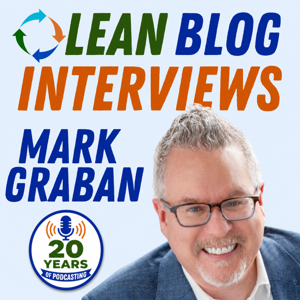
Lean Blog Interviews: Real-World Lean Leadership Conversations features thoughtful, in-depth discussions with leaders, authors, executives, and practitioners who are applying Lean thinking in the real world.
Hosted by Mark Graban—author of Lean Hospitals, Measures of Success, and The Mistakes That Make Us—the podcast explores Lean as a management system, a leadership philosophy, and a people-centered approach to continuous improvement.
Episodes span healthcare, manufacturing, startups, technology, and professional services. Guests share candid stories about what actually works—and what doesn’t—when organizations try to improve.
This is not a podcast about chasing tools, jargon, or “Lean theater.” Instead, you’ll hear honest conversations about leadership behaviors, culture, psychological safety, learning from mistakes, and building systems that help people do their best work.
If you believe improvement starts with respect for people—and that better systems beat blaming individuals—this podcast is for you.
Find show notes and all episodes at LeanCast.org.
Learn more about Mark Graban at MarkGraban.com.

31,883 Listeners
456 Listeners

1,460 Listeners

199 Listeners
15 Listeners

27 Listeners

8,307 Listeners

9,065 Listeners

20 Listeners
375 Listeners
2,424 Listeners

9 Listeners

2,215 Listeners

39 Listeners
19 Listeners

154 Listeners

1,622 Listeners
28 Listeners