
Sign up to save your podcasts
Or

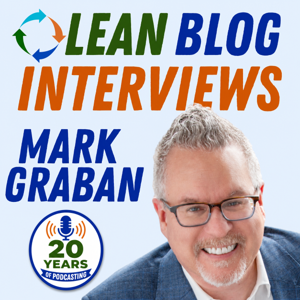


John Rizzo joins Mark Graban to discuss why sustainable improvement depends on empowering people — not command-and-control leadership or short-term value extraction.
Links and more:
John is a senior executive, investor, and change leader who has led transformational improvement efforts across manufacturing, healthcare, retail, services, and nonprofit organizations. He is the author of Creating Value: Empowering People for Sustainable Success, a book that deliberately avoids Lean jargon while describing a holistic continuous improvement business system rooted in humility, listening, and people development.
In this episode, John shares lessons from Wiremold, private equity–backed companies, and healthcare organizations, including the powerful “six-inch move” story that shows how small acts of listening can unlock trust and transformation. The conversation explores what real empowerment means (and what it does not), why leaders must shift from firefighting to developing problem solvers, and how organizations can create lasting value for employees, customers, and owners.
This episode is especially relevant for CEOs, executives, managers, and internal change agents looking to improve results without burning out their people or relying on command-and-control leadership.
What if operational excellence depends less on doing more with less—and more on how leaders create meaning, optimism, and relationships at work?
Episode page with video, transcript, and more
In this episode, Mark Graban is joined by Kathy Miller, senior operations executive, leadership coach, and author of More Is Better: Leading Operations with Meaning, Optimism, and Relationships for Excellence. Drawing on decades of experience in manufacturing and aerospace, along with research from positive psychology, Kathy explains how leadership behavior directly shapes safety, quality, engagement, and performance.
The conversation explores why “soft skills” are not soft at all, how leaders can practice realistic optimism without ignoring real problems, and how everyday interactions either build psychological safety or quietly undermine it. Kathy also shares practical insights for leading under pressure, balancing compassion with accountability, and helping people find meaning even in highly segmented operational work.
This episode is especially relevant for leaders in manufacturing, healthcare, and operations who want sustainable results without burnout, fear, or disengagement.
Don Kieffer has spent more than fifty years redesigning how real work gets done. In this episode, he explains why so many improvement efforts stall—and how Dynamic Work Design offers a clearer, more practical way forward.
Episode page with video, transcript, and more
Don traces his path from machinist to Vice President of Operational Excellence at Harley-Davidson and senior lecturer at MIT Sloan. He shares what he learned working with Toyota legend Hajime Oba, including the moment he realized that copying Toyota’s rituals was the wrong goal. The real power, he argues, lies in understanding the thinking behind great work design.
We break down the five principles of Dynamic Work Design—solving the right problem, structuring for discovery, connecting the human chain, regulating flow, and making work visible—and discuss how they apply far beyond the factory floor. Don explains why intellectual work is “almost infinitely compressible,” why executives misdiagnose morale problems, and why most leaders can draw their org chart but not the actual flow of work.
Along the way, he shares stories from Harley, MIT, and client organizations that learned to shift from firefighting to flow. His message is consistent: when you redesign the work, you change the culture. Engagement follows the system, not the other way around.
This episode pairs well with Episode 538 with Nelson Repenning and is essential listening for leaders trying to improve performance, reduce frustration, and create environments where people can do their best work.
Key ideas
Representative Quotes
My guest for Episode #539 of the Lean Blog Interviews Podcast is Darren Walsh, author of Making Lean and Continuous Improvement Work: A Leader’s Guide to Increasing Consistency and Getting Significantly More Done in Less Time.
Episode page with video, transcript, and more
Darren is the Director and Leadership Coach at Making Lean Work Ltd and holds a master’s degree from the Lean Enterprise Research Centre at Cardiff University. He brings more than 25 years of experience helping leaders transform organizations in automotive, aerospace, medical devices, energy, and healthcare.
In this episode, Darren and Mark explore why so many Lean and continuous improvement programs fail to sustain—and how leaders can build the right systems and habits to make improvement last. Darren explains the three common pitfalls he’s seen across industries: choosing the wrong improvement approach, relying on traditional “solution thinking,” and lacking consistent leadership routines.
Darren also introduces his DAMI model—Define, Achieve, Maintain, Improve—as a way for organizations to avoid “kaizening chaos” and instead create a stable foundation for improvement. He shares stories from across sectors, including healthcare examples where better standards and daily management led to faster care, higher throughput, and dramatically lower mortality rates.
Mark and Darren discuss the difference between problem-solving and firefighting, the danger of “shiny Lean” initiatives that don’t address core issues, and the leadership routines that keep everyone aligned and focused on the right problems. The conversation offers a grounded reminder that Lean isn’t about tools or jargon—it’s about building consistency, clarity, and capability throughout the organization.
“You can’t kaizen chaos. First, you have to define and stabilize the standard.”
“If every team in your business is working on the right problem, that’s an incredibly powerful organization.”
This podcast is part of the #LeanCommunicators network.
My guest for Episode #538 of the Lean Blog Interviews Podcast is Nelson Repenning, Faculty Director of the MIT Leadership Center and co-creator of Dynamic Work Design.
Episode page with video, transcript, and more
Nelson describes himself as an "organizational engineer," helping leaders redesign the routines and decisions that determine how work really gets done. He joins host Mark Graban to discuss his new book, There's Got to Be a Better Way: How to Deliver Results and Eliminate the Chaos of Modern Work, co-authored with Donald Kieffer.
In this conversation, Nelson shares insights drawn from his decades of experience studying system dynamics, Lean thinking, and organizational learning. He explains how leaders often fall into the "capability trap" -- spending their days firefighting immediate issues instead of improving the underlying system. From the arms race of hospital alarms to the collapse of fast-growing companies, he connects examples from healthcare, manufacturing, and technology to show why even good intentions can create destructive feedback loops if we don't understand the system.
Mark and Nelson also explore how Dynamic Work Design translates Lean principles like flow, visualization, and problem-solving into knowledge work. They discuss the five core principles -- including "Structure for Discovery" and "Connect the Human Chain" -- that help organizations make work visible, surface problems early, and evolve systems continuously. Listeners will learn how to move from firefighting to focus, and from chaos to sustainable improvement.
This podcast is part of the #LeanCommunicators network.
In this special bonus episode of Lean Blog Interviews, Mark Graban is joined by C.J. Kaufman, Education Chair for the ASQ Cincinnati Section, to preview the ASQ Southwest Ohio 2025 Conference, themed “Excellence Through Quality.”
Episode page with transcript, video, and more
Taking place Saturday, November 8, 2025, in Mason, Ohio, the event brings together quality professionals from the Cincinnati and Dayton regions for a half-day of engaging speakers, practical insights, and networking — plus an optional afternoon workshop with Mark.
C.J. shares how the conference was designed collaboratively by the Cincinnati and Dayton ASQ Sections, what attendees can expect, and why psychological safety is a cornerstone topic for today’s quality and Lean leaders.
“Psychological safety is essential for positive change — without it, continuous improvement can’t sustain.” — Mark Graban
“We want people to leave with practical things they can use Monday morning.” — C.J. Kaufman
“Excellence through quality isn’t just a theme — it’s how we build better systems and better workplaces.” — Mark Graban
My guests for Episode #537 of the Lean Blog Interviews Podcast are Caroline Greenlee and Chris Butterworth, two of the three co-authors (with Chris Warner) of the book Why Care: How Thriving Individuals Create Thriving Cultures of Continuous Improvement Within Organizations.
Episode page with transcript and more
In this conversation, we discuss their experiences and lessons on building cultures of continuous improvement that are rooted in respect, caring, and psychological safety.
Caroline brings rich experience as a Lean and continuous improvement coach, having partnered with organizations across different sectors to develop people and improve performance. Her background spans leadership development, organizational behavior, and a Master's degree in human resources management.
Chris is an award-winning author, international speaker, and a certified Shingo Institute Master-level facilitator and faculty fellow. He has more than 20 years of experience coaching executive teams and helping organizations embed sustainable improvement practices, always with a deep respect for people at the center.
In this episode, we explore topics such as:
In this short bonus episode, I’m joined by my friend and Lean Coffee Talk co-host, Jamie Flinchbaugh. We’re inviting you — our listeners and fellow continuous-improvement thinkers — to help shape upcoming conversations.
We’d love to hear your questions about Lean, leadership, culture, and problem-solving. The best discussions often start with the toughest questions — the ones without neat answers.
If you have something you’ve been wrestling with or want to hear us unpack together, please share it with us at:
We may feature your question (and name) in a future episode — and yes, we’re doing a few Lean Coffee Talk mug giveaways for contributors ☕
Building psychological safety while still holding people accountable
Making Leader Standard Work more about behavior than calendar
Avoiding bureaucracy while sustaining Lean improvements
Responding to mistakes with curiosity instead of blame
Using data wisely: when to react, when to step back
If you’ve got a question, story, or Lean challenge — send it our way. We can’t wait to explore it with you in a future episode.
#Lean #Leadership #ContinuousImprovement #LeanCoffeeTalk #LeanCulture #PsychologicalSafety #MarkGraban #JamieFlinchbaugh
In Episode 536 of the Lean Blog Interviews Podcast, Mark Graban talks with Carlos Scholz, the new CEO of Episode page with video, transcript, and more
In this episode, Carlos shares lessons from his Lean journey—starting with one-piece flow in apparel manufacturing and continuing through large-scale healthcare transformations. He explains why lasting improvement requires leaders to move beyond tools and rapid improvement events to embrace behaviors, principles, and a true Lean management system.
We also explore themes from his recent article, Leading Through Disruption: How Healthcare Leaders Can Respond. Carlos discusses the critical role of humility, vulnerability, and psychological safety in today’s leadership, and why leaders must sometimes “unlearn” old command-and-control habits to unlock engagement and creativity across their organizations.
Listeners will hear practical insights and real-world examples from Catalysis partners—including UMass Memorial, Ohio Health, and Zuckerberg San Francisco General—that demonstrate what’s possible when leaders fully commit to continuous improvement.
In this bonus episode of Lean Blog Interviews, host Mark Graban is joined by Geoff Neiley (chair) and Andrew Wagner (co-chair) of the Lean Product & Process Development Exchange (LPPDE).
The 2025 North America Conference will be held October 27–30 in Milwaukee, bringing together Lean practitioners, leaders, and innovators to share insights on reducing waste in product development, improving collaboration, and accelerating learning cycles.
Geoff and Andy share their Lean journeys, the history of LPPDE, and what attendees can expect this year. From keynote speakers to interactive sessions, they highlight why LPPDE continues to be a hub for cross-industry learning and continuous improvement.
What is LPPDE, and why was it founded in 2008?
How Lean principles apply to product and process development
The role of community and peer learning in driving improvement
Geoff and Andy’s personal reflections on attending and leading LPPDE
What’s in store for the Milwaukee 2025 conference
👉 Special offer: Use code LEANBLOG for 20% off registration https://lppde.org/event/lppde-north-america-2025-milwaukee/
🎟️ Register for LPPDE 2025 – Use discount code LEANBLOG
🌐 Jim Morgan on Lean Product Development]
The Lean Product & Process Development Exchange (LPPDE) is a nonprofit organization dedicated to advancing Lean thinking in product development. Since 2008, LPPDE has hosted global conferences to connect practitioners and share practical, real-world lessons.
From the publisher's feed
Lean Blog Interviews: Real-World Lean Leadership Conversations features thoughtful, in-depth discussions with leaders, authors, executives, and practitioners who are applying Lean thinking in the real world.
Hosted by Mark Graban—author of Lean Hospitals, Measures of Success, and The Mistakes That Make Us—the podcast explores Lean as a management system, a leadership philosophy, and a people-centered approach to continuous improvement.
Episodes span healthcare, manufacturing, startups, technology, and professional services. Guests share candid stories about what actually works—and what doesn’t—when organizations try to improve.
This is not a podcast about chasing tools, jargon, or “Lean theater.” Instead, you’ll hear honest conversations about leadership behaviors, culture, psychological safety, learning from mistakes, and building systems that help people do their best work.
If you believe improvement starts with respect for people—and that better systems beat blaming individuals—this podcast is for you.
Find show notes and all episodes at LeanCast.org.
Learn more about Mark Graban at MarkGraban.com.

31,925 Listeners
455 Listeners

1,460 Listeners

199 Listeners
15 Listeners

27 Listeners

8,340 Listeners

9,061 Listeners

20 Listeners
375 Listeners
2,424 Listeners

9 Listeners

2,219 Listeners

39 Listeners
19 Listeners

154 Listeners

1,622 Listeners
28 Listeners