
Sign up to save your podcasts
Or



I first met Davis Balestracci at a conference a few years back, where I heard him give a very spirited and insightful presentation. That's why I'm happy to have him as my guest for Episode #323 of the podcast.
We'll talk about a range of topics, including some of the key lessons that you'll find in his book (as a much deeper dive than we can get into here) Data Sanity: A Quantum Leap to Unprecedented Results (2nd edition). Davis has been a long-time columnist for Quality Digest, and you'll hear his thoughts on Process Behavior Charts, W. Edwards Deming, Lean Six Sigma, and more.
From his bio: “Davis has a BS degree in chemical engineering and an MS degree in statistics, yet describes himself as a “right-brained” statistician: his Myers-Briggs profile is INFP and he is a pipe organist who done graduate work in conducting.”
Today's podcast is a departure from the usual interview format. As I blogged about last week, the Lean community has lost a young, thoughtful, inquisitive, and reflective member -- Samuel Selay. I regret not having Sam on the podcast to talk about our learning and reflections. He was a guest of Ron Pereira's on the Gemba Academy podcast in 2016, talking about Lean in the Department of Defense. Today, I'm doing a reading of a blog post that Sam wrote for this site back in August. I'm also sharing the audiobook version of his chapter from the book Practicing Lean (which is read by our audiobook narrator). It's not his voice, but it's his words and thoughts. As the Marines say (Sam was an active duty Marine for 13 years), Semper Fi. There is a GoFundMe page that was set up by Sam's sister-in-law to provide financial support to the family — his wife and four children under 18. I've donated and I hope you might consider doing the same.
My guest for episode #321 of the podcast is Mark Hamel, He is a partner and COO with The Murli Group. Mark is a two-time recipient of the Shingo Research and Professional Publication Award for his books The Kaizen Event Fieldbook and his most recent book Lean Math, the main subject of this episode. I hope you enjoy the discussion, which is about people as much as it is about math.
Skip Steward, the Chief Improvement Officer at Baptist Memorial Health Care in Tennessee, was a guest on Episode #314 of the podcast talking about TWI and Toyota Kata in healthcare (he was joined by Brandon Brown). Today, I've asked Skip to come back and chat 1x1, in Episode #320, about his experience with Don Wheeler, learning from W. Edwards Deming, and more. I hope you enjoy his reflections, our discussions about healthcare, and connections to my book Measures of Success (Skip undoubtedly has a book in him too).
My guest for Episode #319 is Karen Martin, whose most recent book is Clarity First: How Smart Leaders and Organizations Achieve Outstanding Performance.
Episode page
She was previously a guest on Episodes #151, #190, and #285. Karen is an author of many books on Lean, quality, and performance excellence. She is also a speaker and a consultant with a B.S. in Microbiology from Pennsylvania State University and an M.A. in Education from California State University, Bakersfield. Read her full bio. What is clarity? How can we work toward creating less fog and more clarity in organizations? We'll talk about that, along with a bit of discussion about clarity in metrics, as I write about in my book Measures of Success.
318 - Marcus Hammarberg, How Lean & Kanban Saved an Indonesian Hospital Joining me from Sweden for Episode 318 of the podcast is Marcus Hammarberg, author of the fascinating book Salvation: The Bungsu Story: How Lean and Kanban saved a small hospital in Indonesia. Twice. And can help you reshape work in your company. Marcus is a software developer, consultant, lean/agile coach, speaker, and author. He ended up with an opportunity to work with a hospital in Indonesia and he tells that compelling story in the book. How did a huge hole in the roof help trigger a change in culture and results? You'll hear about that and more in this episode. I hope you enjoy it and find it inspirational, as I did.
My guest for Episode #317 of the podcast is Patricia Morrill, a speaker, trainer, consultant, researcher, and author of the book The Perils of Un-Coordinated Healthcare: A Strategic Approach toward Eliminating Preventable Harm.
With 30 years of experience in the healthcare industry, she has focused on blending operational efficiencies with healing environments. Patricia has successfully integrated Lean and Project Management methodologies with organizational strategic goals to build roadmaps for execution. Check out her website and her blog.
In today's episode, we discuss her personal story about her mother's death that came as the result of a preventable medical error. What can be done to prevent medical errors, harm, and death?
@Flinchbaugh Interviews @MarkGraban About "Measures of Success"
Today's episode is the second time that friend and podcast guest Jamie Flinchbaugh has turned the tables by playing host to interview me about my new book, Measures of Success: React Less, Lead Better, Improve More, which has recently been the #1 best selling book in Amazon's Total Quality Management category. Jamie is very knowledgeable on these topics, so he was a great person to interview me and to have more of a conversation about choosing the right metrics and then managing them the right way. I hope you enjoy the conversation and future podcasts will return to the usual format where I interview guests and try to let them do most of the talking.
From the publisher's feed
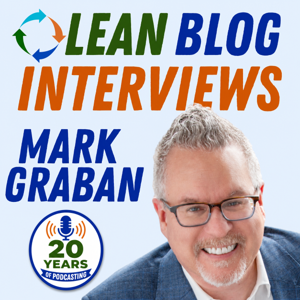
Lean Blog Interviews: Real-World Lean Leadership Conversations features thoughtful, in-depth discussions with leaders, authors, executives, and practitioners who are applying Lean thinking in the real world.
Hosted by Mark Graban—author of Lean Hospitals, Measures of Success, and The Mistakes That Make Us—the podcast explores Lean as a management system, a leadership philosophy, and a people-centered approach to continuous improvement.
Episodes span healthcare, manufacturing, startups, technology, and professional services. Guests share candid stories about what actually works—and what doesn’t—when organizations try to improve.
This is not a podcast about chasing tools, jargon, or “Lean theater.” Instead, you’ll hear honest conversations about leadership behaviors, culture, psychological safety, learning from mistakes, and building systems that help people do their best work.
If you believe improvement starts with respect for people—and that better systems beat blaming individuals—this podcast is for you.
Find show notes and all episodes at LeanCast.org.
Learn more about Mark Graban at MarkGraban.com.

32,058 Listeners
452 Listeners
1,461 Listeners

198 Listeners

15 Listeners

27 Listeners
8,564 Listeners
9,063 Listeners

20 Listeners
377 Listeners
2,438 Listeners

9 Listeners
2,204 Listeners

40 Listeners
19 Listeners
152 Listeners

1,620 Listeners

28 Listeners