
Sign up to save your podcasts
Or



For episode #236, things are a little different than usual. Today, I wanted to share a video discussion between my friends Ted Stiles and John Toussaint, MD. Ted is a partner with the recruiting firm Stiles & Associates. John, of course, is the president of the ThedaCare Center for Healthcare Value and has been a frequent guest in my podcast series. John's most recent book is Management on the Mend. For a link to this episode, refer people to www.leanblog.org/236.
For the episode and more details, visit http://www.leanblog.org/audio235. If you've been a listener of my LeanBlog Podcast series, you might know that I normally record conversations and then publish them into the podcast feed. Today, I'm going to do my first live broadcast of a podcast discussion via the "Blab.im" streaming platform. My guest is Sam MacPherson and we are talking about Lean leadership, including his lessons learned from his time as a Green Beret. Topics Include: Differences between Special Forces (The Green Berets) and the rest of the military Similarities between “The Green Beret Way” and The Toyota Way - shockingly similar Command and Control vs. Leadership "Commander's Intent" Misconceptions regarding military leadership and industry leadership Lean transformation - you current leadership style and skills wont cut it!
Today's guest is Mitch Cahn, president of Unionwear, a manufacturer of hats, bags, and apparel in Newark, NJ. I first learned about Mitch and his company because of a display they had at the Northeast LEAN Conference, which I blogged about here. What caught my eye was their display of politician hats they produce, including the famous red "Make America Great Again" hat that Donald Trump wears. Beyond the surface of those hats is a fascinating story about competing instead of making excuses. As Mitch explains in the podcast, Unionwear has been very successful even though he's producing in one of the highest-cost parts of the world. Unionwear has had to compete against imports from China and lower-wage southern states in the U.S. Starting in 2007, Lean has been a major part of their strategy for improving productivity, reducing cost, and being fast to market. Whether you work in healthcare or manufacturing, I think you'll love the story behind Mitch, his company, and his employees. For a link to this episode, refer people to www.leanblog.org/234.
Today's guest is Katie Anderson, and we're talking about her experiences living in Tokyo for 18 months and what she's learning about Lean culture, Japanese culture, and how those aren't always one and the same. I first met Katie through the Healthcare Value Network and our participation in that collaborative. She's an experienced Lean healthcare practitioner, coach, consultant, having worked for Stanford Children's Hospital and the Palo Alto Medical Foundation before starting her own consulting practice. Katie has been generously sharing her experiences in Japan and her reflections on her blog, which I highly recommend. You can also find her on Twitter and LinkedIn. For a link to this episode, refer people to www.leanblog.org/233. Podcasts are sponsored by KaiNexus and their software that helps spread continuous improvement -- Learn more at http://www.KaiNexus.com
Today's podcast, #232, is presented with a heavy heart, after the recent passing of my friend Dr. Michel Téatrault, the CEO of St. Boniface General Hospital and a great Lean leader. He was a friend to many in the Healthcare Value Network and the broader Lean healthcare community. As I was remembering Michel, it occurred to me that I had recorded a podcast with him, back in 2010, as part of a series that I was doing for the Healthcare Value Network. I never shared that audio as part of my main podcast series, so I'm doing so today. In the episode, we talk about "Lean from the CEO perspective." I hope Michel's words and experiences at St. Boniface continue to help and inspire people. For a link to this episode, refer people to www.leanblog.org/232.
Today's guest is Eric Dickson,MD, MHCM, FACEP, the president and CEO of UMass Medical Center. Episode #231 of the podcast is a little different than the usual. Normally, I record a podcast interview via Skype or a phone call. Today's podcast is a recording of an interview that I did on stage at the 2015 Lean Healthcare Transformation Summit, as part of the CEO panel I was moderating. Eric was one of three CEOs who did a 10-minute interview with me, then we had them take questions as a panel group. The audio quality isn't as good as normal, so there's a transcript of the conversation below. Eric tells what I think is an important story about why UMass Medical Center used Lean and Kaizen as an important strategy for the challenges and crisis they faced at the time. For a link to this episode, refer people to www.leanblog.org/231.
Audio remastered May 2025
Episode page
Joining me for episode #230 is Paul DeChant, MD, MBA to talk about reducing burnout, especially physician burnout, through Lean. Paul (see his bio here) is the former CEO of Sutter Gould Medical Foundation, a 300-physician multispecialty medical group in California's Central Valley. Before that, he had stints at organizations including Geisinger Health System and the Palo Alto Medical Foundation. He is now a consultant and executive coach for Simpler Healthcare. For a link to this episode, refer people to www.leanblog.org/230.
In the podcast, we talk about questions and topics including: Tell us about your career... how did you get involved in healthcare leadership and how did you get exposed to Lean? What problems or opportunities were you trying to address with Lean? How did you see your role and participation as CEO? As a physician leader? You recently wrote a blog post "why is physician engagement even an issue?" How would you describe the current state of life for an MD before Lean? Can Lean help prevent burnout for MDs or others? Is there a point where somebody gets "too burned out" and can't be turned?
My guest for episode #229 is John Dyer, president of his consulting firm, JD&A, Inc., and a contributor for IndustryWeek.com. John started his career at General Electric and later moved to Ingersoll-Rand, where he was VP of Operations for their Security and Safety sector. John had the good fortune to learn directly from W. Edwards Deming, as he took the famed four-day seminar (that included the Red Bead Experiment) and was also invited to take the follow on course with a smaller group. You'll also want to scroll down to see the great picture that he posted on Twitter of him and Dr. Deming. For a link to this episode, refer people to www.leanblog.org/229. In the podcast, we talk about questions and topics including: Tell us about the early days of your career in manufacturing engineering and management... how did you get involved in operational excellence? While at GE, you had some experience with W. Edwards Deming, tell us about that... What are some of the key lessons from Dr. Deming that stick with you today? GE's CEO Jack Welch had once derided Deming as "too theoretical." Was it that or did Deming's concrete suggestions just fly in the face of Jack's way? What did John recently witness when a relative was a hospital inpatient? How did that compared to some things Dr. Deming saw and reported as a patient in 1987?
Remastered January 2022
Episode page: https://www.leanblog.org/228
Labor Day is Monday, so maybe it's appropriate that my guest for episode #228 of the podcast is Zeynep Ton, an Adjunct Associate Professor of Operations Management at the MIT Sloan School of Management. You may have recently seen her being interviewed by Fareed Zakaria on CNN. Read her full bio here.
She is author of the 2014 book The Good Jobs Strategy: How the Smartest Companies Invest in Employees to Lower Costs and Boost Profits.
I saw Ton give a lecture at an MIT alumni event back in June and immediately bought and read the book (read my blog post about the book and parallels to Lean and healthcare). I highly recommend it and I wish more hospitals and health systems would pursue this “good jobs strategy” instead of being so focused on cutting labor costs. As Ton explains in the book and our discussion, this strategy is not about being kind or nice — it's just good business that drives better long-term results for all.
In the podcast, we talk about:
From the publisher's feed
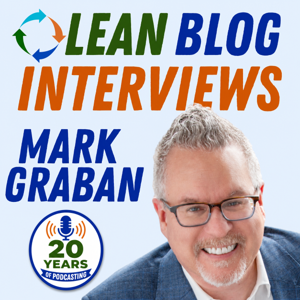
Lean Blog Interviews: Real-World Lean Leadership Conversations features thoughtful, in-depth discussions with leaders, authors, executives, and practitioners who are applying Lean thinking in the real world.
Hosted by Mark Graban—author of Lean Hospitals, Measures of Success, and The Mistakes That Make Us—the podcast explores Lean as a management system, a leadership philosophy, and a people-centered approach to continuous improvement.
Episodes span healthcare, manufacturing, startups, technology, and professional services. Guests share candid stories about what actually works—and what doesn’t—when organizations try to improve.
This is not a podcast about chasing tools, jargon, or “Lean theater.” Instead, you’ll hear honest conversations about leadership behaviors, culture, psychological safety, learning from mistakes, and building systems that help people do their best work.
If you believe improvement starts with respect for people—and that better systems beat blaming individuals—this podcast is for you.
Find show notes and all episodes at LeanCast.org.
Learn more about Mark Graban at MarkGraban.com.

32,058 Listeners
452 Listeners
1,461 Listeners

198 Listeners
15 Listeners

27 Listeners

8,564 Listeners
9,063 Listeners

20 Listeners
377 Listeners
2,438 Listeners

9 Listeners
2,204 Listeners

40 Listeners
19 Listeners
152 Listeners
1,620 Listeners
28 Listeners