
Sign up to save your podcasts
Or



My guest for episode #218 is Karen Kiel-Rosser, Vice President/Quality Improvement Officer at Mary Greeley Medical Center in Iowa. You can see her full bio below in this post. You might remember Karen from a recent post where she told a great story about putting patient safety first. We're talking today about the Malcolm Baldrige National Quality Award and how that framework and process is mutually supportive of Lean and quality improvement. In December, Mary Greeley Medical Center was named a recipient of Gold level recognition in the 2014 Iowa Recognition for Performance Excellence (IRPE) program - the state level Baldrige award. They previously received the Silver level in 2011. In the podcast, we talk about why and when Mary Greeley decided to pursue the Baldrige award, what it was like to be reviewed at the state level, and their future plans for applying at the national level. Karen also shares thoughts about how Baldrige ("the what") and Lean ("the how") fit together, some of their key quality outcomes measures, and how the recognition has helped internally with staff. She also talks about their safety huddles, the importance of "engaging those closest to the work," and the need for a "systematic approach" to capture Rapid Improvement Events and daily improvement work and how their use of KaiNexus has supported those efforts. The hospital was previously featured in episode #201: Ron Smith & Suz Kaprich, the KaiNexus WorkOut at Mary Greeley Medical Center. For a link to this episode, refer people to www.leanblog.org/218. Podcasts are sponsored by KaiNexus and their continuous improvement software platform -- www.KaiNexus.com For earlier episodes of the Lean Blog Podcast, visit the main Podcast page at www.leanpodcast.org, which includes information on how to subscribe via RSS or via Apple iTunes.
Podcasts are sponsored by KaiNexus and their continuous improvement software platform -- www.KaiNexus.com Our guest today is Alan G. Robinson, PhD, an award-winning author, educator, researcher and consultant. He has co-authored six books, including Modern Approaches to Manufacturing Improvement: The Shingo System, Ideas Are Free, and his latest, The Idea-Driven Organization. His specialties include managing continuous improvement, creativity, ideas and innovation, and Lean production, being one of the earliest professors to visit Japan to study the Toyota Production System. In this episode, we talk about the history of suggestion programs (and a surprising detail about their history), why 80% of an organization's improvement comes from staff ideas, and why high-performing idea systems are rare. We also talk about some of the pitfalls of traditional cost-benefit analysis, the role of leaders and humility, and a company, Scania, that intentionally overstaffs to provide time for Kaizen, leading to 12-15% annual productivity improvement. Why is mankind still battling against command-and-control management systems? And what's the real story behind American Airlines famously removing an olive from their salads? We cover all of that and more in this episode. For a link to this episode, refer people to www.leanblog.org/217. For earlier episodes of the Lean Blog Podcast, visit the main Podcast page at www.leanpodcast.org, which includes information on how to subscribe via RSS or via Apple iTunes.
Podcasts are sponsored by KaiNexus and their continuous improvement software platform -- www.KaiNexus.com Returning to the podcast after his first appearance in Episode #188 is Daniel T. Jones, founder and chairman of the UK-based Lean Enterprise Academy. You can find him on Twitter now as @DanielJonesLean. Dan collaborated with Jim Womack on the books The Machine That Changed the World, Lean Thinking, and Lean Solutions and published other books through the LEA. He is also a senior advisor to the relatively new website and journal "Planet Lean." In this episode, we talk about some of the progress being made in areas outside of manufacturing. Dan says there's "awareness everywhere" but asks if there's "real depth" in Lean progress? We'll discuss how we can reframe Lean for the public sector and healthcare as a way of going beyond mere cost cutting programs. What does Dan seeing happen in software and startup sectors with Lean in companies like Spotify in Sweden? How is interest in the core "respect for people" leading to a search for "more holistic management methods?" For a link to this episode, refer people to www.leanblog.org/216. For earlier episodes of the Lean Blog Podcast, visit the main Podcast page at www.leanpodcast.org, which includes information on how to subscribe via RSS or via Apple iTunes.
Today's guest is my friend John Ervin and we were able to sit down together here in San Antonio to record this episode. John has about 20 years of healthcare leadership experience, including in military medicine and the civilian sector. He's been a manager and director of operating rooms in many types of hospital and surgical center settings.
2022 update: John is now a part of the team and is my colleague with the firm Value Capture and we were able to collaborate on an engagement with a Philadelphia health system.
We share a passion for Lean and, more importantly, patient safety. We believe strongly that you need the right type of culture and leadership to encourage and support a culture of safety and that's what we'll talk about today.
For a link to this episode, refer people to www.leanblog.org/215.
For earlier episodes of my podcast, visit the main Podcast page, which includes information on how to subscribe via RSS or via Apple Podcasts. You can also subscribe and listen via Stitcher.
Today's guest is Michael Ballé, an author of many novels about Lean management, published by the Lean Enterprise Institute. He joins us for this episode from Paris (he shares many photos of “Paris moments” via his Twitter account @Michael_Balle).
Michael and his father, Freddy, have collaborated on these books and have learned about as directly from Toyota as anybody (Freddy was CEO of the French automotive supplier Sommer-Allibert and was coached by Toyota there).
The three novels are:
See all of his books via Amazon
As we joke about in the podcast, I'm not a fiction reader, in general, so I don't care for business novels. But, many people do!
I read Michael's non-fiction essays and articles, including:
Michael is a first-time podcast guest (which we were both shocked to discover), but I did host a four-part written Q&A with him back in 2009.
For a link to this episode, refer people to www.leanblog.org/214.
For earlier episodes of my podcast, visit the main Podcast page, which includes information on how to subscribe via RSS or via Apple Podcasts. You can also subscribe and listen via Stitcher.
Today's podcast is different than my usual interview format. I still plan on continuing the podcast format and series, but I also wanted to try something new.
I'm starting a “Lean Blog Audio” podcast, which is basically an “audio book” type reading of blog posts. I won't do it for all posts, but maybe a few a week. I'll also occasionally look back at an old post, as I did in this episode, which is actually #4 in the new series. The episodes in this new series won't have their own page, but the audio will be embedded in the blog post itself. To find all episodes, you can visit www.LeanBlog.org/audio.
I realize this won't add value to all readers of the blog or all listeners of this podcast. But, many people tell me they like listening to the podcasts while they drive or workout and this new podcast provides a way to keep up on the blog in addition to or instead of the written word on the blog. These are really easy to do and many of them will be done while I'm doing a final proofreading of a new post, basically (which might reduce the number of typos and other defects!). Interviews (planning them, prepping for them, editing them) for my original podcast series is actually more time consuming than doing a podcast of this type.
If you go to www.LeanBlog.org/audio, you'll see information about how to subscribe via an RSS feed or the iTunes podcast directory.
For a link to this episode, refer people to www.leanblog.org/213.
For earlier episodes of my podcast, visit the main Podcast page, which includes information on how to subscribe via RSS or via Apple Podcasts. You can also subscribe and listen via Stitcher.
Today's guest is David Mann (bio), talking about the new 3rd edition of his Shingo Research Award winning book Creating a Lean Culture. David tells us what's new in the book and we discuss “leader standard work” and other elements of a Lean culture.
David also talks about the difference between “Lean production” and a “Lean management system,” and we discuss forcing “compliance” versus leaders teaching and learning in the workplace. What is the role of executives in creating a Lean culture? I hope you enjoy the discussion. David was also one of my earliest podcast guests, back in Episode #9.
For a link to this episode, refer people to www.leanblog.org/212.
For earlier episodes of my podcast, visit the main Podcast page, which includes information on how to subscribe via RSS or via Apple Podcasts. You can also listen via Stitcher.
Normally, my podcast is all about my guests. This episode has me being interviewed by the hosts at Healthcare Tech Talk, a new podcast for Healthcare IS professionals. This originally appeared as episode #23 of their series.
Thanks to hosts Terry Baker and Kelley Hill for interviewing me and for allowing me to republish their episode here.
I hope you like the podcast. You can subscribe to their series via iTunes, Google Play, and their app for iOS or Android. Learn more at their site. My podcast series will return next week.
For a link to this episode, refer people to www.leanblog.org/211.
From the publisher's feed
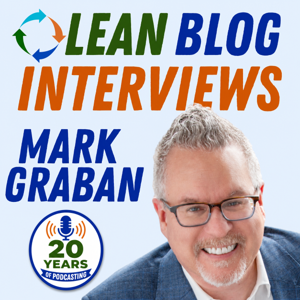
Lean Blog Interviews: Real-World Lean Leadership Conversations features thoughtful, in-depth discussions with leaders, authors, executives, and practitioners who are applying Lean thinking in the real world.
Hosted by Mark Graban—author of Lean Hospitals, Measures of Success, and The Mistakes That Make Us—the podcast explores Lean as a management system, a leadership philosophy, and a people-centered approach to continuous improvement.
Episodes span healthcare, manufacturing, startups, technology, and professional services. Guests share candid stories about what actually works—and what doesn’t—when organizations try to improve.
This is not a podcast about chasing tools, jargon, or “Lean theater.” Instead, you’ll hear honest conversations about leadership behaviors, culture, psychological safety, learning from mistakes, and building systems that help people do their best work.
If you believe improvement starts with respect for people—and that better systems beat blaming individuals—this podcast is for you.
Find show notes and all episodes at LeanCast.org.
Learn more about Mark Graban at MarkGraban.com.

32,058 Listeners
452 Listeners
1,461 Listeners

198 Listeners
15 Listeners

27 Listeners
8,564 Listeners
9,063 Listeners

20 Listeners
377 Listeners
2,438 Listeners

9 Listeners
2,204 Listeners

40 Listeners
19 Listeners
152 Listeners
1,620 Listeners
28 Listeners