
Sign up to save your podcasts
Or



My guests today are Darrell Damron and Hollie Jensen and we're talking about Lean in Washington state government. Darrell and Hollie are both state employees, serving in the role of Enterprise Lean Consultant within a team called “Results Washington.” I've seen them both present at a Lean Enterprise Institute summit and I'm really happy to have them share their ongoing improvement story here in the podcast.
In the episode, we talk about their backgrounds and how they got started with Lean – Darrell in the public sector and Hollie at Starbucks. How did the state of Washington get started with Lean? What are some of their goals and accomplishments? How is Lean a strategy under Governor Jay Inslee and why is Lean a non-partisan issue that was supported by both gubernatorial candidates in the last election? What are some of the challenges that lay ahead for Washington?
For a link to this episode, refer people to www.leanblog.org/210.
For earlier episodes of my podcast, visit the main Podcast page, which includes information on how to subscribe via RSS or via Apple Podcasts. You can also listen via Stitcher.
With a passion for public service, Darrell has served as an enterprise lean consultant in the Governor's Office for the past 3 years, under two governors, helping Washington state government learn to use lean principles and tools to deliver better value to more Washingtonians. As part of the Results Washington team, Darrell created Washington State's Lean Expert Partnership Program through which, over the past 3 years, more than 200 private sector lean experts have volunteered their time (no cost to taxpayers) to give thousands of Washington state's public servants advice, training, and coaching as they learning to use Lean principles and tools to make improvements throughout state government. Darrell has been a public servant in Washington State government for more than 23 years, working in the Department of Corrections and the Department of Revenue. Prior to joining state government, Darrell served 6 years on active duty in the U.S. Marine Corps.
As part of her role with the State of Washington, Hollie Jensen is developing and implementing a Lean Fellowship program while also consulting on the governor's priority goal areas. In this role Hollie focuses on developing state leaders by teaching, consulting and coaching on Lean principles and leadership behaviors. Through her work with the Fellowship and State leaders, she is focused on every state employee learning how to problem solve and every state leader supporting the problem solving work by teaching and coaching. She joined state government in the spring of 2013 as an enterprise lean consultant after her 17-year tenure with Starbucks, where she began as a barista on the front lines and worked her way up through the organization with roles in human resources, global strategy and operations. Most recently she was a lean practice strategy manager with a focus on implementing the store system of work and the leadership/coaching program. Jensen holds a bachelor's degree from the University of Washington and has worked closely with LEI over the past 7 years to grow her lean knowledge and experience. Most recently, Hollie has had the opportunity to teach other practitioners at the Lean Transformation Summit, LEI public workshops in Seattle and the Lean Coaching Summit.
My guest for episode #209 is George Friesen, Business Practice Leader for Lean Transformations in the Workforce Solutions Group at St. Louis Community College.
In this episode, we talk about his early experiences at the GM/Toyota NUMMI plant, why candor and trust are so important in a Lean transformation, and how to engage front-line employees in Kaizen and continuous improvement, and much more.
For a link to this episode, refer people to www.leanblog.org/209.
For earlier episodes of my podcast, visit the main Podcast page, which includes information on how to subscribe via RSS or via Apple Podcasts. You can also listen via Stitcher.
George has been a Lean Manufacturing Consultant with St. Louis Community College since April 2000. Since coming to the College, George has developed an extensive and very well received series of training and consulting services focused on helping the College's clients take advantage of the power of Lean thinking and Lean work processes. In addition to services specific to certain Lean tools such as 5S, Value Stream Mapping, and Six Sigma, the College's Lean Transformations Business Unit has developed and provided to various clients, the Lean Leadership Certification Program, the Kaizen Thinking series, a series of discussions focused on Mike Rother's Toyota KATA, and the Lean Culture Change Symposia. These programs have received high praise from participants, eliciting comments such as, “What a great set of experiences.” “The training was just great. I learned a lot I can apply right now on the job.”
Prior to joining the College, George worked for the Maritz Performance Improvement Company. He has provided performance improvement consulting and training services across a wide variety of industries, serving companies such as Toyota, Mercedes Benz, Texaco, BellSouth, Duke Power, Sigma-Aldrich, Caterpillar, AT&T, ThermoKing, Shell Oil Company, Illinois Bell, GM, Nestle, and Ford Motor Company. Over the past 35 years, George has facilitated over 800 seminars in areas such as 5S System implementation, Toyota KATA, Kaizen Thinking, Value Stream Mapping, Lean Leadership, Lean Culture Change, SMED, Visual Management, sales training, strategic planning, time management, and communication techniques. He has made presentations on Lean Manufacturing at the conventions of the National Council of Advanced Technology Centers, the National Council on Workforce Education, the Society of Manufacturing Engineers, and the American Society for Quality.
George is a graduate of Washington University (AB), Webster University (MA), and United States Air Force Flight Training. He is also a certified AchieveGlobal and DDI facilitator.
Joining me for episode #208 is Michael Bremer, author of the recently released book How to Do a Gemba Walk. Michael is president of The Cumberland Group, a business improvement consulting firm based in Illinois.
In today's episode, Michael talks about different types of gemba walks, key behaviors that need to be exhibited by leaders, and why it's critically important to build trust and credibility over time. How can gemba walks help a leader be more in touch with reality in the workplace? How can gemba walks help develop critical thinking skills in others? Listen to find out.
For a link to this episode, refer people to www.leanblog.org/208.
For earlier episodes of my podcast, visit the main Podcast page, which includes information on how to subscribe via RSS or via Apple Podcasts. You can also listen via Stitcher.
Episode #207 is part two of my conversation with Chris Jerry, founder of The Emily Jerry Foundation. The foundation was created in the aftermath of the tragic death of his daughter, Emily – a preventable medical error caused by a number of factors and bad systems. You can read Emily's story here.
In the first part (Episode #203), Chris told the story of what happened. In part two, we talk about topics including:
For a link to this episode, refer people to www.leanblog.org/207.
For earlier episodes of my podcast, visit the main Podcast page, which includes information on how to subscribe via RSS or via Apple Podcasts. You can also listen via Stitcher.
My guest for episode #206 is Ed Pound, co-author of the book Factory Physics for Managers: How Leaders Improve Performance in a Post-Lean Six Sigma World that was released in April. It is, of course, a new version of the original Factory Physics textbook that I used in college and was the subject of Podcast #25 with Prof. Mark Spearman. Ed is the chief operations officer of Factory Physics, Inc., a company started by Spearman. In the podcast, we talk about the term "Factory Physics" (including the origin of the term) and what it means, including understanding the relationships between capacity, throughput, inventory, and variability. Ed also brings up great points about "dogma" versus manufacturing science, including dogma that can get companies in trouble, including: - Thou shalt have no finished goods inventory - Thou shalt have single piece flow, always - Thou shalt always have a moving assembly line We also talk about the subtitle of the book and what he means by a "post-Lean Six Sigma world" (it doesn't mean a world without Lean or Six Sigma). It's a great discussion and I hope you'll enjoy it, even if you don't work in factories. The lessons and ideas are certainly applicable. For a link to this episode, refer people to www.leanblog.org/206. For earlier episodes of the Lean Blog Podcast, visit the main Podcast page at www.leanpodcast.org, which includes information on how to subscribe via RSS or via Apple iTunes. Podcasts are sponsored by KaiNexus and their continuous improvement software platform -- www.KaiNexus.com
Episode #205 is a conversation with Joe Schnur, VP Business Development at Intelligent M, a company that “designs data-driven hand hygiene compliance improvement solutions for hospitals that dramatically reduce healthcare-acquired infections and their associated costs.” Joe and I share a passion for improving patient safety and we've had a number of great conversations comparing notes on the problem and the different ways we need to work toward solving it. We decided to finally record one of those discussions for a podcast.
In the podcast, Joe shares some shocking statistics about “hand hygiene compliance” – that while hospitals report numbers that are far higher, the typical care provider washes or cleans their hands only about 20% of the time. One management challenge (and sales challenge for Joe) is that hospital executives might find it too easy to sit back and point to the inaccurately high numbers that claim 90%+ compliance (numbers that are based on sampling instead of real data).
When I first started talking to Joe, I was skeptical about a “monitoring” technology for healthcare professionals, since I see hand hygiene as a system problem (lack of time, empty gel dispensers) that management has to work to fix… it's a process problem. But, I think (as in many cases) there is a role for technology that can be supportive of people (patients and staff) and can enable systemic improvement. What's the proper balance between individual accountability and the role of “the system?” I'm curious to hear what you think (you can post a comment on this post).
For a link to this episode, refer people to www.leanblog.org/205.
For earlier episodes of my podcast, visit the main Podcast page, which includes information on how to subscribe via RSS or via Apple Podcasts. You can also listen via Stitcher.
From the publisher's feed
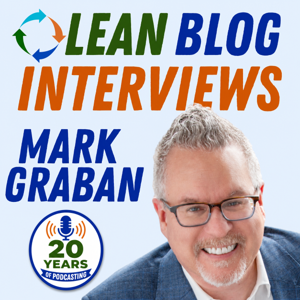
Lean Blog Interviews: Real-World Lean Leadership Conversations features thoughtful, in-depth discussions with leaders, authors, executives, and practitioners who are applying Lean thinking in the real world.
Hosted by Mark Graban—author of Lean Hospitals, Measures of Success, and The Mistakes That Make Us—the podcast explores Lean as a management system, a leadership philosophy, and a people-centered approach to continuous improvement.
Episodes span healthcare, manufacturing, startups, technology, and professional services. Guests share candid stories about what actually works—and what doesn’t—when organizations try to improve.
This is not a podcast about chasing tools, jargon, or “Lean theater.” Instead, you’ll hear honest conversations about leadership behaviors, culture, psychological safety, learning from mistakes, and building systems that help people do their best work.
If you believe improvement starts with respect for people—and that better systems beat blaming individuals—this podcast is for you.
Find show notes and all episodes at LeanCast.org.
Learn more about Mark Graban at MarkGraban.com.

32,058 Listeners
452 Listeners
1,461 Listeners

198 Listeners
15 Listeners

27 Listeners

8,564 Listeners
9,063 Listeners

20 Listeners
377 Listeners
2,438 Listeners

9 Listeners
2,204 Listeners

40 Listeners
19 Listeners
152 Listeners
1,620 Listeners
28 Listeners