
Sign up to save your podcasts
Or



I love hearing from Autistic Adults, and Paige Layle has garnered quite a following on TikTok and Instagram, sharing her story and creating resonating content for her viewers traveling similar journeys.
Paige’s recently published memoir, But Everyone Feels This Way: How an Autism Diagnosis Saved My Life, has been an opportunity to reach her followers on a deeper level, connect beyond the internet, and create a resource for those that relate to her story. Just two weeks before her 15th birthday, Paige received her diagnosis. It was what she calls “Life Shattering”. She describes that she had been internally begging and pleading for an explanation of why life is so hard for her; the diagnosis was just that.
She took to social media after becoming comfortable with these platforms across her life, in her second year of university. Paige made her first autism-focused video discussing her anger about “trending sounds” insulting autistic individuals, which pushed her to start educating and sharing the autistic voice. She now creates content full-time, with the bulk of her income coming from public speaking events and consulting with schools and other organizations.
Paige reminds parents not to be scared. If you have concerns about delays or other symptoms in your child, just know that whatever information you collect will help you, she says. And for those of us out there consuming content, she informs us that not all autistic people want to be advocates, so be respectful, as well as diversify your resources so that you may hear a variety of voices. You can find Paige on Instagram and TikTok at @PaigeLayle.
#autism #speectherapy
What’s Inside:
Mentioned In This Episode:
Paige Layle
Paige on TikTok
Paige on Instagram
Join us in the ABA SPEECH Connection for Parents
Join us in the ABA SPEECH Connection for Professionals
Rose Griffin (@abaspeechbyrose) on Instagram
Lisa is a BCBA and the mom of 3 boys, including Kruz. He is Lisa’s youngest child and has Autism Spectrum Disorder. You may be familiar with their journey as they share it with you through @CruisingWithKruz on Instagram.
During our conversation, Lisa dives into the struggles that take place when it comes to advocating for a diagnosis and the other ones that pile on once you do get it! Waitlists can be excruciatingly long, not only for evaluations but for services too. That’s why it’s key to stay in communication with your team. It’s not easy once you enter services either. Lisa talks about the financial weight of high insurance premiums as well as high maximum out of pocket costs.
Lisa shares Kruz’s progress in the last year and a half. He has participated in 25 hours a week of ABA, weekly speeches, and been involved with his family, friends, and community. A look at Kruz’s skills in January 2023 would show nonverbal communication and dangerous self-injurious behavior. Now his progress, reflected in June 2024, reveals conversational communication, a blossoming sense of humor, and critically reduced self-injurious behavior. With this great news, they are able to target other needs and reduce the intensity of services.
Parent education and training is something Lisa is very passionate about, as she heeds other parents advice to advocate, advocate, advocate. If you’re noticing a delay or have heightened concerns, do not wait! You will NEVER regret providing support and intervention. But you will regret losing time. Lisa is heading up our brand new parent portal that you can access with an ABA Speech Connection Membershi
#autism #speectherapy
What’s Inside:
Mentioned In This Episode:
CruisingWithKruz (@cruisingwithkruz) on Instagram
Cruising With Kruz
Join us in the ABA SPEECH Connection for Parents
Join us in the ABA SPEECH Connection for Professionals
Rose Griffin (@abaspeechbyrose) on Instagram
Parents are an important piece of the team. Today I am talking with Dr. Janie Funk about parent training in ABA. Caregiver engagement is imperative to an individual's success. Dr. Janie explains how her team at Behaven Kids supports parents through a strong team of clinicians with great interpersonal skills, a referral network for access to services in collaboration with other providers, and ensuring systems are in place to support caregiver concerns and questions.
Parental support is a mandated requirement for most insurance payers. Dr. Janie talks through how she meets these requirements by maximizing caregiver engagement from the beginning of the process with families, even when quantifiable minimums of these efforts may not be presented.
We also touch on children with dual diagnoses across Autism and Mental Health. At Behaven Kids, Dr. Janie has the opportunity to work within her scope of practice across this demographic and collaborate in a way that isn't often seen in the field. “From outpatient therapy services to specialized day programs to medication management, Behaven Kids strives to provide the services a family needs to maximize each child and adolescent’s potential for individual success.”
Let’s keep talking about these important topics! Leave a review where you listen to podcasts to let me know what you think or want to hear next.
#autism #speectherapy
What’s Inside:
Mentioned In This Episode:
Behaven Kids
Join the ABA SPEECH Connection Membership
Rose Griffin (@abaspeechbyrose) on Instagram
I always love the opportunity to talk with a parent and hear their story. I feel it really provides an opportunity for learning and growth as a provider. Susanna Peace Lovell, a professional life coach and advocate, joins me to discuss her journey as a parent of a child with autism and her book on the topic, Your True Self is Enough: Lessons Learned on My Journey Parenting a Child with Autism.
In her book Your True Self is Enough, Susanna shares her story of being of support and service to parents and families with similar stories. This journey begins at the birth of her first child, Arizona. The difficulties began right away with food allergies and skin issues, and the diagnosis and challenges just kept coming. Susana says that her daughter cried for what felt like nonstop for the entirety of her first 18 months of life. At age 2.5, Arizona was diagnosed with ASD. This was nearly 16 years ago, and for Susanna, this was a challenging and unfamiliar experience.
You can find out more about Susanna's journey in her book, which she describes as part memoir, part guidebook, where she finds a balance between honoring her child’s experience while also honoring her own journey and voice. Her daughter, Arizona, wrote the foreword and inspired the title.
If you have this feeling that something is different, Susanna says to stay in tune with that feeling, which she calls the “Caregiver Gut." Write everything down; no detail is too little. She reminds us that being an advocate for your child requires tenacity and a help seeking mentality. The doors can be opened just a little bit more when you’re vulnerable to those who can help.
#autism #speectherapy
What’s Inside:
Mentioned In This Episode:
Susanna Peace Lovell
Your True Self Is Enough: Lessons Learned on My Journey Parenting a Child with Autism by Susanna Peace Lovell
Get our Ethics Course about SLP/BCBA Collaboration in the ABA SPEECH Connection
Rose Griffin (@abaspeechbyrose) on Instagram
“Well, I guess you better figure it out”. Those are words you do NOT want to hear from your CFY supervisor. Supervision in your Clinical Fellowship Year is so important for setting the tone for the rest of your career. Lynn Dudek shares her experience on both sides of the spectrum, from not meeting any of her expectations to exceeding them all.
What makes a positive mentor and supervisor? It all comes down to communication and these qualities Lynn lists for us are: being a good communicator, setting professional goals, building relationships and connections, assessing performance, and providing specific feedback. Ultimately, it's great practice for a supervisor to begin this relationship with this question; “What do you expect from this experience?”. Lynn explains how she interviews her mentees and has gotten her supervision down to a science with standard forms to provide the best possible outcome.
Lynn shared her own personal experience of a not so great mentor. What should someone in their CFY do if their supervision just doesn't feel right? The truth is, it might be hard, but you need to discuss it directly with your supervisor with direct, open communication. Lay out your expectations, find compromise, and lean on ASHA and state requirements.
If YOU are looking to become a supervisor, Lynn recommends knowing yourself and what you're capable of so that you’re able to give the best mentorship possible. It affects someone's entire career and all the clients they work with subsequently. Check out ASHA for CEUs and assessments for becoming a supervisor, or reach out to your state with questions!
#autism #speectherapy
What’s Inside:
Mentioned In This Episode:
Episode #109: The Power of SLP and BCBA Collaboration with Lynn M. Dudek - ABA Speech
Get our Ethics Course about SLP/BCBA Collaboration in the ABA SPEECH Connection
Rose Griffin (@abaspeechbyrose) on Instagram
Enjoy this replay from episode 62.
Joint attention is closely linked to receptive and expressive language skills, highlighting the power of communication. To build connection before communication, use shared activities like playing with toys, singing songs, and reading books. Even if students aren't fully engaged initially, tracking their baseline data and progressing with goals can lead to impressive transformations and excitement.
Toys: Playing with toys in therapy is all about creating interaction in a semi-structured environment. Remember to use simple language, allow for natural curiosity and play, and not bombard with questions. Toys I personally love to use include: cars and car tracks, mini objects, and farm sets.
Literacy: Build excitement around the book, use books with repetition, and if your kids like it try an animated voice, which can be really fun. A few books I love to keep in my therapy bag that are a great success for joint attention are: Pete the Cat and his White Shoes, Brown Bear, The Very Hungry Caterpillar, and Chicka Chicka Boom Boom.
Music: Students love songs because they are familiar and create engagement. I also love to use visuals, which can be just laminated pictures or little toys that match the activity of the song. It can also be engaging to sing songs that have motions for the words. My favorite songs to use are Old Macdonald, Wheels on the Bus, Head, Shoulders, Knees, and Toes.
It can be difficult to keep data and set goals around these abstract ideas, be sure to check out my goal bank on ABA speech. I hope you love these ideas, and I can’t wait for you to try them out in your next therapy session!
#autism #speectherapy
What’s Inside:
Mentioned In This Episode:
IEP Goals for Students with Autism - ABA Speech
Get our Ethics Course about SLP/BCBA Collaboration in the ABA SPEECH Connection
Rose Griffin (@abaspeechbyrose) on Instagram
Conflict is part of what we do as a provider in this field. When it comes to helping the most difficult learners, it's no surprise we might find ourselves contentious at IEP meetings, I’ve definitely had my fair share in my 20+ year career. But you CAN get through them with the best interest of the learner at hand.
Here are my top 5 tips for navigating contentious IEP meetings:
We all want to help maximize outcomes for our learners; we are all there for the benefit of the learner! You can get through these difficult, contentious, and often conflict filled meetings if you keep these 5 tips in mind.
#autism #speectherapy
What’s Inside:
Mentioned In This Episode:
Take our ASHA and ACE approved course about Navigating Contentious IEP Meetings Ethically With Confidence
Rose Griffin (@abaspeechbyrose) on Instagram
AAC stands for Augmentative and Alternative Communication. These are communication devices, systems, strategies and tools that replace or support spoken language. We have talked about this many times on the podcast but I am sharing some top tips for AAC that I have learned along the way during my 20+ years!
If you’re loving this summer series of short, easy-to-consume topics, let me know! Leave a review or send me a message on Instagram.
#autism #speectherapy
What’s Inside:
Mentioned In This Episode:
Get our Ethics Course about SLP/BCBA Collaboration in the ABA SPEECH Connection
Message me on Instagram
Even though I started as a school-based SLP, when I found my way to an ABA setting, I also found my true passion to help all autistic learners find communication. Navigating a non-public program can have challenges and is certainly different than working in a school, so I want to share a few of my own gems of wisdom with you!
What I wish I knew: 5 tips for working in an ABA setting:
If you’re loving this summer series of short, easy-to-consume topics, let me know! Leave a review or send me a message on Instagram.
#autism #speectherapy
What’s Inside:
Mentioned In This Episode:
Get our Ethics Course about SLP/BCBA Collaboration in the ABA SPEECH Connection
Rose Griffin-Autism Speech Therapy Tips (@abaspeechbyrose) • Instagram
Are you transitioning into a school-based SLP role? Let me share the gems of wisdom I have learned looking back on my first year in a public school setting. I am back with another short episode for my summer series, sharing 5 top tips and strategies as a school-based SLP!
No matter if you’re an SLP, BCBA, teacher, Para-Pro, or RBT and you're working in a school, let me know what you thought of this episode! Help me get the word out that we are talking about important things over here!
#autism #speechtherapy
What’s Inside:
Mentioned In This Episode:
Membership - ABA Speech
From the publisher's feed
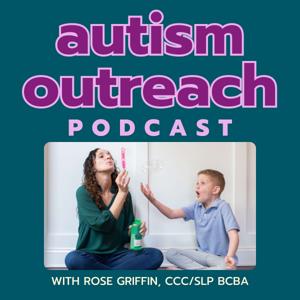
Join Rose Griffin, a dedicated Speech Therapist and BCBA from ABA SPEECH, as she shares her compassionate approach to supporting the communication needs of autistic individuals. With 20 years of…
This podcast is a resource for professionals and parents alike, offering practical strategies that honor each person's unique communication style. Rose covers a wide range of topics, including how to recognize and support autistic communication from an early age, the distinctions between autism and speech differences, and effective, respectful approaches to fostering communication, whether a child is non-speaking, minimally speaking, or verbal.
Through a mix of interviews and solo episodes, Rose explores how to enhance meaningful connections, address challenges with empathy, and celebrate the strengths of autistic individuals. Whether you're a parent, therapist, or educator, you'll find valuable insights and actionable advice to create supportive environments that empower communication and honor neurodiversity.
Hit subscribe and learn more at www.abaspeech.org.

7,683 Listeners
11,950 Listeners
626 Listeners
9,093 Listeners

25,787 Listeners

4,759 Listeners

46,879 Listeners
1,346 Listeners

625 Listeners
422 Listeners

15,404 Listeners

29,200 Listeners
59 Listeners

19,209 Listeners

10,193 Listeners