
Sign up to save your podcasts
Or



Are you nervous before a therapy session because you don’t know how it will go? Let’s make therapy fun and functional again by giving you the tools you need to reach every single one of your students. If you have students with autism and they’re not making a lot of progress, or you’ve used every trick in the book to help a student and you’re stumped, my course Help Me Find My Voice is a great next step for you.
Inside Help Me Find My Voice, you’ll learn:
You’ll also have lifetime access to this course, plus access to a private Facebook group where you can collaborate with other SLPs.
This course is geared for speech-language pathologists, but it also benefits anyone who’s working on communication issues with students. Enrollment is open now, but it will close on April 14th. And I don’t know when I’ll open this course again.
We’ve had over 400 people join us already for this 5-hour ASHA-approved course because the bite-sized modules mean you can fit your learning into your busy day. The cost is $99, and we will send you the proper CEU certificates upon completion.
I also have a FREE webinar on April 6th, 7th or 13th called 5 Strategies to Help Your Students with Autism Engage and Communicate. If you attend live, you’ll receive free therapy material and a certificate of participation.
What's Inside:
Recently, Deidra Darst was able to take her son who has autism to get his first big haircut in four years in a salon. Using tips she learned in my Help Me Find My Voice course, Deidra’s son has really grown in his communication abilities. As a Speech Language Pathologist, Deidra has seen first hand how ABA techniques can blend or enhance the work she does with clients. You’re going to love hearing how BCBAs and SLPS can collaborate to help students find ways to share their voices.
In her work as an SLP, about half of Deidra’s caseload was students with autism. But it wasn’t until her own young son was diagnosed that she got a true window into what a parent was experiencing. She realized that 30 minutes of therapy a week just wasn’t enough, and she wanted to help parents take a more active role in therapy. Since then, she’s learned how to support parents better in her SLP practice, and she leads with the phrase, “If you have questions, ask”.
How can SLPs and BCBAs learn from each other? This idea of collaboration is one that Deidra and I really explore. What we’re doing is similar, but we’re calling it different names. And we miss out on the chance to collaborate positively when we can’t understand each other. Deidra and I talk about some techniques in each of our respective fields that can enhance the work each professional does for a child with autism.
Be sure and check out the Help Me Find My Voice course that helped launch Deidra’s success, and send her an email if you have any questions.
What's Inside:
How do we help our students generalize their language skills in the community and the larger school environment? Fellow “unicorn”, BCBA, and SLP, Katie Castro is an alumni of my Help Me Find My Voice course, and she’s also a clinical director of speech therapy at Children’s Autism Center.
You can’t just hope that a student figures out how to generalize on their own. As therapists, we can build a system that helps lead them to generalize. Generalization is teaching students to apply skills in different environments and circumstances. We may not realize that when we teach a word, there are many different examples of that word. For example, how many kinds of dogs are there? If we show a picture of a Labrador and only that kind of dog, it doesn’t teach a child the variety that is inside the word “dog”.
It’s hard for therapists to have the resources they need to teach generalization which is why I ended up creating some. Katie talks about how she uses multiple examples and teaching loosely to help a child learn a less strict definition of a word.
It’s important to keep really specific data when you’re working with students, but when you combine specific data with IEP goals and first trial data, it can be difficult to keep track of where a student is progressing. If you want to make your progress reporting easier, then Katie and I have some techniques to streamline the process.
For more SLP strategies, be sure to check out my FREE webinar 5 Strategies to Help Students Engage and Communicate. Register now for this April event.
What's Inside:
There are times I feel stressed as a therapist because I want to get through all of the goals for my therapy session, so that’s why I love Liz’s playful approach to therapy. Liz Willis is an SLP who went back to school for her BCBA so that she could provide speech therapy and ABA services. Her dual degrees have made her feel more confident in the services that she provides, and you can really see how they inform how she structures her therapy sessions.
It can be tempting to jump straight into the language piece of an IEP, but Liz suggests that you consider focusing on the social and play piece first. Every interaction begins with social engagement, and when therapists nail down the basics of engagement first, expanding into other skills can reap dividends.
Liz is passionate about supporting teachers and providers, and she shares some of her favorite strategies including:
As an educator or service provider, there are going to be times when you just don’t have the skills your students need. Liz says that you need to recognize when you don’t know something and refer your clients out to someone else. There are so many pieces to the therapy puzzle, and collaborating makes your job easier. If you’d like to connect with Liz, you can reach her at her website, on Instagram, or at [email protected].
What's Inside:
Have you ever worked with a student who needs an AAC, but you don’t know which one would work best for them? If you have, then you’ll appreciate this episode. Annabeth and Mara from The Fanny Pack Therapist have found that their respective therapy styles, as a speech language pathologist and an occupational therapist, mesh so well that they teamed up to help more students.
Annabeth and Mara love how AACs empower students to find ways to communicate their thoughts and needs with the people around them. They’ve found that AACs don’t prohibit verbal speech, but simply give a child a way to communicate while they work toward verbal speech. You don’t want to miss their ABCs of AACs on their Instagram page from October 2020.
By collaborating together, SLPs and OTs can get a more holistic view of a child. While the SLP is evaluating a child’s expressive and receptive skills, an OT can come in and see where a child’s fine motor skills are. And once they’ve passed the initial evaluation, together, the SLP and OT can try signs, low-tech options, verbal speech, and just about anything else to see what works.
I hope this episode gets your wheels turning on how you can work with other professionals or how you can help your students or clients use AACs to meet their therapy goals. Make sure you check out The Fanny Pack Therapist for more ideas on collaborating with other therapists.
What's Inside:
Something I find so inspiring is to watch a student find a way to communicate with the people who exist in their world. For over 47 years, Susan Berkowitz has been helping students with autism learn to communicate by whatever means are necessary. Using Augmentative and Alternative Communication (AAC), Susan is reaching students who are complete non-speakers or who struggle to communicate the full range of their thoughts and feelings.
Susan has a wealth of knowledge, and she’s passionate about helping teachers, parents, and fellow Speech-Language Pathologists find the tools they need to teach their students. She tells the amazing story of one of her students who stopped his self-injurious behavior after she created a POG book filled with 120 pages of pictures that he was able to use to communicate that he wanted to run outside.
There are so many options for AACs, and since the technology for this field is so new, there will continue to be new options every year. Susan has found it helpful to become good friends with the AAC customer service reps so that she has direct insight into this industry.
If you think one of your students would benefit with an AAC, or you’d like to learn more about apps, games, or strategies that you can use in your therapy sessions, Susan is really a wealth of information. Check out her book, her websites, or her TPT store for more resources.
What's Inside:
Can you imagine if someone stood over you and evaluated your behavior with a clipboard while you were trying to act naturally? Organically evaluating your student or client’s progress while they participate in group activities can be a challenge, but it’s one that Shayna Gaunt happily takes on.
There are a variety of assessments that are available to use to help you figure out where a student is at, and Shayna often combines assessments because none of them are completely perfect. She’s rewritten the VB-MAPP to help with some of the more abstract skills that students have to learn, and she shares with me how she creates groups for in-person or telehealth therapy sessions.
Shayna and I know that it can be lonely and overwhelming for therapists, especially since so many of us are virtual now. I am so excited to announce The ABA Forum, which will be a free virtual conference for SLPs, RBTs, and ABA therapists to help give them resources to support their clients. On March 2nd, 3rd, and 4th, we invite you to join us from 7:00-9:00 pm for a chance to network with other experts. And while this event is free to attend, CEUs will be available to purchase if you need them.
What's Inside:
The day before his 3rd birthday, Dr. Mary Barbera’s son Lucas was diagnosed with moderate-to-severe autism, and she felt like she’d fallen into a hole. Even though she had a nursing background, she still felt completely unprepared to help her son. Lucas wouldn’t keep his clothes on, he only spoke pop-out words, and she had no idea how to even start helping him.
Like many other parents, Mary took on the role of the lead therapist as she worked to find proven therapies and techniques that would help Lucas. In the early 2000s, it was like the Wild West in the ABA world. Inspired by her work trying to find solutions for Lucas, Mary went on to get a BCBA-D, and wrote her dissertation on The Effects of Fluency-Based Autism Training on Emerging Educational Leaders.
Mary is passionate about helping families help their young children. She believes that the sooner we can get to the parents and teach them how to help their children, the better their families will be. Today, 1 in 6 children have some kind of developmental disorder. The increase in this population puts stress on the medical community that hasn’t quite caught to the demand. Many of these parents are sitting on a waitlist because therapy places are backlogged.
The information that Mary shares help parents get a headstart on how to help their children, and it puts tools into their hands that help them become their child’s best advocate. Her newest book Turn Autism Around: An Action Guide for Parents of Young Children with Early Signs of Autism will be published on March 30th, and if you sign up now, you can join her book launch team.
What's Inside:
Lisa Chattler works with middle school and high school students as an SLP. In this podcast, we talk about how to teach conversation-based skills to students who are struggling with asking and answering questions. All of us learn some form of “faking it”, where we pretend to be interested in casual small talk with strangers or acquaintances. For children with autism, this back-and-forth can be even harder as they learn to ask and answer questions while actively listening to their conversational partner.
Lisa’s strategies cover different learning styles for students, and include:
Students who are confident in therapy can sometimes stumble during tests or in classroom discussions. Why do some students avoid asking for help? Lisa shares her thoughts on the self-advocacy piece of asking questions that we may be overlooking as we work with our patients.
What's Inside:
Pediatric speech-pathologist Cari Ebert’s passion is the birth to three stages where she focuses on laying the foundation for children to begin to speak. And even though my focus is on middle schoolers with autism, we have a similar approach to teaching children. I loved hearing how Cari lays down a solid foundation of nonverbal skills before she moves on to teaching speech.
A big focus of Cari’s therapy work is setting a child up for success by teaching them how to “learn to learn”. Speech therapy isn’t about making the child less autistic; it’s helping the child learn how to engage with the important people in their life. With that in mind, Cari shares how she uses these 5 foundational skills to prepare a child to learn.
Cari's 5 Autism Early Intervention Foundation Skills
Cari is passionate about helping children with autism communicate in any way possible. Listen carefully to how she uses PIE, or participation, independence, and engagement, to move children forward with her goal to help them find a way to communicate with the people they care about.
What's Inside:
From the publisher's feed
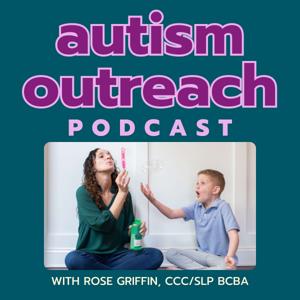
Join Rose Griffin, a dedicated Speech Therapist and BCBA from ABA SPEECH, as she shares her compassionate approach to supporting the communication needs of autistic individuals. With 20 years of…
This podcast is a resource for professionals and parents alike, offering practical strategies that honor each person's unique communication style. Rose covers a wide range of topics, including how to recognize and support autistic communication from an early age, the distinctions between autism and speech differences, and effective, respectful approaches to fostering communication, whether a child is non-speaking, minimally speaking, or verbal.
Through a mix of interviews and solo episodes, Rose explores how to enhance meaningful connections, address challenges with empathy, and celebrate the strengths of autistic individuals. Whether you're a parent, therapist, or educator, you'll find valuable insights and actionable advice to create supportive environments that empower communication and honor neurodiversity.
Hit subscribe and learn more at www.abaspeech.org.

7,684 Listeners

11,965 Listeners

625 Listeners

9,089 Listeners

25,789 Listeners
4,763 Listeners

46,901 Listeners
1,346 Listeners

625 Listeners

422 Listeners

15,409 Listeners

29,204 Listeners
59 Listeners

19,254 Listeners

10,179 Listeners