
Sign up to save your podcasts
Or



Working on social skills virtually presents its own special challenge, and I am so excited to talk with Tricia Detig from Detig Dialect about strategies she uses in her virtual therapy sessions. Tricia works with children in grades 6-8, and she really feels like these students are thriving academically with virtual work.
However, being at home and away from constant peer interaction means that students are even more distracted by phones and everything going on around them, and their therapy sessions focusing on social skills have taken on a new challenge.
Tricia has restructured her therapy session so that in small chunks of time, she’s able to:
Because her students are older, Tricia is able to use virtual games like Baamboozle and Among Us to reinforce social skill goals. There are some other expectations that she just doesn’t have for this age group, like letting them sometimes leave the camera off, but by explicitly giving instructions, she’s able to control the session’s outcome much better. More than ever, middle school students with autism need someone they can trust, and that has continued to be a focus for Tricia throughout the pandemic.
What's Inside:
Have you ever worked with students who have trouble engaging in a session? If you have, then you’ll love this conversation with Jessie Ginsburg. As a speech pathologist and the CEO of Pediatric Therapy Playhouse in Los Angeles, Jessie helps young kids on the autism spectrum build foundational skills.
For SLPs, one of the biggest misconceptions is that we’re supposed to immediately start working on speech when a child walks in the door. But without foundational skills in place, we won’t be able to have an improvement in speech. That’s why Jessie focuses on three areas first before diving into speech therapy. You’ll hear how she uses regulation, engagement, and motivation to build that foundation for her clients.
Therapy can’t occur in a child until they’re in the optimal level of arousal. Think of the challenge of teaching an “Eeyore” energy level child, or a “Tigger” energy level child. Using alerting or calming activities, Jessie talks about how she gets a student’s energy centered just right so that work can begin.
Motivation is so specific to each student that it will take some sleuthing to uncover what makes a student want to learn. Jessie loves involving parents to help her get the low-down on what students like, and she often collaborates with parents to see a child’s sensory preferences.
Collaborating with other speech-language pathologists can help you strategize when you’re stuck on how to help a child with autism. Connect with Jessie’s Facebook group, or visit ABA Speech for more tips and advice.
What's Inside:
For emerging communicators, defining goals can be so stressful. I want to help relieve that overwhelmed feeling for you that I often had at the beginning of my practice. As you create speech therapy IEP goals, I want you to keep in mind how assessment, collaboration, and functional goals all work together to support and sustain the student as they work with you throughout the year.
One of the common tools used in the classroom is a standardized test, but for students with autism, this may not give us the best information. Oftentimes, children with autism may not be able to answer, or their manding may not be assessed. Instead, I prefer to use the VB-MAPP test or the functional communication profile.
As you set the early learning goals for your students with autism, you’ll need to consider measurable communication skills they may already have like labeling, verbal imitation, filling in the blank, matching abilities, or group listening skills.
Once the initial assessment has been given, and the team collaboration has produced a good picture of where the student is and where the team would like to send him, then it’s time for you to apply a practical and systemic approach to establishing the year’s goals. In this episode, I’ll share with you why these questions are so important to ask as you write the IEP:
Please take a minute and download my IEP Goal Bank to help your team as you write specific and actionable IEP goals for your students.
What's Inside:
I have a great routine established for my students when we’re in person. I love working on yoga with them because I think it’s a lifelong leisure skill. I use cards to demonstrate the yoga pose we’re going to practice and then together we hold the pose for ten seconds. This year, as so many of my tools have had to be adjusted to fit into teletherapy, I’ve been happy to see that I can still do yoga with my students virtually.
For many of us, flexing into the teletherapy space has proven to be a challenge. In addition to dealing with unfamiliar technology, we’ve also had to come up with creative ways to teach the same skills without being in person. And we’ve had to find how to get around new barriers for therapy, including the challenge of scheduling and having students at home without parental support.
My five favorite autism teletherapy strategies can help you set up boundaries and expectations for students that will help them thrive in this challenging season.
Despite the challenges of this year, I’ve found that teletherapy has made it easier to communicate with families, and it’s led to more frequent communications as well. This opportunity can help us build stronger relationships with our students’ families.
What's Inside:
One of the most meaningful moments I had as a speech therapist was as I was watching a mentor work with a student over the age of 18. She was teaching him to use a static device to request the things that he enjoyed, and it was such a joy to watch him find a way to communicate with the world.
In this podcast series, I’m going to teach strategies that help children with autism learn to communicate. As a Speech-Language Pathologist and a board-certified behavior analyst, I love working in both public and private settings. It gives me an opportunity to see many different kinds of situations and students and adjust my communication techniques to reach each one.
Whatever setting a Speech-Language Pathologist is in, you can find them working on a variety of tasks like:
No matter the tasks, the setting, or the age of a patient, if a topic touches on communication in any way, I’m going to address it here with my guests. Don’t miss the preference assessment that I use to engage with my patients who are on the autism spectrum that immediately helps you connect with them.
What's Inside:
From the publisher's feed
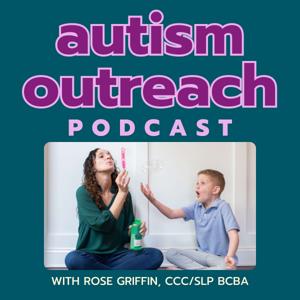
Join Rose Griffin, a dedicated Speech Therapist and BCBA from ABA SPEECH, as she shares her compassionate approach to supporting the communication needs of autistic individuals. With 20 years of…
This podcast is a resource for professionals and parents alike, offering practical strategies that honor each person's unique communication style. Rose covers a wide range of topics, including how to recognize and support autistic communication from an early age, the distinctions between autism and speech differences, and effective, respectful approaches to fostering communication, whether a child is non-speaking, minimally speaking, or verbal.
Through a mix of interviews and solo episodes, Rose explores how to enhance meaningful connections, address challenges with empathy, and celebrate the strengths of autistic individuals. Whether you're a parent, therapist, or educator, you'll find valuable insights and actionable advice to create supportive environments that empower communication and honor neurodiversity.
Hit subscribe and learn more at www.abaspeech.org.

7,684 Listeners

11,965 Listeners

625 Listeners
9,089 Listeners

25,789 Listeners
4,763 Listeners

46,901 Listeners
1,346 Listeners

625 Listeners

422 Listeners

15,409 Listeners

29,204 Listeners
59 Listeners

19,254 Listeners

10,179 Listeners