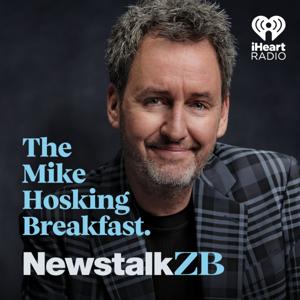
The Mike Hosking Breakfast

The Mike Hosking Breakfast

By Newstalk ZBNews
Download on the App Store
  • Favorites

    295

    Followers

  • Typical duration

    4 min

    per episode

  • If it hooks

    63%

    finish an episode

Based on Podcast App listening data

The Mike Hosking Breakfast episodes

  • Mike Hosking: Holland a sign Covid complacency is running out
    A question worth pondering is how long do people put up with their lot as a result of Covid before things get ugly.
    The Dutch are into their third day of rioting in protest over lockdown. Their Prime Minister says if it’s not contained the place is headed for civil war.
    Italy is watching their Prime Minister quit because one of the coalition partners is fed up with the countries handling of Covid.
    Mix this in. The head of Moderna last week said we’ll be living with Covid forever, thus indicating it’s a flu like virus, and we will need a jab a year –which is fine, but you don’t lock populations down and restrict their movement for flu, so why Covid?
    And if Covid is flu like, who makes the call and when that the approach until now can’t last?
    And that’s before you get to the many protests we’ve seen already all over the world from people who never really brought into the approach at all in the first place.
    And that’s before you get to the federalism issues in places like Australia, the states and to a lesser extent Britain, where state or local authorities can run their own programme and make their own decisions, thus leaving the population to a crap shoot set of rules depending on where you live..
    And then you mix in time and the seasons.  I am sure at least part of what we’re watching in Holland this week is driven by a dark wet miserable winter: the human spirit can only take so much for so long.
    Hell, our government defends wandering around for exercise in MIQ over a 14 day period. Try being locked down for Christmas, trying having kids at home from school for months, trying seeing your pub closed till July.
    There is a lot at play here and obviously it will vary population to population. We, for example are as compliant as any in the world. Probably too much so, hence our government has turned being asleep at the wheel into an art form.
    But millions are getting closer to being over it, and Holland might just be the current example of how dangerous and explosive this could get.
    2 min
  • Craig Hudson: Small businesses experiencing strong job growth
    The small business sector looks to be in healthy shape.
    The latest figures from Xero small business insights show small business jobs grew 2.8% in December.
    Even more promising is the overall figures, 6.4% more small business jobs are above pre-Covid-19  figures.
    Xero managing director for New Zealand & Pacific Islands Craig Hudson joins Mike Hosking to crunch the numbers.
    LISTEN ABOVE
    4 min
  • Jacqueline Rowarth: NZ farming leading the world in low emission production
    Kiwi dairy farmers are leading the world in low emission production, but there's always room for improvement.
    AgResearch analysis placed New Zealand at the top for efficiency, with an average carbon footprint almost half the size of the 18 other countries.
    Agriculture analyst Jacqueline Rowarth told Kate Hawkesby some fine tuning could create an even better result.
    "When we help farmers who are struggling, we can improve the average."
    Rowarth says they haven't had the fine detail until now.
    She says it looks at supplementary feeds, pasture and grain around the world, and we have very efficient farmers.
    LISTEN ABOVE
    3 min
  • Mike Rosenberg: British singer Passenger to release his 13th album
    It's time to catch up with Britain's biggest music exports.
    Mike Rosenberg, better known as Passenger, burst onto the scene in 2012 with "Let It Go."
    That topped the chart in 16 countries, and sold tens of millions of copies.
    Now he's back with his 13th studio album, Songs for the Drunk and Broken Hearted.
    Mike Rosenberg joins Mike Hosking to give us an update on his career and what we can expect from the new album.
    LISTEN ABOVE
    13 min
  • Lee Hames: Last Holden ever made set to sell for $500,000
    The very last Holden ever manufactured in Australia has been put up for auction this weekend and looks set to fetch a hefty $500,000.
    The Holden VF Series II SSV Redline built in October 2017 is the very last Holden ever framed, stamped and painted in Australia and offers one lucky buyer a cherished piece of Australia’s 70 years of automotive history.
    Lloyds Auctions chief operations officer Lee Hames said the interest in the car from collectors, investors and Holden enthusiasts from across the nation had been “phenomenal”.
    He said the car had just 102km on the odometer and presented in the same original, showroom condition of when it rolled out of Holden.
    “Phones are ringing off the hook night and day,” Mr Hames said.
    “There are some very passionate Holden enthusiasts and collectors looking to own this special piece of Australian history.
    “We start all auctions at $1, there’s no precedent for price on this car as it is just so rare. There will never be another ‘last Holden’, but it certainly wouldn’t surprise us if it achieved a strong six-figure result.”
    Holden, owned by United States based company General Motors, closed its Australian manufacturing operations in October 2017 after 69 years of building cars in the country.
    4 min
  • David Williams: NZ-made immunity test could screen future travellers
    Kiwi innovators have joined forces with the global company behind airport "eGates" on technology designed to quickly screen future travellers for immunity against the coronavirus.
    Dubbed a "lab on a disk", Orbis Diagnostics' tech is currently the only one of its kind in the world suitable to be rolled out in airports, and capable of rapidly detecting whether someone was capable of carrying the virus.
    Today, the Kiwi company announced it had partnered with multinational company Idemia, which invented biometric passport eGates, and that it wanted to carry out local trials with people in quarantine facilities, subject to Government approval.
    Orbis chief executive Brent Ogilvie said the tech had the same level of accuracy as complex quantitative immunity tests carried out in medical labs.
    But in this case, the system, presently in final-phase testing, could produce results within 15 minutes, for 15 to 30 people at a time.
    "Quantitative immunity testing is key to confidently verifying whether a person has sufficient immunity against Covid-19," he said.
    "It is well understood that high levels of antibodies against certain parts of viruses can rapidly neutralise and prevent infection; such antibodies are known as neutralising antibodies."
    The company, led by renowned University of Auckland scientist Professor David Williams, had specifically targeted its tech at quickly quantifying these fast-acting antibodies.
    "In the absence of verifying a person's immunity, it will be challenging for governments to have the confidence to reduce current border and travel restrictions."
    Originally designed for use in animal health, the system was turned to Covid-19 antibody levels over the past year.
    Ogilvie said it was now in its end stages and, while it required final phase studies and manufacture scale-up, the company aimed to roll out the system halfway through the year.
    The company has proposed to the Government carrying out a 12-week trial with quarantining travellers to demonstrate its system could work at scale.
    "We will also monitor those individuals to confirm that they do not develop the disease," he said.
    In piloting it here, the Government could gain confidence in the tech, he said.
    "Unlike other countries who are dealing with the 'here and now', New Zealand has the luxury to look into the future and adopt long-term sustainable solutions that will allow us to safely reopen our borders."
    A Ministry of Health spokesperson said the tech appeared promising, but added that it had yet to be fully evaluated.
    New Zealand currently wasn't considering point-of-care testing for Covid-19.
    Idemia's Oceania managing director, Xavier Assouad, expected immunity screening to become a "crucial element" of the world resuming travel.
    "As part of the innovation process, we are exploring an integration of the Orbis solution with Idemia's Mobile ID and border control platform - notably for risk assessment purposes."
    7 min
  • Mike's Minute: So the borders are closed for 2021, now what?
    A headline with no follow up questions, and certainly no answers.
    Isn't that what we got this week with the announcement that the borders will be closed for the year?
    It follows Brendan Murphy's assessment in Australia last week he doesn’t think they're going anywhere this year either.
    So, the Chief Australian Medical Officer and our Prime Minister have decreed travel is off. This is a shame because it yet again shows a lack of willingness to keep trying, to keep pushing, and to keep exploring possibilities.
    But, more importantly, the questions that didn’t come were, if the border is closed what happens to the hotels and the businesses that support international travel? What happens to the travel agents? The airlines?
    And given the questions weren't asked, there certainly weren't any answers.
    It has been shown here after pretty much a full year of tourism devastation that there is a gap of somewhere between $4 and $6 billion between the domestic boost we have given the industry, and the sort of money that flows when Americans and the Chinese roll into town.
    There was a mismanaged fund for companies last year in which some got millions, others got nothing despite them seemingly doing pretty much the same thing. There was the wage support. And Air New Zealand got to tap into a mafiaesque type loan facility that runs at a rate of nine percent.
    As we know, thank god, the better part of the economy has bounced back. Jobs are recovering slowly, spending is solid although not well spread.
    The QE programme is working. Money is cheap, there is less pessimism around business, hiring, and investing.
    But, one of the key components of our economy, tourism is as troubled now as it was last year. In fact, it might be a bit worse given last year no one had a clue. Whereas now, we do. You can write the year off.
    So, what to do? Where's the help? What sort of help is it?
    Can you honestly expect our national airline to borrow $900 million at nine percent? And then what? Does the government take a bigger stake?
    How much of the tourism industry do you mothball? Given the original thinking was we need to support it for the bounce-back. Is that still the thinking? Or has it changed? Is there a bounce back? Do really hard calls need to be made to say, some businesses aren't coming back, and the tap needs to be turned off? Where do the banks and their lending facilities fit into this?
    Where, once again we ask, is the plan?
     
    Telling us borders are closed is easy, the follow up is the bit we, yet again, are waiting for.

    3 min
  • Rod Liddle: British schools still closed, dispute with EU over vaccines continues
    British Prime Minister Boris Johnson has indicated that the coronavirus lockdown in England will remain in place until at least March 8 as he ruled out any imminent return to school for most students.
    In a statement to lawmakers, Johnson also confirmed new restrictions for travellers arriving in England from countries where the government thinks there is a risk of known variants of the coronavirus.
    He said the U.K. remains in a “perilous situation” with more than 37,000 patients hospitalized with COVID-19, nearly double the number during the country's previous peak in April.
    While dashing hopes of a return to classrooms after a mid-February school break, Johnson cautioned that the March 8 target is an aspiration dependent on progress on the vaccination front and ongoing reductions in the prevalence of the virus in the community. He said a "roadmap" for the “gradual and phased” easing of the lockdown will be unveiled in the week commencing Feb. 22.
    “The first sign of normality beginning to return should be pupils going back to their classrooms," he said.
    England’s schools are closed to all students bar those deemed to be vulnerable and children of key workers, such as doctors and delivery drivers. The same applies in Scotland, Wales and Northern Ireland.
    Johnson said he hoped that by Feb. 15, the four most vulnerable groups, including those over the age of 70 and nursing home residents, will have gotten a first vaccine jab that would give them a level of immunity within three weeks.
    “We hope it will therefore be safe to begin the reopening of schools from Monday, March 8 with other economic and social restrictions being removed thereafter as and when the data permits " he said.
    Johnson’s announcement points to shops selling non-essential items and pubs and restaurants remaining closed until well into March at least.
    Johnson also toughened border rules to limit the chances of new variants of the coronavirus being seeded in England. He confirmed plans for a 10-day quarantine in hotels or other government-provided accommodation for anyone arriving from 22 hotspot countries, including South Africa, Portugal and all in South America.
    Given travel bans are already in place for these countries, the quarantine measures will largely apply to British residents, who will also have to pay for their hotel stays.
    “They will be met at the airport and transported directly into quarantine,” he said.
    In addition, he said anyone leaving England will be asked the reasons behind their trip and will be instructed to go home if they do not have a valid reason. Under lockdown restrictions, holidays abroad are not allowed. He said discussions are taking place so the rules apply across the U.K.
    Further details will be unveiled next week. Critics are saying the government should be mandating quarantines for every arrival.
    On Tuesday, the U.K. became the fifth country to record more than 100,000 coronavirus-related deaths. The U.K. is the smallest to breach that threshold, and has one of the world's worst COVID-19-related mortality rates.
    Johnson has come under renewed fire for his handling of the pandemic, specifically for consistently being too slow in making tough decisions.
    Keir Starmer, leader of the main opposition Labour Party, pointed to a series of missteps by Johnson that he says represent a “damning indictment of how the government has handled this pandemic.”
    For one, Johnson is being criticized for delaying the latest lockdown after scientists had informed him on Dec. 18 that a new variant of the virus first identified in London and the southeast of England was up to 70% more infectious than the original coronavirus strain.
    The lockdown only came into force on Jan. 5, a delay that critics say fueled the rapid increase in new coronavirus infections around the turn of the year, and the subsequent acute pressure on hospitals and deaths.
    Though...
    6 min
  • Sheryl Mai: Mayor of Whangarei on Northland's community-run Covid-19 checkpoints
    As health officials investigate two new possible cases of Covid-19 linked to the Pullman Hotel, community-run Covid-19 checkpoints will be operating in Northland from Thursday, without police support.
    Te Tai Tokerau is expecting an influx of Aucklanders ahead of Auckland Anniversary weekend and some are nervous, after a local woman tested positive for the South Africa strain of Covid-19 after leaving managed isolation in Auckland.
    She caught it from another returnee who was also staying at the Pullman Hotel. On Wednesday it was revealed two more returnees who recently left the Pullman returned positive Covid-19 tests.
    "It is yet to be confirmed if they are recent or historic infections. Further urgent testing is being carried out this evening," the Ministry of Health said in a statement on Wednesday evening.
    The Ministry was slow to come forward with the new information. Earlier when asked for clarity regarding the two new cases, it said "it would be irresponsible to go to air based on a rumour," before confirming the two new cases hours later.

    Te Tai Tokerau Border Control operated Northland checkpoints during 2020's Covid-19 lockdowns. Spokesman Hone Harawira believes they are needed again, but he says the police will not help.

    In a statement, Northland police Inspector Riki Whiu said police were not aware of a local group's plans to re-establish checkpoints in the region.
    "We are all coming to this kaupapa from the same place out of a need to protect the most vulnerable in the community. As we have throughout the Covid-19 response, we continue to work with our partners which includes iwi," he said.
    "Police respect and recognise the good intentions of the group, however, while New Zealand remains in alert level 1 police do not believe there is any requirement for checkpoints at this time."
    Harawira said it is "really disappointing".
    "Police have the authority to run a checkpoint and stop every vehicle on the road for alcohol, for firearms, for a licence ... but they won't support a checkpoint to provide information to the public about the threat of Covid-19 and the impact it may have on our kaumātua and kuia.
    "We stood up our checkpoints last time without the declared support of the police. They came and supported what we were doing because they could see what we were doing was in the interest of keeping our community safe.
    "Regardless of what the police position is, our position is we are there to defend the rights and interests and wellbeing of our kaumātua, kuia, and the people of Tai Tokerau. We would love to have the police on board with us. If they can't be there, that's something they have to consider, not us."
    Far North Mayor John Carter supports the checkpoints going ahead.
    "I think there's every justification. [Tai Tokerau Border Control] are to be applauded for it quite honestly. What they're doing is taking a responsible attitude, they're not looking to turn people away, they're just saying to people 'be aware'.
    "We are of course looking to have our visitors, and just as importantly, our permanent people safe. I think they're doing a good job.
    "We need to be sensible and approach this realistically. We had the one instance with the lady who is to be congratulated on the steps she's taken, but now we've been made aware there may be another couple. We just need to be careful."
    Carter said a short lockdown would have been premature, "but we'll have to wait and see what happens with these two other cases now".
    By RNZ
    3 min

About The Mike Hosking Breakfast

From the publisher's feed

Open your mind to the world with New Zealand’s number one breakfast radio show.

Without question, as New Zealand’s number one talk host, Mike Hosking sets the day’s agenda.

The sharpest…

Best of The Mike Hosking Breakfast

Ranked by our users in the last 21 days

More shows like The Mike Hosking Breakfast

Test Match Special by BBC Radio 5 Live

Test Match Special

212 Listeners

Sky Sports Cricket Podcast by Sky Sports

Sky Sports Cricket Podcast

120 Listeners

Gone By Lunchtime by The Spinoff

Gone By Lunchtime

28 Listeners

Australian True Crime by Bravecasting

Australian True Crime

1,218 Listeners

Saturday Morning with Jack Tame by Newstalk ZB

Saturday Morning with Jack Tame

2 Listeners

Heather du Plessis-Allan Drive by Newstalk ZB

Heather du Plessis-Allan Drive

11 Listeners

Early Edition with Ryan Bridge by Newstalk ZB

Early Edition with Ryan Bridge

2 Listeners

Weekend Sport with Jason Pine by Newstalk ZB

Weekend Sport with Jason Pine

4 Listeners

The Weekend Collective by Newstalk ZB

The Weekend Collective

4 Listeners

The Re-Wrap by Newstalk ZB

The Re-Wrap

2 Listeners

The Leighton Smith Podcast by Newstalk ZB

The Leighton Smith Podcast

81 Listeners

Smart Money by Newstalk ZB

Smart Money

2 Listeners

Matt Heath & Tyler Adams Afternoons by Newstalk ZB

Matt Heath & Tyler Adams Afternoons

0 Listeners

The OneRoof Radio Show by Newstalk ZB

The OneRoof Radio Show

5 Listeners

Kerre Woodham Mornings Podcast by Newstalk ZB

Kerre Woodham Mornings Podcast

1 Listeners

A Captain's Cup by Radio Sport

A Captain's Cup

1 Listeners

Between Two Beers Podcast by Steven Holloway & Seamus Marten

Between Two Beers Podcast

145 Listeners

The High Performance Podcast by High Performance

The High Performance Podcast

576 Listeners

I Catch Killers with Gary Jubelin by News.com.au

I Catch Killers with Gary Jubelin

538 Listeners

Newstalk ZB ANZAC Centenary Tribute by Newstalk ZB

Newstalk ZB ANZAC Centenary Tribute

0 Listeners

Election 2026: The Front Bench by Newstalk ZB

Election 2026: The Front Bench

0 Listeners

On The Front Foot by Newstalk ZB

On The Front Foot

4 Listeners

Holiday Breakfast by Newstalk ZB

Holiday Breakfast

0 Listeners

The Superior Sailor Series by Newstalk ZB

The Superior Sailor Series

0 Listeners

Rugby Direct by Newstalk ZB

Rugby Direct

6 Listeners

The Dom Harvey Podcast by Dom Harvey

The Dom Harvey Podcast

82 Listeners

Secrets We Keep by LiSTNR

Secrets We Keep

79 Listeners

Motive & Method by Tapt Media

Motive & Method

86 Listeners

The Big League Podcast by Newstalk ZB

The Big League Podcast

2 Listeners

All Sport Breakfast Canterbury by NewstalkZB

All Sport Breakfast Canterbury

0 Listeners

News Fix by Newstalk ZB

News Fix

0 Listeners

Football Fever by Newstalk ZB

Football Fever

0 Listeners

Sports Fix by Newstalk ZB

Sports Fix

2 Listeners

Great Chats with Francesca Rudkin by Newstalk ZB

Great Chats with Francesca Rudkin

0 Listeners

In My Day by Newstalk ZB

In My Day

0 Listeners