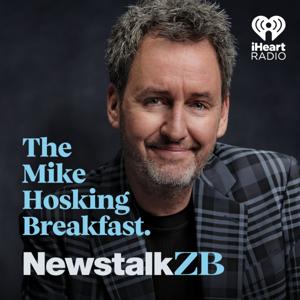
The Mike Hosking Breakfast

The Mike Hosking Breakfast

By Newstalk ZBNews
Download on the App Store
  • Favorites

    295

    Followers

  • Typical duration

    4 min

    per episode

  • If it hooks

    63%

    finish an episode

Based on Podcast App listening data

The Mike Hosking Breakfast episodes

  • Mike Hosking: We are economically our own worst enemies
    We are one of the most open economies in the world - heard it before?
    Yes, you have. It’s the Prime Minister sprooking our Covid success. She is comparing our economy to others. The fact it’s all a myth is separate to the fact she’s making the comparison.
    Most of the world is open they’re not crippled the way we are with a handful of cases. But the comparison part is important, because over the next two days the government are going to be bending over backwards to avoid comparisons, because when we look to Australia, it will be confirmed they’ve spanked us economically: Their lockdown was superior and the facts and the numbers will prove it.
    Grant Robertson last week on this show told me it’s not a game of rugby. It certainly isn’t - we don’t know how to host games of rugby. The Australians do, as we also learned last week with the championship debacle. 
     
    The government’s line is that Australia has a different economy to ours. That’s true too. But, and here’s the bit they won’t mention, that’s also our fault.
    What do Australia have in their arsenal that has served then up a fortune for generations? Natural resources. They dig gold, literally and figuratively, out of the ground and sell it to the world.
    We don’t. Why not? Because we have chosen not to.
    Our call, no one else’s, from Taranaki and its oil to the west coast and its coal and gold. To Waihi and the endless resource  trouble they’ve had adding jobs and bringing in income, we have selected not to be a part of a global market that offers billions every year to those who want it.
    So what then happens? We become more reliant on what we do want to do. As it turns out that’s dairy and tourism.
    One of which is now buggered - lack of diversity will bite you every time. The other this government has spent a lot of time on making increasingly difficult - ask any farmer.
    We are economically our own worst enemies.
    The money, the revenue streams, the jobs are all there. We just don’t want to exploit them.
    So when the figures are produced and yet again Australia teaches us what good economic policy and decision making is about, don’t let the Robertson’s pull the wool over your eyes with spin.
    They have been out played, as it turns out given last week, off the field, as well as on it.
    2 min
  • Mark Robinson: Bledisloe Cup tests could bring millions into economy if fans can attend
    The two rescheduled Bledisloe Cup tests in New Zealand will bring tens of millions of dollars to the economy if crowds are able to attend the tests.
    The dates for the two Bledisloe Cup matches were yesterday confirmed by New Zealand Rugby, with the All Blacks to play the Wallabies at Wellington's Sky Stadium on Sunday October, 11 and a week later at Eden Park in Auckland (Sunday October, 18).
    Whether fans will be able to attend will be dependent on updates to the Government's Covid-19 Alert Levels. Super Rugby Aotearoa games were able to hold crowds under level one.
    NZR chief executive Mark Robinson told the Mike Hosking Breakfast on Newstalk ZB that going off previous measurements, the two tests would bring in tens of millions to the country.
    "[Holding] Six match days, we've already said is in excess of $100m into the country so if you work back from that around two big events days, it's obviously in the tens of millions of dollars.
    "It's great but I think more importantly than that, at this time the country just needs a bit of a lift and some top-class sporting action and something to support and get in behind is obviously going to be something positive for peoples mindset and wellbeing as we go forward as well. So we're excited about playing a leadership role in that space too," Robinson said.
    "It's nice to have this resolved. It's fantastic for the country and for rugby fans. It can breathe a bit of life hopefully into our smaller businesses and communities around the place," Robinson added.
    NZR should expect sellout crowds at both Sky Stadium and Eden Park if fans are able to attend.
    Cabinet will review Auckland's Covid-19 Alert Level settings on September 21 with a view to increasing gathering limits in Auckland if it is deemed safe, which would come into effect on September 23.
    Cabinet will also look at moving the rest of the country to level 1, which would come into effect at 11.59pm on that day - September 21.
    Under the new Government guidelines, the Australian squad will be able to train fully as a squad four days after arriving in the country, dependent on all squad members returning a negative Covid-19 test on day three.
    "We acknowledge that this has been a complex and challenging puzzle to solve and we're grateful that both rugby organisations, together with our Government, have come together to get these matches across the line," Robinson said in a statement yesterday.
    "We're also pleased that the All Blacks team and management now have certainty and can plan accordingly, and we wish them all the very best for the Bledisloe Cup campaign."
    NZR also confirmed the matches will kick off at 3.30pm on both Sundays.
    "Our fans both here in New Zealand and around the world have long been looking forward to the resumption of international rugby and we're excited to finally lock the details into the calendar," Robinson said.
    Robinson told Hosking that there will be a Sanzaar meeting tomorrow which should confirm the plans for the Rugby Championship tournament which will be held in Australia.
    There have been concerns members of the All Blacks squad and management would still be in quarantine during the Christmas period once returning home at the conclusion of the Rugby Championship.
    "At this stage we've got a strong sense we'll be able to get the team out soon after the 5th or 6th [December] and have them cleared by Christmas," Robinson said.
    4 min
  • Steve Price: Thousands of Australians stranded overseas due to stringent border controls
    No job, no visa, no health care -- and barred from returning home. This powder keg of misfortunes is the current reality for tens of thousands of expats who hold the world's ninth most powerful passport.
    While situations differ, one point remains the same -- Australians abroad feel abandoned by their government during the coronavirus pandemic.
    Sunday marked two months since Prime Minister Scott Morrison introduced a cap of just under 4,000 international arrivals per week. He made the move in response to the country's second coronavirus wave, which was sparked by a hotel quarantine security scandal.
    The cap has resulted in a barrage and backlog of cancelled flights, with ticket prices skyrocketing.
    The Department of Foreign Affairs and Trade (DFAT) says at least 25,000 Australians, many of who are financially and medically vulnerable, have registered their need to come home since July. However, the Board of Airline Representatives of Australia estimates the true number of those stranded is closer to 100,000.
    Prior to the pandemic, the Aussie accent echoed across the world, with over one million Australians living and working overseas at any given time.
    Before the cap was put in place, Australia already had some of the world's strictest coronavirus travel measures. Since March, hotel quarantine has been mandated, foreign tourists have been barred from entry and citizens banned from leaving.
    Those trying to return home now are Australian citizens who left the country prior to the pandemic, not holiday makers.
    "You should have come home"
    In the first three months following international border closures, over 357,000 Australian citizens returned home, according to DFAT.
    Contrast that to the past two months, where the cap restricted entry to just over 30,000 Australian citizens. It's the argument of critics, including Trade Minister Simon Birmingham, that citizens should have returned in the early stages of the pandemic.
    "If you wanted to come back you should have already come back in most circumstances," said Birmingham.
    A number of Australians currently stranded abroad told CNN that while the government did urge citizens to return home in March, it was a message aimed at short term travellers.
    Those who had a permanent job, home and savings were advised by their consulates to stay put. No one in March could predict the trajectory the pandemic would take, nor the impact it would have on their lives. Six months on, many still have a secure income and home, while others have had their lives crumble apart.
    For Stephen Spencer in Abu Dhabi, returning to Australia in March would've meant quitting his job, uprooting his kids' education and abandoning his house -- with nothing secured on the other side. Spencer and his wife Kate chose the most stable option for their kids, which was to ride it out in Abu Dhabi.
    Several months later, Spencer lost his job and is now struggling to get his family home. As the sponsor of his wife and teenagers, once he cancels their visas, an act he must do before they leave, they will have just 30 days to exit the country.
    "If we are unable to get on a flight to Australia, we are effectively living as refugees, with no legal right to remain in the UAE and a home country that will not allow us to return," he explained. "I cannot believe how quickly the Australian government abandoned its citizens overseas."
    It's a story retold by many of those stranded.
    Sarah Tasneem was living in Canada when the invisible enemy caused the world to go into hibernation. She had a stable job and was undergoing the process of permanent residency. However, her application was canceled by the Canadian government in June, resulting in the loss of employment. She is now running out of money and is unable to work while she fights to get home.
    "I am worried I will eventually face deportation," Tasneem said. "I am running out of time."

    7 min
  • Dr Katie Ayers: NZ Dental Association welcomes National's policy to increase dental spending
    Dentists are pleased National wants to put an extra $30 million dollars a year into children's oral health,  but say there are gaps when it comes to adults' dental care.
    The party would give children a new toothbrush and toothpaste each year,  and would put more money into paediatric and school services.
    National is calling the policy MySmile and builds on New Zealand's current policy of free dental care for children under 18 years old.
    Dental Health President Dr Katie Ayers told Mike Hosking a number of children are slipping through the cracks so the money will assist with preventive care for them.
    "We're desperately seeking funding for low income adults , because depending on where you live in the country, you may or may not have access to help."
    LISTEN ABOVE
    4 min
  • Chris Chiu: Imperial College London lead researcher on testing inhaled coronavirus vaccines
    British scientists are beginning a small study comparing how two experimental coronavirus vaccines might work when they are inhaled by people instead of being injected.
    In a statement on Monday, researchers at Imperial College London and Oxford University said a trial involving 30 people would test vaccines developed by both institutions when participants inhale the droplets in their mouths, which would directly target their respiratory systems.
    Larger studies of the Imperial and Oxford vaccine are already under way, but this study aims to see if the vaccines might be more effective if they are inhaled.
    “We have evidence that delivering influenza vaccines via a nasal spray can protect people against flu as well as help to reduce the transmission of the disease,” said Dr. Chris Chiu of Imperial, who is leading the research. He suggested that might also be the case with COVID-19.
    “It is critical we explore whether targeting the airways directly can provide an effective response compared to a vaccine injected into muscle,” Chiu said in a statement.
    The study is currently recruiting participants aged 18 to 55 and hopes to begin vaccinating people in London in the coming weeks.
    Previous studies have shown vaccines delivered by inhalation require lower doses than by injection, which might help stretch limited supplies.
    “It may well be that one group has the right vaccine but the wrong delivery method, and only trials such as this will be able to tell us that," said Robin Shattock, who is leading the development of Imperial's vaccine.
    The Imperial vaccine uses synthetic strands of genetic code based on the virus. Once injected into the muscle, the body’s own cells are instructed to make copies of a spiky protein on the coronavirus. That is expected to trigger in turn an immune response so the body can fight off any future COVID-19 infection.
    In comparison, Oxford’s vaccine uses a harmless virus — a chimpanzee cold virus, engineered so it can’t spread — to carry the coronavirus’ spike protein into the body, which should trigger an immune response.
    Last week, Oxford temporarily paused its large-scale vaccination tests after one participant in the U.K. reported severe neurological symptoms; it was restarted on Sunday.
    5 min
  • Chris Whelan: No fees-free extension for universities
    Thousands of university students have voiced concerns at the lack of social distancing provisions and non-mandatory masks as they prepare to return to lectures next week.
    Auckland University students are required back in face-to-face classes from Monday but many want to stick with online learning until the university can uphold social distancing requirements to protect against Covid-19.
    The call to return to class comes in the same week that 89 users of an Auckland gym visited by someone infected with Covid-19 are being asked to get tested.
    The infected person attended three classes at the Les Mills gym in Takapuna last week.

    In August a student at the University of Auckland tested positive for Covid-19.
    This week students flooded the email inbox of vice-chancellor Dawn Freshwater and signed a petition requesting all learning apart from practical work remained online.
    However the university says safety remains its priority and mask-wearing is "strongly encouraged" where physical distancing is not possible.
    One student, who wished to remain anonymous, said the university was "actively ignoring concerns of students" and said they were being required back on campus with "no support".
    The fifth-year law and art student said the university handled the first lockdown well and students were well supported and communicated to.
    "Since August however the University of Auckland's response has been lacklustre at best, negligent at worst," the student said.
    "Updates have been few and far between, telling students to suck up the move back online when the second lockdown has been far tougher mentally."
    The student said after Prime Minister Jacinda Ardern announced Cabinet would review Auckland's settings on September 21 the university delivered a final "kick in the guts".
    "Vice-chancellor Freshwater announced that students would be going back to university," the student said.
    "There is no requirement to wear masks, there is no support for students, there is no guarantee of physical distancing."
    Other students echoed concerns, saying there was a limit of 10 on social gatherings and no more than 50 at a funeral but it was okay to "put 300 in a lecture hall with no mandatory masks".
    More than 80 students contacted NZME with their concerns, saying they were "appalled", "stressed out", and thought the decision was "insane" "ridiculous", and "unsafe".
    Many wanted to wait until there was no community transmission and felt like they were being treated as a customer instead of a student.
    Third-year engineering student Bayley Dropich said it was "ridiculous".
    "Family members of mine are classified as 'at risk' so if they were to catch Covid second–hand from me this would obviously be devastating."
    Dropich questioned why gatherings throughout the city were limited to 10, but classes would be allowed to be "crammed into a lecture hall" where not everyone knows each other. He was concerned the university "could potentially spark the next Covid wildfire".
    One student, who worked in a Halls of Residence, said while physical distancing might work on paper, it had "gone out the window" very quickly in the halls. He could not see it being any different on campus.
    "A lot of students want to stay home and have a right to safety.
    "The university should not be breaching that right to safety for profit … where's the pastoral care here? Where is the wellbeing?"
    Other students were looking forward to getting back to classes.
    Second year commerce student Fiona Bygrave said not all students were stressed about returning to class next week.
    "The online assessments are just not of the same standard or quality of what we can get on campus," she said.
    Students also said the limited free counselling services were always booked and there was little other support.
    Another petition, also signed by thousands, requested another grade...
    3 min
  • Richard Arnold: President Trump highlights foreign policy wins
    In the past two weeks, President Donald Trump has notched a string of diplomatic wins he’s highlighting with voters in the run-up to the election, but his report card on the most serious threats to U.S. national security shows an “incomplete.”
    The Trump administration will host the leaders of the United Arab Emirates and Bahrain on Tuesday at the White House, where the two nations will formally recognize Israel. Trump officials also brokered an economic cooperation agreement between Serbia and Kosovo, bitter foes in the Balkan wars. And Trump has moved to withdraw U.S. troops from Iraq and Afghanistan and held U.S. talks with the Taliban, which paved the way for fragile all-Afghan peace negotiations that began last weekend.
    While acknowledging that these are all positive developments, William Wechsler, director of the Atlantic Council’s Middle East programs, said they must be weighed against a much more “negative” set of actions by the president.
    Among those he cites: deference to Russian President Vladimir Putin; the president's love-hate relationship with China; refraining from heavily punishing Saudi Arabia for the gruesome killing of journalist Jamal Khashoggi; and pushing U.S. relations with Europe to a low ebb.
    On some of the most troublesome national security challenges facing America — nuclear threats from Iran and North Korea — Trump has failed to make deals. And the pro-Israel agreements with the UAE and Bahrain leave the far more contentious Israeli-Palestinian conflict as intractable as ever.
    The White House, for its part, casts Trump's recent flurry of foreign policy activity as evidence that long-sought initiatives are coming to fruition. It dismisses the idea he's trying to distract voters from matters such as the president's handling of the coronavirus pandemic, racial unrest and the struggling economy.
    “He’s not running on his foreign policy,” Trump’s senior adviser and son-in-law Jared Kushner told White House reporters last week. “He’s running on his track record as the president who built the greatest economy in our country and somebody who’s going to keep Americans safe and continue to get things done for them.”
    Kushner helped broker the UAE and Bahrain agreements, which the White House has labeled the most significant steps toward peace in the Middle East in more than a quarter-century.
    Trump critics and experts in the region say that's an overstatement because relations between some Arab nations and Israel already had been thawing over their common opposition to Iran and Tehran's aggression in the Mideast.
    Trump disagrees, saying the deals change the dynamics in the region. He predicts that other Arab nations will normalize relations with Israel and that the Palestinians will change their hardline stance against Israel. With an eye to recently being nominated for the Nobel Peace Prize, Trump says the deals are the beginning of a movement that will lead to peace in the Middle East.
    “I think that so many great things are going to happen. ... I think the Palestinians are going to end up doing something that’s going to be very smart for them," Trump said last week. “All their friends are coming into this, and they want to come into it — they want to come into it very badly.”
    That's far from certain. Wasel Abu Yousef, a senior Palestinian official, called the Bahrain and UAE moves to normalize relations with Israel a “stab in the back” to the Palestinian people and their rights.
    Democratic presidential nominee Joe Biden said he was “gratified” by the UAE announcement. He said it builds on multiple administrations' efforts seeking broader engagement between Israel and the Arab world. Biden supports a two-state solution to the long-running Israel-Palestinian conflict and has accused both Israeli Prime Minister Benjamin Netanyahu and Palestinian leaders of intransigence.
    As for problems with Iran and North Korea that have bedeviled presidents...
    4 min
  • Stuart Nash and Mark Mitchell on economic numbers, Mongrel Mob funeral and Judith Collins
    Economic figures due out today are expected to be dire.
    Treasury will unveil its Pre-election Economic and Fiscal Update this afternoon, to give political parties an indication of the state of the Government's books.
    Small Business Minister Stuart Nash told Mike Hosking he's had a brief look at the data.
    “We all know we've come through a recession, it's a one-in-100 year event and was never going to be pretty.”
    However, National's Mark Mitchell claims border management hasn't been good enough.
    "It’s put us back into lockdowns and there's a major economic price to pay for that. We are going to see that in the numbers, without a doubt."
    Listen to the audio above as Stuart Nash and Mark Mitchell join the Mike Hosking Breakfast.
    12 min
  • Mike's Minute: No Prime Minister, the economy is not back to level 1
    You can feel the incredulity meter ramping up.
    Good on all those who spoke out yesterday calling out the Prime Minister over her claim on Monday that the economy was back to level 1.
    Quite apart from the fact it isn't, the claim was based on a small skerrick of card data that spanned a ludicrously short period of time. It indicated nothing other than we had been locked down and when we weren't as locked down, some might have gone out for a dinner.
    It's the bounce-back we've seen before, the bounce-back seen all over the world. The shop takes in nothing one week, and the next week under a new level it takes in $10, half of which wasn’t spent the week before.
    So, from $0 to $10 looks more impressive than it actually is.
    The Prime Minister's fundamental lack of economic understanding, if she's not careful, is going to get her in real trouble. Economies win and lose elections, and no one is more invested in their personal economy than those living it.
    So, out came the business people of this country with the dismay and anger that was richly deserved over a claim that, by the time she turned up on this show yesterday, when challenged she couldn't back up.
    The economy is not back to level 1, and highly likely it won't be for several reasons. The wage subsidy is running out, government support is tailing off, and given we now bounce in and out of various forms of invented levels, confidence is trashed. As a result, we won't be spending like we used to, even those that can.
    And we have those who can't spend, because they lost work. That number continues to grow daily. Not by the record breaking amounts of the early level 4 days, but it grows every day nevertheless.
    Today's PREFU, the fiscal update, will tell us just what a mess they’ve made of this economy. And then tomorrow the GDP figure will confirm it.
    But the most dangerous thing you can do in politics, especially around an election, is pretend things are what they aren't. You can do it with future promises, who knew they were never building 100,000 houses.
    But when you tell people whose lives have been upended that the bounce-back is on and spending is great, and you're standing behind your counter wondering where the people are, and how level 2.5 is no way to pay the bills, no amount of fairytales changes your reality.
    Once again, the pulpit of truth was the podium of BS.
    2 min

About The Mike Hosking Breakfast

From the publisher's feed

Open your mind to the world with New Zealand’s number one breakfast radio show.

Without question, as New Zealand’s number one talk host, Mike Hosking sets the day’s agenda.

The sharpest…

Best of The Mike Hosking Breakfast

Ranked by our users in the last 21 days

More shows like The Mike Hosking Breakfast

Test Match Special by BBC Radio 5 Live

Test Match Special

212 Listeners

Sky Sports Cricket Podcast by Sky Sports

Sky Sports Cricket Podcast

118 Listeners

Gone By Lunchtime by The Spinoff

Gone By Lunchtime

30 Listeners

Australian True Crime by Bravecasting

Australian True Crime

1,219 Listeners

Saturday Morning with Jack Tame by Newstalk ZB

Saturday Morning with Jack Tame

1 Listeners

Heather du Plessis-Allan Drive by Newstalk ZB

Heather du Plessis-Allan Drive

10 Listeners

Early Edition with Ryan Bridge by Newstalk ZB

Early Edition with Ryan Bridge

2 Listeners

Weekend Sport with Jason Pine by Newstalk ZB

Weekend Sport with Jason Pine

4 Listeners

The Weekend Collective by Newstalk ZB

The Weekend Collective

2 Listeners

The Re-Wrap by Newstalk ZB

The Re-Wrap

2 Listeners

The Leighton Smith Podcast by Newstalk ZB

The Leighton Smith Podcast

82 Listeners

Smart Money by Newstalk ZB

Smart Money

2 Listeners

Matt Heath & Tyler Adams Afternoons by Newstalk ZB

Matt Heath & Tyler Adams Afternoons

0 Listeners

The OneRoof Radio Show by Newstalk ZB

The OneRoof Radio Show

5 Listeners

Kerre Woodham Mornings Podcast by Newstalk ZB

Kerre Woodham Mornings Podcast

1 Listeners

A Captain's Cup by Radio Sport

A Captain's Cup

1 Listeners

Between Two Beers Podcast by Steven Holloway & Seamus Marten

Between Two Beers Podcast

148 Listeners

The High Performance Podcast by High Performance

The High Performance Podcast

571 Listeners

I Catch Killers with Gary Jubelin by News.com.au

I Catch Killers with Gary Jubelin

532 Listeners

Newstalk ZB ANZAC Centenary Tribute by Newstalk ZB

Newstalk ZB ANZAC Centenary Tribute

0 Listeners

Election 2026: The Front Bench by Newstalk ZB

Election 2026: The Front Bench

0 Listeners

On The Front Foot by Newstalk ZB

On The Front Foot

4 Listeners

Holiday Breakfast by Newstalk ZB

Holiday Breakfast

0 Listeners

The Superior Sailor Series by Newstalk ZB

The Superior Sailor Series

0 Listeners

Rugby Direct by Newstalk ZB

Rugby Direct

5 Listeners

The Dom Harvey Podcast by Dom Harvey

The Dom Harvey Podcast

80 Listeners

Secrets We Keep by LiSTNR

Secrets We Keep

77 Listeners

Motive & Method by Tapt Media

Motive & Method

86 Listeners

The Big League Podcast by Newstalk ZB

The Big League Podcast

1 Listeners

All Sport Breakfast Canterbury by NewstalkZB

All Sport Breakfast Canterbury

0 Listeners

News Fix by Newstalk ZB

News Fix

0 Listeners

Football Fever by Newstalk ZB

Football Fever

0 Listeners

Sports Fix by Newstalk ZB

Sports Fix

2 Listeners

Great Chats with Francesca Rudkin by Newstalk ZB

Great Chats with Francesca Rudkin

0 Listeners

In My Day by Newstalk ZB

In My Day

0 Listeners