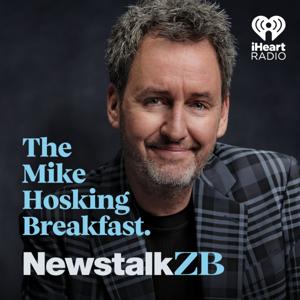
The Mike Hosking Breakfast

The Mike Hosking Breakfast

By Newstalk ZBNews
Download on the App Store
  • Favorites

    294

    Followers

  • Typical duration

    4 min

    per episode

  • If it hooks

    64%

    finish an episode

Based on Podcast App listening data

The Mike Hosking Breakfast episodes

  • Greg Mission: Survey suggests confusion over cannabis referendum
    It's being suggested people have no idea what the cannabis referendum is about.
    A survey commissioned by Eqalis Pharmaceuticals has found 23 percent of people know it relates to recreational use, with about the same number thinking it's about medicinal use.
    Most of the rest thought it was for both.
    Managing director Greg Mission told Mike Hosking there's nothing in this referendum that relates to medicinal cannabis - it's all about smoking weed.
    “There’s a clear disconnect between what people think they're voting for and the reality, with only 23 per cent of people knowing what the referendum is actually about.”
    Mission says the referendum will rob Kiwis of the opportunity to enjoy a mature medical cannabis industry.
    "Kiwis might vote yes in the wrong belief that they're supporting medicinal cannabis treatment.
    "By voting for this referendum, it would rob the NZ public of the opportunity to enjoy a mature medical industry."
    Mission says this referendum is all about smoking weed.
    LISTEN ABOVE
    4 min
  • Mike Hosking: Is Warriors upheaval the key to their comeback?
    I feel a bit remiss over my beloved Warriors.
    Normally we would start a Monday off the back of a win, with a word or two about how good it was, how good they are, how inspiring it all is, and how this is our year.
    I haven't done it this year for fairly obvious reasons, apart from the start when I think we were all immeasurably uplifted by the NRL in general basically being the first in the world to get a major season back up and running under the most arduous of circumstances.
    Peter V’landys who runs league still deserves every recognition for what he managed to achieve and we still enjoy week in week out. While other sports still struggle, for all intents and purposes, the league has had a pretty normal looking season.
    The Warriors, though, have not only had to park up in another country, they've seen their owners take an already tricky season and tip it on its head.
    Which makes the last two weeks little short of spectacular. Let’s be honest, two wins in a row is a reason to celebrate at the best of times, far less in a season like this. Hell, they’re three points outside the top eight.
    To boost a good win and two good weekends we have Nathan Brown and Phil Gould lining up to turn it all round next year and take us to the promised land. The trick to upheaval is if you create it, it better be part of a big picture plan.
    In other words, it better pay off.
    Steven Kearney's demise was shockingly timed. Add the players who went home, the bulk of them who weren't hangers-on, they are major stars. Add blake greens treatment which I still argue was pretty shabby.
    Look at people like Tuivasa-Sheck, who is without his family and the only bloke there with out his family, and one of the games greatest talents, surrounded by an increasing array of part-timers and loan players and a coach who didn’t want the job, and you'd forgive him for going bugger this for a game of soldiers.
    And yet through it all, they stitch together two glorious wins in a row.
    Adversity is a wonderful leveller. You learn who your mates are and you learn how deep you can dig when times are tough.
    And no one’s had it tougher than the Warriors, and yet, as the Tigers and Manly will attest, the Warriors on their day are still magic, and if they can do it when it’s tough, imagine what awaits when life is back to normal.
    3 min
  • Mike Hosking: Where are the adults in charge of our recovery?
    Am I reading this right?
    In this mad old world of mixed messages, we seem to have an admission from the government that more specialist workers are going to be let into the country.
    Good. We need them. We needed them yesterday, and last week, and the reluctance was driving various industries nuts.
    But one step forward, one step back. The same government appears not remotely convinced over private enterprise getting into the quarantine business. Not good. Why not? Many of the scenarios are in fact the same people. In other words, some of the workers are required for large business that have a problem, like labour, and have a solution, like the where with all to do the quarantining and cover the costs.
    This, by the way, isn't about the tertiary sector. Which it actually should be, given they too, offer a problem and a solution.
    Why is the government not interested in being a hell of a lot more proactive than they are?
    CRL, for example, the company building a massive hole through half of Auckland, have machines that cannot be driven by anyone in this country through lack of skill, and for a project massively behind schedule and over budget, you'd think the government would be bending over backwards to address that.
    Even Helen Clark, who you would have thought might have an “in” with this lot, said so eloquently last week that we can do so much more. Yes, we can. What happened to "let's do this?"
    So migrants in, but no to quarantine. It's sort of like, "haven't we done so well? But hold on, can you go stock up on masks and get a cotton bud up your nose and wear a lanyard?"
    So which is it? Are we doing well? Or we going to level two?
    Are we getting more workers? Or we letting the government be the sole provider of quarantine? And a massive choke point as a result that serves no ones demands, needs or purpose, or provides any sort of professional, well managed solution.
    It's hopelessly piecemeal, it lacks coordination, and there doesn’t seem a plan. It's whack-a-mole with an economy that needs adults in charge. Where are the adults?
    2 min
  • Comm Box on the Crusaders' Super Rugby win
    Over the past four years, Kiwi rugby fans have grown accustomed to Crusaders coach Scott Robertson dancing after his team wins a competition.
    While the past three seasons of Super Rugby saw the 45-year-old bust a move, when the Crusaders clinched the Super Rugby Aotearoa title on Sunday with a 32-22 win over the Highlanders, Robertson stayed on his feet.
    Unlike the original Super Rugby season, the New Zealand-only incarnation is a round-robin only competition. So while the Crusaders claimed the title on Sunday, they have to run back out next weekend for their final game of the season against the Blues at Eden Park in Auckland.
    Speaking after the win over the Highlanders, Robertson explained the competition not yet being over was one of the reasons he chose not to dance in celebration.
    "I didn't do any back-spinning at this stage because we've still got a job to do. I felt it was (respectful) to the comp and to (Crusaders prop) Oli (Jager) after the head knock he got. I think the haka will suffice in respect to local iwi and what the trophy means.
    "We'll have a couple of quiet ones and reflect, but we realise we've still got a big game ahead. There are curfews – it's not like normal when you get to your last game and sleep when you can."
    Jager was forced from the field on a stretcher with about 15 minutes left on the clock against the Highlanders after an ugly high shot from Sio Tomkinson which saw the Highlanders midfielder spend 10 minutes in the sin bin.
    Jager was the second Crusaders prop forced from the field due to injury in the match, after loosehead Joe Moody left the match after just 15 minutes.
    It was a fast and physical match between the Crusaders and Highlanders. Despite being unable to clinch the title themselves, the Highlanders made sure they weren't seen as a team just making up the numbers as they crossed for the first try in just the second minute.

    Oliver Jager is taken off the field in the Crusaders win over the Highlanders. Photosport
    The Highlanders led for most of the game, before the Crusaders ran over the top of them in the final 20 minutes.
    "The gas tank was on red for the last 20 minutes; what an effort to come back," Robertson said. "We're really pleased. The last 20 minutes, some of our big players just stood up and the work to scramble on defence and create those opportunities for us to get back down to the other end was pretty special and worthy of a final."
    Had the Highlanders been able to hang on to upset the Crusaders, the competition would have been decided when the Crusaders meet the second-placed Blues in the final round of the competition, in what would have been the dream finish for organisers.
    "The powers that be would have loved it to have been next week, that would have been ideal," Robertson admitted. "But it's first past the post and we got there. Now, it's ability to back that up and that will be how we look at the season."
    11 min
  • David Hayman: Parts of NZ take pre-treated drinking water from polluted rivers
    Parts of New Zealand are drawing pre-treated drinking water from rivers found to be regularly polluted with harmful nasties like E.Coli and campylobacter.
    New research, led by a group of Massey University scientists, raises more warnings about the impacts of agricultural intensification, at a time of heightened worry over the quality of many of New Zealand's drinking water supplies.
    The scientists investigated levels of four microbes – the bacteria campylobacter and E.coli, and protozoa cryptosporidium and giardia – at 16 waterways supplying drinking water for 13 towns and cities.
    Between 2009 and 2019, with three-month intervals, they collected more than 500 samples from abstraction points at each of the study sites.
    The waterways in the study ranged from those draining catchments heavy in agriculture to rivers running through native bush.
    To pick apart what role the surrounding landscape played on pollution levels, the study used machine-learning algorithms to determine contributions of land use, geology, topography and vegetation.
    Those rivers in highly-stocked catchments – such as the Waikato River and Oroua River in Manawatu – were found to have all four microbes present, and often in high numbers.
    At the Waikato River, near Tuakau, 10 of 37 samples taken over the decade carried E.coli levels that were above safe limits, along with 10 containing campylobacter, 32 with giardia and 26 with cryptosporidium.
    But at the study sites at the Hutt River and Big Huia Creek in Wellington, the scientists found no pathogenic microbes, or any unsafe levels of E. coli, which is known to cause severe stomach cramps, vomiting and diarrhoea.
    "They have catchments entirely of native vegetation," said study co-author and Massey University freshwater ecologist Professor Russell Death.
    The two protozoa were found to be more prevalent in waterways with lower water quality and higher numbers of ruminant animals like cows, sheep and deer in the catchment – especially in September and December.
    "The protozoa live in the guts of ruminants and the eggs come out in faeces," Death said.
    "The eggs are very resistant and so probably get transported to streams quite easily."
    The two bacteria, meanwhile, became more abundant with higher rainfall, saturated soils and catchments where more than a third of the land was used for agriculture.
    "These bacteria can come from a range of animals including farm livestock," Death said.
    "It seems when the bacteria are deposited on grassland, in faeces, it can get into waterways more easily than if it is deposited in a forest.
    "But there may also be more because farm animals produce a lot more waste - 25kg per dairy cow per day - versus not much from say, a wild deer or duck."

    At Hutt River, near Wellington, scientists found little sign of harmful microbes. Photo / Supplied
    Study co-author Professor David Hayman said the survey work went directly to the Ministry of Health, where it helped national drinking water treating standards.
    "It does not, of course, tell people about the safety of their particular water supply or deal with rare events," Hayman said.
    "But it can identify the drivers of contamination and therefore if we wish to improve drinking water quality without simply relying on increased water processing and the costs with it, so these analyses are really informative."
    All of the water tested was what's called raw water, and hadn't been treated in plants.
    Although modern treatment protocols usually remove many pathogens from drinking water, Death and his colleagues noted that several recent outbreaks of waterborne disease happened because of treatment failures.
    "There is a lot of concern over the quality of drinking water supplies in New Zealand," Death said.
    "Many are excellent, but many are not, especially in smaller rural communities.
    "The issues in Havelock North a few...

    4 min
  • Steve Price: Victoria latest and Newspoll shows high PM approval
    Australia's Deputy Chief Medical Officer has appeared cautiously optimistic about Victoria’s ability to get its coronavirus outbreak under control.
    With case numbers hovering around the 500 mark for the past seven days, Dr Nick Coatsworth said on Sunday: “It appears that we’re on the plateau”.
    With metropolitan Melbourne under stage four restrictions kicking off last week and with the lockdown set for at least another five weeks, Dr Coatsworth said good news appears to be on the horizon.
    “What we’re looking for is the inflection point that tells Victorians that their efforts are being rewarded, that we see numbers going down,” he said.
    “We haven’t seen that yet but I have no doubt that we will see it. If you consider that stage three restrictions had us almost at a plateau, then the stage four restrictions will produce a result.”
    Dr Coatsworth said that the coronavirus outbreak in Victoria currently has a “basic reproductive number” of one “or just below one”.
    The reproductive number is basically how many people one infected person will transmit the virus to.
    “The ideal situation would be if we could see that reproductive number at 0.5,” he said.
    “We don’t have enough data at the moment from the numbers to see whether that’s approaching 0.5, but in the coming days to week we will see that.”
    Dr Coatsworth’s comments echo analysis suggesting Victoria’s coronavirus outbreak peaked on July 30, sparking hope that the state has seen the worst of the crisis.
    Last week, Melbourne University epidemiologist Professor Tony Blakely provided news.com.au with details of his analysis published on Pursuit, which uses a five-day average that smooths out the daily cases so a more accurate picture of how the state is tracking can be seen.
    Prof Blakely’s analysis suggests coronavirus cases peaked on July 30 and have since plateaued, about seven days after masks became mandatory in Melbourne on July 23.
    “If you look at the five-day average, even though cases are fairly volatile day-by-day, it does look like they flatten off from about 8-10 days after masks were introduced,” he said.
    “Masks were introduced on July 23 but a lot of us were starting to wear them before that as well.
    “I am reasonably comfortable that we have bent the curve.”
    On Sunday, Victoria recorded 394 new cases of coronavirus – the lowest number since July 29. But there was also 17 deaths, two more than the previous record of 15 which was set on August 5.
    There are 634 Victorians in hospital, 43 of whom are receiving intensive care. 26 people are on ventilators.
    Premier Daniel Andrews said on Sunday there were 2758 cases with an unknown source, an increase of 174 since Saturday.
    “That’s 174 of those mystery cases which are, in many respects, our biggest challenge,” he said.
    “Even large numbers in known, contained outbreaks are, to a certain extent, less significant than the smaller number of cases where we simply can’t find the circumstance or the point of origin.
    “Where did that person get the virus from? They’re the ones that are incredibly challenging from a containment point of view, and that’s what has made fundamentally necessary these really challenging settings, these really difficult decisions we’ve had to make to drive down movement, and therefore, drive down the number of cases.”
    6 min
  • James Shaw: Greens confident parts of housing policy will be picked up
    The Greens accept that only part of their new housing policy is likely to see the light of day.
    The 'Homes for All' plan includes the goal of clearing the social housing wait list, a Crown guarantee for community providers to build new rentals, and introducing a rental 'warrant of fitness'.
    Greens co-leader James Shaw told Mike Hosking they won't know how much of it will be adopted until after the election.
    "It does depend on how many votes we get, how much leverage we're able to get in the next Parliament, but I think we've put something together here that is sensible and is costed."
    He is confident that the Greens will back into Parliament and be able to put these plans into motion through MMP.
    Shaw hopes these ideas will be picked up, should the Greens get back into government.
    "What we're saying here is that it is good that the Government has started to ramp up the public housing build, but we need to expand that, and the only way to do that is to actually bring in the community sector and really support that as well."
    6 min
  • Fergus Brown: Why you need to book your campground holiday now
    People looking to spend their summer getaway at a holiday park are being told to book sooner rather than later to avoid disappointment.
    The sector is expecting a busier summer than usual as New Zealanders look to travel locally for their vacation as Covid-19 affects global travel.
    The head of Holiday Parks New Zealand, Fergus Brown, said while the normal hotspots would be busy, people should consider alternative destinations.
    "Especially those around the main population areas, Northland and Coromandel are always extremely popular for Kiwis, the Bay of Plenty is popular as well," he said.
    "Then you've got the traditional areas like Lake Taupō, and Rotorua which Kiwis flock to as well. But we're finding areas such as Taranaki, and places in Waikato like Raglan, are very popular for New Zealanders.
    "I guess what we'd like to see is more New Zealanders exploring areas like the West Coast of the South Island, and maybe the Catlins. Some of those places that are a little bit more remote, but have fantastic holiday options."
    Holiday parks have always depended on the domestic market as their base.
    Of the 8.5 million guest nights last year, the national average was that New Zealanders took up two thirds of them.
    But with options abroad still limited for New Zealanders, Fergus Brown said people should consider booking now.
    "We're expecting this coming summer to be busier than previous. With limited international holiday options, I guess more and more New Zealanders will be looking for that traditional Kiwi holiday in a holiday park."
    People should consider booking now, he said.
    "At this stage, there is still space, but we are encouraging people to get in and make those bookings as soon as possible, because we know the demand is going to be higher than the previous year.
    "We're not sold out yet, but things are starting to fill up."
    text by RNZ
    3 min
  • Richard Arnold: Donald Trump signs executive orders to provide pandemic relief
    With stimulus talks stalled, President Donald Trump announced he would go around Congress to deliver aid to Americans affected by the pandemic.
    But a close read of the actual text of executive actions he signed Saturday suggests that even if they are deemed constitutional, they will not quickly deliver the aid Trump promised. They may not deliver much at all.
    Here's a breakdown of the actions, the many strings attached and questions about what they actually accomplish.
    Unemployment benefits
    Trump described the memorandum signed Saturday as an action providing "an additional or extra $400 a week and expanded benefits."
    But in reality, the additional unemployment aid is more complicated than the White House acknowledged and experts say it may not help a lot of the unemployed.
    Under the previous unemployment benefit passed by Congress, millions of Americans received an additional blanket $600 a week from the federal government on top of their state unemployment benefits.
    States have to chip in. Now, under Trump's measure, the federal government is requiring states to pick up the tab for 25% ($100) of the as much as $400 additional benefit each person may be able to receive weekly in additional aid. On top of that, a state must agree to enter into this financial agreement with the federal government for any unemployed person living there to get any of the additional benefits.
    States are in dire financial straits. Many states have already asked the federal government for major financial help. Several experts told CNN there are major questions about how many states may be able to afford the extra cost.
    If a state says that it does not have the funds or does want to enter into the agreement with the federal government, the unemployed person in that state receives zero dollars in extra federal benefits (they would still receive the normal state unemployment insurance).
    In fact, states have asked Congress to provide them with an additional $500 billion to help shore up their budgets, which have been crushed by the loss of tax revenue amid the pandemic. This has been one of the main points of contention between Democrats, who want to allocate additional aid, and Republicans, who don't want to bail out what they say are badly managed states.
    The millions of Americans who've filed for jobless benefits also have drained several states' unemployment benefits trust funds. Already, 10 states have borrowed nearly $20 billion from the Treasury Department to cover their share of payments, which typically last 26 weeks.
    Requires a new system. Because Congress has not authorized an extension of extra federal unemployment assistance, the state will have to set up an entirely new system to deliver the additional aid.
    "The state has to enter an agreement saying not only can they pay the benefit, but that they have some ability to administer the benefit," said Michelle Evermore, an unemployment expert at the National Employment Law Project.
    Building a brand new program could take states months to accomplish, Evermore said. She added Trump needed to do it this way because "in order for states to administer a benefit it has to be authorized by Congress, so they can't use their administrative systems to pay a benefit that hasn't been authorized by Congress."
    Few will be helped. Evermore, one of the nation's leading experts on unemployment, told CNN she considered the chances of this effort helping many of the newly unemployed due to Covid-19 "low."
    Lastly, according to the memorandum, an individual can only receive the $300 federal benefit if he or she first qualifies for $100 in aid from their state. Evermore said this will cut out a large group of people. "There are so many problems with people getting a benefit under this," she said.
    Evictions
    The executive action signed by Trump does not reinstate the previous moratorium on evictions, which lapsed in July....

    5 min
  • Jacinda Ardern on why she hasn't been tested for Covid-19
    Prime Minister Jacinda Ardern says she has not had a Covid test because she hasn't had any symptoms, nor has she been asked to have one.
    "None. I haven't had any, Mike, because I haven't had any symptoms or any cause to," Ardern told Mike Hosking today.
    Hosking: "You haven't said yes to the test?"
    Ardern: "I have never been offered a test and just to be clear when I said 'say yes to the test', that was a request that when people are offered them by their GP, they say yes. We have had reports and surveys that suggest a reasonable portion of people being offered them by their GP because they were unwell... were saying no. To suggest that people should continue to say no was worrying to me."


    Hosking: "So the pop-up centres you put in places like Queenstown to check the community spread for people to voluntarily go down, you haven't felt the need to do that and lead the way?"
    Ardern: "Those community testing stations were established specifically to make sure we had additional community surveillance as a precautionary measure after we had seen the positive offshore test, in particular. That's why we were targeting those areas. And we continue to keep those pop-up stations in South Auckland in particular because that's the region where we have some of our managed isolation facilities."
    Hosking said he had watched her on the campaign trail at the Grey Lynn farmers' market at the weekend and she hadn't been practising social distancing.
    "No, and nor do we ask anyone to continue practise social distancing because we are at level 1," she said.
    Hosking said he had seen a poster that encouraged social distancing at level 1.
    Ardern said at level 1, people had to wash hands, stay home if they were sick, and get advice from Healthline or their GP about being tested. Plus the restrictions at the border continued.
    She said she could not comment on the poster, "but we have never been encouraging social distancing at level 1".
    "I am happy to clarify for you, Mike. I was frankly a little worried when you started suggesting that people shouldn't take the test the doctor offered to them. We have had 100 days of no community transmission but that doesn't lessen the risk... Vietnam got to 99 days and had an outbreak.
    "The reason we are asking people to keep a mask on hand is if we experience a resurgence. It would be false hope to claim that everything is done and dusted."
    Ardern still asked people to go into community testing stations.
    Asked whether New Zealand went too hard too quickly, Ardern denied that, after being asked about a new report about mortality and productivity.
    "Mostly the comparisons are going the other way. Many other places are asking whether they should have done what New Zealand did."
    On the possibility of a Cook Islands travel bubble, she said she would be giving an update today. Asked if the bubble was coming, she said "yes" but there were no confirmed dates yet.
    Cabinet has been discussing plans to open the border with the popular South Pacific island of Rarotonga and other hotspots like Aitutaki Island with its large lagoon, coral reefs and sandy inlets.
    New Zealand's largest airport, Auckland International, says it will be ready to operate a travel bubble with Covid-free Pacific countries by August 17, if given the green-light.
    Business groups and some Pacific countries, including the Cook Islands, have been urging the Government to open travel with some parts of the region.
    Hosking asked about Helen Clark's suggestion letting more people into the country. Ardern said she was asking what more the country could do with border controls.
    She said there still had to be health checks conducted by health authorities, with swabbing carried out twice. A critical difference between New Zealand and Victoria was that we've had arrest powers. "I haven't ruled it out but there are still things that would need to be required."
    10 min

About The Mike Hosking Breakfast

From the publisher's feed

Open your mind to the world with New Zealand’s number one breakfast radio show.

Without question, as New Zealand’s number one talk host, Mike Hosking sets the day’s agenda.

The sharpest…

Best of The Mike Hosking Breakfast

Ranked by our users in the last 21 days

More shows like The Mike Hosking Breakfast

Test Match Special by BBC Radio 5 Live

Test Match Special

210 Listeners

Sky Sports Cricket Podcast by Sky Sports

Sky Sports Cricket Podcast

118 Listeners

Gone By Lunchtime by The Spinoff

Gone By Lunchtime

30 Listeners

Australian True Crime by Bravecasting

Australian True Crime

1,222 Listeners

Saturday Morning with Jack Tame by Newstalk ZB

Saturday Morning with Jack Tame

1 Listeners

Heather du Plessis-Allan Drive by Newstalk ZB

Heather du Plessis-Allan Drive

10 Listeners

Early Edition with Ryan Bridge by Newstalk ZB

Early Edition with Ryan Bridge

2 Listeners

Weekend Sport with Jason Pine by Newstalk ZB

Weekend Sport with Jason Pine

4 Listeners

The Weekend Collective by Newstalk ZB

The Weekend Collective

2 Listeners

The Re-Wrap by Newstalk ZB

The Re-Wrap

2 Listeners

The Leighton Smith Podcast by Newstalk ZB

The Leighton Smith Podcast

84 Listeners

Smart Money by Newstalk ZB

Smart Money

2 Listeners

Matt Heath & Tyler Adams Afternoons by Newstalk ZB

Matt Heath & Tyler Adams Afternoons

0 Listeners

The OneRoof Radio Show by Newstalk ZB

The OneRoof Radio Show

5 Listeners

Kerre Woodham Mornings Podcast by Newstalk ZB

Kerre Woodham Mornings Podcast

1 Listeners

A Captain's Cup by Radio Sport

A Captain's Cup

1 Listeners

Between Two Beers Podcast by Steven Holloway & Seamus Marten

Between Two Beers Podcast

148 Listeners

The High Performance Podcast by High Performance

The High Performance Podcast

566 Listeners

I Catch Killers with Gary Jubelin by News.com.au

I Catch Killers with Gary Jubelin

530 Listeners

Newstalk ZB ANZAC Centenary Tribute by Newstalk ZB

Newstalk ZB ANZAC Centenary Tribute

0 Listeners

Election 2026: The Front Bench by Newstalk ZB

Election 2026: The Front Bench

0 Listeners

On The Front Foot by Newstalk ZB

On The Front Foot

4 Listeners

Holiday Breakfast by Newstalk ZB

Holiday Breakfast

0 Listeners

The Superior Sailor Series by Newstalk ZB

The Superior Sailor Series

0 Listeners

Rugby Direct by Newstalk ZB

Rugby Direct

5 Listeners

The Dom Harvey Podcast by Dom Harvey

The Dom Harvey Podcast

81 Listeners

Secrets We Keep by LiSTNR

Secrets We Keep

76 Listeners

Motive & Method by Tapt Media

Motive & Method

88 Listeners

The Big League Podcast by Newstalk ZB

The Big League Podcast

1 Listeners

All Sport Breakfast Canterbury by NewstalkZB

All Sport Breakfast Canterbury

0 Listeners

News Fix by Newstalk ZB

News Fix

0 Listeners

Football Fever by Newstalk ZB

Football Fever

0 Listeners

Sports Fix by Newstalk ZB

Sports Fix

2 Listeners

Great Chats with Francesca Rudkin by Newstalk ZB

Great Chats with Francesca Rudkin

0 Listeners

In My Day by Newstalk ZB

In My Day

0 Listeners