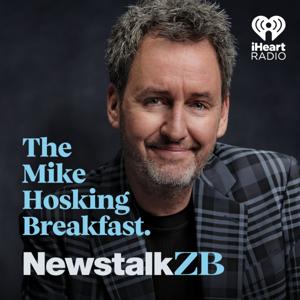
The Mike Hosking Breakfast

The Mike Hosking Breakfast

By Newstalk ZBNews
Download on the App Store
  • Favorites

    294

    Followers

  • Typical duration

    4 min

    per episode

  • If it hooks

    64%

    finish an episode

Based on Podcast App listening data

The Mike Hosking Breakfast episodes

  • Peter Dunne: Election will be a referendum on Government's handling of Covid
    MPs are hitting the campaign trail for the next six weeks.
    Parliament has adjourned ahead of the General Election on September 19.
    Former United Future leader Peter Dunne told Mike Hosking it will be a referendum on the government's handling of the pandemic.
    "The National Party are either for what has been done for Covid, or against it. In that sort of situation. National run the real risk of getting swamped."
    Dunne says Labour should be fine so long as things remain as they are.
    "But if there is another outbreak of Covid in the next six weeks, then all bets are off."
    LISTEN ABOVE
    6 min
  • Mike’s Minute: This isn't the New Zealand we know and love
    I end the week in a level of some despair.
    Every home needs masks, so says Ashley Bloomfield. He wanted level two to last longer but the government overruled him. So I guess that indicates that he's running this programme by himself as opposed to being directed by a government that wants us freaking out long enough to reelect them.
    But if you believe yesterday's Herald poll, and I do, a lot of people love Bloomfield, a closed border, a broke country, and a sense that what ever tomorrow holds doesn’t need thinking about right now, far less planning for.
    What saddens me most is this isn't the New Zealand I know and love. This isn't the aspirational country I thought we purported to be. This isn't the country that boxes a mile above its weight.
    It's now a country that thinks getting a good health outcome is enough. That a lockdown was plenty, there is nothing more to do, or worry about. We just sit here, for god knows how long going "look at us, didn't we do well."
    Yes, we did do well. But we did well months ago and we have failed to move on. We have fallen for the Grant Robertson trick of reassuring ourselves how well we have done by looking and finding useless people and thinking because they are hopeless, we are less hopeless, therefore that’s plenty.
    It isn't. Bloomfield is saying it's not if, but when, and the virus is coming. Why is it coming? Why are we setting our standards so low? Why are we offering up negative fait accompli?
    I was fantastically reassured by Helen Clark. Say what you what about her if you're not a Labour luvvie but that’s a woman who, at least, is a globalist. Sir John Key is too, of course, but if you are a labour luvvie you hate him. And he took heat for his comments about rich Americans.
    In that is my frustration, why do we hate rich Americans? Why do we now seemingly hate success? Why is what we have enough? Why aren't we desperate for more and better? Why aren't we more like Clark and Sir John, and want more for this country?
    Why can one Labour leader be aspirational for us and urge us on, and the current Labour leader coast to the election with no policy, no plan, no desire to be better than what we are? Which is a small country locked off from the rest of the world with seemingly no real plan, and certainly no desire to ever reconnect.
    Why is this it? Why don't we want more? Why don't we want to be what we once were?
    3 min
  • Sir David Skegg: Kiwis urged to buy supply of face masks
    Worksite temperature testing and giving staff the choice to work from home are just some of the ways New Zealand's biggest companies have been staying prepared for a possible second wave of Covid-19.
    The threat posed by a potential second outbreak has been highlighted by Covid-19's recent spread in Victoria in Australia, which has plunged into a second lockdown and ordered its residents to always wear face masks in public.
    That led Health Minister Chris Hipkins yesterday to also urge every Kiwi to keep face masks in their emergency kits at home.
    It marked a notable U-turn from advice three months ago when the Government said there wasn't enough evidence to either support or discourage mask use.
    Director general of health Dr Ashley Bloomfield will this morning hold a Facebook Live session to demonstrate the correct use of a face mask and answer questions from the public.
    Hipkins said that while Kiwis were enjoying freedoms the envy of the world, it paid to be prepared.
    "It isn't scaremongering to say that could all change, and it could all change very quickly."
    With regions such as Belgium, Japan, France, Germany and Hong Kong also battling resurgent Covid-19 outbreaks, dairy exporter Fonterra said it was among major Kiwi companies staying alert to the risks.
    "We've maintained temperature testing at our offices and manufacturing sites, and we have a good supply of personal protective equipment on hand," Karen Smyth, the group manager preparedness and response, said.
    The company had also devised "business continuity plans" that it would put in action should New Zealand go back into lockdown or partial lockdown.
    "We learned a lot during New Zealand's initial response to Covid-19 and know we could respond quickly if we needed to," she said.
    And while staff were currently back at their work sites, the business said it had flexible policies to allow its workers to work from home if need be.
    Safety guidelines were also at the ready for staff deemed essential workers who would need to continue working through any future lockdown.
    As evidence of this, Fonterra was currently operating in other countries experiencing lockdown, such as Victoria in Australia, Smyth said.
    These experiences from around the globe were shared at a weekly teleconference of members of Fonterra's Covid-19 incident management team, she said.
    Major bank BNZ, meanwhile, said that since lockdown it had continued to allow staff to work from home as part of a trial.
    During the trial, BNZ was continually surveying its staff "to find out how flexible working is impacting on their wellbeing and productivity", it said.
    BNZ said it had learnt a lot during New Zealand's lockdown and had "robust plans" in place for future lockdowns should it need to again open some branches as essential services.
    Telecommunications company Spark said it also had robust continuity plans that it could quickly put in place, should New Zealand change alert levels.

    Health Minister Chris Hipkins and Director General of Health Dr Ashley Bloomfield are now urging Kiwis to keep a supply of face masks. Photo / Mark Mitchell
    Yesterday marked 97 days since evidence of community transmission in the country.
    There were no new Covid-19 cases, while 23 people with active cases were being quarantined at border hotels.
    This week, National MP Gerry Brownlee issued a press release, saying the Government "needs to come clean on what they know about the state of Covid-19 in New Zealand".
    Brownlee said it didn't stack up that they were warning about a second wave when there were so few cases.
    "What do these guys know that they are not telling us?"
    Hipkins said he "utterly" rejected they weren't being honest about community transmission.
    "I would encourage Gerry Brownlee to swap the tinfoil hat for a face mask."
    He said the warnings were "about general preparedness".
    5 min
  • Mike Hosking: Provincial Growth Fund another one of Labour's incompetent failures
    Two major polices, one I liked, one I didn’t, yet both of them failed and seemingly failed miserably.
    I called KiwiBuild bluff in October and November of 2017 before the government had even been formed. Even an amateur could see they were never going to build those houses in those numbers.
    It’s a policy that should haunt them forever, it sums up in a nutshell just how utterly out of touch with the market they were.
    And the other policy? The Provincial Growth Fund, a laudable idea that now officially has been busted with this week’s auditor general’s report
    The signs were there all along sadly, the numbers they didn’t have, the money that hadn’t gone out the door, the jobs that didn’t actually eventuate.
    But unlike KiwiBuild, there was little reason for it to fail other than the one that did it in: incompetence. 
    The concept of money into the regions is not a bad one. The concept of boosting forgotten areas is fine. And no one has a cheque book like a government to do at times what the market is reluctant to.
    But even Shane Jones who has been on this programme numerous times has known and admitted that he’s had trouble, he’s been open about the lack of stats.
    The longer term projects he’s been right about, some of them take time to get up and running ,some need a report or scoping study to work out how they’re going to unfold, and he’s been open about paper work and bureaucracy.
    But as much sympathy as you might want to award him, and I do, the cold hard facts can’t be avoided. $3 billion is an astonishing amount of money to do so little with.
    And in that realisation is the realisation of the dangers of government and other people’s money. When it’s not yours, you get loose, fast.
    When it’s not yours, you think nothing of spending $30 million on Lake Onslow, which wasn’t the PGF but stupid never the less. It’s already had a report written about it and a whole industry telling you it’s too expensive and not worth it, and yet you still go ahead.
    You get trapped by the headlines of a jobs machine, the glare of the spotlight at a whole bunch of announcements and press releases and turning of the sod ceremonies. And yet three years on, you end up telling us there are more than 10,000 jobs when in reality there aren’t and the auditor general flushes you out
    Delivery, delivery, delivery. This government even named a year for it, and yet their two biggest calling cards lie in tatters.
    3 min
  • Tami Neilson on her album tour, performs live in studio
    Tami Neilson has kept herself busy recently, releasing her new album Chickaboom this year.
    She's also kept in touch with her native Canada and has been hosting an online show for her fans.
    Now, she finally gets to tour her album - with a nationwide tour planned September.
    Tami Neilson joined Mike Hosking to give us an update on her music career.
    LISTEN ABOVE
    11 min
  • Alan Pollard: Apple and pear industry likely to be worth $2b billion in 10 years
    Kiwis may not be able to leave the country, but at least our apples are.
    The apple and pear industry believes it's on track to becoming a $1 billion industry by 2022, and a $2 billion industry by 2030.
    To put that into perspective, at the last census, meat was $5.5 billion and fruit overall was $1.2 billion.
    NZAPI chief executive Alan Pollard told Mike Hosking that while they have faced logistical issues due to Covid, the demand has increased for our products. 
    "Food security is important and New Zealand has a reputation for producing fresh, safe, quality fruit." 
    While the economic future is up in the air, Pollard says that they have a real opportunity.
    "We set a goal of being a billion dollar industry by 2022, and we're well on track to do that."
    3 min
  • Jo McKenna: Pope Francis offers prayers for Lebanon following deadly explosion
    As Lebanese rescuers counted the dead and combed rubble for signs of life a day after a huge explosion shattered swaths of Beirut, nations near and far pledged Wednesday that the country, already trapped in a deep economic crisis, would not be left alone.
    The explosion at the capital’s port that killed at least 135 and injured thousands, with shock waves smashing deep into the city, stunned the world. From Australia to Indonesia to Europe and the United States, countries readied to send in aid and search teams.
    Reflecting both the gravity of the disaster and France's special relationship with its former protectorate, French President Emmanuel Macron was to visit Lebanon Thursday. Paris wasted no time in dispatching two planeloads of specialists, rescue workers and supplies to Beirut on Wednesday.
    The blast appeared to have been triggered by a fire that touched off a giant quantity of ammonium nitrate fertilizer stored for years in the port, which exploded with the force of a moderately strong earthquake.
    The disaster comes atop the worst economic crisis in Lebanon's modern history, and hesitancy among some backers, including France, to keep propping up a country in dire need of reform.
    The European Union was activating its civil protection system to round up emergency workers and equipment from across the 27-nation bloc. The EU commission said the plan was to urgently dispatch over 100 firefighters with vehicles, sniffer dogs and equipment designed to find people trapped in urban areas.
    The Czech Republic, Germany, Greece, Poland and the Netherlands were taking part in the effort, with other countries expected to join. The EU’s satellite mapping system will be used to help Lebanese authorities establish the extent of damage.
    Cyprus, where Tuesday's blast was felt approximately 120 miles (180 kilometers) from Beirut, was sending in emergency personnel and sniffer dogs. Britain promised a $6.6 million humanitarian support package.
    Russia flew in a mobile hospital, along with 50 emergency workers and medical personnel. Another three Russian flights were scheduled to arrive within the next 24 hours, carrying equipment for a coronavirus testing lab and protective gear, among other relief supplies.
    Help also was coming from closer to home. Iraq was sending six trucks of medical supplies and an emergency medical team to help bolster Lebanon’s overstretched health system, and Egypt and Jordan were supplying field hospitals.
    Tunisia was sending medical teams, and offered to bring 100 patients back for treatment in Tunisia.
    In a mark of respect for victims, a U.N.-backed tribunal postponed until Aug. 18 the delivery of judgments in the trial of four people charged with involvement in the 2005 assassination of former Lebanese Prime Minister Rafik Hariri. The verdicts were to be read out Friday in a Netherlands courtroom.
    Even Israeli Prime Minister Benjamin Netanyahu said his country, officially in a state of war with Lebanon, stood ready to offer to assist the Lebanese “as human beings to human beings.”
    U.N. peacekeepers from Indonesia already stationed in Lebanon were helping in the evacuation effort, and Australia said it was donating 2 million Australian dollars ($1.4 million) in humanitarian support.
    But the pledges of aid raised new questions for a country whose economic and political crisis, combined with endemic corruption, have made donors wary in recent years.
    Macron’s visit could carry some awkward moments.
    In a visit to Lebanon less than two weeks ago, French Foreign Minister Jean-Yves Le Drian made clear that France, Beirut’s steadfast economic backer, would withhold support not destined directly to the Lebanese population, until “credible and serious reform measures” get under way.
    Whether the French president would skirt his country’s own no-go zone and offer more than emergency aid was unclear. About $11 billion was pledged to Lebanon...
    5 min
  • Mike's Minute: Unemployment number simply not real
    Who knew? We have read this all wrong. Covid-19 is actually good for the economy, why didn’t we get it here faster?
    The unemployment number, originally forecast to be 9.8 percent, is in fact a jobs machine. 4 percent is your headline rate as of yesterday. It was 4.2, so it's trending down.
    That lockdown was good for jobs. All those stories you heard about people getting laid off, the thousands upon thousands, what we didn’t realise is they all went out and got new jobs.
    We've got the pivot to infrastructure and the shovel ready projects. Fortunately the fact that none of them are shovel ready, doesn’t matter, because there is work a plenty in an economy that is clearly booming.
    How do we explain this? Artificiality, statistics, and distortion is the answer.
    In an odd way, what an insult to everyone who has been laid off and joins the in excess of 200,000 on the jobseeker and other benefits. Their plight is clearly forgotten as we celebrate the statistical jobs machine that clearly is the New Zealand economy.
    If you've ever struggled with statistics none of this helps. The headline figure is a joke, it's worse than Newshub's rogue poll. It's not real, the real answer is  the underutilised rate and that increased at record levels.  
    But it does highlight the danger we are in. If $13 billion can buy you the sort of job protection it clearly has, you have to ask what sort of carnage is coming on as of September 1. Just how much artificiality is there in the economy? We've got the wage subsidy, the mortgage holidays, the deferrals, and the loans system with the banks and Inland Revenue.
    That is all a false reality and it can't last. We simply don't have the where with all, to keep printing, keep borrowing, and keep living in la la land. The same way the spending we are currently seeing on cars,  art, and houses is pent up.
    The carnage we will see next quarter, the quarter after that, and into the new year will be the flood of trouble and reality that is released when the sugar stops.
    I hope ultimately the 9.8 percent unemployment they picked isn't that bad. Banks had yesterday's number at between five and seven percent, they couldn't have been more wrong.
    But most of us, I think, suspect its wrong because the carnage is simply better hidden by the printed money than was previously thought. In other words the disease is there, it's currently just masked by a pile of artificial fiscal bandages.
    3 min
  • Neil Gemmell: The genetic secrets of NZ's 'living fossil' tuatara
    It's roamed the Earth for perhaps 250 million years, but tuatara have only now yielded their genetic secrets – and they're unlike anything scientists have ever seen.
    A world-first study, published today, reveals the rare reptile's entire genetic makeup, or genome, is more than two-thirds bigger than our own – and helps confirm its evolutionary position and unique life history.
    Tuatara were once widespread across New Zealand, but humans and pests has squeezed its total population to somewhere between 60,000 and 100,000.
    The species have been out on their own branch of the evolutionary tree for a staggering amount of time, with prior estimates of divergence ranging from 150 to 250 million years.
    With no close relatives, the position of tuatara on the tree of life has long been contentious.
    Some argue tuatara are more closely related to birds, crocodiles and turtles, while others say they stem from a common ancestor shared with lizards and snakes.
    The new study, featured in prestigious scientific journal Nature, puts tuatara firmly on the latter branch – but with some twists.
    They appear to have split off on their own trajectory for around 250 million years – a massive length of time when we consider primates only originated around 65 million years ago, and hominids, from which humans are descended, originated approximately six million years ago.
    "Proving the phylogenetic position of tuatara in a robust way is exciting," said the study's leader, and Otago University geneticist Professor Neil Gemmell.

    Tuatara number only between 60,000 and 100,000 today, having once been widespread across New Zealand. Photo / Department of Conservation
    "But we see the biggest discovery in this research as uncovering the genetic code and beginning to explore aspects of the biology that makes this species so unique, while also developing new information that will help us better conserve this taonga or special treasure."
    One area of particular interest was to understand how tuatara, which can live to be more than 100 years of age, achieve such longevity.
    Examination of some of the genes implicated in protecting the body from the ravages of age found that tuatara have more of these genes than any other vertebrate species thus far examined.
    "Could this be one of the keys to their long lifespan?" Gemmell added.
    "Tuatara also don't appear to get many diseases, so looking into what genetic factors might protect them is another point of focus for our study, as too we have also explored genetic aspects that underpin the vision, smell and temperature regulation of tuatara."
    With the genome now sequenced, the international science community now had a blueprint through which to examine the many unique features of tuatara biology, aiding our understanding of the evolution of the amniotes, a group that includes birds, reptiles and mammals.
    "It is not far-fetched to suggest that through our new understanding of the tuatara genome, there may be novel insights that emerge that will benefit our understanding of our own biology and health."

    Otago University geneticist Professor Neil Gemmell. Photo / Otago Daily Times
    Another big part of the research was its collaboration with local iwi Ngātiwai, something Gemmell said had proven "incredibly rewarding", while providing an exemplar to future studies.
    "Very early on it become clear that a primary goal for us all was to develop new knowledge that would improve the conservation of this species," he said.
    "We agreed to partner together to achieve that aim, whilst also looking for opportunities to share other benefits that might derive from the research."
    Ngātiwai Trust Board resource management unit manager Alyx Pivac said tuatara were a taonga, and it was pleasing to see the study published.
    "Our hope is that this is yet another piece of information that will help us understand tuatara and aid in...

    3 min
  • Rod Liddle: Lockdown re-imposed in Scottish city over virus 'cluster'
    Officials in Scotland ordered bars, cafes and restaurants in the city of Aberdeen to close Wednesday, re-imposing anti-virus restrictions after a cluster of 54 confirmed COVID-19 cases in the area was linked to a single bar.
    Scottish First Minister Nicola Sturgeon said the new cases raised wider alarm of a “significant outbreak” of the coronavirus emerging in the northeastern port city.
    Aberdeen officials published a list of 28 bars and restaurants, three golf clubs and a soccer club visited by about 200 people so far traced from the cluster.
    Sturgeon said all hospitality venues in the city of about 229,000 residents need to be closed by the end of business Wednesday. Visitors were advised not to travel to the city, and residents should not travel more than 5 miles (8 kilometers) from their homes unless for work or essential trips.
    Entering other people's houses was also prohibited as part of the local lockdown.
    Extra police officers will be on the streets in Aberdeen to ensure residents comply with the renewed restrictions, which will be reviewed in one week and may be extended, if necessary.
    “The last thing we want to do is to reimpose these restrictions, but this outbreak is reminding us just how highly infectious COVID is,” Sturgeon said.
    Sturgeon has taken a much more cautious approach to easing lockdown measures than British Prime Minister Boris Johnson.
    The official coronavirus death toll in the U.K. as a whole stands at 46,299. England has seen the largest increase in death rates in Europe.
    Across Scotland, Sturgeon said a total 18,781 people have tested positive for the virus, up by 64 from the day before.
    Also Wednesday, a scathing report by British lawmakers said that the scale and pace of infections in the U.K. could have been slowed down had the government imposed quarantine restrictions on travellers earlier on during the pandemic.
    The report by the Home Affairs Committee said some 10,000 people with COVID-19 may have entered or returned to the country in March - when the infection rate in Spain, Italy and France was rapidly increasing.
    Lawmakers slammed the British government’s “completely inexplicable” decision to lift all border restrictions that month.
    “The U.K. was almost unique in having no border checks or quarantine arrangements at that time,” committee chair Yvette Cooper said.
    Britain asked travelers from some countries to voluntarily self-quarantine in February and early March, but the government lifted all border restrictions on March 13. A mandatory quarantine was introduced in June, but many countries were later added to a “safe list” exempted from the requirement.
    A government spokeswoman said the committee’s claims were “incorrect” and that all public health policy has been “guided by the science.”
    5 min

About The Mike Hosking Breakfast

From the publisher's feed

Open your mind to the world with New Zealand’s number one breakfast radio show.

Without question, as New Zealand’s number one talk host, Mike Hosking sets the day’s agenda.

The sharpest…

Best of The Mike Hosking Breakfast

Ranked by our users in the last 21 days

More shows like The Mike Hosking Breakfast

Test Match Special by BBC Radio 5 Live

Test Match Special

210 Listeners

Sky Sports Cricket Podcast by Sky Sports

Sky Sports Cricket Podcast

118 Listeners

Gone By Lunchtime by The Spinoff

Gone By Lunchtime

30 Listeners

Australian True Crime by Bravecasting

Australian True Crime

1,222 Listeners

Saturday Morning with Jack Tame by Newstalk ZB

Saturday Morning with Jack Tame

1 Listeners

Heather du Plessis-Allan Drive by Newstalk ZB

Heather du Plessis-Allan Drive

10 Listeners

Early Edition with Ryan Bridge by Newstalk ZB

Early Edition with Ryan Bridge

2 Listeners

Weekend Sport with Jason Pine by Newstalk ZB

Weekend Sport with Jason Pine

4 Listeners

The Weekend Collective by Newstalk ZB

The Weekend Collective

2 Listeners

The Re-Wrap by Newstalk ZB

The Re-Wrap

2 Listeners

The Leighton Smith Podcast by Newstalk ZB

The Leighton Smith Podcast

84 Listeners

Smart Money by Newstalk ZB

Smart Money

2 Listeners

Matt Heath & Tyler Adams Afternoons by Newstalk ZB

Matt Heath & Tyler Adams Afternoons

0 Listeners

The OneRoof Radio Show by Newstalk ZB

The OneRoof Radio Show

5 Listeners

Kerre Woodham Mornings Podcast by Newstalk ZB

Kerre Woodham Mornings Podcast

1 Listeners

A Captain's Cup by Radio Sport

A Captain's Cup

1 Listeners

Between Two Beers Podcast by Steven Holloway & Seamus Marten

Between Two Beers Podcast

148 Listeners

The High Performance Podcast by High Performance

The High Performance Podcast

566 Listeners

I Catch Killers with Gary Jubelin by News.com.au

I Catch Killers with Gary Jubelin

530 Listeners

Newstalk ZB ANZAC Centenary Tribute by Newstalk ZB

Newstalk ZB ANZAC Centenary Tribute

0 Listeners

Election 2026: The Front Bench by Newstalk ZB

Election 2026: The Front Bench

0 Listeners

On The Front Foot by Newstalk ZB

On The Front Foot

4 Listeners

Holiday Breakfast by Newstalk ZB

Holiday Breakfast

0 Listeners

The Superior Sailor Series by Newstalk ZB

The Superior Sailor Series

0 Listeners

Rugby Direct by Newstalk ZB

Rugby Direct

5 Listeners

The Dom Harvey Podcast by Dom Harvey

The Dom Harvey Podcast

81 Listeners

Secrets We Keep by LiSTNR

Secrets We Keep

76 Listeners

Motive & Method by Tapt Media

Motive & Method

88 Listeners

The Big League Podcast by Newstalk ZB

The Big League Podcast

1 Listeners

All Sport Breakfast Canterbury by NewstalkZB

All Sport Breakfast Canterbury

0 Listeners

News Fix by Newstalk ZB

News Fix

0 Listeners

Football Fever by Newstalk ZB

Football Fever

0 Listeners

Sports Fix by Newstalk ZB

Sports Fix

2 Listeners

Great Chats with Francesca Rudkin by Newstalk ZB

Great Chats with Francesca Rudkin

0 Listeners

In My Day by Newstalk ZB

In My Day

0 Listeners