The Modern Manager

The Modern Manager

Download on the App Store
  • Favorites

    164

    Followers

  • Typical duration

    29 min

    per episode

Based on Podcast App listening data

The Modern Manager episodes

  • 44: Manager as Coach with Amy Born

    Managers play many roles throughout their day: leader, task-master, visionary, advisor, facilitator, cheerleader, etc. One of the most important roles any manager plays is that of coach. When a manager puts on their metaphorical coaching hat, they’re shifting out of the role of telling people what to do and into one of encouraging team members to discover their own answers.

    This week’s guest, Amy Born, has spent most of her professional career in the field of organizational development and organizational psychology. Amy and I talk about strategies and approaches to help managers be good coaches for their direct reports.


    Join the Modern Manager community to get episode guides and guest bonuses to support your learning journey!


    Subscribe to my newsletter to get episodes, articles and mini-guides delivered to your inbox.


    Read the related blog article: How to Coach your Team Members


    Key Takeaways:

    • When managers play the role of coach, they focus on asking questions to get the other person to discover the answers for themselves.
    • It’s surprisingly difficult to switch from giving the answers to asking the questions. Try saying, “what ideas have you considered?” before giving your thoughts.
    • Coaching is not always the right approach. Coaching is appropriate when you’ve clarified what success looks like, defined the parameters or boundaries, and you trust that the individual has the capability to come to their own conclusions with a bit of help.
    • Instead of coaching, use a more directive approach when the questions are for clarification and/or the individual is new to the role or still developing.
    • No one wants a manager who has completely disconnected or is micromanaging. Coaching requires regular check-ins to maintain alignment and ensure the individual is moving in an appropriate direction.
    • To make the shift more incremental and avoid creating unnecessary stress on your team members, let them know that you’ve got ideas but you want to hear from them first. You can also offer for everyone to spend a day thinking it over and regroup the following day to share thoughts.
    • Most patients ask their doctor the most pressing or sensitive question just as the doctor is leaving. Encourage your team members to ask you whatever question they have. Try shifting from “do you have any questions” to “what questions do you have?”
    • Coaching doesn’t mean you avoid accountability. You still need to hold others and yourself accountable to deadlines, metrics and progress.
    • Communicating internally is critical. Many organizations spend more time thinking about how they communicate externally than internally.
    • As a manager, you’re striving to find the right balance between over- and under-communicating with your team.


    KEEP UP WITH AMY

    Website: www.leadingedge.org

    Email: [email protected]

    Linkedin: https://www.linkedin.com/in/amyborn/

    27 min
  • 43: Learning from Experience Interviews

    Managers are often expected to be natural interviewers with a discerning ear, able to determine if a candidate is both capable of doing the job and a good fit with the team. I had to learn how to interview and assess a candidate because it's way more complicated than a gut check.

    This week, I explain learning from experience interviewing and the process I use to understand a candidates capability, competencies and culture fit.


    Get the free mini-guide to help you prepare for your next interview.


    When you join the Modern Manager community, get the full guide with competencies and questions I often use when interviewing. In addition, get access to prior episode guides, guest bonuses and 30% off personality based coaching to help you better understand your preferences and learn new strategies to help you be a rockstar manager.


    Subscribe to my newsletter to get episodes, articles and mini-guides delivered to your inbox.


    Read the related blog article: How to Lead Learning from Experience Interviews


    Key Takeaways:

    • I typically seek to assess whether a candidate has the hard skills (capability), soft skills (competencies) and culture fit to thrive in the role.
    • Use the interview to primarily assess competencies. Use a simulation to assess capability. Culture fit can be assess during the interview and simulation.
    • How a person behaved in the past is a great indicator of how they'll be have in the future. Use "tell me about a time when..." questions to explore how a person has behaved in the past under certain conditions.
    • Explore prior behavior, how they understand a competency intellectually, and what they've learned from an experience where they didn't apply the competency well or over-used it.
    • Prepare for the interview by know what competencies are important for the role, what questions you'll ask, and what you'll look for in their answers.
    16 min
  • 42: Deep Listening with Oscar Trimboli

    Are you a good listener? Like breathing, listening is something we do every day yet most of us struggle to do it well simply because we were never taught how. A lack of listening skills in combination with the many distractions vying for attention can have a profound impact on our ability to work effectively, make good decisions, and connect with other people.

    This week, I speak with Oscar Trimboli, speaker and author of Deep Listening: Impact Beyond Words. Oscar is on a quest to create 100 million Deep Listeners in the world.

    Join the Modern Manager community to get 10% off the Deep Listening book. Plus, access additional guest bonuses and other resources to support your learning journey when you join.


    Subscribe to my newsletter to get episodes, articles and mini-guides delivered to your inbox.


    Read the related blog article: Going Beyond Active Listening to Deep Listening


    Key Takeaways:

    • Deep listening involves listening to what isn’t said in addition to what is said. It means making space for and exploring the thinking behind the words.
    • People can think much faster than they think. Often what we initially say is only part of what we’re truly thinking.
    • In order to listen well, you must quiet your mind. The worse distractions are our own brains.
    • Put your phone on airplane mode so you won’t be tempted to sneak a peek at it.
    • Drink plenty of water so your brain can function at its best.
    • Take deep breaths. Your mind follows your breathing.
    • Make space for silence. Silence allows people time to think and go deeper.
    • How we listen impacts whether people feel heard, whether a group generates insights that lead to good decisions, whether a team is aligned and works harmoniously.


    KEEP UP WITH OSCAR

    Website: https://www.linkedin.com/in/oscartrimboli/

    Podcast: https://www.oscartrimboli.com/podcast/

    Books: https://www.oscartrimboli.com/books

    33 min
  • 41: Redesign How Your Team Works

    How many times have you thought, “I’m too busy to figure out a better way to do X” or “I’ll improve this process as soon as things settle down.” The reality is that things never really settle down and yet, if we don’t periodically pause to reflect and improve our processes, we’ll soon discover they’ve eroded into overly complicated, burdensome ways of working.

    This week, I walk through a real-life example of a process redesign session I led with one of my team coaching clients. It was an incredibly enlightening session that had them questioning the root of their activities, pushing back on previous assumptions, and designing completely new ways of working.


    Get the free mini-guide to help you lead a session to rethink your ways of working with your team members.


    Get the full guide with 10 productivity hacks and ways to streamline work when you join the Modern Manager community. In addition, get access to prior episode guides, guest bonuses and 30% off personality based coaching to help you better understand your preferences and learn new strategies to help you be a rockstar manager.


    Subscribe to my newsletter to get episodes, articles and mini-guides delivered to your inbox.


    Read the related blog article:  How to Hack Your Team’s Productivity


    Key Takeaways:

    • You must “sharpen the saw” if you want to efficiently and effectively cut down the tree - one of Stephen Covey’s 7 Habits of Highly Effective People.
    • If you don’t periodically pause and reflect on your processes, they will slowly begin to burden you.
    • In just a few hours, your team can identify critical pain points in their current ways of working and generate solutions to reduce or eliminate those pains.
    • Some solutions may have a high implementation cost such as a new technology platform while others may be low cost such as a shared template or checklist.
    • When looking for opportunities to save time, consider what areas of work take up the most time already. It’s typically easier to save an hour when it’s a 10-hour activity compared to a 2-hour activity.
    • Learn from others: how were these activities done at other places you worked? What practices or policies do other departments have that you could model off of?


    Other Resources:

    • Episode 19: Time Management Methods, Mindsets and Approaches


    I’d love to work with your team to reimagine your processes and ways of working! Get in touch with me at [email protected]

    15 min
  • 40: The Power of Questions with Pete Mockaitis

    Asking questions, and knowing when not to, can be a kind of ‘secret sauce’ that enables you and your team to be more efficient and effective. Questions can help you prioritize, clarify, and even make decisions, when you know how to use them.

    This week, I speak with Pete Mockaitis, award-winning speaker and coach who helps professionals perform optimally at work, and host of How to be Awesome at your Job podcast.

    Listen to Pete interview me about productive meetings in episode 321 of Awesome at Your Job.


    Join the Modern Manager community to get Pete’s Business Promises Worksheet templates to help you manage your team’s projects and progress. Plus, access additional guest bonuses and other resources to support your learning journey when you join.


    Subscribe to my newsletter to get episodes, articles and mini-guides delivered to your inbox.


    Read the related blog article:  When to Ask Questions...And When Not To


    Key Takeaways:

    • We don’t always ask clarifying questions for fear of looking stupid in front of our colleagues, but by not asking, we risk misunderstanding and doing the wrong work.
    • There are six key things you want to clarify regarding deliverables: the timing, the process, the resources, the audience, and the motive.
    • To help you prioritize, ask questions first to align on the goal: what does success mean? What does victory look like? What is the result, the output that we're after? How do we define quality? Then ask the questions to determine what work to do: What actions will have the biggest impact on achieving the goal? (Typically 20% of our work makes for 80% of the impact.)
    • If you don’t know the answer to a question, just say so and commit to finding the answers. Managers aren’t expected to have all the answers, but we are expected to move the work forward which may mean helping to find the answers.
    • Avoid asking questions, especially in front of a group, when it’s clear the other person is not prepared to answer them. Take it off-line to avoid embarrassing them.
    • Pause before asking a question in a meeting and reflect on whether the answer will materially impact your perspective, position or decision. Imagine the whole range of potential answers to your question and if from one extreme to the other, the decision is not at all changed, then you know that's a question not worth asking.
    • When making a decision and organizing your analysis or research, ask ‘what must be true for this to be a wise move’, and ‘how do we test for that’?


    KEEP UP WITH PETE

    Website: www.Awesomeatyourjob.com

    LinkedIn: https://www.linkedin.com/in/petemockaitis/

    Twitter: https://twitter.com/PeteAwe

    28 min
  • 39: Motivating Your Team to Adopt New Behaviors

    As a manager, you are responsible for your team members accomplishing their individual and collective goals, but you also need to motivate them to work in ways that will foster a culture that will ultimately serve the team best. This may include what seem like obvious behaviors such as owning your mistakes, or more complex ones such as giving real-time feedback to one another or asking for help.

    It’s your job as the manager to find both the internal and external motivators that resonate with each person and help them adopt the desired behaviors.


    Get the free mini-guide to help you get reflect on the different motivations of each of your team members. Get the full guide when you join the Modern Manager community. In addition, get access to prior episode guides, guest bonuses and 30% off personality based coaching to help you better understand your preferences and learn new strategies to help you be a rockstar manager.


    Subscribe to my newsletter to get episodes, articles and mini-guides delivered to your inbox.


    Read the related blog article: How To Motivate Your Team To Work in New Ways.


    Key Takeaways:

    • People will change their behavior when (1) the expectation is clear, (2) they have the capability and opportunity to do the new behavior, (3) they understand why it’s important, (4) they are rewarded when they do it, and (5) feel consequences when they don’t.
    • Motivation is only one component of successful behavior change.
    • According to Daniel Pink, there are internal motivators, external motivators, positive rewards and negative consequences. Different motivators resonate with different people.
    • BJ Fogg explains 3 essential motivators, each with a positive and negative side: Sensation (pleasure and pain), Anticipation (hope and fear), Belonging (social acceptance and social rejection).
    • How we respond to expectations set by ourselves and others impacts our motivation. According to Gretchen Rubin, there are 4 tendencies which explain how we respond to expectations - those who meet all expectations, those who meet internal but struggle with external, those who meet external but struggle with internal, and those who push back against all expectations. There are various strategies that work to support each tendency to meet expectations.
    • It’s not always easy to follow-through on rewarding the desired behavior or “punishing” lack thereof. Many times managers unintentionally respond negatively to the exact behaviors they asked for, ensuring people don’t try them again.
    • Your job as the manager is to clarify expectations, ensure proper systems/processes/tools to support successful behavior change, help people understand why it matters, link the behavior to each person’s motivators, and finally reward positive behavior and reprimand failure to change.


    Links to Additional Resources:

    • Gretchen Rubin’s 4 Tendencies Quiz: https://quiz.gretchenrubin.com/
    • BJ Fogg’s Motivation Model: https://www.behaviormodel.org/motivation.html
    • Daniel Pink’s book Drive: https://www.danpink.com/drive./
    • Episode 1: What it Means to be an (Un)Intentional Manager: www.mamieks.com/podcast-001
    • Episode 9: Show Meaningful and Authentic Appreciation: www.mamieks.com/podcast-009


    Get it touch! Email me at [email protected]

    19 min
  • 38: How to Unleash New Ideas Through Failure with Jesse Fowl

    "It's OK to fail." Really? Does anyone actually believe that? No matter how genuine your intent, innovation will never flourish while your team remains constrained by systems designed to enforce and reward traditional metrics of success. So how can you truly invest in new ideas and recognize "failure" as a vital part of the idea development cycle?

    This week, I speak with Jesse Fowl, managing director and lead strategist at Solomon where he coaches clients to help them create a safe space for innovations while keeping fiscal responsibility front and center.


    Join the Modern Manager community to get 2 templates Jesse uses to manage innovation and the learning cycle. Plus, access additional guest bonuses and other resources to support your learning journey when you join.


    Subscribe to my newsletter to get episodes, articles and mini-guides delivered to your inbox.


    Read the related blog article: How to Fail More (Effectively)


    Key Takeaways:

    • Failure is both a “dirty word” and something we’ve started to embrace through methods like lean startup, agile and “fail fast, fail cheap”.
    • Innovation typically looks like this: one person has an idea; they generate lots of buy in which takes a long time, slowing the cycle of innovation; but it spreads out the risk so if it fails, it wasn’t just one person’s bad idea - we all bought into it.
    • To create a culture in which innovation and creativity flourish, you need processes, tools, systems and a psychologically safe space which in combination foster innovation.
    • Hide failures and promote successes by turning failures in ‘frequency of learning.’ What are all the ideas to explore and how will we measure each? In this way, you are protected from failure because you’re focused on finding and promoting what works, knowing that some things won’t.
    • Design small learning experiments that have clear measures that will provide the essential information within a constrained time/budget. Without constraints, experimentation will be elongated and slow.
    • To do this you need clarity on the goal and what success looks like. You also need time for innovation and creativity, when we aren’t swept up in the daily activities.
    • Different people contribute to innovation in different ways so design multiple opportunities for engagement e.g. have a brainstorm session with sticky notes, have a verbal ideation session, collect ideas ongoing rather than just during an innovation session.
    • When an experiment get big, it becomes about getting it right rather than about learning. And when you need to get it right, it’s hard to let an unsuccessful idea go.


    KEEP UP WITH JESSE AND SOLOMON

    Website: http://gosolomon.com

    LinkedIn: https://www.linkedin.com/in/jessecfowl

    29 min
  • 37: Defining Your Management Style

    I’ve found that most teams don’t often enough pause to reflect on or evaluate the success of the work itself. There is so much to do, that we just keep pushing forward without pausing to ask how we’re doing and if we should keep going. In this episode, I outline four approaches to evaluating your teams’ work.


    Get the free mini-guide to help you get started with evaluating your team’s work.


    Join the Modern Manager community to get 30% off personality based coaching to help you better understand your preferences as a manager. 


    Subscribe to my newsletter to get episodes, articles and mini-guides delivered to your inbox.


    Read the related blog article: Finding Your Own Management Style


     Key Takeaways:

    • Management style is how you approach your responsibilities as a manager - everything from how you make decisions to how you allocate resources and workload to how you communicate.
    • Management style is based on three primary factors: (1) your personality and preferences, (2) your values, and (3) what you've learned works well to achieve the outcomes you desire.
    • Understanding your personality and preferences will help you understand how they are expressed in your style.
    • Clarifying your values will help you be intentional about the behaviors you encourage in other and yourself.
    • Intentionally adopting tactics and approaches you've learned through external sources (books, podcasts, TED talks) and personal experience (prior managers, observing other managers) will also make you more effective.
    • No single management style is perfect because no one style works for every team member. 


    Get it touch! Email me at [email protected]

    16 min
  • PYB 4: This way!

    This is the fourth bonus episode in the Parenting Your Business series. In these episodes, I talk about my experiences as a parent and manager / entrepreneur, comparing situations and learnings.

    In this episode, I reflect on moments when we communicate unclearly or don't say what we actually mean and how we make assumptions about what other's say or do.  

    Get in touch and join the conversation!

    [email protected]

    mamieks.com/podcast

    patreon.com/modernmanager

    5 min
  • 36: Speaking from Strength with Jackie Miller

    We all have moments when we wish we were better communicators: less nervous, more confident, better able to connect with and inspire members of our team, and more likely to really be heard by those listening. According to this week’s guest, “Owning your voice means feeling confident in the moment of communication because you know how to move through nerves and anxiety to say what you need to say so that it will resonate with your audience."

    This week, I speak with Jackie Miller, CEO and President of Bespoken, a communication coaching firm utilizing practical theatre techniques to help individuals and teams own their voice and speak with purpose.


    Join the Modern Manager community to get 18% off when you purchase my and Jackie’s courses on GenConnectU together. Plus, access additional guest bonuses and other resources to support your learning journey when you join.


    Learn more about Jackie’s course Own Your Voice and my course Leading Meetings for Results and Real Leadership


    Subscribe to my newsletter to get episodes, articles and mini-guides delivered to your inbox.


    Read the related blog post: Own Your Voice in the Workplace


    Key Takeaways:

    • Communicating effectively is a learned skill and we need to train it like a muscle. First, reflect on what aspect(s) of speaking you struggle with: projecting loud enough, presenting from a pre-written script, sharing criticisms without apology, commanding a meeting, etc.
    • Techniques developed in theater were designed to help actors communicate given the extraordinary circumstances: People are staring at you in the dark and you're supposed to pretend they're not there. Pre-microphones, you had to project so people in the last row could hear you. You're saying words that someone else has written and you need them to sound as if it's the first time you're saying them and that they're your own words, even though you do it night after night.
    • Step one is to connect your diaphragm and voice, to your breath and intention of what you want to communicate. (For a beautiful experiential walk through, listen to the episode.)
    • When communicating in a stressful situation, think “outside-in” and ‘inside-out’.
      • Outside-in: How is your body feeling? How are you physically sitting - with arms crossed, in a defensive stance, or more open? Are you fully facing the person so you’re giving them your full energy? What impression are you giving them?
      • Inside-out: Think about the other person, their world, their situation. Imagine yourself in their shoes, how would you want to be spoken to in that moment? What tone feels right?
    • Women and men’s voices are perceived differently in the workplace. Studies have been done with people reading the same script and yet the male voices are perceived as exponentially more authoritative and persuasive than the woman's.
    • Women and men can reference what other women have said by name to lift up their voices. Women can also appear more confident by removing fillers, qualifiers and apologies from their remarks.


    KEEP UP WITH JACKIE AND BESPOKEN

    Website: www.bespokenpartners.com

    LinkedIn: www.linkedin.com/company/bespoken-partners

    Twitter: @bespokenNY

    34 min

About The Modern Manager

From the publisher's feed

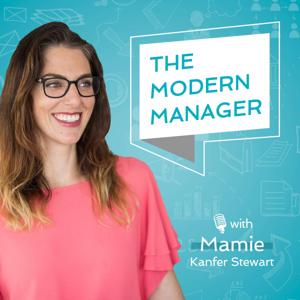
Practical management skills you can use this week. Host Mamie Kanfer Stewart helps managers close the gap between knowing what good management looks like and actually doing it.

Best of The Modern Manager

Ranked by our users in the last 21 days

More shows like The Modern Manager

The Look & Sound of Leadership by Essential Communications - Tom Henschel

The Look & Sound of Leadership

1,157 Listeners

Coaching for Leaders by Dave Stachowiak

Coaching for Leaders

1,462 Listeners

Modern Mentor by QuickAndDirtyTips.com

Modern Mentor

688 Listeners

How to Be Awesome at Your Job by How to be Awesome at Your Job

How to Be Awesome at Your Job

1,022 Listeners

7 Minute Leadership by Paul Falavolito

7 Minute Leadership

93 Listeners

Radical Candor: Communication at Work by Kim Scott & Jason Rosoff

Radical Candor: Communication at Work

705 Listeners

Speak Up: Develop Your Executive Presence & Leadership Communication Style by Laura Camacho

Speak Up: Develop Your Executive Presence & Leadership Communication Style

97 Listeners

Maxwell Leadership Executive Podcast by John Maxwell

Maxwell Leadership Executive Podcast

375 Listeners

No Bullsh!t Leadership by Martin G Moore

No Bullsh!t Leadership

126 Listeners

Leadership Without Losing Your Soul: Master Communication and Management Skills to Boost Productivity, Teamwork, and Ease Overwhelm by David Dye, President Let's Grow Leaders

Leadership Without Losing Your Soul: Master Communication and Management Skills to Boost Productivity, Teamwork, and Ease Overwhelm

35 Listeners

The Anxious Achiever by Morra Aarons-Mele

The Anxious Achiever

563 Listeners

Take Command: A Leadership Podcast by Dale Carnegie Flagship Podcast, Joe Hart

Take Command: A Leadership Podcast

119 Listeners

Coaching Real Leaders by Muriel Wilkins

Coaching Real Leaders

674 Listeners

HBR On Strategy by Harvard Business Review

HBR On Strategy

80 Listeners

HBR On Leadership by Harvard Business Review

HBR On Leadership

161 Listeners