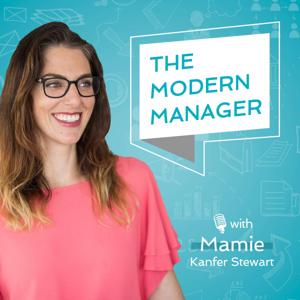
The Modern Manager

The Modern Manager

Download on the App Store
  • Favorites

    164

    Followers

  • Typical duration

    29 min

    per episode

Based on Podcast App listening data

The Modern Manager episodes

  • 35: How to Evaluate Your Team’s Work

    I’ve found that most teams don’t often enough pause to reflect on or evaluate the success of the work itself. There is so much to do, that we just keep pushing forward without pausing to ask how we’re doing and if we should keep going. In this episode, I outline four approaches to evaluating your teams’ work.


    Get the free mini-guide to help you get started with evaluating your team’s work.


     Join the Modern Manager community to get the full guide which includes questions to ask and more for all four approaches to evaluation.


    Subscribe to my newsletter to get episodes, articles and mini-guides delivered to your inbox.


     Key Takeaways:

    • Evaluating your team’s work is different from evaluating individual or team performance.
    • Evaluation meetings go by various names: retrospectives, post-mortums, after action reviews or plus/deltas.
    • There are for approaches to measuring your team’s work: (1) Accountability - Did we do what we said we would do? (2) Impact - Did the result of our work make a difference and did it matter? (3) Learning - What did we learn by doing this work? (4) Cost-Benefit - Is the investment we made worth the return?
    • Evaluating your teams work is critical to building trust, streamlining your processes, improving impact and allocating resources.
    • By evaluating your team’s work across all four dimensions, you will be able to accurately determine if the work was successful, how to improve it, and whether to do it again.
    • (1) Accountability. Ask questions like: Did we execute the project activities on time? If not, why?, Did we stay on budget? If not, why?, We we accomplish all the work? If not, why?
    • (2) Impact. Ask questions like: What is the result of the work we accomplished?, What impact did the work achieve?, Did we achieve the outcome we expected?
    • (3) Learning. Ask questions like: What might we do differently if we did a similar project again?, What surprised you - either in a good or disappointing way?, What worked really well ? Why?, What didn’t work so well? Why?
    • (4) Cost-Benefit. Ask questions like: What was the full total of resources invested in or deployed for this work? (people, time, energy, finances, social or relational capital, physical resources), What other ways might we accomplish the same impact?, What didn’t we do because of the resources spent on this work?


    Get it touch! Email me at [email protected]

    16 min
  • 34: How Stories Can Transform Relationships with Ann Smith

    When was the last time your team had a conversation about a non-work topic? That might seem like an unusual question when in fact, it’s an important component to building a high performing team. When people connect on a human level, they develop and deepen trust and respect, enabling them to constructively engage in conflict, openly share ideas and much more.

    This week, I speak with Ann Smith, Executive Director of the non-profit Books@Work. Books@Work partners with employers to break down barriers, build connections and foster openness, trust and respect. Using facilitated dialogue about a carefully-curated piece of narrative literature, the program invites colleagues to deepen the relationships that anchor healthy and inclusive organizations.


    Join the Modern Manager community to get 3 stories from Books@Work to use with your team. Plus, access additional guest bonuses and other resources to support your learning journey when you join.


    Subscribe to my newsletter to get episodes, articles and mini-guides delivered to your inbox.


    Read the related blog post: How to use Stories to Transform Relationships


    Key Takeaways:

    • Using narrative text as the basis for a discussion tees up conversations that don't normally happen, enabling the group to address topics as potentially challenging as race, and gender, and politics. The story creates an alternate reality to talk about, so people feel more open to share their view. When people engage in a narrative text, they each bring their own perspective, often seeing different things.
    • There's almost no organization or industry where the ability to connect more deeply with other people isn't relevant and profound. Books@Work has impact any place that the human relationship lies at the core of being successful.
    • The big difference between the Books@Work approach and other common forms of team bonding such as a happy hour, is that a happy hour is wonderful in the moment, but most people will gravitate to the people they already know.
    • To elevate the conversation, don't use business books or self-help books, and select stories that are on topics unrelated to your work. Use narratives because they bring up human stories which actually attract you to share your own. Once you've shared your own, others will share theirs as well.
    • Really bring everybody to the table for the conversation. Even beyond your direct team - bring people from different functions, different roles, different levels of the organization.  People are always pleasantly surprised that the most insightful comments don't always come from the most senior person in the room or the most educated person in the room.
    • If possible, have somebody who's trained to facilitate the discussion through questions. This will help ensure the conversation is open and that the text becomes a starting point but not the only thing you talk about. The facilitator allows people to go deeper and deeper into the story and bridge to the implications for people in the workplace.
    • Different stories tee-up different conversations on big topics like creativity, accountability, free will, etc. Start by asking some of the fundamental human questions: What are the actions that this character took that really intrigued you? What are the actions that the character took that gave you pause? Is there somebody that you identify with? And then to move to more essential, topical questions e.g. What does it take for human nature to be innovative? Or, would you make the same choice as the character?
    • Don’t be afraid of silence. Give people space to reflect, gather their thoughts and speak up. Ask open-ended questions rather than yes-no. Don’t ask if people liked the story. This doesn’t lead to productive discussion.
    • Only at the end might you ask if there are any implications or connections to your work.


    KEEP UP WITH ANN AND BOOKS@WORK

    Website: www.booksatwork.org

    LinkedIn: https://www.linkedin.com/in/annkowalsmith/

    Twitter: @anksmith1 and @books_at_work

    Facebook: facebook.com/readbooksatwork

    29 min
  • 33: Do you really need that meeting?

    Meetings are just one form of communicate. Chat, email, collaborative digital tools and meetings are all good for some things and not others. While it seems simple to say, “let’s have a meeting,” it is important to pause and consider if a meeting is really necessary.


    Get the free mini-guide to help you write a desired outcome.


    Join the Modern Manager community to get the full guide which includes suggestions for when to hold a meeting vs use an alternative, and more.


    Subscribe to my newsletter to get episodes, articles and mini-guides delivered to your inbox.


    Learn more about how to have productive meetings and build a healthy meeting culture in my book,  Momentum: Creating Effective, Engaging, and Enjoyable Meetings.


     Key Takeaways:

    • Meetings are quite costly when you factor in the time to plan, schedule, complete pre-work, meet and follow-up. Plus there are emotional costs to sitting in meetings that feel unproductive.
    • Meetings are only one form of communication. All forms of communication have their best uses.
    • Before scheduling a meeting, be clear about why you’re meeting and what you want to accomplish (the desired outcome).
    • Once you know what you need to accomplish, decide if a meeting is the right next step. Consider a meeting alternative such as sending an email or memo, chat (e.g. Slack or Microsoft Teams), or a collaborative document (Google Doc, InvisionApp, etc) might be better suited.
    • A meeting alternative can be used as a first step in which it helps you narrow the focus of your meeting based on the initial responses.
    • To know if a meeting is the right next step, look at your desired outcome and ask yourself the following questions: (1) Do I need the participants to listen to, respond to, or interact with one another? (2) Is there a lot of complexity in the content or situation that needs real-time discussion? (3) Do I need to generate buy-in with this group of people?
    • If the answers to all are No, then a meeting is likely not necessary.


    Get it touch! Email me at [email protected]

    15 min
  • 32: Give and Receive Better Feedback with Robleh Kirce

    Do you still remember that uncomfortable, nerve-wracking or awkward feedback conversation you had with your manager, a colleague or direct report? Why are these conversations so difficult and how can we be better feedback givers and receivers?

    This week, I speak with Robleh Kirce, Head of Coaching at LifeLabs. His research centers on transformative leadership experiences, behavioral-based 360 tools, leadership skills under pressure, and workplace habits that drive change.


    Join the Modern Manager community to access guest bonuses and other additional resources to support your learning journey.


    Subscribe to my newsletter to get episodes, articles and mini-guides delivered to your inbox.


    Learn more and register for my upcoming online course Meeting Mastery - classes start January 8th!


    Read the related blog post: Feedback:  The Art of Giving and Receiving


    Key Takeaways:

    • Difficult conversations generally fall into two buckets: giving feedback and conflict resolution.
    • It’s totally normal to have anxiety about giving someone negative feedback.
    • Prepare yourself for giving feedback: (1) Get a micro-yes from the person e.g.“Is it ok if I talk with you about this specific topic?” (2) Identify and share the behaviors you observed. (3) Identify and share the impact of the behavior and why it matters. (4) Open up and listen to what the other person has to say.
    • When we give feedback, we can trigger emotional, reactionary responses. What causes that trigger to go off is particular to each person.
    • The most common trigger in a workplace setting is ego. When feedback we receive is at odds with how we perceive ourselves, it often causes an emotional reaction.
    • Be careful about how you overvalue an aspect of yourself. You can be kind or smart without having a self conception or ego around it.
    • If a colleague comes to you with a negative opinion about a person, ask about the behaviors they’ve observed to substantiate their opinion. Then ask if they’ve had a direct conversation with the person, and if they haven’t, recommend and support them to do so. If they are uncomfortable, offer to sit with them both and facilitate the conversation.
    • If you have an issue with a colleague, it’s OK to go to your manager with a positive intent to ask for help with how to address the issue yourself.
    • Negative surprises can spike your emotional response by up to 400%.
    • When asking for feedback from others, narrow the focus to a specific area. Give them time to reflect and then meet a few days later with them to discuss.
    • If something happens in the workplace and you’re still thinking about it after 24 hours, give the feedback immediately.
    • To get feedback for reluctant people, frame it as “pro-tips.” Ask for suggestions and recommendations for how to do something specific with a focus on the future rather than the past.


    KEEP UP WITH ROBLEH

    Website: http://lifelabslearning.com

    LinkedIn: http://linkedin.com/in/kirce

    Email: [email protected]

    32 min
  • 31: Planning Growth Goals for Your Team

    As we prepare for another year, many of you I’d expect are doing some reflection on yourself, your personal goals, and what you hope for in 2019. Teams have goals, skills and competencies, just as individuals do. As you reflect on individual performance and opportunities for growth, consider also reflecting on how your team could become stronger. How might you invest in your team’s capabilities in order to work more effectively, accomplish great things, and create an environment where people flourish?


    Get the free mini-guide to help you plan and follow-through on team development goals this year.


    Join the Modern Manager community to get the full guide which includes questions for reflections, potential areas of growth to focus on, and more.


    Subscribe to my newsletter to get episodes, articles and mini-guides delivered to your inbox.


     Key Takeaways:

    • Teams have goals, skills and competencies just as individuals do. It’s worth investing in strengthening how your team works and setting team development goals.
    • Introduce the concept of a team growth goal at an upcoming meeting. Explain why it’s important for teams to invest in their collective capabilities.
    • Decide on an area of growth and generate buy-in.
    • If you already have a topic in mind, present it to the team and be sure to explain (1) what the problem is, (2) how you, the team, the company will benefit, and (3) how each of them will benefit.
    • If you haven’t selected a topic, ask the team to brainstorm areas for growth. Come up with decision-making criteria and agree upon the area you’d like to focus on developing.
    • Set growth goals that explicitly state how you will measure success. Break down the goal into reasonable milestones to help you assess progress along the way.
    • Create a learning and accountability plan. Decide how you will collectively gain the knowledge and/or skills to grow e.g. attend a webinar, read a book, develop ground-rules, etc.
    • Set a meeting schedule to regularly check in on learnings and progress.
    • Collectively commit to the goals and plan. Make it part of your overall performance system. Ensure each person understands that this is just as important as other team goals and needs to be taken seriously.
    • Implement the plan by learning, debriefing, problem solving, experimenting, and supporting one another.
    • Assess progress regularly and reflect on what’s working and what still needs to be figured out. Refine, update and iterate the plan as needed.
    • Celebrate any and all progress, no matter how big or small.
    • Don’t let distractions or a busy calendar get in the way of following through on your growth plan. If your team slows down or stops investing, regroup, recommit and re-prioritize.


    Get it touch! Email me at [email protected]

    15 min
  • 30: Driving Intentional Culture with Isaac Tolpin

    Team culture exists whether you intentionally shape it or not. Many managers organically build a culture based on their own values. But how do you design and transform a culture intentionally - one that delivers greater results for the individual, team and company?

    This week I speak with Isaac Tolpin, co-founder of ConveYour.com, the #1 Microlearning platform for learner engagement. Isaac and I talk about how to build a culture that enhances results, effective meetings and investing in your team members.


    Join the Modern Manager community to Isaac's free course on building high performing teams and other additional resources to support your learning journey.


    Subscribe to my newsletter to get episodes, articles and mini-guides delivered to your inbox.


    Key Takeaways:

    • To create a learning culture, you need to understand the dreams of your team members and help them grow even if that means they leave your team to pursue their next step.
    • We are most energized when we are learning, improving, growing in exciting directions.
    • Most of what we learn when listening to a speech or attending a training is quickly forgotten. To really create change, you need just in time learning.
    • Culture can’t be created by events. Culture is created by a never ending positive pressure on the right levers of the business.
    • If you’re not living elements of the culture you want to drive, you will never be able to sustain that culture.
    • Use powerful and consistent language to refer to your culture and key values.
    • Culture is the ethos, the unwritten rules, how people behave when no one is looking.
    • To shape a new culture, you need to start with understanding “what is” - both the good and bad.
    • Identify the 3-5 key levers of your business. Levers are those things that will have the most positive impact when activated.
    • Write a key statement that captures the essence of each lever and you feel confident saying over and over again.
    • To go beyond incremental thinking into revolutionary thinking, you need to suspend what you know (or think you know) and think expansively. Schedule time in your calendar to do this.


    KEEP UP WITH ISAAC 

    Website: https://conveyour.com/

    Facebook: https://www.facebook.com/conveyour

    Twitter: https://twitter.com/isaactolpin

    Instagram: https://www.instagram.com/isaactolpin

    LinkedIn: https://www.linkedin.com/in/isaactolpin

    29 min
  • PYB 3: Halloween Costume Confusion

    This is the third bonus episode in the Parenting Your Business series. In these episodes, I talk about my experiences as a parent and manager / entrepreneur, comparing situations and learnings.

    In this episode, I reflect on moments when we make assumptions that result in wasted effort, and then how we respond to them.

    Get in touch and join the conversation!

    [email protected]

    mamieks.com/podcast

    patreon.com/modernmanager

    5 min
  • 29: Overcoming Common Challenges with Task Managers

    It’s normal to have ups and downs with any new app. There will be times when you love using your task manager and times when you slow down or completely stop. Thats because using an app is really about building new habits. Whenever we try to change behavior we run into challenges.


    Get the free mini-guide to help you overcome some common challenges with using a digital task manager.


    Join the Modern Manager community to get the full guide which includes printable trackers, tips and approaches.


    Subscribe to my newsletter to get episodes, articles and mini-guides delivered to your inbox.


    Key Takeaways:

    • There are a few common reasons we struggle with using a digital task manager:
      • The excitement of a new app wears off;
      • We don’t get into a routine of putting tasks into the app or keeping it up to date;
      • We stop trusting the tool to be helpful;
      • We struggle with combining our use of paper and digital;
      • The app is missing a capability or starts to feel like too much work.
    • To prevent or overcome these challenges, acknowledge they're real and normal, and then make a plan.
    • Decide how you will integrate your use of paper and digital tools. Be intentional about how together, they will support you to be most productive.
    • Integrate your new habits for using your task app with your existing routines.
    • Use visual reminders, like a 30-day chart, to help you track your usage. Set a goal of using your task app every day for a month. Make it a team goal if you’re collaborating with others.
    • Explore new features, automations, integrations, etc to make it easier to use the app.
    • Hold regular reflections on how it’s going. Consider what you want to do differently so you can get more value from the app.
    • Recognize the challenges and frustrations are real. No app is perfect.
    • If you’re really having a hard time consider changing to an app that is better suited to your needs, or whether an app is needed at all. There are many paper-based task management systems as an alternative.


    Get it touch! Email me at [email protected]

    15 min
  • 28: How to Hire Remote Team Members with Nate Hirsch

    Hiring remote team members has gained in popularity over recent years. With access to a wider talent pool, more varied price ranges, and the ability to hire project-based and full-time resources, what's not to love? So how do you effectively hire and work with someone whom you never meet in person?  

    This week I speak with Nate Hirsch, entrepreneur and expert in remote hiring and eCommerce. Nate is the co-founder and CEO of  FreeeUp.com. Nate and I talk about how to hire remote workers to grow your team’s capabilities. We talk about different types of freelancers and how to set yourself and the new hire up for success.


    Join the Modern Manager community to get a $25 credit to  FreeeUP and other additional resources to support your learning journey.


    Subscribe to my newsletter to get episodes, articles and mini-guides delivered to your inbox.


    Key Takeaways:

    • With remote hiring, you have access to a larger pool of talent at a wider variety of price point. You can hire a remote individual for a one-off project, sporadic work, and full time employees.
    • Even ‘brick-and-mortar’ stores can supplement their work with remote team members for things like customer service, social media management, graphic design, etc.
    • There is always a risk with hiring anyone, in person or remote, that the person won’t deliver. But hiring is the only way to gain capacity and grow. It’s about implementing good processes for accountability and building trust.
    • You need to know what you’re looking for before you start the hiring process. Too often when hiring remote, we think ‘we’ll know it when we see it’ about finding the right person.
    • Once you’ve identified a person to hire, be intentional about sharing your expectations and clarifying what success looks like.
    • Freelancers often work with multiple clients who have different needs and expectations. What makes one client happy doesn’t make another client happy.
    • There are three levels of hires: (1) The basic level freelancer who can follow and execute on the processes and systems you’ve already set up; (2) The mid-level freelancer who is a specialist doing the work, for example a graphic designer, book-keeper or Facebook Ad manager who knows their craft; (3) The experts who advise in addition to doing work by bringing their own experience to help your business.
    • Defining what level of work you need is critical. Where people go wrong is by hiring a basic level freelancer when the don’t have systems yet and then expecting that person to create the systems.
    • If you hire full time people who are doing work central to your business, treat them as full members of your team or business by including them in weekly meetings.
    • Ask for feedback regularly, even with your remote team members. Set the expectation that asking for and giving feedback are part of our culture.


    KEEP UP WITH NATE AND FREEEUP

    Website:  FreeeUp.com

    Facebook:www.facebook.com/nathan.hirsch and https://www.facebook.com/freeeupcom/ 

    Twitter:@realnatehirsch and @freeeup

    Instagram:@realnatehirsch and @freeeup_

    LinkedIn:https://www.linkedin.com/in/nathanhirsch/ and https://www.linkedin.com/company-beta/10455467/

    YouTube: https://www.youtube.com/channel/UCqoq7EGvwLQXgiYuIG8_iMg and https://www.youtube.com/channel/UCSWdjdeVEWmk6f6wrsMeZcQ

    Online Hiring Mastermind Group:  https://www.facebook.com/groups/OnlineHiringMastermind/?ref=br_rs

    28 min
  • 27: Getting Started with a Task Manager

    Introducing a new technology tool to your workflow, whether doing it alone or with a team, shouldn’t be taken lightly. You have to work the technology in order to reap the benefits. Getting set up properly from the start will make it easier to sustain the new behaviors that will lead to less stress, more alignment, and greater productivity.


    Get the free mini-guide to help you set yourself and/or your team up for a strong start with a new to-do app.


    Join the Modern Manager community to get the full guide to getting started with a task manager.


    Subscribe to my newsletter to get episodes, articles and mini-guides delivered to your inbox.


    Key Takeaways:

    • Be thoughtful about how you will structure your work in the app. As more content goes in, it becomes harder to find what you’re looking for. Having the content well organized from the beginning will make it easier to keep it organized over time.
    • Be explicit about what norms or ground rules you’ll follow when using the app. Consider how you’ll use specific features, like tags, followers, and due dates.
    • If you’re using the app with a team, agree together on expectations for how tasks will be assigned, communicated about, and updated.
    • Reflect on what changes you’ll need to make to your existing routines. For example, how will you capture tasks when you’re not at your desk? When will you input those tasks? How will you plan your priorities for the day?
    • How will you hold yourself (and your team) accountable to using the app and following the ground rules? Consider having a weekly team huddle to reflect on how you’re using the app, how you’re benefiting and what you can do differently.
    • Consider adding some new routines like daily and weekly time to input, update and review the tasks in your app.
    • Set up the infrastructure of your app before you input any content. Name the folders, create the tags, add and avatar, update your notifications, bookmark the app’s URL, etc.
    • Do a braindump of everything you need to do. Collect items from your notebooks, email, other apps, etc to get a full picture of all your work.
    • Input each task including the owner, due date, relevant tags, documents or links, etc.
    • Remember this is a journey and you’ll discover what works (and what doesn’t) as you use the tool. You’ll find ways to use the features that are helpful and features you wish the app had which you need to work around.
    • If you find you’ve stopped using the app consistently (or completely), don’t worry. Decide if you want to give it another go. Then reflect on what was challenging before and how you’ll work differently this time around.


    Get it touch! Email me at [email protected]

    17 min

About The Modern Manager

From the publisher's feed

Practical management skills you can use this week. Host Mamie Kanfer Stewart helps managers close the gap between knowing what good management looks like and actually doing it.

Best of The Modern Manager

Ranked by our users in the last 21 days
More shows like The Modern Manager

The Look & Sound of Leadership by Essential Communications - Tom Henschel

The Look & Sound of Leadership

1,157 Listeners

Coaching for Leaders by Dave Stachowiak

Coaching for Leaders

1,462 Listeners

Modern Mentor by QuickAndDirtyTips.com

Modern Mentor

688 Listeners

How to Be Awesome at Your Job by How to be Awesome at Your Job

How to Be Awesome at Your Job

1,022 Listeners

7 Minute Leadership by Paul Falavolito

7 Minute Leadership

93 Listeners

Radical Candor: Communication at Work by Kim Scott & Jason Rosoff

Radical Candor: Communication at Work

705 Listeners

Speak Up: Develop Your Executive Presence & Leadership Communication Style by Laura Camacho

Speak Up: Develop Your Executive Presence & Leadership Communication Style

97 Listeners

Maxwell Leadership Executive Podcast by John Maxwell

Maxwell Leadership Executive Podcast

375 Listeners

No Bullsh!t Leadership by Martin G Moore

No Bullsh!t Leadership

126 Listeners

Leadership Without Losing Your Soul: Master Communication and Management Skills to Boost Productivity, Teamwork, and Ease Overwhelm by David Dye, President Let's Grow Leaders

Leadership Without Losing Your Soul: Master Communication and Management Skills to Boost Productivity, Teamwork, and Ease Overwhelm

35 Listeners

The Anxious Achiever by Morra Aarons-Mele

The Anxious Achiever

563 Listeners

Take Command: A Leadership Podcast by Dale Carnegie Flagship Podcast, Joe Hart

Take Command: A Leadership Podcast

119 Listeners

Coaching Real Leaders by Muriel Wilkins

Coaching Real Leaders

674 Listeners

HBR On Strategy by Harvard Business Review

HBR On Strategy

80 Listeners

HBR On Leadership by Harvard Business Review

HBR On Leadership

161 Listeners