
Sign up to save your podcasts
Or

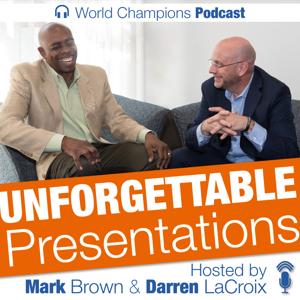


As presenters we are often tempted to teach our audience everything we know. Mark and Darren drill down on the importance of, and methods for giving each audience one clear idea in every presentation.
SNIPPETS:
• Be completely clear on one specific idea
• Don’t depend on implication; rely on declaration
• Bring up your point; hold up your point
• Give your audience and idea, principle, technique, habit, tip or action item
• Use specific language like, “If you only absorb ONE IDEA, it’s this:”
• Your ‘one thing’ must be easy to remember
• Your ‘one thing’ must be immediately applicable
• State your ‘one thing’ early in your presentation and repeat it at the end
• Test your ‘one thing’ and get your audience’s response
The term ‘Selfish Presenter’ may seem harsh, but today Mark and Darren talk about one way we deny our audiences the full experience of our presentations. We give great value when we use the spaces between our words wisely.
SNIPPETS:
• Give your audience time to process your questions
• Without reflection there is no connection
• Place wisdom on the ‘Pause Pedestal’ and ‘put some air around it’
• Pause in HEARTBEATS, not SECONDS
• Your audience needs space to absorb you points
• Use the pause to acknowledge the audience or affirm eye contact
• Don’t step on your audience’s thoughts
• The most important part of the presentation is the thought process in the audience’s mind
It’s easy to focus on your next presentation based on the occasion, especially when you have customized it for a specific audience. Today Darren and Mark offer advice on thinking about the future value of your presentation. Speech contestants often prepare for a specific contest, then set the speech aside. Mark and Darren explore ways to extend your speech’s shelf life, modify the format, and reach broader audiences.
SNIPPETS:
• Think and act today for the future
• Ask: “What other audience needs to hear this message?”
• Make adjustments immediately when you think of them
• Resolve to evolve
• Expand your audience demographic
• Convert you message into a different format
• Look for additional messages in your content
• Think, “The NEXT time I give this speech, I will…”
No matter how pithy your point may be, you have to PROVE it to your audience. Today Darren and Mark offer nine ways to do so, while establishing a deeper connection to your audience. You need not use all nine at once, but when chosen selectively and used effectively, they will help to make your presentation unforgettable.
SNIPPETS:
• Personal stories help you to establish a relationship with your audience
• Connect to your audience’s world
• There are ways to keep your audience fully engaged
• It is important to SHOW your method or process
• Infuse your data with human characters
• Give your audience a representation of your expertise and experience
• Involve your audience with tools like Mentimeter
You deliver your presentation, then well-meaning friends and would-be advisors offer their feedback. However, their recommendations vary widely. Which do you implement? Mark and Darren share their experience and offer specific guidelines and a process for deciding which feedback you should use.
SNIPPETS:
• Facilitate your audience feedback
• Ask your audience members key questions
• Discern which feedback fits for you
• Individually inventory each piece of feedback
• Remember you are the CEO of your speech
• Don’t use feedback just because it’s from someone with status or authority
• Test every bit of feedback and follow your heart
Mark and Darren have oft said that the first step to an unforgettable presentation is A CLEAR MESSAGE, but what is Step #2? In this episode they describe your Foundational Phrase and explain how a well-crafted Foundational Phrase can make your presentation unforgettable.
SNIPPETS:
• Create a Foundational Phrase to make your message memorable
• It should be rhythmic
• 10 words or fewer are easier to remember
• A well-crafted Foundational Phrase has weight and influence
• It should run like thread throughout your presentation
• It can be rhyming or alliterative
• Connect your Foundational Phrase to your message
• Brainstorm with a friend to craft each other’s Foundational Phrase
A key element in a story is the hero’s journey, and it must end in transformation. There are ways to make the transformation clear, and meaningful, to your audience. Darren and Mark talk about that transformation and offer simple but practical techniques for doing so.
SNIPPETS:
• If there is no transformation, there is no story
• Establish an emotional connection between the hero and your audience
• RELATABLE - Your audience should relate to the hero’s struggle
• DESIRABLE - Your audience should want the hero’s transformation
• Include the right details and paint the right picture of the hero’s ‘THEN’
• Let the audience witness the change and see the hero’s ‘NOW’
• Show a vivid contrast between the ‘THEN’ and the ‘NOW’
• Let another character see and acknowledge the transformation
• Revisit your story and make your character transformation clear
“If you want to get booked, you need a demo reel!” This is now common advice for speakers. But what makes a good speaker demo reel? Where do you begin? Today Mark and Darren find out from Chris West, Founder and Owner of Video Narrative, Inc. and the authority on outstanding speaker demo reels. His advice provides a roadmap of the steps necessary for you to create your unforgettable speaker demo reel!
SNIPPETS:
• Position yourself in a category of ONE
• Turn your story into a video narrative
• Your video should be like a good movie
• Meeting planners view video to create their short list
• Meeting Planners look for reasons to disqualify you
• It is your #1 sales tool
• It should clearly distinguish you as the one, or NOT the one
• It must define problems, teach tactics, give you credibility and show results
• It should be under four minutes long
• It should answer the question, “Why should we choose you?”
“Don’t give a speech; deliver an EXPERIENCE!” is an exhortation that co-host Mark offers frequently. Today he and Darren dive into the ‘3-D’ technique they used with a recent coaching client. They discuss how this technique will help you to authentically recreate and relive the scenes in your stories, elevate your audience’s experience, and make your story unforgettable.
SNIPPETS:
• Go beyond stage-ology
• Recreate and re-live your stories
• Anchor scene locations in your speaking area
• Anchor points of wisdom to specific locations in your speaking area
• Use post-its to represent and rehearse specific locations in a scene
• Use stage depth for realistic distances in scenes
• Use angles to correctly depict the location of objects and characters
• Realistically show character height differences when standing, sitting etc.
• Visit speaking location beforehand and map out post-it locations
Can you remember the moment when you KNEW you were ‘legit?’ Perhaps you’re an emerging presenter and have no idea what that means. Darren and Mark each share their coming of age story and explain how acknowledging, understanding and sharing your coming of age story can serve your audience and make you unforgettable.
SNIPPETS:
• Your journey encourages others
• You can come of age by teaching other people’s content
• Strive to be unforgettable
• Dollars follow impact
• Always deliver value
• You can start by delivering fee-waived presentations
• Share your coming-of-age story
• Encourage others to share their coming-of-age stories
From the publisher's feed

43,341 Listeners

2,266 Listeners

152,841 Listeners

2,694 Listeners

4,585 Listeners

1,935 Listeners
13,975 Listeners

99 Listeners

27,963 Listeners

643 Listeners

812 Listeners

2,216 Listeners

29,160 Listeners

26,562 Listeners

19,009 Listeners