
Sign up to save your podcasts
Or

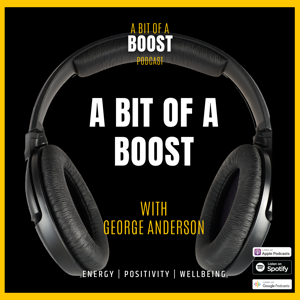


A Bit Of A Boost has had a bit of a break for a couple of months but we're back with a short series of mindset strategies that have helped me over the years. Some may resonate, some may not, but they're all practical with real world application.
This week's episode descibes a strategy called 'Get Out Of The Chair', which I frequently call on when I'm tackling some big project or task.
My guest today is former World Rally Championship driver Penny Mallory, who became the first woman in the world to drive a Ford Focus World Rally car.
I met Penny at an event a few years ago and having seen her presenting numerous car-related programs on TV and listening to her talk about her specialist topic of mental toughness, I knew she'd make a great guest for the show.
We talk about her own incredible story, of homelessness and hopelessness, to winning trophies skidding around forests in high powered cars.
I asked her about her own mental toughness and where it came from, and how she encourages other people to develop more of it in the 4 key areas of control, commitment, challenge and confidence.
Penny has worked with hundreds of corporate teams over the years since hanging up her driving gloves, and we also talked about some of the insights she's gathered in that time, in particular what some of the biggest challenges are that professionals are facing today when it comes to their mental toughness.
As well as being a champion racing driver, Penny has turned her attention to marathon running, triathlon, mountain climbing and even boxing, and the tools and techniques she developed behind the wheel are equally as applicable in any high pressure situation.
You can find out more about Penny's work as a speaker and coach through her website and LinkedIn profile:
https://www.pennymallory.co.uk/
https://www.linkedin.com/in/pennymallory/
Her book '365 Ways To Develop Mental Toughness' is due for publication in November 2022:
https://www.pennymallory.co.uk/product/365-ways-to-develop-mental-toughness
We all know people who are the absolute masters of their craft, whether that's as an artist, in sports or in their job.
We look at people who make it look so effortless and ask the question 'how on earth do they do that!', yet often when we have mastery of an aspect in our lives we dismiss it or don't even notice it as being anything exceptional.
Parenting, in our relationships, in our own approach to exercise or perhaps an aspect of our own jobs, there are likely to be areas that we have achieved a level beyond 'consciously competent'.
My guest on today's episode is William Buist and he talks about intentional mastery and the stages that go before it. The area that he specialises in is small business mentoring, but the concepts and strategies that he offers are translatable to almost every other aspect of our lives.
William and I have worked together in the past and I recently read his new book by the same name - Intentional Mastery - and I was intrigued to see an entire chapter devoted to the importance of 'Self', where he discusses emotional wellbeing, physical wellbeing and mental resilience.
William also has his own inspirational story of making changes in his life to reflect the need to take better care of his health and energy, and I ask him about how he started on his journey towards losing 2 stone and keeping it off.
If you've ever yo-yo'ed with your weight loss in the past I think you'll find this particular section of interest.
You can find out more about William's work (and the book) through his website or LinkedIn:
https://www.williambuist.com
https://www.linkedin.com/in/wbuist
20 years ago when I started out as a personal trainer answering the question of 'what do you do?' was an easy one.
Over the course of the last 2 decades the scope of my work has expanded to include what can be broadly described as 'wellbeing & performance', but what do these words actually mean?
There are many definitions depending on who you talk to, and although I don't claim to have the definitive answer I do believe that a part of it must include something that relates to the 'dynamic tension between a desire for progress and a contentment with the present'.
But rather than try to come up with the perfect definition, this episode drills into the 5 'pillars' that I believe make up the concept of wellbeing & performance:
1) Wellbeing
2) Drive
3) Mindset
4) Resilience
5) Connection
I break each of these down into smaller chunks as follows:
Wellbeing - DASH - PERMA - Stress & Energy - Emotions
Drive - Goals - Motivation - Confidence - Purpose
Mindset - Global Mindset - Beliefs & Values - Optimism - Self-Talk
Resilience - Grit - Bouncebackability - Change - Acceptance
Connection - Relationships - Support - Belonging - Self
And then finally identify some of the common blockers that stop us from doing and being more of what and who we want to do and be!
Blockers - Procrastination - Self-Sabotage - Confidence - Overwhelm - Defaults
Finally finally, all of this is wrapped in habits, systems, planning and evaluation processes that if you're not careful can quite easily suck out all the messy joy from life so be warned: this is just a model!
My intention for sharing this is to encourage you to ask yourself the question: how am I doing right now with my wellbeing & performance?
Try rating yourself on a scale of 1-10 and make a note of any scores that come out lower than you are happy with, and then start to make a plan for what you could do to nudge them up by +1.
These are also all topics that I speak about regularly, at conferences, corporate events and in training rooms both in the UK and Internationally.
If you want to find out more about how I work with my clients please get in touch via email: [email protected]
There's been a bit of a pause on the podcast these last few weeks because my father sadly passed away at the beginning of the month.
In today's episode I describe the process that has been helping me navigate the challenging landscape of grief in what feels to me to be a healthy and adaptive way.
Often in times like this we know that we should 'take the pressure off' or 'go easy' on ourselves, but this can be a difficult thing to do in practice. On the one hand we don't want to let people down or let our high standards slip, and on the other we know that something has to give in order to create the space and time necessary for grieving.
Giving a eulogy at his funeral a week ago also gave me the chance to put into words some of the many life lessons he taught me through his life, and I share a couple with you today in the second half of this episode.
A couple of resources I mention in the episode include the book 'On Grief & Grieving' by Elisabeth Kubler-Ross & David Kessler, and this Huberman Lab episode on grief which I had been listening to on my several trips up to Manchester to be with my dad in his final days.
In fact stress is the very thing that enables us to perform at our best but if the pressure grows too much we can slip into a paralysing feeling of overwhelm.
In today's episode I explore some of the areas that a state of overwhelm can impact, and some practical techniques to bring you back to a more grounded, action-oriented state.
To find out more about the 6 Week Boost fitness challenge I mention in this episode, head over to the website for more information (starts June 13).
bygeorgeanderson.com/boost-challenge
Have you ever come away from an event with loads of ideas but then gone back to your day to day and not done anything with them?
Or perhaps you've listened to a podcast, read a book or watched a video and felt motivated and inspired to put things into action but struggled to bridge the gap between knowing and doing.
Today's short episode is dedicated to the simple idea of implementation, not just information.
Creating movement, not just consuming content.
It's about progress not perfection, and how even just a small amount of action can build momentum.
It's about the journey from data > information > knowledge > wisdom.
It's simple but powerful and the question at the end is worth considering.
A bit of an unusual episode this week as it was produced in two parts. I interviewed a friend of mine, Mat Poole, a couple of days before he departed for the Sahara desert to take part in the infamous Marathon des Sables.
At the start of this episode I share the notes I made during this call with Mat, where I asked him about his hopes and fears, logistics and expectations of the event.
Then in the interview itself we find out how it went, and how close to his expectations it came!
In a challenge like this there are always lessons to be learned and I was interested to try and extract them in a way that could be useful to you and I in more day to day areas of our lives.
Mat was raising money for the charity Walking With The Wounded who support mentally, socially and physically wounded veterans.
For a few more weeks following the publication of this episode the Just Giving page will be open should you care to donate:
https://www.justgiving.com/fundraising/matp
My guest this week is cognitive neuroscientist Dr Lynda Shaw, and we spend the episode discussing the brain and neuroscience and how we can improve our wellbeing and performance.
I seem to spend most of my free time reading journals and books and studies about neuroscience and we had a great conversation!
I was really interested to hear from Lynda where the cross over lies between psychology and neuroscience, and how we can use the latest research to benefit us in our wellbeing and performance.
I know Lynda through the Professional Speaking Association of which I'm a member, and Lynda is the current president so I've heard her speak on numerous occasions.
She always explains complicated subjects so clearly and I knew we'd have a blast talking about all things brain-related in this conversation today.
I asked Lynda about the neuroscience that underpins some of the commonly known areas such as growth mindset, neuroplasticity, and the fight and flight stress response.
We talk about neurobiology and chemistry, and some of the chemicals we produce that influence our mood and motivation such as dopamine, serotonin and the less-well-known nitric oxide.
Lynda works with a lot of senior leaders to help them 'recalibrate their thinking', and we touch on some of the approaches and tools she shares with her audiences.
https://drlyndashaw.com
https://www.linkedin.com/in/lyndashaw
I'm joined this week by life coach and author Simon Ong, who's new book Energize has just been published.
We talk about the subject matter of the book and the importance of optimising your energy. This is a topic I'm passionate about and active with in my own work, and it was great to get Simon's take on it.
He shares some of his own journey through a decade in the corporate world and into the world of personal development and coaching, what he's learned and how he applies it.
I love it when my guests share tips and tools, and Simon is very generous with some real crackers so this is a truly high-value episode for you today.
https://getenergizebook.com
https://www.simonalexanderong.com
https://www.linkedin.com/in/simonalexanderong
https://www.instagram.com/simonalexandero
From the publisher's feed

4,349 Listeners
11,777 Listeners
1,118 Listeners
226 Listeners

8,463 Listeners
590 Listeners

3,612 Listeners
9,163 Listeners
250 Listeners
2,212 Listeners

89 Listeners

29,191 Listeners

2,028 Listeners

1,192 Listeners
254 Listeners