
Sign up to save your podcasts
Or

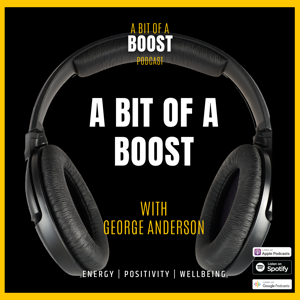


I'm joined today by Emotional Empowerment and Wellbeing Coach Daniel Dzikowski to talk about 'letting go' of stuck emotions.
This is something he introduced me to when we first met at an event and I was really intrigued to find out more, so I invited him on the podcast to explore it!
Early on in our interview I became aware that understanding this was something that was going to take full concentration and I had to step out of 'interviewer' mode and into the role of 'curious questioner'.
Although there's a lot of cross over between the two, there were moments where it felt a little too disjointed and that perhaps we ought to start again, but then it just felt natural and conversational and so I decided to just keep going.
Daniel explains the process and benefits and how it's possible to separate out stuck emotions from the story we tell ourselves about them, and I've since gone on to do a session with him which was incredibly powerful.
Connect with Daniel on LinkedIn >>
https://www.linkedin.com/in/daniel-dzikowski-1857845/
Visit his website >>
https://www.clearthepath.co.uk
My guest on this week's episode is mental health nurse, speaker and educator, Alex Williams.
Alex has almost 2 decades of clinical experience working with patients suffering from severe cases of mental ill health. Over the years as he has helped these people he has made a number of observations about mental health that don't often get discussed.
He also has a powerful personal story of overcoming significant trauma as he was growing up, and just a few years ago his own mental health was at it's lowest ebb.
In our conversation Alex shares some of his insights into mental health, including an outline of what he calls 'the 3 Rs of getting back up, when life knocks you down'.
For such a deep and potentially difficult topic, Alex has a knack of talking about it with a real positive energy and sense of optimism.
Links to follow Alex's and the work he is doing:
LinkedIn - https://www.linkedin.com/in/thealexjwilliams
Instagram - https://www.instagram.com/thealexjwilliams
Website - https://thealexjwilliams.co.uk
Today's guest is a friend of mine and fellow fitness enthusiast, Greg Williams, who has established himself as the go-to guy for everything and anything related to Hyrox - the emerging sport of fitness racing.
Greg is the man behind the RoxLyfe website and YouTube channel, and as well as sharing information on tips and techniques to train for and approach a Hyrox event he has interviewed some of the sports biggest stars.
I took part in my first Hyrox event in Birmingham in October 2022 with my training partner Martin Shipperley, and we were delighted to come 5th in our category and qualify for the world championships taking place later this year in Manchester, and used Greg's blog extensively as part of my preparation.
In our conversation today I ask him about some of the things he's learned from talking to some of the elite competitors, as well as explaining what Hyrox and fitness racing is all about, why it's suddenly exploded in popularity, and we even get into a discussion about Stoicism towards the end.
Maybe you'll feel inspired after listening to today's episode to get out there and 'get your Rox on' with your first Hyrox event, but even if this isn't your thing there's plenty of the good stuff in our conversation to give you a bit of a boost…
Roxlyfe blog >>
Roxlyfe Instagram >>
Roxlyfe YouTube channel >>
Hyrox main website >>
Today's guest is a lady who I came across in a Facebook group for marathon runners, and after reading some of her jaw dropping story I knew that she'd make a great guest for the podcast.
Rachel Kennedy is a runner, and just a few short years ago she was a complete beginner. In fact, she describes how she despised anything related to athletics - at school she was sick a lot with asthma, was - as she put it - the theatre nerd - and thought sports were a joke.
I've spoken to many people over the years who have been put off physical exercise during their school career so the story so far isn't particularly unusual.
But then in 2018 she decided to try running and was delighted to eventually complete a run without having an asthma attack.
She stuck with it, started entering races, half marathons, then marathons, and made a few other changes to her lifestyle along the way.
Fast forward to today, and she's running marathons in elite times, and is currently eyeing up the qualifying times required for selection by the US team for the next Olympic Games.
Her trajectory has been astonishing, and of course we get into some of the details of this in our conversation, but I was most interested in how she shifted her mindset - and even her identity - to shake off old stories and begin a brand new one.
I get the feeling that right now we're parachuting into the middle of Rachel's story: even since recording this at the end of 2022 she has been setting yet more personal best times and has been invited to join the elite field of a major event in the US.
There's a huge amount of inspiration to be found in listening to Rachel share her story, but some practical tools as well. We all have our own stories and some of these may well be holding us back. We might not all be vying for a spot at the next Olympics, but some of these ideas may help us unlock a little more of our own potential.
Check out Rachel's Facebook profile to follow her incredible journey
********** NEW FOR 2023 **********
Join the weekly Boost Bulletin, exclusively for professionals working in high-pressure roles and receive a copy of '7 Quick Wins for Busy Professionals To Boost your Energy'
The short weekly email is delivered on a Saturday morning and contains an immediately applicable strategy, tool or resource, and takeaways from recent podcast episodes.
Sign up for free at https://bygeorgeanderson.com/bulletin
I'm joined today by leading lifestyle behaviour change specialist Dr Heather Mckee to talk about one of my favourite topics, habits.
Having studied health behaviour change psychology for 10 years, her mission is to offer a sustainable, evidence-based alternative to an industry saturated with quick fixes and health fads.
In today's conversation among other things we talk about:
- What is a habit?
- Frequency of habits (including annually!)
- Why we get distracted from our new habits
- The link between goals, motivation and habits
- Goal dilution, and how to avoid it
- Values and identity in relation to habits
- The role of curiosity and self-compassion in change
- Creating systems for change
- The role your environment plays in sustaining change
- Skillpower over willpower
- Building Bite-Sized habits
Heather referenced some a number of studies and resources during our conversation, and here are some direct links if you want to explore further:
Wendy Wood:
- Podcast episode (https://open.spotify.com/episode/1ZUfGd8WLyzTvjligc4u3O?si=ViTIgRaASQqFtLKjdPATMg&dl_branch=1&nd=1)
- Summary of key studies (https://behavioralpolicy.org/wp-content/uploads/2017/05/BSP_vol1is1_Wood.pdf)
- Good Habits Bad Habits book (https://behavioralscientist.org/good-habits-bad-habits-a-conversation-with-wendy-wood/)
Katy Milkman's book 'How To Change' (https://www.katymilkman.com/book)
Dr Heather McKee's website (https://www.drheatherspeaks.com/) and LinkedIn (https://www.linkedin.com/in/drheathermckee/)
********** NEW FOR 2023 **********
Join the weekly Boost Bulletin, exclusively for professionals working in high-pressure roles and receive a copy of '7 Quick Wins for Busy Professionals To Boost your Energy'
The short weekly email is delivered on a Saturday morning and contains an immediately applicable strategy, tool or resource, and takeaways from recent podcast episodes.
Sign up for free at https://bygeorgeanderson.com/bulletin
The previous strategies I've been sharing in this series are applicable in most areas of life but the ones I have for you on today's episode are focused on training mindset.
There may be some carry over to other areas as well but I wanted to put together some of the top strategies that I regularly use with my own training in case as some of them may be of value and benefit to you.
There are 10 altogether - 3 that help me before a workout*, 5 during and 2 after.
I wouldn't lean on all of them in any one workout, but they all come up regularly and then all help.
Have a listen, try a few out, keep what works, discard the rest.
Here are the 10 strategies:
1) Plan the session
2) Negotiate with yourself
3) Put yourself in the bin
4) No rep
5) Through the line
6) It's why you're here
7) Go beyond
8) Trash talk
9) Overcome and become
10) Just for you
Enjoy!
*My training is very varied - some running, some swimming, some cross training, some strength. Some (though by no means all) of my workouts end up with me pushing myself to my limite which isn't appropriate or desirable for everybody, but I wanted to share the strategies in their raw form and leave it to you to decide which ones are applicable to you!
Part 5 of the mini-series of mindset strategies is 'deliberate discomfort'.
Life inevitably involves brief moments of physical discomfort, whether it's carrying heavy bags around an airport or having to run to catch a bus.
If you're used to training and pushing yourself as a part of your exercise routine, you can use the Deliberate Discomfort strategy to reframe these moments and boost the mental toughness you get from your workouts as well.
Part 4 of this mini-series of mindset strategies is another one that can be boiled down to a short and snappy phrase: control the controllables. It's one that could application across many different aspects of your life, particularly when you find yourself feeling overwhelmed.
We're going to take a look at what it means, where it comes from, and how adopting it could potentially benefit you.
Part 3 of the mini-series of mindset strategies is 'cast a vote'.
This phrasing comes from the book Atomic Habits by James Clear, where he talks about 'casting a vote for the person you want to be'.
In this week's episode we take a look at how we can use small habits to reinforce a part of our identity that is important to us. Related quotes that we dig into is Aristotle's 'we are what we repeatedly do... excellence, therefore, is a habit, and not an act' (though it turns out this wasn't actually an Aristotle quote!), and Admiral William McRaven's 'make your bed' from his famous commencement speech.
You've got to love a quote, but to lift them off the bumper sticker and into our lives we need to look at how we can apply them in reality and that's exactly what this episode (and all the episodes in this series) aims to do.
Part 2 of the mini-series of mindset strategies, is the 'Fertile Garden'.
This comes straight from a Bruce Lee quote where he says "The mind is a fertile garden – it will grow anything you wish to plant – beautiful flowers or weeds. And it is with successful, healthy thoughts or negative ones that will, like weeds, strangle and crowd the others. Do not allow negative thoughts to enter your mind, for they are the weeds that strangle confidence."
In this episode I get into why this quote is so powerful as a mindset strategy, and how it can be used in every day life.
From the publisher's feed
4,349 Listeners
11,777 Listeners
1,118 Listeners
226 Listeners

8,463 Listeners
590 Listeners
3,612 Listeners
9,163 Listeners
250 Listeners
2,212 Listeners
89 Listeners

29,191 Listeners

2,028 Listeners
1,192 Listeners
254 Listeners