
Sign up to save your podcasts
Or

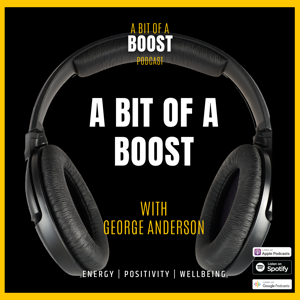


Accredited psychotherpist and performance psychologist Sam Bishop returns to share some insights from behind the curtains working in the world of elite sport.
Sam and I have regular mini-mastermind sessions and when he shared with me his PER framework for elite level performance I figured it could be helpful to you as well.
The framework is very simple:
P for Preparation
E for Execution
R for Reflection
But where Sam brings his expertise and experience is helping us understand how this can be applied in a range of situations where we need to perform at our best.
In our conversation Sam shares some specific examples that help translate the ideas from theory to reality.
Find out more about Sam on his website:
https://www.sambishopcoaching.com
Or follow him on LinkedIn:
https://www.linkedin.com/in/sam-bishop-4958b117a
I send out a weekly email called the Boost Bulletin to professionals who are looking for tips and strategies to help boost performance and wellbeing.
(If you're not already signed up for it you can rectify that situation over at https://bygeorgeanderson.com/bulletin )
A couple of editions back I wrote about slee and shared 10 'top tips' on the topic, and given the positive response it received I thought I'd share them here on the podcast as well.
I've had sleep expert Dr. Lyndsay Browning on the show in the past (9th April 2021) to talk about sleep and I've also done an episode on the protocol NSDR (Non-Sleep Deep Rest) which, despite the name, is actually another great way to help promote better quality sleep.
You can find both of those episodes here:
https://abitofaboost.libsyn.com/lindsay-browning-how-to-improve-your-sleep
https://abitofaboost.libsyn.com/nsdr-10-minute-stress-busting-sleep-boosting-mind-clearing-technique
In this episode though, I wanted to get straight into the tips and strategies that can help improve sleep quality and quantity.
The objective isn't to completely transform your sleep - don't put that pressure on yourself! - but to give it a bit of a boost and notice what an impact that has on your health, wellbeing, energy and motivation the very next day.
Try some of these strategies on for size and let me know how you get on!
And don't forget - you can register for the Saturday morning Boost Bulletin over here:
https://bygeorgeanderson.com/bulletin
How are you doing today?
If you answer is 'fine thanks', 'ok', or maybe 'not too bad', then you DEFINTELY need to listen to this week's episode!
My guest is Michael Heppell, an author, coach and speaker who has made it his mission to help more people strive for BRILLIANCE.
I read his book 'Flip It' over 10 years ago and recently read How To Be Brilliant, and I loved the strategies and ideas behind it.
In our conversation Michael shares his thoughts on the power of language, including the impact that throw away responses like 'I'm busy', or 'I don't have the time' can have on our energy and motivation (and what we say instead!)
We discuss the power of certainty and beliefs, both limiting and limitless, and how we can start to identify, challenge and change them.
Beliefs, confidence, stories we tell ourselves, motivation... and the BIGGEST consequence of living your life through limiting beliefs.
There's a ton of gold packed into this episode.
You can find out more about Michael and his work on his website:
https://www.michaelheppell.com
Or find him on LinkedIn:
https://www.linkedin.com/in/michaelheppell
His new book Write That Book is available on Amazon or through his website:
https://shop.michaelheppell.com/wtbbook
\\\\\ Episode 100! \\\\\
Delighted to reach this podcasting milestone, thank you to everybody who has listened, subscribed or shared the show, and especially to my incredible guests from whom I've learned so much over the last couple of years.
Today's episode is an introduction to the topic of burnout which, it turns out, is best prevented by creating more engagement.
That's according to the work of Christina Maslach, one of the world's leading authorities on the subject of burnout.
I share the framework she has developed over 30 years of research, including the 3 Dimensions of burnout and the 6 Predictors.
When I'm facilitating sessions with senior leaders and managers on the subject of burnout and engagement, this is the framework I use and it's incredibly useful on an individual level to understand some of the elements that are important for us to feel engaged with the work that we do.
===============================
[On that note, quick plug: I work with teams within corporate organisations to deliver wellbeing and performance programs, covering areas such as physical and mental wellbeing, resilience, stress, mindset & motivation and of course burnout and engagement.
If you have a team and want to find out more about how I support my clients, get in touch via email - [email protected] or my LinkedIn profile. ]
===============================
Ultimately, the responsibility for our own wellbeing is shared between us as individuals and the leaders who shape the environment in which we work.
Whilst we have a high degree of control about how take care of ourselves and manage our enegy through the day, the culture we operate in has a significant influence as well.
My guest this week is Celynn Morin, a qualified dietician, author of two books and workplace wellbeing consultant.
I heard Celynn speak at an event, and because I'm the absolute last word authority on anything related to wellbeing I noticed my 'oh this'll be good' reaction when I read the agenda.
My defensives dissolved within the first few seconds of her presentation and I found myself nodding along, participating and - gasp - learning a thing or two.
I came away with a real sense of being uplifted and having enjoyed myself for 90 minutes, but I also noticed a slight niggling about whether this was due to biases I had towards the information. The first question I ask Celynn in this interview - quite off the cuff - is how we can monitor and work around our own biases so we find the best information that's going to help us move forwards.
This spiralled into a conversation about breakfast, and whether it really is 'the most important meal of the day', and our individual wrestlings with this question over the years.
The big topics we get into centre on gut health and epigenetics, two areas that Celynn is a real expert in. But as always we wended our way around a variety of other areas of nutrition, wellbeing, performance and life with plenty of takeaways and advice along the way.
Celynn mentioned her Wellculator framework that I have completed and this is freely available through her website: https://www.celynnmorin.com
She also mentioned a gut health masterclass which you can access through her YouTube channel here: https://youtu.be/wH67OYojb7o
You can also connect with her on LinkedIn: https://www.linkedin.com/in/celynnmorin-wellbeingexpert
Save or favourite this episode as it's one you may want to return to.
The 5 senses mindfuness technique is a fantastic way to quickly bring your awareness and attention to the present moment and practice mindfulness in a meaningful way.
The script itself is only 4 minutes long and we get into it pretty quickly.
Although you can take this and use it any time, any place, without having to rely on accessing the recording, this guided version is best used either sitting or lying down somewhere comfortably (definitely not driving a vehicle or operating heavy machinery!)
The 5 senses can be used as a regular practice to help hone and strengthen your mindfulness muscle, or in those moments where you really need to create a few moments of calm.
If you're a fan of A Bit Of A Boost you've probably read your fair share of personal development books, listened to other podcasts or watched inspirational and uplifting videos.
But how much of it do you put into practice when the right moment arises?
Personal development is less about the accumulation of knowledge and more about the implementation of new approaches.
To do that we need to be able to quickly access these tools, and my guest today is somebody who helps with exactly that.
Hannah Wilson is an illustrator and creator of Quoted Visually, and produces the most amazing, powerful illustrations that condense big ideas into simple and memorable takeaways.
She's amassed over 100k followers on Instagram and her work is regularly reshared by the likes of Dragon's Den star and host of the Diary Of A CEO podcast Steven Bartlett.
We talk about the kinds of the ideas Hannah shares, what draws her to them, and how it was her dyslexia that motivated her to start illustrating in the first place as a way to help her recall information for exams.
Some really interesting insights in this conversation and I highly recommend giving Hannah a follow to beef up your own toolkit for life.
Hannah's website - https://www.quotedvisually.co.uk
Instagram - https://www.instagram.com/quotedvisually
Twitter - https://twitter.com/quotedvisually
LinkedIn - https://www.linkedin.com/in/quotedvisually
This week I'm joined by Jack Kavanagh to talk about resilience, inspiration, grief and change.
Jack's a pharmacist and speaker on health & wellbeing and his personal story is simultaneously tragic and uplifting.
In 2012 he suffered a life changing spinal cord injury leaving him with just 15% muscle function, and as he shares his story there's a real honesty and vulnerability that comes through as you realise this is a guy has really had to do the work to get to where he is today with his outlook and determination.
When we're going through challenging times in our own lives it can sometimes feel like there's a pressure to 'be resilient', to bounce back or stay positive but that's not always the case.
Jack shares the ups and the downs, and how he moved through this unimaginable change in his life and there are many lessons that we can all take from this.
As always, when it comes to inspiration it's about your own personal change. I hope that you listen to this podcast and today's episode in particular and are moved to make some small change in your own life, whether that's a behaviour you do or a belief that you hold.
Find out more about the work Jack is doing on his website:
jack-kavanagh.com
Or follow him on LinkedIn, Instagram or Twitter.
I have always been fascinated by the power of the mind to help you accomplish more and effectively change your reality.
It's something I've leveraged in nearly every aspect of my life, from relationships to health and fitness, challenges and my business.
When I read Dave Robson's book 'The Expectation Effect' I made pages of notes and got some big takeaways that I've since gone on to apply.
David is a science writer and his book was a BBC Radio 4 Book of the Week and won a British Psychological Society Book Award in the popular science category.
The Expectation Effect is the power of our beliefs or expectations to not only bring us more motivation, but potentially bring about physical changes to our brains and bodies.
The book covers a whole range of different areas where this has an effect, and details a number of fascinating studies that demonstrate just how important our beliefs and mindset really are.
I spoke to Dave for today's episode of the podcast and we got into some of the areas that I'm particular interested in around health, wellbeing and performance.
Dave talks about how the brain is a 'prediction machine', and how reappraisal techniques can help us view discomfort in different ways.
We get into the application to fitness, diet, stress and will power, and what the science tells us about how we can take advantage of this inbuilt expectation effect.
==========================================
You can find out more about Dave via his website:
https://davidrobson.me/
LinkedIn (https://www.linkedin.com/in/david-robson-5761791b/)
Twitter: https://twitter.com/d_a_robson
And the book is available on Amazon and good book shops:
https://www.amazon.co.uk/Expectation-Effect-Your-Mindset-Transform/dp/183885326X
in April 2020 Robert Glynn was given 12 months to live following a terminal cancer diagnosis, 2 months after losing his father to cancer.
He was also offered the chance to be a part of a trial treatment at The Christie hospital, which he 'jumped at', and at the same time made some big changes to his lifestyle through nutrition and exercise.
Two years later and Rob is not only still with us but his cancer is all but gone and he has a completely new approach to life.
Speaking to Rob I wanted to find out how he managed the mental pressure, and what some of the changes were that he made to his lifestyle.
He details the research he did into diet and countries with low cancer rates, and the specific foods he cut out of his diet to help 'create a hostile environment for the cancer', losing 31kg (5 stone) in the process.
Being given 12 months to live is a bit of a hyperthetical scenario sometimes posed with the purpose on focusing your attention on what you'd do differently with your life.
For Rob it was very real and we talked about how his attitide to life has changed over this period.
We talk about the importance of having support around you, speaking to friends about your inner struggles, and finding beauty and happiness in every day moments of life.
Why do we have to wait until our health is in jeapoardy before we reevaluate our lives and make course corrections?
Maybe we don't have to. Maybe we can choose to do exactly that today.
From the publisher's feed

4,349 Listeners
11,777 Listeners
1,118 Listeners
226 Listeners

8,463 Listeners

590 Listeners
3,612 Listeners

9,163 Listeners
250 Listeners
2,212 Listeners
89 Listeners

29,191 Listeners

2,028 Listeners

1,192 Listeners
254 Listeners