
Sign up to save your podcasts
Or



The religious vote is often treated as shorthand for white evangelical Christians. PRRI CEO and political scientist Melissa Deckman says that misses much of what is happening ahead of the 2026 midterms.
Deckman joins Faithful Politics to examine which religious voters may actually be moving, including white Catholics, white mainline Protestants, Hispanic Catholics, and Hispanic Protestants. She explains why immigration and the economy are affecting Hispanic religious voters, how gender is reshaping politics among Christian women, and why younger Americans are increasingly disconnected from both political parties and organized religion. melissa-josh-will
The conversation also explores Christian nationalism, Gen Z, abortion, James Talarico and the emerging visibility of progressive Christianity in Democratic politics. Deckman also explains how to read political polling without being misled by small samples, margins of error, or surveys that confirm what we already want to believe.
Book: The Politics of Gen Z: How the Youngest Voters Will Shape Our Democracy
Author: Melissa Deckman
Bookshop.org: The Politics of Gen Z on Bookshop.org
Melissa Deckman, Ph.D., is CEO of PRRI and a political scientist specializing in religion, gender, age, public opinion, and American political behavior. She previously served as the Louis L. Goldstein Professor of Public Affairs at Washington College and chaired its political science department. She is the author of several books, including The Politics of Gen Z: How the Youngest Voters Will Shape Our Democracy.
What if America’s political polarization is connected to the decline of traditional religion?
Christian theologian Matthew Kaemingk and Muslim political scientist Shadi Hamid make a provocative argument in their new book, Can Religion Save Democracy?: as religious participation has declined, Americans have increasingly looked to politics for identity, meaning, community, and even a struggle between good and evil.
We discuss Christian nationalism, secularism, political tribalism, religious certainty, pluralism, and why democracy requires people who can lose elections, live alongside deep disagreement, and resist treating political opponents as enemies who must be destroyed. The conversation also explores epistemic humility - including the Islamic tradition of saying “God only knows” - and how Christianity and Islam might provide resources for disagreement without domination.
Kaemingk and Hamid also explain why local religious communities may help develop the patience, humility, relationships, and “democratic table manners” that social media and national politics often fail to provide.
Book: Can Religion Save Democracy? How More Faith - Not Less - Can Heal Our Public Life
Authors: Matthew Kaemingk and Shadi Hamid
Bookshop.org: https://bookshop.org/a/112456/9781587436895
GUEST BIOS
Matthew Kaemingk is a Christian ethicist and public theologian, professor of public theology at Theological University Utrecht, and senior research fellow at Georgetown University. His work focuses on Christianity, Islam, pluralism, and public life. He co-hosts Zealots at the Gate with Shadi Hamid and co-authored Can Religion Save Democracy? Hendricks Chapel
Shadi Hamid is a political scientist, Washington Post columnist, and senior fellow at Georgetown University’s Center for Muslim-Christian Understanding, where he co-directs the Faith and Future of Democracy Initiative. His work focuses on Islam, democracy, political pluralism, and American politics. He co-hosts Zealots at the Gate and co-authored Can Religion Save Democracy?
Albert Mohler has spent decades as one of the most influential voices in conservative evangelical Christianity. Now he is arguing that America’s Constitution should explicitly acknowledge Christianity - a position Warren Throckmorton says represents a major departure from the Baptist tradition of religious liberty.
Throckmorton joins Will Wright and Pastor Josh Burtram to examine Mohler’s evolving views on Christian nationalism, the Constitution, religious tests, and blasphemy laws. They discuss Mohler’s proposal that the constitutional order acknowledge the lordship of Jesus Christ and authority of Scripture, why Throckmorton believes that conflicts with the founding-era approach to religious liberty, and how Mohler’s position differs from Christian nationalist figures such as Doug Wilson. Warren Throckmorton
The conversation also examines an important development: after criticism of his position on criminalizing blasphemy, Mohler said he had “blew it” and that theological judgments should be left to the church rather than government. He has continued, however, to defend constitutional acknowledgment of Christianity.
BOOK
Book: The Christian Past That Wasn't: Debunking the Christian Nationalist Myths That Hijack History
Author: Warren Throckmorton
Bookshop.org: https://bookshop.org/a/112456/9798889835820
GUEST BIO
Warren Throckmorton is an author and retired professor of psychology who taught at Grove City College. His recent work focuses on religion, politics, American history, and Christian nationalism. He is the author of The Christian Past That Wasn't: Debunking the Christian Nationalist Myths That Hijack History and co-author of Getting Jefferson Right. His current writing through The Throckmorton Initiative examines Christian nationalism, religious liberty, and competing claims about America's founding.
Latino Christians are often discussed as a voting bloc. Rev. Dr. Cristal Silva-McCormick and Dr. Daniel Montañez explain why that misses much of what is actually happening.
Silva-McCormick, a professor at Austin Presbyterian Theological Seminary who researches Latino Christianity and Christian Zionism, and Montañez, founder and executive director of the Center for Public Theology and Migration, examine how theology, migration history, church authority, national identity, and the search for belonging shape Latino political life.
The conversation explores why some Latino Christians have supported Donald Trump, how Pentecostal and evangelical theology can influence political identity, the role churches play in attitudes toward immigration, and how Christian Zionism has spread within Latino Christian communities. They also discuss biblical interpretation, undocumented immigrants who understand their own migration through the language of sin, the difference between what is legal and what is just, and why the idea of a single "Latino vote" obscures a much more complicated reality.
GUEST BIOSRev. Dr. Cristal Silva-McCormick is Assistant Professor of Missions and Evangelism and Director of Latinx Studies at Austin Presbyterian Theological Seminary. Her work examines Latino and Latin American Christianity, migration, Christian Zionism, missions, and the relationship between theology and political life. Her forthcoming book with Orbis Books develops research from interviews with Latino Christians about Israel, Palestine, faith, and solidarity.
Dr. Daniel Montañez is founder and executive director of the Center for Public Theology and Migration. His scholarship focuses on theology, ethics, migration, Latino Pentecostalism, and the experiences of undocumented pastors. He holds a PhD from Boston University School of Theology and co-edited The Church and Migration: A Theological Vision for the People of God.
Most Americans know Hobby Lobby as a craft store. Investigative journalist Michael Blanding says the bigger story is how the Green family has used the fortune behind the company to advance its understanding of the Bible in American law, culture, education, and politics.
Blanding joins Faithful Politics to discuss his new book, The Gospel According to Hobby Lobby. We trace the family’s rise from an Oklahoma craft business to the 2014 Burwell v. Hobby Lobby Supreme Court case, which held that closely held corporations could receive protections under the Religious Freedom Restoration Act.
We also examine the Museum of the Bible, the Green family’s controversial acquisition of antiquities, relationships with conservative Christian organizations, Dominionism, Christian nationalism, and Blanding’s reporting on the museum as a gathering place for religious and political networks in Washington.
The conversation asks a larger question running through Blanding’s book: what happens when sincerely held religious convictions are backed by billions of dollars and an effort to shape a pluralistic democracy?
BOOKBook: The Gospel According to Hobby Lobby: Inside a Billionaire Family’s Quest to Craft a Christian Nation
Bookshop.org: https://bookshop.org/a/112456/9781541703940
Michael Blanding is an investigative journalist and author whose work has appeared in The New York Times, WIRED, Smithsonian, Slate, The Nation, and other publications. He is the author of The Map Thief, In Shakespeare’s Shadow, and The Gospel According to Hobby Lobby, which examines the Green family’s religious, cultural, and political influence. Blanding is a former senior writing fellow at Harvard Kennedy School’s Carr-Ryan Center for Human Rights and a former senior fellow at the Schuster Institute for Investigative Journalism.
What happens when your political opponent becomes more than wrong and starts to look like an agent of evil?
Religion scholar Michael E. Heyes joins Faithful Politics to trace America's long history of mixing demons with politics. From spiritualists, abolition and Abraham Lincoln during the Civil War era to Billy Graham, the Satanic Panic, modern spiritual warfare, C. Peter Wagner and the New Apostolic Reformation, Heyes shows how demonic language has repeatedly been used to explain political conflict and social change.
We also explore why conspiracy theories thrive when complicated problems are reduced to cosmic battles, how suffering can make people more susceptible to othering, and what happens when Christians begin seeing themselves as soldiers fighting human opponents on God's behalf.
The conversation ultimately raises a larger question: How do we recognize genuine evil without turning our neighbors, political opponents and fellow citizens into monsters?
BOOKBook: Devils of Democracy: America's Love Affair with Political Demons from the Revolution to Today
https://bookshop.org/a/112456/9798341900936
The book was published September 15, 2026, by Broadleaf Books.
GUEST BIOMichael E. Heyes is associate professor of religion and chair of the Department of Religion at Lycoming College. His research focuses on Christianity, demonology, monsters, religion and culture, including the ways ideas about demons have shaped American religious and political life. He is the author of Demons in the USA, Margaret's Monsters, and Devils of Democracy: America's Love Affair with Political Demons from the Revolution to Today. He earned his PhD in religious studies from Rice University.
Who should choose a party’s vice presidential nominee - the presidential candidate or the delegates?
Mike ter Maat, the Libertarian Party’s 2024 vice-presidential nominee, joins Faithful Politics to explain why he wants to change how the Republican Party chooses its VP candidate. ter Maat is now seeking the GOP’s 2028 vice-presidential nomination while arguing that Republican convention delegates should independently select the nominee rather than simply accepting the presidential candidate’s choice. His campaign publicly describes delegate selection of the VP nominee as its central proposal.
Josh and Mike discuss Republican convention rules, the modern vice presidency, and whether a VP with an independent political base could provide another check on concentrated presidential power. They also examine ter Maat’s move from the Libertarian Party into the Republican liberty movement, his critique of both major parties, and his broader argument that political institutions need stronger internal checks and more room for disagreement.
GUEST BIO
Mike ter Maat is an economist, former police officer, and the Libertarian Party’s 2024 vice-presidential nominee. Libertarian delegates selected ter Maat as their vice-presidential nominee at the party’s May 2024 national convention, where he received a majority on the second ballot.
After the 2024 election, ter Maat moved into Republican politics and is now seeking the Republican Party’s 2028 vice-presidential nomination. His campaign is built around giving Republican convention delegates an independent role in choosing the party’s VP nominee. Earlier in his career, he worked as an economist, including at the White House Office of Management and Budget, and later spent more than 11 years in law enforcement in Broward County, Florida.
For Faithful Politics, this conversation is especially local. Rep. Rob Wittman represents Virginia’s 1st Congressional District, the same district where our Josh lives.
We ask Wittman, in this shorter interview, what Congress can do about the cost of living, including energy, housing, health care, and grocery prices. We also press him on President Trump’s proposed $5,000 payment to Americans and how Congress would pay for it.
The conversation then turns to the Republican Party and a question many conservatives are wrestling with: when should a Republican member of Congress be willing to disagree with Donald Trump? Wittman points to his vote to override Trump’s veto of the National Defense Authorization Act and his opposition to proposed cuts to Chesapeake Bay funding as examples.
We also discuss political division, his bipartisan relationships in Congress, and what he believes Washington can do to rebuild some level of trust across party lines.
Finally, with Wittman seeking another term representing VA-01, we ask him directly why voters should choose him over Democratic nominee Shannon Taylor. Wittman discusses his record in Congress and raises several criticisms of Taylor’s record as Henrico County Commonwealth’s Attorney.
LINK MENTIONED IN THE INTERVIEW
SoftShannonTaylor.com
Guest Bio:
Rep. Rob Wittman has represented Virginia’s 1st Congressional District since 2007. He serves as vice chairman of the House Armed Services Committee and chairs its Tactical Air and Land Forces Subcommittee, giving him a central role in debates over national defense and military readiness. He also serves on the House Natural Resources Committee, with a particular focus on the Chesapeake Bay and Virginia’s coastal communities. Before Congress, Wittman worked in state government and served in local and state elected office. He holds a Ph.D. in Public Policy and Administration from Virginia Commonwealth University.
Why are millions of women walking away from American churches, and what finally pushes them to leave?
Journalist Sarah Stankorb, author of Damned If She Does: Why Women Quit Church and What It Means for the Future of Religion, traces an exodus she says has been building for decades. The conversation examines purity culture, sexual abuse and institutional cover-ups, racism, LGBTQ exclusion, political polarization, and the growing influence of Christian nationalism.
Stankorb explains why leaving is rarely about a single event. For many women, questions and contradictions accumulate until the institution they trusted becomes impossible to reconcile with the faith and values they were taught. Some leave Christianity entirely. Others reach a different conclusion: they never lost faith in God. They lost faith in the church.
The conversation also looks at Gen Z women, deconstruction, the Christian Right, and what the continued departure of women could mean for the future of American religion. Stankorb's book documents this trend through women's stories from the 1980s through today
Book: Damned If She Does: Why Women Quit Church and What It Means for the Future of Religion
https://bookshop.org/a/112456/9798889837091
GUEST BIOSarah Stankorb is an award-winning journalist and author whose reporting focuses on religion, politics, gender, and power. She is the author of the national bestseller Disobedient Women and Damned If She Does: Why Women Quit Church and What It Means for the Future of Religion. Her work has appeared in The New York Times, The Washington Post, The Atlantic, Vogue, and Elle. She studied religion and philosophy at Westminster College and ethics and South Asian religion and history at the University of Chicago Divinity School.
What happens when moderation becomes a political liability inside your own party?
Filmmakers Meg Griffiths and Scott Faris join Faithful Politics to discuss The Life of the Party, their documentary following three Republican women in Texas whose careers reveal a party undergoing significant change.
Former State Rep. Sarah Davis was once the last pro-choice Republican in the Texas House and represents a tradition of moderate dissent. Former U.S. Rep. Mayra Flores, the first Mexican-born woman elected to Congress, represents a newer, faith-driven and MAGA-aligned Republican coalition. And longtime State Rep. Geanie Morrison reflects on an older political culture where bipartisan relationships and compromise were more common.
Together, the filmmakers describe them as an outlier, an outsider, and an old guard.
We talk about abortion, faith, MAGA, women as the Republican Party’s political organizers, partisan purity tests, political identity, and what disappears when disagreement becomes disloyalty. Meg and Scott also explain what they learned as liberal filmmakers spending a year listening to conservative women and why relationships across political differences still matter.
Watch the film: https://universecreative.org/the-life-of-the-party/
GUEST BIOMeg Griffiths and Scott Faris are documentary filmmakers, producers, and co-founders of Universe Creative. Their work focuses on stories that complicate political and cultural assumptions and elevate perspectives that are often overlooked. Before founding Universe Creative in 2017, they worked together at Teach For America and later in social-impact video strategy. Their documentaries include Impossible Town and The Life of the Party, which follows three Republican women navigating leadership, identity, and political change in Texas.
From the publisher's feed
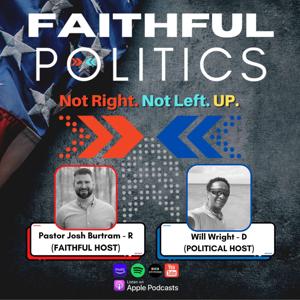
Dive into the profound world of Faithful Politics, a compelling podcast where the spheres of faith and politics converge in meaningful dialogues. Guided by Pastor Josh Burtram (Faithful Host) and…
Join our hosts, Josh and Will, as they engage with world-renowned experts, scholars, theologians, politicians, journalists, and ordinary folks. Their objective? To deepen our collective understanding of the intersection between faith and politics.
Faithful Politics sets itself apart by refusing to subscribe to any single political ideology or religious conviction. This approach is mirrored in the diverse backgrounds of our hosts. Will Wright, a disabled Veteran and African-Asian American, is a former atheist and a liberal progressive with a lifelong intrigue in politics. On the other hand, Josh Burtram, a Conservative Republican and devoted Pastor, brings a passion for theology that resonates throughout the discourse.
Yet, in the face of their contrasting outlooks, Josh and Will display a remarkable ability to facilitate respectful and civil dialogue on challenging topics. This opens up a space where listeners of various political and religious leanings can find value and deepen their understanding.
So, regardless if you're a Democrat or Republican, a believer or an atheist, we assure you that Faithful Politics has insightful conversations that will appeal to you and stimulate your intellectual curiosity. Come join us in this enthralling exploration of the intricate nexus of faith and politics. Add us to your regular podcast stream and don't forget to subscribe to our YouTube Channel. Let's navigate this fascinating realm together!
Not Right. Not Left. UP.
15,996 Listeners

19,474 Listeners
1,126 Listeners
4,427 Listeners
1,476 Listeners

7,113 Listeners

6,436 Listeners
5,113 Listeners
5,167 Listeners

576 Listeners
219 Listeners

4,376 Listeners
1,926 Listeners
560 Listeners
872 Listeners