
Sign up to save your podcasts
Or



Guest: Karen McWater, MOT, OTR/L - As SLPs, we can often look at speech and language development in isolation, as our formal assessments encourage us to do; however, it is imperative that we learn from our occupational and physical therapy colleagues regarding motor learning principles and how they parallel those of language development. When we get out of our box, we can further understand the children we work with and their capacities. Erin and Karen will discuss their journey of collaborating within this context and how they learned from each other to help the children they worked with reach further potential.
Guest: Karen McWaters, MOT, OTR/L - With all the therapy tools we have access to, all the worksheets, toys, and bubbles, it is important to understand that you are your own best tool. Karen and Erin discuss the role of effect and attunement to truly connect with children and their caregivers in sessions. They discuss the intentional relationship model and how we clinicians can use it to truly identify and improve our relationships with our clients and their caregivers to further build our connection. They will discuss the evidence behind relationship-based therapy and the true heart and joy that comes with it.
Guest: Karen McWaters, MOT, OTR/L - As SLPs, we have, in the past, passed all of our questions regarding sensory systems and regulation off to our OT counterparts due to their expansive education on the subject. However, it is time that we sit at the same table and have a conversation about sensory and its role in communication. A child needs to be regulated to grow their communication skills, and as such, we as SLPs need to learn from those around us how to support a child’s sensory system for optimal language development. Today, Erin and Karen discussed sensory systems and regulation and how it is imperative for us to join in.
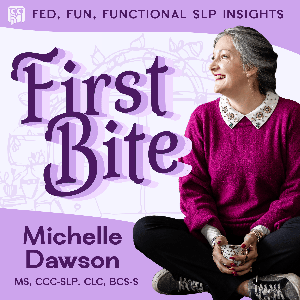
Guest: Meg Simione, Ph.D., CCC-SLP - In this episode, Michelle is joined by Meg Simione, Ph.D., CCC-SLP, a clinician-scientist focusing on infant and child feeding and growth and implementing innovations to improve care delivery. One of the hardest aspects of the “Pediatric Feeding Disorder” diagnosis to grasp can be the “psychosocial" domain. Why? As clinicians, we were trained to focus on the “feeding skill” domain, typically addressing the caregiver’s psychosocial impact falls by the wayside. But, it is critical that we understand this core component of PFD. Dr. Meg shares some of the most common psychosocial consequences, what clinicians can do to overcome these impacts, and why it is critical for clinicians to collaborate with researchers to expedite current research into daily practice for the little ones we have been called to serve.
Guest: Hallie Sherman, MS, CCC-SLP - In this episode, Hallie Sherman discusses all things about working with older elementary-age students. If you’re a “First Bite” listener but work with older elementary-age students or are considering leaving the world of early intervention and jumping to the school setting, this is the motivational hour for you. Hallie shares her tips on the trade in how to establish buy-in from older children in taking ownership of their goals and speech-therapy destiny. If you need guidance on building rapport with older speech kids, how understanding their reading fluency and comprehension levels impact all facets of their learning readiness, or how to help these students create their own speech therapy goals, this episode is for you.
Guest: Amy Miller Sonntag, SLPD, CCC-SLP - In this episode, Michelle is joined by Amy Miller Sonntag, SLPD, CCC-SLP, a faculty member in the OSU Assistive and Rehabilitative Technology Certificate Program and the current secretary of the USSAAC (United States Society for Augmentative and Alternative Communication) Board. The ability to say “No!”, the ability to say “Yes!”, the ability to name reproductive body parts, the ability to request tattoos, or a quick “Hey, how are you?” these are crucial conversations for late teens and young adults even more so when it comes to those who utilize AAC devices. So, how do we, as speech-language pathologists working with these individuals, help caregivers and AAC users determine the ideal vocabulary to communicate their wants, needs, likes, dislikes, passions, dreams, and hopes? In his hour, Amy shares current research and pulls from her clinical experiences to shape and offer guidance on holding these empowering conversations with grace and compassion.
In this episode, Michelle and Erin tackle the joy of episodic care for the treatment of Pediatric Feeding Disorder. For those who are used to productivity requirements, understand that those percentages are probably substandard during the summer months. But what if those weekly sessions for a year-long plan of care that adhere to tight productivity regimens may not be optimal for your patient or client? Let Michelle and Erin share the power of episodic care with you. The who, what, where, when, and why will all be covered in this hour-long conversation on an alternate form of service delivery.
Guest: Amanda Pericles, MS, CCC-SLP - In this episode, Michelle is joined by Amanda Pericles, MS, CCC-SLP (She/Her/Ella), a bilingual speech-language pathologist working in Charlotte, NC. Amanda, a Black Dominican-American daughter of immigrant parents and a simultaneous Spanish-English language learner engages in a crucial conversation today regarding her personal experiences as a member of the BIPOC speech-language pathology community. Our lived experiences in this profession, starting with our college journey, the application process into graduate school, the overwhelming juggling act of graduate coursework and clinical practicums, and applying for and surviving the clinical fellowship, all of it can leave a lasting impact on how we ultimately engage in the profession as “CCC-SLP.” However, research has consistently demonstrated that the lived experiences of our colleagues who are members of the BIPOC community are often fraught with additional challenges, such as academic literacy, challenges that clinical supervisors, faculty, and colleagues need to be aware of, as well as be prepared to offer strategies and support. Join in for this hour empowering hour to inspire future generations of SLPs.
Guest: Cheri Dodge Chin, ClinScD, CCC-SLP - In this episode, Michelle is joined by Dr. Cheri Dodge Chin, an Assistive Technology consultant, adjunct professor, published researcher, and one of the original SLP bloggers known as “Super Power Speech.” Cheri shares her professional lows and highs, the barriers that her students encounter, and how to work through the “storming, forming, and norming” stages of teams, to fully equip high-tech AAC users for success.
Guest: Kendra T. Allison, MS CCC-SLP - Kendra is a founding owner of Speechology communication services and founder/host of "8% Summit for Speech Pathologists and Audiologists of Color." By the end of this hour, which starts with a fair bit of astrology-driven laughter, you will be able to describe the heartfelt mentorship mission that drives Kendra and the 8% Summit, describe common barriers to members of the BIPOC community for entering the fields of speech-language pathology and audiology, as well as how mentorship can be an invaluable tool to overcome those barriers.
From the publisher's feed
171,968 Listeners

12,075 Listeners
6,450 Listeners

8,306 Listeners

221 Listeners
164,465 Listeners
47 Listeners

6,233 Listeners
13,925 Listeners
124 Listeners
27 Listeners
7,542 Listeners
427 Listeners
15,409 Listeners

29,138 Listeners
6 Listeners
3,700 Listeners
12 Listeners
3 Listeners

9 Listeners
7 Listeners
7 Listeners