
Sign up to save your podcasts
Or

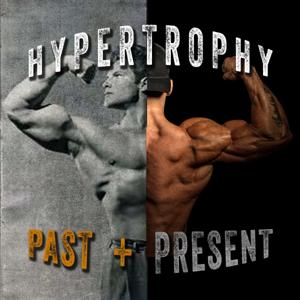


In this episode of Hypertrophy Past & Present, Jake and Chris begin with Leroy Colbert’s late-1970s enormous volume training plan. The conversation then explores whether using pre-steroid bodybuilders as a model for natural training is really an “appeal to tradition,” before examining the evidence that anabolic steroids can directly stimulate muscle growth even without resistance training.
Key topics include:
Join our Hypertrophy Past and Present Training group on TrainHeroic.com
In this episode of Hypertrophy Past & Present, Jake and Chris begin with Reg Park’s 1949 pre-contest routine, which involved training six days per week, twice per day, including the infamous 20-rep breathing squat. This leads into a deep dive on time under tension: Does making a set last longer actually increase muscle growth? Jake and Chris explore why total time under tension may be the wrong thing to measure and whether we should instead be thinking about “time under stimulating tension.”
Key topics include:
Join our Hypertrophy Past and Present Training group on TrainHeroic.com
In this episode of Hypertrophy Past & Present, Jake and Chris begin with a full-body routine from legendary bodybuilding coach Vince Gironda and the unusual reliance on isolation exercises. The conversation then shifts to workout duration: Is there any truth to the claim that workouts must be kept under 45, 60 or 90 minutes? Jake and Chris examine what actually happens as a workout becomes longer, including declining motivation, cardiovascular fatigue, exercise-order effects, cortisol, and the post-workout MPS elevation.
Key topics include:
Join our Hypertrophy Past and Present Training group on TrainHeroic.com
In this episode of Hypertrophy Past & Present, Jake and Chris begin with an early 1950s “muscular bulk” routine from Jack Delinger. They discuss the minimalist, barbell-only full-body program and how exercise variety may need to gradually increase as a bodybuilder becomes more advanced.
The conversation then shifts to training plateaus: what actually qualifies as a plateau, why slow progress is often mistaken for no progress, and how to distinguish between plateaus caused by accumulating fatigue and those caused by limitations in exercise selection or motor unit recruitment.
Key topics include:
Join our Hypertrophy Past and Present Training group on Trainheroic.com
In this episode of Hypertrophy Past & Present, Jake and Chris begin with a 1972 routine from Bradley J. Steiner and discuss what makes it one of the more sensible "golden era" bodybuilding programs they've reviewed so far and whether splitting exercises across consecutive days is likely to be more or less effective than performing all exercises in a single workout.
The conversation then shifts towards the concept of "training hard." Jake and Chris unpack what hard training actually means, why RPE is often a poor proxy for hypertrophy, and how chasing "hard training" can unintentionally encourage fatigue instead of productive training.
Key topics include:
In this episode of Hypertrophy Past & Present, Jake and Chris begin with Steve Michalik’s enormous 1972 Mr. America routine and why silver-era routines are the best data set for natural training routines. From there, Jake and Chris explore how the hypertrophy dose-response relationship interacts with the stimulating reps model. They discuss why the second and third sets provide progressively less growth stimulus, whether this means they contain fewer stimulating repetitions, and how the answer depends on whether the reduction is caused by fatigue or stimulus saturation.
Key topics include:
• Steve Michalik’s 1972 Mr. America routine
• How training status changes the number of potentially stimulating repetitions
• Combining the stimulating reps and weekly net stimulus models
• Why fewer hypertrophy gains from a second set does not necessarily mean fewer stimulating reps
• The difference between fatigue and stimulus saturation
• How longer rest periods can make a second set more effective
• Why making the second set better makes later sets less valuable
• Why back-off sets are an inefficient method for doing a second set
• How to achieve more hypertrophy stimulus with fewer total sets
In this episode of Hypertrophy Past & Present, Jake and Chris begin with Alan Stephan’s classic Silver Era full-body routine, which he reportedly followed for years while building enormous strength and muscle. This leads into a deeper discussion about exercise variation, whether exercises really “stop working”, and why good natural bodybuilding programs often end up looking repetitive.
From there, Jake and Chris move into one of the most important physiological arguments behind the stimulating reps model: hypertrophy is not a whole-muscle phenomenon, but a muscle-fibre-specific one. They discuss why this matters for understanding mechanical tension, light-load training to failure, sarcomerogenesis, stretch-mediated hypertrophy, force-velocity relationships, fatigue, exercise selection, and training frequency.
Key topics include:
• Alan Stephan’s 1940s full-body routine
• Why an exercise does not “stop working” just because progress slows
• How single-fibre mechanical tension explains the stimulating reps model
• Sarcomerogenesis, passive tension, titin, and stretch-mediated growth
• Why hypertrophy and sarcomerogenesis are not the same thing
• How cross-bridge formation and shortening velocity influence fibre tension
• Why exercise selection matters if hypertrophy is fibre-specific
• How Silver Era routines line up with modern physiology
In this episode of Hypertrophy Past & Present, Jake and Chris begin with a classic Clancy Ross full-body routine from the Silver Era, then move into a discussion about training frequency, mTOR, muscle protein synthesis, and whether training again before the previous hypertrophy stimulus has “finished” is actually a problem.
Key topics include:
• Clancy Ross’ 1940s full-body single set routine
• Whether training a muscle every 48 hours can blunt hypertrophy
• How repeated bout effect studies can be misapplied to training frequency
• Why mTOR signalling is not the same thing as muscle growth
• The role of oxidative stress and inflammation in post-workout recovery
• How volume, frequency, stress, dieting, and athletic workloads affect recovery
• Why the best training frequency is limited by recovery
In this episode of Hypertrophy Past & Present, Jake and Chris discuss a full body training A/A/A program from Steve Reeves before exploring how to choose between repeating the same full body workout three times per week or alternating between two different full body workouts.
Key topics include:
• Steve Reeves’ full body AAA routine
• Why many old-school routines online should be treated cautiously
• The lying dumbbell front raise and how it may train different regions of the chest
• Why exercise selection should come before choosing a training split
• Full body AAA vs full body ABA/BAB
• The problem with doing multiple sets of the same exercise versus using more exercise variety
• How spinal CNS fatigue, supraspinal CNS fatigue, metabolites, and calcium ion accumulation affect hypertrophy training
• How advanced lifters can use priorities to decide which exercises stay the same and which rotate
In this episode of Hypertrophy Past & Present, Jake and Chris discuss deloads. The episode begins with a look at a training program used by six-time Mr. Olympia Dorian Yates before exploring the physiology of accumulated fatigue and recovery.
Key topics include:
• Dorian Yates' Olympia-era training program
• Why training hard does not automatically mean you need a deload
• The difference between planned deloads and reactive deloads
• How accumulated fatigue affects hypertrophy training
• Whether anabolic steroid use changes the need for deloads
• How Chris would structure the “perfect” deload
• How to program RIR during a deload
• How long a deload should actually last
From the publisher's feed

12,099 Listeners

389 Listeners

1,424 Listeners

1,261 Listeners
344 Listeners

375 Listeners

372 Listeners

1,194 Listeners
1,563 Listeners

738 Listeners

211 Listeners

227 Listeners

66 Listeners

76 Listeners
306 Listeners