
Sign up to save your podcasts
Or



Based on Podcast App listening data
We are a nation of snackers and we tend to get a whopping 25% of our daily calories from our snacks. But surprisingly, snacking isn’t necessarily bad for our health. Dr Sarah Berry at Kings College London explores a pragmatic approach to snacking, and tells Michael how what you snack on and when you snack has the greatest impact on your health. You don’t have to stop snacking - just snack smartly by swapping in some less-processed options. Our volunteer Denise, a hotel facilities manager from Liverpool, tries to reap the benefits of better snacks.
Series Producer: Nija Dalal-Small
Tracking your exercise is a simple and surprisingly effective way to motivate you to move more. Most of us own an exercise tracker, whether it’s the fitness app on our phone or a special bit of kit on our wrist. But how do they make us more active? Professor Carol Maher, from the University of Southern Australia, has found wearing an activity tracker really can encourage more physical activity. She tells Michael how the instant feedback allows people to take control of their activity levels. Michael learns the extra movement a tracker encourages can really help improve your brain power and reduce your risk of certain cancers and type 2 diabetes. Volunteer Rumbi opens her fitness app and steps out to see if it really works.
Series Producer: Nija Dalal-Small
Michael discovers his long-time penchant for an early night could have some real health benefits. If you are someone who could go to sleep earlier and simply put it off with an extra episode or phone scrolling, Michael recommends going to bed an hour earlier than normal because getting enough sleep deeply impacts your brain, protecting against depression and other neurological problems. Professor Esra Tasali at the University of Chicago's Sleep Centre, shares her research that sleeping an extra hour a night has been found to have an incredible effect on our appetite, reducing cravings often linked to weight gain. Our volunteer Dylan, who is very health and exercise conscious, is surprised to find a little more sleep every night could benefit his fitness routine.
Series Producer: Nija Dalal-Small
Michael discovers incorporating wholegrains into our diet, is a tasty swap that could really benefit our health. Wholegrains such as wholegrain pasta, bread and brown rice contain more fibre, vitamins and minerals, than refined grains. This simple swap can help reduce blood pressure, improve heart health and boost the gut microbiome. Michael talks to Dr Caleigh Sawicki, from the Brigham and Women’s hospital and Harvard Medical School, whose research suggests that the fibre consumption of wholegrains can keep us fuller for longer and this slow digestion could result in a lower increase in blood sugar.
Series Producer: Nija Dalal-Small
Michael adds a plank into his exercise routine and is surprised to learn of its huge benefits to our physical health. Dr Jamie O'Driscoll, a Reader of Cardiovascular Physiology at Canterbury Christ Church University, reveals how the plank is a form of isometric exercise, where muscles are held still, neither stretching nor contracting. Jamie shares his research that found these exercises, including the plank and the wall-squat, could massively reduce our blood pressure. Michael also explores how the plank can even be better than crunches of sit ups for your abs and core muscles. Our volunteer Penelope takes on the plank, excited to learn that this small addition to her fitness regime could wield great results.
Series Producer: Nija Dalal-Small
Michael takes a break to brew up a cup of green tea, warming up to its distinctive taste and its health benefits. Dr Edward Okello, from the Human Nutrition Research Centre at the University of Newcastle, reveals how green tea can benefit our brain power and health. Green tea contains the polyphenol EGCG (Epigallocatechin Gallate) and Professor Okello explains how this polyphenol inhibits a destructive enzyme which harms our brain cells. Michael also learns that a nice hot cup of green tea also induces calming brain waves, improves heart health and could even help delay dementia. Meanwhile, volunteer Jacqui enjoys the benefits of going green.
Series Producer: Nija Dalal-Small
During the winter months, here in the UK, days are short and there isn’t enough sunlight for most of us to make the Vitamin D we need. Taking a tiny Vitamin D supplement is a minute change that could have a huge impact on our health. Professor David Llewellyn from Exeter University explains to Michael that Vitamin D helps clear abnormal proteins, such as amyloid plaques and tau, from the brain, which may help protect you from dementia. Having enough vitamin D can also boost your immune systems, making that common cold easier to recover from. It could even lift your mood! Volunteer Baljit tries making Vitamin D a habit.
Series Producer: Nija Dalal-Small
We could all use a little kindness in our lives. Surprisingly, a little altruism can actually have big benefits for our own health! Michael discovers that small acts of kindness can not only boost your mental health and improve your relationships but also boost the immune system. Dr Tristan Inagaki from the San Diego State University explains to Michael how her research has revealed that those performing acts of kindness had lower levels of systemic inflammation, which could reduce the risk of many major diseases. Meanwhile, our volunteer Sam enjoys finding ways to consciously incorporate kindness into his week.
Series Producer: Nija Dalal-Small
In this series of special editions of BBC Radio 4 podcast Just One Thing, Michael Mosley quizzes the world’s leading health experts on the best ways to live well.
We hear the top tips that Professor Lord swears by to reduce the damaging effects of inflammation on our body. How can simply moving your muscles make anti-inflammatory chemicals? Why could how much you eat be important? And what should you be eating to help reduce inflammation?
And as this is a Just One Thing special, we'll end each interview by asking Professor Lord for the one single-most effective health hack to reduce inflammation.
Producer: Dom Byrne
In this series of special editions of BBC Radio 4 podcast Just One Thing, Michael Mosley quizzes the world’s leading health experts on the best ways to live well.
And as this is a Just One Thing special, we'll end each interview by asking Professor Yeo for the one single most effective health hack to shift a few pounds.
Producer: Dom Byrne
From the publisher's feed
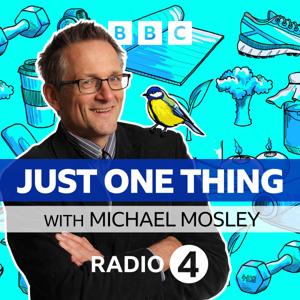
If time is tight, what's the one thing that you should be doing to improve your health and wellbeing? Michael Mosley reveals surprisingly simple top tips that are scientifically proven to change…
Ranked by our users in the last 21 days

7,624 Listeners

1,044 Listeners
382 Listeners

5,482 Listeners

1,796 Listeners
1,813 Listeners
1,034 Listeners
2,022 Listeners
265 Listeners
96 Listeners
80 Listeners
235 Listeners
582 Listeners
3,592 Listeners
133 Listeners
268 Listeners

3,224 Listeners

1,003 Listeners
115 Listeners

1,004 Listeners
113 Listeners
59 Listeners
2,027 Listeners
101 Listeners