
Sign up to save your podcasts
Or



Show notes: https://www.leanblog.org/6
Remastered June 2021
Here is LeanBlog Podcast #6, the second part of my discussion with Jamie Flinchbaugh, co-author of The Hitchhiker's Guide to Lean. You can find the first part of the podcast here.
In this Podcast, we talk about how leadership needs to apply the ideas of waste to reduction to their own jobs and how leaders really “lead” rather than being merely “behind” lean efforts.
Show notes: https://www.leanblog.org/5
Remastered June 2021
Here is LeanBlog Podcast #5, with a new guest: Jamie Flinchbaugh, co-author of The Hitchhiker's Guide to Lean. In this Podcast, we talk about the “language of waste” and how waste reduction is a critical tool in the implementation of lean manufacturing and the Toyota Production System. There will be a second Podcast to follow, where we focus more on the role of leadership in driving waste out of your processes.
If you're a regular Lean Blog reader, you should recognize Jamie as a valued contributor to the blog. Click here for a link to some of his blog posts. Prior to starting the Lean Learning Center, Jamie was part of the development, training and implementation of the Chrysler Operating System. Jamie also worked at DTE Energy, parent to Detroit Edison, as a lean thought leader to help transform the operations, leadership and thinking of the utility industry towards a philosophy of lean systems. You can read more about his background here on Jamie's web site.
Show notes: https://www.leanblog.org/4
Remastered June 2021
This is the second part of my discussion (started in Episode #3) with Dr. Jeff Liker of the University of Michigan and his books, including "The Toyota Way." This time, we focus on "lean healthcare" or the applications of lean in hospital settings, waste elimination, and problem solving.
Please visit www.leanblog.org for show notes, links and more information.
Author of "The Toyota Way"
Show notes: https://www.leanblog.org/3
Remastered June 2021
Here is the third LeanBlog Podcast, featuring Dr. Jeffrey Liker, Professor of Industrial and Operations Engineerring at the University of Michigan. Dr. Liker is very well known in the lean world and is a leader in studying Toyota's own practices and management approaches. More information about Dr. Liker and his books can be found in the show notes, below.
Remastered audio June 2021
Show notes https://www.leanblog.org/2
Here is the second LeanBlog Podcast, featuring author and consultant Norman Bodek, President of PCS Press.
The first one can be found here and you can visit the main Podcast page, which includes information on how to subscribe via RSS or via Apple Podcasts.
Author & President of PCS Press
Remastered June 2021 (the best I could do with a 2006 recording)
Show notes: HTTP://www.leanblog.org/1
Here is my first LeanBlog Podcast, featuring author and consultant Norman Bodek, President of PCS Press.
I have to give credit for the idea to Norman, as he approached me about doing a series of audio interviews as a follow up to and continuation of our Q&A that I posted here on the blog earlier this year. I'll take credit for turning it into a Podcast, something that I plan on making a regular feature, every month or so. There will be additional conversations with Norman and I also plan on interviewing other lean leaders and innovators.
Visit the main page for all episodes and information about how to subscribe.
Here is a blog entry that Norman wrote about the podcast, with additional thoughts:
“Mark Graban interviewed me this past week for his first Podcast. We talk about my discovery of Quick and Easy Kaizen, how it was the heart of the Toyota system – getting all employees involved in continuous improvement. The puzzle to me is why every company doesn't add this most valuable process to their management lexicon. We say that “People are our most valuable asset.” but we do very little to develop that asset to its fullest.
China does represent short-term labor savings but in the long term we are giving away our companies to them. This week I was watching parts of the Tour de France bicycle race on television and saw one of the leaders on a Giant bike.
At one time over fifteen years ago, Schwinn was probably America's leading bicycle company. They went to Taiwan to manufacture their bikes to take advantage of the low labor cost. The company in Taiwan was Giant. Initially, Schwinn wanted to reduce their assembly costs but Giant convinced them to also save money on engineering and every other phase of manufacturing and design. After ten years or so when the initial contract was over, Giant told Schwinn, “We don't need you anymore. We know how to make great bikes, you taught us how.” All we have to do is learn how to market the bikes. “Shortly, thereafter Schwinn went bankrupt and sold their “name,” to another American company.
Unfortunately, we are great in short term thinking. Toyota recognizes the threat from China but they are building more and more automobiles in America. If they can do it why can't other American companies do it? To me, the only difference in Toyota and American manufacturers is that Toyota develops their people and the best way to develop people is from their own creative ideas.
Please do listen to the podcast…
And give me some feedback,
Thank you”
Here is an amazon.com link to Norman Bodek's Books.
My announcer is my old friend, Steve Sholtes, a musician from Michigan.
From the publisher's feed
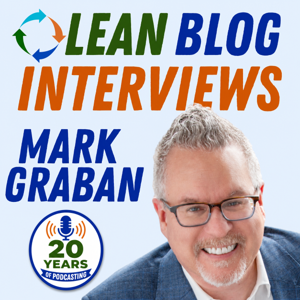
Lean Blog Interviews: Real-World Lean Leadership Conversations features thoughtful, in-depth discussions with leaders, authors, executives, and practitioners who are applying Lean thinking in the real world.
Hosted by Mark Graban—author of Lean Hospitals, Measures of Success, and The Mistakes That Make Us—the podcast explores Lean as a management system, a leadership philosophy, and a people-centered approach to continuous improvement.
Episodes span healthcare, manufacturing, startups, technology, and professional services. Guests share candid stories about what actually works—and what doesn’t—when organizations try to improve.
This is not a podcast about chasing tools, jargon, or “Lean theater.” Instead, you’ll hear honest conversations about leadership behaviors, culture, psychological safety, learning from mistakes, and building systems that help people do their best work.
If you believe improvement starts with respect for people—and that better systems beat blaming individuals—this podcast is for you.
Find show notes and all episodes at LeanCast.org.
Learn more about Mark Graban at MarkGraban.com.

32,056 Listeners
452 Listeners
1,462 Listeners

198 Listeners
15 Listeners

27 Listeners

8,554 Listeners
9,066 Listeners

20 Listeners
376 Listeners
2,432 Listeners

9 Listeners
2,204 Listeners

40 Listeners
19 Listeners

153 Listeners
1,619 Listeners
28 Listeners