
Sign up to save your podcasts
Or



As therapists we know that every client is different when it comes to goals, abilities, and needs but how often are we checking up on our cultural awareness for each individual? Maria Davis-Pierre is a mental health counselor and the founder of Autism in Black. As a mother with two autistic children and autism herself, Maria understands the stigma associated with the diagnosis and is on a mission to educate on inclusive, culturally responsive therapy for black families and other underrepresented cultures.
“Is there anything culturally we should know about you?” A question Maria highlights as one of the best questionnaire form inclusions she has seen when it comes to starting therapy. As a professional and therapist working with unique individuals from all cultures and backgrounds, there are no details too small to incorporate into therapy that fit your client's culture. For example, bring culturally relevant props for a therapy lesson or check your understanding of cultural concepts that could be a typical household routine for one culture but seen as a learning deficit in another.
Whether props, books, flashcards, etc. be cognisant of your materials and the reflection of your client within them. It is important for black children to see themselves reflected in their learning materials to not only understand but also stay engaged. It is okay if you’re not an expert on every culture and every family. Ask questions, be open, and create a dialog so that you can continue to learn and support your clients in a culturally responsive way.
What to keep in mind when getting started with culture-responsive therapy:
As therapists and professionals are number one, the goal is to always help the children and culturally responsive therapy is a really important but often forgotten piece of that. Maria shares some great tips and insights for professionals to consider. You can find out more about her work on the Autism in Black website.
What’s Inside:
Mentioned In This Episode:
Autism in Black
ABA Speech: Home
Register for the free SLP in an ABA Setting Mentorship webinar
Dr. Ariana Boutain is the Vice President of Clinical Services at KGH Autism Services. At their facility, they are passionate about child-initiated and play-based therapy with NDBI.
Naturalistic Developmental Behavioral Intervention is an empirically supported approach to treating young children with autism that involves learning through play. NDBI represents a merge of ABA and developmental science.
The general framework for NDBI that Dr. Ariana and her colleagues use is the principles of ABA as well as developmentally based assessments and intervention strategies for guiding goal development and individualization. Teaching strategies with NDBI involve child-initiated, child-led play. This involves environmental setup, communication temptation, and shared control with turn-taking.
Interdisciplinary collaboration is a hot topic in the field of autism but it is a high priority at KGH. As they add SLPs, OTs, and other providers to their team they match therapy approaches, encourage play-based therapy for all disciplines and provide thorough training on NDBI.
You can find out more about the work and treatment model at KGH on their website!
#autism #speectherapy
What’s Inside:
Mentioned In This Episode:
Our Services | KGH Autism Services: ASD Treatment Clinic, Chicago & Madison
Advanced Language Learner - Sign Up Today - ABA Speech
Register for the Pyramid Educational Consultant’s Third Annual FUNctional Communication Conference on October 17th & 18th
ABA Speech: Home
Whether you’re a parent, professional, or an autistic individual, you have most likely seen the Autism Puzzle Piece. Like myself, you might even have a sticker or magnet on display as a symbol of your support for the community. But what is the real symbolism behind it? In this episode, I have the honor to talk with Thomas McKean, an autistic adult who had an integral part in the development of this icon.
Prior to Thomas’s collaboration in the creation of today’s autism puzzle piece, the original icon developed in 1963 was a puzzle piece with a child crying. This symbol represented the hopelessness, sadness, and confusion for children with autism at the time. In the 1960s, there was little to no research, ethical treatment, or support for autism families.
When Thomas and his colleagues developed the new symbol in 1999 they knew the view and information about autism had changed a lot. There was much more hope and a positive shift had taken place in the community. They wanted to embody that. The autism symbol as we know it today is represented by a puzzle piece reflecting the information we are still missing and learning as we add new “pieces”, it features a multi-colored design to represent diversity in the community.
"If you've met one person with autism, you've met one person with autism." - Dr. Stephen Shore
This representation of diversity is so crucial to Thoma’s advice when it comes to division in the field. He says, the difference is not bad, in fact, it's necessary. Because each individual with autism is so different it's important for professionals to see things differently and really work toward an individual approach. No professional is going to have all the answers for every autistic person, and when we understand that, we can peacefully collaborate.
Thomas says one of his most asked questions is how to help parents who are just venturing into their autism journey with their child. For that, he has 4 steps.
This was such an enlightening talk on the true vision and meaning of such an important icon in our community. I hope you found it just as interesting as I did!
#autism #speectherapy
What’s Inside:
Mentioned In This Episode:
Thomas A. McKean
Thomas A. McKean | Facebook
Advanced Language Learner - Sign Up Today - ABA Speech
Register for the Pyramid Educational Consultant’s Third Annual FUNctional Communication Conference on October 17th & 18th
ABA Speech: Home
“Rose speaks through the lens of the SLP and BCBA which is incredibly helpful in bridging the communication between the two fields. Rose keeps students' individual needs at the forefront of decisions on therapy targets and she incorporates autistic voices and has worked hard to keep therapy and training relevant to autistic learners. I appreciated her practical therapy ideas and sharing of materials to get started.” Jenny Blackman, SLP
Introducing ABA Speech’s newest course, Advanced Language Learner. A brand new 5-hour ASHA and ACE-approved course. Are your autistic learners struggling to break beyond their basic communication skills? Plateauing? This course is packed full of helpful, transformative content to bring your learners and your therapy to the next level.
What can you expect to learn?
-Effective assessments
-Collaboration tips and techniques
-Developing expressive and receptive communication skills
-Strengthening social skills AND respecting individuality
-IEP Meeting Tips
-Effective group intervention
-Guest Lecturer: Oliver Wendt, Matrix Training
-Monthly group mentoring and support with access to the online community
-Materials: Adapted books, no prep group activities, language book, leisure activity visuals, and so much more.
Do not miss out on this one-time-only FOUNDERS pricing: $197 available for 1 week only!
#autism #speectherapy
What’s Inside:
Mentioned In This Episode:
Advanced Language Learner - Sign Up Today - ABA Speech
Register for the Pyramid Educational Consultant’s Third Annual FUNctional Communication Conference on October 17th & 18th
ABA Speech: Home
“Rose, I’m not sure how to plan a session. I have 5 autistic students that I need to see for group therapy to work on social language instruction and I am not sure what activities to plan to help them remain engaged and work on their individual and social language goals.”
I received this question in an email from one of my listeners! So today’s episode I am sharing my customizable framework for planning group therapy, along with some great resources, activity ideas, and freebies!
Group Therapy Framework
Tools: SmartBoard or iPad for sharing visuals with group
Question of the Day
Literacy-Based Activity
Extension Based Activity
Leisure Based Activity
I have linked all of the resources and freebies I shared today that can be used in this customizable framework for planning group therapy sessions for autistic learners, be sure to check them out!
#autism #speectherapy
What’s Inside:
Mentioned In This Episode:
Fall Freebie Would You Rather by ABA SPEECH
Farm Visit Adapted Book by ABA SPEECH
Grocery Store PPT
Register for the Pyramid Educational Consultant’s Third Annual FUNctional Communication Conference on October 17th & 18th
ABA Speech: Home
Start Communicating Today – Waitlist – ABA Speech
Help Me Find My Voice – EVERGREEN – ABA Speech
What is it that develops speech production in our learners? Today, Tamara Kasper, BCBA and SLP, is sharing some really great and specific information on how speech production and reinforcement differs between typical developing children versus children with autism.
Speech Sound Production
In typically developing children, speech sounds are reinforced differentially and automatically when making sounds that sound like words. For example, they get a cookie when they make a sound that sounds like cookie or they get happy, hugging excitement when they say something that sounds like mama or dada. Naturally, typical children are encouraged by the sounds and interactions in their environment and want to match the sounds made by the people they value in their world. This is where self-correction and refinement comes in because they will notice and hear how their sounds may sound different from the adults around them.
In non-typically developing children, specifically those with autism, they are more sensitive to social stimuli and are less likely to be affected by the attention of their parents or guardians in regards to their sounds. So the traditional, automatic reinforcement to make and refine sounds is not occurring. Additionally, these learners will not likely notice how their sounds sound different from those around them, leading to no self-correction as sound production continues.
Therapy for Speech Sound Production
Tamra shares her assessment and criteria for determining readiness for working on speech production. She collects metrics from the VB-MAPP, indicating responses, manding rate and variety, instruction cooperation development, and echoic repertoire. The scores and data from these metrics will relay whether a Natural Environment or Structure Teaching therapy is appropriate for these students. Within these systems, Tamra discusses the programs she uses. She shares today a little bit of her rubric on how she assigns these programs based on the needs of the child and assessment criteria.
If you’d like to learn more about Tamra, you can find out more about her work and some video tips at Northern Speech Services. Additionally, if you’d like access to her therapy rubric discussed today and other resources, you can reach her via email.
#autism #speectherapy
What’s Inside:
Mentioned In This Episode:
[email protected]
Northern Speech Services
ABA Speech: Home
Start Communicating Today – Waitlist – ABA Speech
Help Me Find My Voice – EVERGREEN – ABA Speech
September 13th FREE Webinar 8-9 pm EST registration link
September 14th Free Webinar 8-9 pm EST registration link
Nothing can cause more stress than an IEP meeting looming in the future. But it doesn’t have to be that way. Stephanie DeLussey, IEP coach and veteran special education teacher, joined me on the podcast today to share some tips and suggestions for making IEPs not only painless but more productive.
Goal Setting
SMART goals are a big buzzword in the education community, but what does it mean? Stephanie breaks down the acronym;
Specific -Is the goal individualized and a direct skill, no generalizations?
Measurable - Can the goal be tracked with data?
Attainable - Is this goal realistic for the student?
Relevant - Is this goal relevant to the student's needs, capabilities, and grade level?
Timebound - Is the goal given a realistic timetable to be met by the student?
Objectives and benchmarks are often used interchangeably when discussing goals, but they are not the same. Objectives are larger skills broken down into smaller skills and goals. A Benchmark looks more like the Annual IEP Goal but is broken into steps to achieve it. As Stephanie called it, ‘same staircase, different way to climb it’.
Every state's guidance when it comes to skills can be very different, some have State Standards, some have Common Core, some have Essential Elements. Depending on even your district or your individual school, whether you include these in your IEP goals or not. Stephanie explains how this relates to the IDEA Federal Law, state laws, and local recommendations.
Stephanie’s Top Two Tips for IEP Preparation:
1. Send Draft IEP - Stephanie recommends always sending home a draft IEP including the present levels of baseline data and the proposed goals. This levels the playing field for the caregiver, and provides much more collaboration between guardian and education team.
2. Consult the General Ed Teacher - Recognizing that there can be animosity between special education and general education teachers, Stephanie encourages collaboration and to work together on IEP accommodations to create individualized and classroom specific modifications.
You can find out more about Stephanie via Mrs. D’s Corner for educational resources and The Intentional IEP for IEP support.
What’s Inside:
Mentioned In This Episode:
The Intentional IEP
Mrs. D's Corner
ABA Speech: Home
Start Communicating Today – Waitlist – ABA Speech
Help Me Find My Voice – EVERGREEN – ABA Speech
September 13th FREE Webinar 8-9 pm eastern registration link
September 14th FREE Webinar 8-9 pm eastern registration link
When it comes to parents advocating for their child’s education there can be so much to navigate, many times parents don’t even know their legal rights. Amanda Selogie and Vicki Brett are attorneys and founders of The Inclusive Education Project, a non-profit organization that educates families on special education rights.
If you have a child receiving in school therapy or you're a school based provider, you may have heard the term IEE. But what is it? An IEE is an Individual Education Evaluation performed by a qualified person not employed by the school district. This evaluation is a legal right detailed in 34 CFR § 300. 502.
The purpose of IEE is to service the child. Not the parent. Not any providers. Not the school district. This is why these can be such a great tool. Parents might seek these out if a child’s education plan is missing critical assessments or if there is a disagreement in the analysis of any assessments. The idea is to get a full scope and understanding of a child’s abilities and needs to best inform their education and any interventions or services. When requesting an IEE it's important to look at what’s the concern with the current assessments, and what is the goal an IEE can help achieve?
If you’re a school based provider, do not be offended about the request for an IEE. The need for an IEE does not mean a therapist, or provider is not doing their job. There are certain limits that can prevent authentic results, such as access to limited assessments, testing environments, and sometimes a damaged rapport. The benefit of an IEE being conducted by a non-school district employed provider means that often the evaluator has different, more complex qualifications and expertise. Meaning, the evaluator can assess and analyze across disciplines. An IEE evaluator can offer fresh perspective, new environment, and more variety in assessment options.
When we’re determining an education plan for a child, more information is ALWAYS better. The more everyone knows about a child's needs and abilities, the more detailed and purposeful goals can be made. Amanda and Vicki are doing great work spreading awareness of parents rights for their children’s education. You can reach them at their website, social media, or via email.
#autism #speectherapy
What’s Inside:
Mentioned In This Episode:
Inclusive Education Project
@inclusiveeducationproject - Instagram
Inclusive Education Project - Home | Facebook
[email protected]
ABA Speech: Home
Start Communicating Today – Waitlist – ABA Speech
Help Me Find My Voice – EVERGREEN – ABA Speech
There is so much opportunity for communication in our students' natural environments. But how can we use this intentionally and build our therapy plan around it? Dr. Cindy Gevarter, BCBA-D and assistant professor in the Department of Speech and Hearing Sciences at the University of New Mexico, joins me to discuss real world applications for naturalistic communication training in your therapy sessions.
Assessments:
When beginning therapy sessions for students, assessments are important for understanding students skills, goals, and needs. Dr. Gevarter listed several of her preferred assessments for naturalistic communication training that we have talked about on the show many times!
Planning:
Naturalistic communication is not random play, when preparing for a session keep in mind opportunities, routines, and priorities that are typical for your student. But you can’t just wing it. Dr. Gevarter recommends planning with an Activity Matrix: skills and goals associated with activities and embedded strategies. Follow through with developmental extension, parent coaching, and an environment set up for natural communication. A lot of the strategies and planning we discuss apply directly to 1 to 1 sessions, but Dr. Gevarter elaborates on how to plan for dyads and group settings by intentional peer to peer interaction or typical routines such as circle time or an art activity.
Data:
In a natural environment, we can’t pause a student while we record data. Dr. Gevarter suggests simplifying your data for quick observations. You may try using a rating scale or other shorthands that you can understand when noting responses, and goal planning. Remember that this is informal data collection used to inform your sessions, don’t overcomplicate it!
Why Natural Environment?
I often find parents in in-home sessions surprised that our therapy isn't taking place at a table with structured activities. While there is a time and a place for the table, there is a major benefit to utilizing a student's natural environment. When participating in natural play or natural environment activities, students are seeing and receiving natural reinforcement from their communication. They can actually see and experience the benefit of communication.
#autism #speechtherapy
What’s Inside:
Mentioned In This Episode:
Cindy Gevarter, Ph.D., BCBA-D
Collaborative Autism Grant
Project SCENES
ABA Speech: Home
Start Communicating Today – Waitlist – ABA Speech
Help Me Find My Voice – EVERGREEN – ABA Speech
I always joke that it is my mission to meet all the unicorns out there, the dually certified SLP and BCBAs, as there are less than 500 in the world. Today I am talking with Dr. Teresa Cardon and Dr. Lina Slim both SLPs and BCBA-Ds. We are focusing on a subject that it a hot topic but near and dear to my heart, collaboration.
Too often I see and hear problems between SLPs and BCBAs in therapy, IEP meetings, etc. But we need to be communicating and collaborating for our clients! Dr. Cardon and Dr. Slim share their perspectives on what barriers exist that are making these relationships so difficult.
First and foremost is communication, frequently there is not respectful, humble, and open communication between these two providers. Additionally, specialty specific jargon is thrown around that can confuse and frustrate other professionals who arent “in the know”. Interpersonal skills, self-reflection, and bias awareness are really key to keeping communication productive. Try going into every conversation with your professional team of other specialties with the understanding that no one is wrong, we just see things differently.
We also discuss logistical differences such as philosophy and theory. Your philosophy as a therapist can really impact your practice and how you view other providers. Whether you approach with a behavioral, developmental, or social theory will really guide your thinking and reception of collaboration with differing points of view.
Dr. Lina Slim shares with us the ideas of the Four Domains of Authentic Interprofessional Culturally Aware and Responsive Collaborative Practice.
We are in agreement that collaboration has to be more common practice in our fields. Working together will benefit the health and educational outcome of the clients we serve. It is necessary, because it is simply not possible for one person to have all the answers.
We have got to start teaching this practice before our new therapists enter schools and facilities! Dr. Slim and Dr. Cardon both share how they are advocating and encouraging this in the field through there work in this great episode!
What’s Inside:
Mentioned In This Episode:
[email protected]
[email protected]
ABA Speech: Home
Start Communicating Today – Waitlist – ABA Speech
Help Me Find My Voice – EVERGREEN – ABA Speech
From the publisher's feed
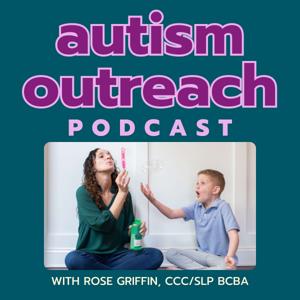
Join Rose Griffin, a dedicated Speech Therapist and BCBA from ABA SPEECH, as she shares her compassionate approach to supporting the communication needs of autistic individuals. With 20 years of…
This podcast is a resource for professionals and parents alike, offering practical strategies that honor each person's unique communication style. Rose covers a wide range of topics, including how to recognize and support autistic communication from an early age, the distinctions between autism and speech differences, and effective, respectful approaches to fostering communication, whether a child is non-speaking, minimally speaking, or verbal.
Through a mix of interviews and solo episodes, Rose explores how to enhance meaningful connections, address challenges with empathy, and celebrate the strengths of autistic individuals. Whether you're a parent, therapist, or educator, you'll find valuable insights and actionable advice to create supportive environments that empower communication and honor neurodiversity.
Hit subscribe and learn more at www.abaspeech.org.

7,683 Listeners
11,950 Listeners

626 Listeners
9,093 Listeners

25,787 Listeners
4,759 Listeners

46,879 Listeners
1,346 Listeners
625 Listeners
422 Listeners

15,404 Listeners

29,200 Listeners
59 Listeners

19,209 Listeners

10,193 Listeners