
Sign up to save your podcasts
Or



Based on Podcast App listening data
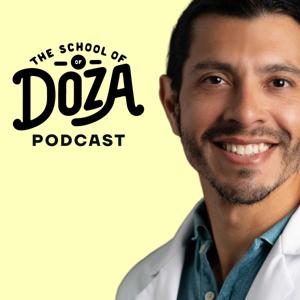
In this School of Doza episode, Nurse Doza kicks off a new series on the health numbers that matter more than the scale. Using the Hume Pod and app, he explains how body composition (body fat percentage, skeletal muscle mass, and visceral fat) tells a fuller story than weight alone, why two people at the same weight can differ, and a simple morning weigh-in habit that tracks trends, not daily swings. Next up: how these numbers connect to your liver and blood sugar.
Hume Health makes the Hume Pod and companion app Nurse Doza uses in this series to look beyond body weight. Stepping on the pod shows body fat percentage, skeletal muscle mass, and visceral fat, and the app displays where you are alongside reference ranges so you're not guessing. Hume Health also backs its devices with a 10-year warranty.
👉 Shop Hume Health: https://humehealth.com Use code NURSEDOZA for 20% off.
Disclosure: Hume Health provided the device featured in this series, and School of Doza earns a commission when you use the code NURSEDOZA. Only products Nurse Doza personally uses are featured. Body composition readings from at-home devices are estimates and are not intended to diagnose, treat, cure, or prevent any disease. Talk with your healthcare provider about your results.
Making sense of your numbers is easier with support. Inside the School of Doza, members learn alongside others working on the same goals, and every Wednesday at 1 PM Central there's a live group consult where you can bring your questions about labs, nutrition, supplements, and lifestyle.
👉 Start your free trial: https://community.schoolofdoza.com/c/start-here
Based on peer-reviewed literature:
JOIN MY SCHOOL for FREE: https://community.schoolofdoza.com/c/start-here
Fatty liver and belly fat tend to show up together, and this episode makes the case that it isn't a coincidence. Your liver is one of the main places your body decides whether fat gets stored, moved, or burned for fuel. Nurse Doza walks through six things that get in the liver's way — insulin resistance, too little brown fat, gut damage, eating when you're not hungry, poor methylation, and shallow sleep — and what the research says about each one.
Liver Boost (Detox) — $111
Sixteen ingredients in a single capsule — milk thistle, NAC, alpha-lipoic acid, turmeric, broccoli seed extract, green tea extract, selenium — formulated to support phase I and phase II liver detoxification and your body's own glutathione production.*
This whole episode is about clearing the path for the organ doing the work. Liver Boost is support for that organ while you change the sleep, the food, and the fasting window. One to two capsules a day.
Through October 31: buy 2, get 1 free — 3 bottles for $222, roughly a six-month supply. No code needed; the discount applies at checkout.
👉 Get Liver Boost here: https://liverboost.mswnutrition.com
*These statements have not been evaluated by the Food and Drug Administration. This product is not intended to diagnose, treat, cure, or prevent any disease. Individual results vary; this is education, not medical advice.
If this episode left you looking at a lab report that never had fasting insulin or leptin on it, that gap is exactly what the School of Doza was built for. Same for the belly fat that hasn't moved in a year of doing everything right.
Every Wednesday there's a live Ask Me Anything that runs like a group consult — labs, nutrition, supplements, liver questions, belly fat questions. You bring it, Nurse Doza answers it directly. It's live only and never recorded, so being in the room is the whole point.
Inside you will also find the courses referenced in this episode — fasting, the liver, MTHFR, and sleep — plus the community working through the same things you are.
👉 Start your free trial: https://community.schoolofdoza.com/c/start-here
00:00 START – Welcome and episode overview
02:54 – #1 Insulin resistance
05:59 – Fasting to lower insulin
07:14 – Diet, simple carbs, and berberine
08:44 – #2 Not enough brown fat
11:35 – Cold exposure and thermogenesis
14:03 – #3 Gut issues and your own GLP-1
16:33 – Leaky gut, dysbiosis, and testing
18:58 – The inflammation cascade: IL-6 and hs-CRP
22:02 – #4 Eating when you're not hungry
23:25 – Leptin resistance and the missed signal
25:52 – Fasting insulin and leptin on labs
28:28 – #5 Poor methylation and MTHFR
33:21 – #6 Deep sleep
38:07 – Liver Boost and the October offer
Links are printed as visible text — YouTube strips hyperlinks from descriptions.
🔗 Connect with Nurse Doza:
Muscle after 40 is the thing women are told to ignore, and it is the one that changes everything. Nurse Doza breaks down why skeletal muscle is an organ, how it makes its own estrogen, why insulin resistance shows up in muscle first, and how much protein menopause actually calls for. Plus the amino acid most women have never been told about.
Liver Boost (Detox) by MSW Nutrition — a comprehensive formula designed to support phase I and phase II liver detoxification of environmental toxins.* Estrogen doesn't simply disappear once it has done its job: it gets conjugated in the liver and cleared through bile. This episode is about the estrogen your muscles make, and the liver is the organ standing at the end of that pathway — the same organ Nurse Doza points back to when he talks about glycogen, fatty liver, and hormones in your forties.
October only: buy 2, get 1 free — 3 bottles for $222, a six-month supply. No code needed; the discount applies at checkout.
👉 Get Liver Boost here: https://liverboost.mswnutrition.com
Also mentioned in this episode — Gut (Digestive Health), the L-glutamine powder Nurse Doza takes at 8 grams each morning, 4 grams per scoop, nothing else added.
👉 Get Gut here: https://mswnutrition.com/products/gut
These statements have not been evaluated by the Food and Drug Administration. This product is not intended to diagnose, treat, cure, or prevent any disease.
If this episode named something you have been living with — aches that got written off as aging, a scale that will not move no matter how little you eat, hormone advice that contradicts itself every time you ask — the School is where those questions get answered directly instead of in a comment thread.
Every Wednesday at 1pm Central there is a live Ask Me Anything that runs like a group consult. Labs, nutrition, supplements, what is actually going on in your body. You bring the question, Nurse Doza answers it in the room. These are live sessions, not recordings — you have to be there.
The Liver Course is running right now, class plus Q&A every Tuesday, wrapping October 13 with Building Your Liver Protocol. September 29 is The Gut Liver Loop, which connects straight to the gut and muscle conversation in this episode.
Your first 7 days are free, so you can sit in on an AMA or a class and decide for yourself.
👉 Start your free trial: https://community.schoolofdoza.com/c/start-here
00:00 START – Welcome and episode overview
01:45 – What is happening inside the School of Doza
03:00 – #1: Your muscles are an organ, not just tissue
04:39 – #2: Your muscles need estrogen
05:20 – Myogenic estrogen: made in skeletal muscle
07:01 – Atrophy, aches, and estrogen receptors
08:10 – Protein in menopause: the actual number
08:50 – The protein math: 68 to 81 grams a day
11:16 – When protein is simply too much food
13:40 – L-glutamine, and four grams per scoop
14:35 – #3: Insulin, the most anabolic hormone you make
15:48 – Estrogen, insulin, and the ovaries
18:12 – Glycogen, fatty liver, and fatty muscle
20:33 – #4: You will not bulk up unless you want to
25:18 – #5: Testosterone is not always the answer
Most people handed an MTHFR result never get it explained. This episode connects MTHFR and liver function — why so much of that gene's work happens in the liver, what methylation actually means in plain language, and how the pathway ties into glutathione, detoxification, and mood. Nurse Doza also covers why methylfolate alone is rarely the whole picture, and what's worth discussing with your own provider. Education, not a protocol.
The MTHFR Stack — Bliss + Boost + Liver Boost
Three formulas built around the same pathway this episode is about. Bliss is a sublingual shot with SAMe and TMG (trimethylglycine) — it supports biochemical reactions that require methyl groups and supports neurotransmitter synthesis and healthy mood. Boost is a morning stick pack built on methylcobalamin — B12 already in its methylated, active form — alongside methylated B vitamins, electrolytes, and antioxidant nutrients (heads up: it contains caffeine, roughly 95 mg). Liver Boost is the capsule piece, formulated to support phase I and phase II liver detoxification.
The rhythm is simple: Boost in the morning, Bliss whenever it fits your day, Liver Boost with a meal.
👉 Get The MTHFR Stack here: https://mswnutrition.com/products/mthfr-stack
If you take medication, run any new supplement by your provider first.
If you walked out of an appointment holding a genetic result and no explanation, that's exactly the gap the School of Doza was built to close.
Every Wednesday at 1pm Central we run a live Ask Me Anything — a group consult where you bring your labs, your questions, and whatever's actually going on with you, and Nurse Doza answers directly. It's live only, so you're getting a real conversation, not a recording.
We're in the middle of The Liver Course right now — live class plus Q&A every Tuesday at 5:30pm Central. October 6 is the MTHFR and the Liver class, which goes deeper than this episode with diagrams, handouts, and live questions. October 13 closes the series with Building Your Liver Protocol.
Your first 7 days are free, so you can sit in on a class and an AMA before you decide anything.
👉 Start your free trial: https://community.schoolofdoza.com/c/start-here
00:00 START – Welcome and episode overview
02:08 – Who this episode is for, plus the Liver Course dates
04:27 – Why he started ordering MTHFR on everyone, including himself
06:27 – The gene is everywhere in the body, but concentrated in the liver
08:51 – How common variants are, and what epigenetics actually means
11:16 – Folic acid vs folate, and everything else the gene does
13:34 – The homocysteine and glutathione pathway
16:20 – The mood connection: folate, serotonin, and the gut
18:46 – What a clinic rotation taught him about prescribing B9
21:06 – Where serotonin is made, and where folate is stored
23:24 – Third: the pathway needs daily vitamins and supplements
25:50 – SAMe, methionine, and betaine (TMG)
29:11 – Fourth: what changes, and how to measure it
31:32 – Phase I and phase II detox, and the full methylation stack
33:49 – What to check, and closing
🔗 Connect with Nurse Doza:
In this Wellness Tech Series episode, Nurse Doza breaks down SONA — an AI-powered earpiece that delivers gentle vagus nerve stimulation at the cymba concha, the one spot in the outer ear where a branch of the vagus nerve reaches the surface. He explains how the paired app reads heart rate variability in real time, why HRV is a window into stress and recovery, and how short guided breath and audio sessions are designed to fit a schedule with no room for a long meditation.
SONA is an AI-powered wearable vagus nerve stimulator. It sits on the ear and delivers low-level, non-invasive electrical stimulation at the cymba concha — the auricular branch of the vagus nerve — while the companion app tracks heart rate variability so users can watch their own trend across a session. Guided breath work and audio pairings are built in, the app has no monthly subscription, and the device ships with a 30-day money-back guarantee and a 1-year warranty. It's the tool Nurse Doza reaches for when the problem isn't knowing how to relax — it's having ten minutes and a way to tell whether anything actually happened.
👉 Get SONA (15% off with code NURSEDOZA): https://sona.pxf.io/k41Dxx
SONA is a consumer wellness device, not a medical device, and nothing here is medical advice. If you are pregnant, have a pacemaker or other implanted electrical device, a heart-rhythm condition, or a history of seizures, talk with your provider before using any form of nerve stimulation. This page contains affiliate links.
Nervous system work is a lot easier when you're not guessing on your own. Inside the School of Doza, members compare notes on the tools that actually earn a place in a daily routine — sleep, stress, recovery, labs — and every Wednesday at 1 PM Central there's a live group consult where you can bring your specific questions.
👉 Start your free trial: https://community.schoolofdoza.com/c/start-here
Based on peer-reviewed literature:
JOIN MY SCHOOL for FREE: https://community.schoolofdoza.com/c/start-here
Child immune system support isn't about stopping every cold — it's about knowing which ones are normal. Nurse Doza breaks down how a school-age immune system actually develops, what's worth a closer look, and five things you can do at home: sleep, food, the right supplements, movement, and nervous system care. Plus the one nutrient that keeps coming back low on lab work.
The D (4-Month Supply) — $75
Vitamin D receptors sit on immune cells throughout the body — in the gut, the sinuses, the lungs — and vitamin D is one of the most commonly low results on a standard lab panel. The D pairs vitamin D3 (cholecalciferol) with vitamin K2 as MK-7 in a single daily capsule, and one bottle runs four months. One habit, one bottle, the whole season covered.
👉 Get The D here: https://mswnutrition.com/products/the-d
Ask your child's pediatrician before giving a child any supplement, and ask them to check a vitamin D level so you're working from a number instead of a guess.
If you're the parent who has been through four rounds of the same cold since school started and nobody will tell you whether that's normal, this is the room for you.
Every Wednesday at 1pm Central we hold a live Ask Me Anything that runs like a group consult — bring your labs, your supplement questions, or what's going on at home and get direct guidance in the room. It's live only, so you're getting answers to your situation, not a recording of somebody else's.
The Liver Course is also running right now — a live class plus Q&A every Tuesday, six weeks, wrapping with Building Your Liver Protocol. If you've ever been told your labs look fine and you still feel off, that's the one to sit in on.
Your first 7 days are completely free.
👉 Start your free trial: https://community.schoolofdoza.com/c/start-here
00:00 START – Welcome and episode overview
00:39 – The cold that never leaves the house, and the 2am question
02:05 – What's happening right now inside the School of Doza
04:05 – Thing #1: Sleep, and why it is the foundation of the immune system
06:05 – Four hours of sleep and what happens to natural killer cell activity
07:20 – Melatonin, dark rooms, and the difference between hours and depth
08:55 – Sleep and how well a vaccine actually works
09:48 – Thing #2: Eat the right food — vitamin D, sunlight, and fatty fish
12:30 – Eating the rainbow, and why yellow-and-white plates fall short
14:27 – Probiotic and prebiotic foods kids will actually eat
16:30 – Thing #3: The right supplements — vitamin D3 with K2
18:30 – What vitamin D level to aim for, and why "in range" is not the same as optimal
20:05 – Thing #4: Exercise — 60 minutes of real play, every day
23:49 – Thing #5: The one most families skip — chiropractic and the nervous system
30:52 – Test, don't guess — and the closing ask
1. Sleep and the Immune System — CDC / NIOSH https://www.cdc.gov/niosh/work-hour-training-for-nurses/longhours/mod2/05.html
2. Melatonin, sleep and immune regulation — PMC8602722 https://pmc.ncbi.nlm.nih.gov/articles/PMC8602722/
3. How To Build Up Your Kid's Immune System — Cleveland Clinic https://health.clevelandclinic.org/how-to-boost-your-kids-immunity
4. Whole foods for kids' immune health — CHOC https://health.choc.org/how-to-strengthen-your-childs-immune-system-with-whole-foods/
5. Vitamin D supplementation reduces the risk of acute otitis media in otitis-prone children (Marchisio et al., Pediatr Infect Dis J, 2013) — PMID 23694840 https://pubmed.ncbi.nlm.nih.gov/23694840/
6. Treatment and Prevention of Infections in Pediatric Acute-Onset Neuropsychiatric Syndrome (vitamin D section) — Cooperstock et al., 2017 https://journals.sagepub.com/doi/full/10.1089/cap.2016.0151
7. New Study Unveils Relationship Between Chiropractic Care and Immune Response — International Chiropractors Association https://www.chiropractic.org/new-study-unveils-relationship-between-chiropractic-care-and-immune-response/
8. Immune Function: Top 5 research papers — Asia-Pacific Chiropractic Journal https://www.apcj.net/site_files/4725/upload_files/ImmuneFunctionTop5(1).pdf
9. The D (4-Month Supply) — MSW Nutrition https://mswnutrition.com/products/the-d
10. School of Doza — start your free 7-day trial https://community.schoolofdoza.com/c/start-here
11. $99 lab review with Nurse Doza https://labs.nursedoza.com
🔗 Connect with Nurse Doza:
JOIN MY SCHOOL for FREE: https://community.schoolofdoza.com/c/start-here
YouTube: https://www.youtube.com/channel/UCwcKyagDi468WscAOWM5VHA
Instagram: https://www.instagram.com/nursedoza/
Website: http://www.nursedoza.com/
LinkedIn: https://www.linkedin.com/in/jonathan-mendoza-dc-aprn-np-c-0609a038/
TikTok: https://www.tiktok.com/@nursedoza
Twitter: https://twitter.com/nursedoza
In this Supplement Stack Series episode, Nurse Doza breaks down the MTHFR gene — the enzyme behind methylation, detoxification, neurotransmitter production, and energy — and explains why the form of folate you take matters if you carry one of the common variants. He walks through The MTHFR Stack by MSW Nutrition: the methyl donors, the methylated B vitamins, and the liver support that keep the methylation cycle turning. If methylation is your bottleneck, start here.
The MTHFR Stack by MSW Nutrition bundles the three formulas Nurse Doza reaches for when methylation support is the goal — Bliss, Boost, and Liver Boost — into one system. Together they cover the methyl donors (betaine/TMG and SAMe), the methylated B vitamins (methylfolate, methylcobalamin, B6 as P-5-P) and glutathione, and the phase II liver pathway where methylation and detoxification meet. Rather than supporting one step and starving the next, the stack works the whole cycle.
👉 Get The MTHFR Stack: https://mthfr.mswnutrition.com/ Launch pricing: $269 through September 30 (retail value $340). $299 from October 1. Discount applies automatically at checkout — no code needed.
These statements have not been evaluated by the FDA. These products are not intended to diagnose, treat, cure, or prevent any disease. If you're pregnant or nursing, or take prescription medication, talk with your provider before starting a new supplement.
Methylation is one of those topics where the labs, the genetics, and the supplement aisle all point in different directions. Inside the School of Doza, members work through it together — and every Wednesday at 1 PM Central there's a live group consult where you can bring your own questions about homocysteine, folate, B12, and what to actually do with an MTHFR result.
👉 Start your free trial: https://community.schoolofdoza.com/c/start-here
Based on peer-reviewed literature:
JOIN MY SCHOOL for FREE: https://community.schoolofdoza.com/c/start-here
Menopause timing is not purely genetic — and this episode explains how to delay menopause by supporting the systems that actually set the clock. Nurse Doza covers the three estrogens you make across a lifetime (E1, E2, E3), why estradiol supports your heart, cholesterol, and insulin, how PCOS and inflamed fat cells drive estrone production, and which labs to order and when in your cycle to run them. You will also hear why the liver belongs in every hormone conversation.
Liver Boost (Detox) by MSW Nutrition — $111
Your liver is where estrogen gets processed, conjugated, and cleared — which is why this episode keeps circling back to it. Liver Boost (formerly known as Liver Love) is a comprehensive formula designed to support phase I and phase II liver detoxification of environmental toxins, the same two-phase pathway your body uses to handle hormones. When that pathway is working against processed food, alcohol, and years of medication, everything downstream of it gets harder.
Nurse Doza takes it daily alongside Mitochondriac (NAD+ Support) — $119 — a complete bioflavonoid complex with resveratrol, quercetin, and pterostilbene. That pairing is what he names at the close of this episode: support the liver, support the mitochondria.
👉 Get Liver Boost here: https://mswnutrition.com/products/liver-boost
👉 Get Mitochondriac here: https://mswnutrition.com/products/mitochondriac
If you have ever been told your labs are "normal" while you feel anything but — or you have never had FSH, LH, estradiol, and progesterone run together, at the right point in your cycle — that is exactly the gap this community exists to close. Inside the School of Doza we host a live Ask Me Anything every Wednesday, and it runs like a group consult. You bring your labs, your cycle, your symptoms, the thing your doctor waved off, and we work through it together in real time. These are live sessions, not recordings, so the answers are about your situation.
Your first 7 days are completely free, so you can sit in on an AMA before committing to anything.
👉 Start your free trial: https://community.schoolofdoza.com/c/start-here
1. Menopause timing is not only genetics.
"My mom went through it at this age, so I will too" is only part of the story. Liver health, insulin regulation, inflammation, alcohol, and years of hormonal medication all shape when the transition begins — which makes lifestyle a lever rather than a bystander.
2. You make three different estrogens, and they are not interchangeable.
E1 (estrone) is the estrogen that dominates in menopause and in inflammation. E2 (estradiol) is the reproductive-year estrogen associated with feeling like yourself. E3 (estriol) is made in pregnancy. Standard panels rarely measure all three, which is why "your estrogen is fine" can be an incomplete answer.
3. Estrogen supports the cardiovascular system.
Estradiol is associated with a more favorable lipoprotein profile — lower LDL, higher HDL — and that association is part of why cardiovascular risk in women shifts after menopause. Losing estrogen is not only a fertility event.
4. Estrogen and insulin are linked.
Menopause has been described in the literature as a potential risk factor for insulin resistance independent of age. PCOS — the most common endocrine disorder in women of reproductive age — sits at that same estrogen-insulin intersection, which is why blood sugar belongs in a hormone conversation.
5. Fat cells make estrone.
Adipose tissue is a source of estrone and of inflammatory signaling like IL-6 and TNF-α. Higher body mass index in postmenopausal women is associated with higher circulating sex hormones and higher breast cancer risk — which reframes weight as a hormone input, not just a number on a scale.
00:00 START – Welcome and episode overview
01:25 – Why women's health can't wait: the hysterectomy statistic
02:30 – Reason 1: The later the menopause, the longer the life
04:20 – Menopause is hormone loss, not just egg loss
06:35 – Estrogen, cholesterol, and cardiovascular protection
09:06 – The three estrogens: E1, E2, and E3 explained
10:48 – Reason 2: Estrogen, insulin, and diabetes risk
13:12 – PCOS as insulin resistance of the ovaries
15:12 – Birth control, IUDs, and what nobody explains
20:01 – Reason 3: Support your healthy estradiol now
24:37 – Reason 4: Fat cells, inflammation, and estrone
27:41 – Hormone replacement and the rest of the panel
29:39 – Which labs to order, and when in your cycle
32:52 – Why this is personal: Nurse Doza's mom
34:46 – Three things you can do today
1. Journal of the National Cancer Institute, 2002 — Endogenous sex hormones and breast cancer in postmenopausal women: reanalysis of nine prospective studies: https://pubmed.ncbi.nlm.nih.gov/11959894/
2. Journal of the National Cancer Institute, 2003 — Body mass index, serum sex hormones, and breast cancer risk in postmenopausal women: https://pubmed.ncbi.nlm.nih.gov/12928347/
3. World Journal of Gastroenterology, 2015 — Liver disease in menopause: https://pmc.ncbi.nlm.nih.gov/articles/PMC4491951/
4. Current Vascular Pharmacology, 2019 — Menopause and Non-Alcoholic Fatty Liver Disease: A Review Focusing on Therapeutic Perspectives: https://pubmed.ncbi.nlm.nih.gov/29992886/
5. International Journal of Cancer, 2025 — The estrobolome and breast cancer risk: gut microbial estrogen metabolism: https://pmc.ncbi.nlm.nih.gov/articles/PMC12178105/
🔗 Connect with Nurse Doza:
JOIN MY SCHOOL for FREE: https://community.schoolofdoza.com/c/start-here
YouTube: https://www.youtube.com/channel/UCwcKyagDi468WscAOWM5VHA
Instagram: https://www.instagram.com/nursedoza/
Website: http://www.nursedoza.com/
LinkedIn: https://www.linkedin.com/in/jonathan-mendoza-dc-aprn-np-c-0609a038/
TikTok: https://www.tiktok.com/@nursedoza
Twitter: https://twitter.com/nursedoza
In this School of Doza Health Tech Series episode, Nurse Doza breaks down Hume Health—the at-home body scan he keeps in his kitchen, his bathroom, and his clinic. He explains why a single weight reading hides at least four things moving in different directions, why visceral fat is the compartment a standard scale is blind to, and how a three-to-five-second barefoot reading turns diet, training, and sleep changes into a trend line you can actually act on. If you've changed your habits and have no idea whether any of it worked, this is the missing feedback loop.
The Hume Pod is the at-home body scan Nurse Doza uses every morning. Step on it barefoot and in three to five seconds it returns estimates for body fat, muscle mass, bone mass, and visceral fat, alongside heart rate, basal metabolic rate, and a calculated body-age score—all synced to a free app that charts the trend over weeks and months instead of handing you one number a day. That's exactly the problem this episode is about: weight alone can't tell you what changed, and the compartments that matter most for metabolic health are the ones a normal scale never shows you. Hume backs the device with a 10-year warranty.
👉 Get the Hume Pod (20% off with code NURSEDOZA): https://humehealth.com Enter NURSEDOZA at checkout. Free worldwide shipping and a 45-day return policy.
The Hume Pod is a consumer wellness device, not a medical device. Body-composition readings are estimates, not diagnostic measurements, and are not intended to diagnose, treat, cure, or prevent any disease. They don't replace lab work or evaluation by a licensed provider. Bioelectrical impedance devices are generally not recommended for people with a pacemaker or other implanted electronic device, or during pregnancy—check with your provider first.
Data is only useful if you know what to do with it. Inside the School of Doza, members bring exactly this kind of thing—body composition trends, lab panels, what actually moved after eight weeks of changes—to a live group consult every Wednesday at 1 PM Central, run like an Ask Me Anything. Instead of staring at a number and guessing what it means, you get to ask. The first 7 days are free.
👉 Start your free trial: https://community.schoolofdoza.com/c/start-here
Based on peer-reviewed literature:
JOIN MY SCHOOL for FREE: https://community.schoolofdoza.com/c/start-here
From the publisher's feed
3,923 Listeners
771 Listeners
1,071 Listeners
1,140 Listeners
31 Listeners
979 Listeners
9,157 Listeners
638 Listeners

332 Listeners
131 Listeners
1,776 Listeners
832 Listeners
1,346 Listeners
506 Listeners
1,679 Listeners
29 Listeners
1,409 Listeners