
Sign up to save your podcasts
Or



Based on Podcast App listening data
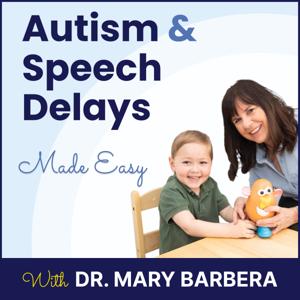
Mary Barbera welcomes back Michelle, a parent and autism coach, to share her daughter Elena's remarkable journey. Michelle discusses recognizing early signs of regression, receiving an autism diagnosis, and navigating therapy shutdowns during COVID-19. She shares how implementing at-home teaching strategies helped Elena progress from two words to 180 words and phrases in just 33 days.
Now eight years old and thriving in third grade, Elena continues to make progress. Michelle reflects on the challenges her family overcame and the importance of empowering parents to actively participate in their children's development.
Mary Barbera interviews longtime collaborator Tracy Rasmussen about helping her 16-month-old granddaughter, Cece, who was showing signs of a speech delay. Tracy shares the strategies she learned through Mary's program, including language sampling, modeling words, repetition, structured table time, and reducing pressure around speaking. She also discusses Cece's early progress with new word approximations, communication, and cooperation. The program is designed to give parents, grandparents, and professionals practical tools they can use to help children build stronger communication and language skills.
Dr. Mary Barbera explains why "free" autism advice and therapy can still carry a cost when they delay real progress. Mary shares two parent stories: Ruth, who spent 150+ hours piecing together free content without a step-by-step plan, and Kelsey, who had funded therapy in place but watched her son work on the wrong goals. Both stories point to the same lesson: parents need to become the "Captain of the Ship" with a clear plan for teaching language, reducing problem behaviors, and supporting progress every day.
When a child has words but speaks too quietly to hear, low volume may be connected to confidence, fluency, and how difficult the word feels. In this coaching call excerpt, Dr. Mary Barbera explains how to increase talking and voice volume by giving the answer, modeling words clearly, slowing down practice, using 3D objects, matching, microphones, mirrors, songs, outdoor play, and weekly word lists. The goal is to shape louder, clearer communication without constant correction or pressure.
Dr. Mary Barbera shares the story of her sons Lucas and Spencer, two boys who looked very similar as toddlers but had very different outcomes. Through their journey, she explains why parents can't predict a child's future with a "crystal ball," but should still take action early when they notice speech delays, autism signs, or developmental concerns. She also introduces her 5 Weeks to More Talking program as a step-by-step way to start helping children right away.
Dr. Mary Barbera interviews Amol Deshpande, creator of the Frontera app and father of a son with autism, about his mission to improve early autism detection and access to care. They discuss biomarker testing that may help identify autism risk as early as birth, the importance of parent support, the role of AI and technology, concerns about misinformation, and why earlier intervention could dramatically improve outcomes for children and families.
Dr. Mary Barbera reflects on nearly three decades in the autism world as both a mom and professional. She shares how denial, long waitlists and limited early support can delay progress for children with autism or developmental delays. She emphasizes the importance of assessment, early action, parent-led intervention and individualized plans, while introducing the free Barbera Early Childhood Assessment (BECA) as a starting point for families seeking clarity and next steps.
Dr. Mary Barbera speaks with Dr. Joseph Cautilli about autism research, including cautious optimism around university-based stem cell studies and stronger evidence for early behavioral intervention. They discuss a 2023 study showing some children diagnosed as toddlers were no longer diagnosable by age five, especially with early intervention and parent-supported engagement. The conversation emphasizes that parents should not wait for a diagnosis to begin helping their child build language, adaptive skills, communication, engagement, and quality of life through fun, child-friendly strategies.
"He'll probably be fine." That's what most parents hear when their toddler shows early signs of autism. After 25 years in the field - and raising a son who looked "mild" at 2 but needs 24/7 care at 30 - Dr. Mary Barbera explains why that reassurance may be the most dangerous sentence in child development.
In this video, Dr. Mary Barbera breaks down:
Dr. Mary Barbera is an RN turned BCBA-D and bestselling author of Turn Autism Around. As both a doctoral-level behavior analyst and the mother of a 30-year-old son with severe autism, she bridges clinical credibility with lived experience to empower parents as the lead in their child's progress.
🤔 QUESTION OF THE DAY:
Did someone tell you to "wait and see" when you first noticed delays? What happened next?
Share your story below - we read every comment.
🔗 RESOURCES MENTIONED:
👉 Turn Autism Around book: https://marybarbera.com/new-book/
👉 White paper with Dr. Rick Cabena - Elena's case study (2 words to 180 in 33 days): https://marybarbera.com/whitepaper
👉 2023 Boston study - 40% of early-diagnosed children no longer meeting criteria: https://marybarbera.com/can-you-outgrow-autism-study/
👉 Dr. Ami Klin's eye tracking research: https://marybarbera.com/turn-autism-around-book-owners/
👉 Five-minute questionnaire - find your best starting place: https://forms.gle/KW4TGN1xia4gqsrQ6
👉 Subscribe to the Dr. Mary Barbera Newsletter: https://marybarbera.com/
Monthly deep dives on where the autism field is headed, what the research actually says, and practical strategies you can start using today - from someone who's both a doctoral-level behavior analyst and an autism mom.
🔍 TIMESTAMPS:
0:00 Can autism be prevented or reversed? 0:29 The river parable - going upstream to find the cause 1:19 "I'm the person going upstream" 1:42 The most important question in the autism world 2:40 Why prevention became politically incorrect in 2026 3:23 The 2023 Boston study - 40% no longer meeting criteria 3:46 Dr. Ami Klin's eye tracking research 5:25 Waiting for a diagnosis is almost always a bad idea 5:41 The "golden year" of neuroplasticity - and why most miss it 7:08 There is no time to wait and worry 7:32 The danger of "he'll probably be fine" 8:31 Lucas's story - mild signs at 2, preschool with no issues 9:26 Lucas at 30 - and the kids who looked worse but thrived 942 Dr. Dunlap's advice treat it like the most severe case 10:48 Why Mary's approach puts parents in the lead 12:44 The Turn Autism Around approach - what makes it different 14:27 Can autism symptoms be prevented? Mary's verdict 15:11 Never too early, never too late
Joint attention is the shared focus between a child and another person, and it is one of the most important foundational communication skills for children with autism and developmental delays. Dr. Mary Barbera talks with Rose Griffin, who explains why joint attention matters, how it supports language, play, and social interaction, and how parents and professionals can build it through simple daily activities like books, songs, bubbles, and games. They also highlight the importance of collaboration between ABA and speech therapy so children get practical, individualized support that strengthens communication through connection and engagement.
From the publisher's feed

39,048 Listeners

1,330 Listeners
15,030 Listeners

111,799 Listeners

8,527 Listeners
418 Listeners

25,789 Listeners

27,762 Listeners

13,018 Listeners
4,492 Listeners
3,514 Listeners

19,254 Listeners

10,653 Listeners

8,796 Listeners